
A Complete Guide for International Patients

Korea is one of the world’s best-known destinations for plastic surgery and aesthetic medicine. Many international patients visit Korea because of its experienced medical professionals, highly specialized procedures, advanced facilities, and organized patient-care services.
However, you should never choose surgery based solely on a clinic’s popularity, social media content, or dramatic before-and-after photos. Plastic surgery is not simply a beauty product or travel package. It is a medical procedure that may involve anesthesia, bleeding, infection, scarring, and other complications.
International patients face additional challenges, including language barriers, limited time in Korea, and difficulties receiving follow-up care after returning home. For a safer experience and more satisfactory results, you should carefully examine the surgeon’s qualifications, the surgical plan, safety protocols, recovery period, total cost, and follow-up arrangements.
Here are 12 essential things every international patient should know before getting plastic surgery in Korea.
The 12 Essentials at a Glance
| No. | What to Check | The Key Question |
|---|---|---|
| 1 | Your goals and expectations | Why do I want this procedure? |
| 2 | Registration for international patients | Is the clinic officially registered to serve international patients? |
| 3 | The surgeon’s qualifications | Is the surgeon a board-certified plastic surgeon? |
| 4 | The actual operating surgeon | Will the doctor I consulted perform my surgery? |
| 5 | Consultation and communication | Do I fully understand the procedure and its risks? |
| 6 | Total cost | Does the quote include all additional charges? |
| 7 | Anesthesia and emergency systems | Who manages anesthesia, and what happens in an emergency? |
| 8 | Risks and limitations | Have the clinic’s staff explained possible complications? |
| 9 | Recovery and length of stay | Have I allowed enough time to recover in Korea? |
| 10 | Follow-up care | What happens if a problem develops after I return home? |
| 11 | Contracts and medical records | Have I received all important terms in writing? |
| 12 | Medical disputes | Do I know where to seek help if something goes wrong? |
1. Define Your Goals and Keep Your Expectations Realistic
Before searching for a clinic, ask yourself why you want plastic surgery and what kind of change you expect.
Plastic surgery can alter certain physical features, but it cannot solve every problem in your life. If you expect to look exactly like a celebrity or influencer—or believe that one procedure will solve all your confidence and relationship issues—you may be disappointed.
A responsible surgeon should explain:
- What can realistically be changed
- What cannot be fully corrected
- Where scars may remain
- Whether some degree of asymmetry may continue
- How long swelling and healing may take
- When you can expect to see the final result
- How your desired appearance may differ from what is surgically possible

Information to Prepare Before Your Consultation
| Item | What to Prepare |
|---|---|
| Your main concern | Identify one or two specific features |
| Desired degree of change | Natural and subtle or more noticeable |
| Previous procedures | Procedure names, dates, and materials used |
| Current medications | Prescription medicine, supplements, and herbal products |
| Allergies | Medication, anesthetic, disinfectant, or adhesive allergies |
| Medical history | Diabetes, cardiovascular conditions, bleeding disorders, and others |
| Planned departure date | The actual amount of time you can remain in Korea |
Reference photos can help communicate your preferences. However, use them to explain the overall style or specific features you like—not to demand an identical copy of another person’s face.
2. Check Whether the Clinic Is Registered to Serve International Patients
Medical institutions that actively attract international patients in Korea must be officially registered under Korean law.
A registered institution must satisfy certain requirements, including having a qualified specialist in the relevant medical department and maintaining medical malpractice liability insurance or an approved medical liability arrangement. Registration is valid for three years and must be renewed if the institution wishes to continue attracting international patients.
Registration does not guarantee perfect surgical results or prove that a particular clinic is superior. However, it is an important basic safeguard that international patients should check.
Medical Korea, operated by the Korea Health Industry Development Institute, provides an official database of medical institutions registered to serve international patients. Patients can search for a clinic and confirm its name, address, registration details, and operating status.
How to Check a Clinic
- Confirm the clinic’s exact Korean and English names.
- Search for the clinic in Medical Korea’s registered-hospital database.
- Make sure the listed address and telephone number match the clinic you plan to visit.
- Check its registration number and current operating status.
- If you use an agency, verify that it is also a registered international-patient facilitator.
Be Careful If:
- The clinic is popular on social media but cannot provide its registration information.
- The consultation room and operating facility are in different locations without a clear explanation.
- A translator or online coordinator cannot explain whether they work for the clinic or a separate agency.
- You are offered an unusually large discount for paying immediately in cash.
3. Verify That Your Surgeon Is a Board-Certified Plastic Surgeon
In Korea, a clinic’s name and a doctor’s medical specialty should be checked separately. A clinic may use words such as “plastic surgery,” “aesthetic,” or “clinic” in its branding, but that does not necessarily mean every doctor working there is a board-certified plastic surgeon.
A board-certified plastic surgeon has completed medical school, obtained a medical license, undergone specialist training, and passed the relevant specialty examination.
The Korean Society of Plastic and Reconstructive Surgeons provides a searchable directory of plastic surgery specialists who are active members of the society.

Information to Verify
| Item | What to Confirm |
|---|---|
| Full name | Obtain the surgeon’s exact Korean and English names |
| Medical specialty | Confirm board certification in plastic surgery |
| Main field of practice | Check experience with your specific procedure |
| Current workplace | Make sure the website and actual clinic match |
| Consulting doctor | Confirm whether the consultant is also the surgeon |
| Follow-up doctor | Ask who will examine you after surgery |
Board certification alone does not guarantee a particular result. You should also consider the surgeon’s experience with your procedure, ability to explain risks clearly, approach to patient safety, and follow-up system.
4. Confirm Who Will Actually Perform the Surgery
One issue international patients should watch for is the possibility that the doctor conducting the consultation may not be the person who performs the operation.
You may consult with a famous surgeon but later discover that another doctor is scheduled to perform all or part of the procedure. In some clinics, a coordinator conducts most of the consultation, and the patient meets the operating surgeon only shortly before surgery.
Ask the clinic these questions and request written confirmation:
“Will the doctor I consulted personally perform the entire operation?”
“Will any part of the procedure be performed by another doctor?”
“If the operating surgeon changes, will the clinic obtain my consent in advance?”
Operating-Surgeon Checklist
- Is the surgeon’s name written on the reservation confirmation?
- Is the surgeon identified in the surgical consent form?
- Will you meet the surgeon again on the day of surgery?
- Will the clinic obtain your consent before changing the surgical plan?
- Will the surgeon personally examine you during follow-up visits?
If the clinic refuses to identify the operating surgeon or avoids giving a clear answer, do not rush into payment or surgery.
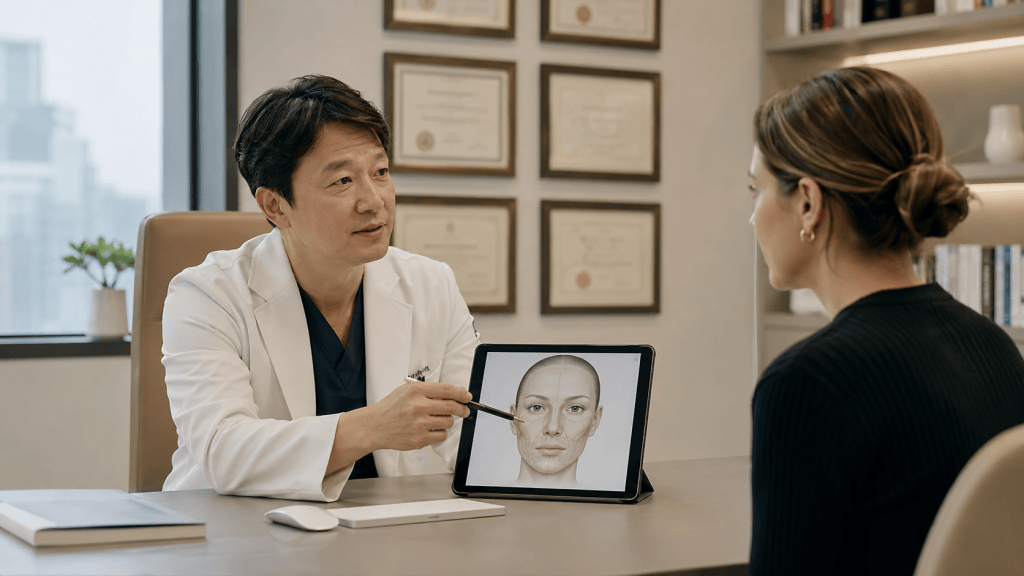
5. Accurate Medical Communication Is More Important Than Basic Translation
A clinic’s claim that it offers “English service” or “multilingual consultation” may not be enough.
A sales coordinator may be able to explain prices and appointment times but may not be qualified to interpret detailed medical information about surgery, anesthesia, complications, alternatives, and aftercare.
Important details may also be shortened, simplified, or unintentionally changed during interpretation.
What to Check About Interpretation Services
| Category | What to Confirm |
|---|---|
| Interpreter | Clinic employee, independent interpreter, or agency coordinator |
| Language ability | Ability to interpret medical information, not just daily conversation |
| Service coverage | Consultation, consent, surgery day, discharge, and follow-up |
| Cost | Free service or additional charge |
| Emergency availability | Availability at night, on weekends, and after discharge |
| Privacy | Who can access your photographs and medical information |
Never sign a consent form that you do not understand. You should clearly understand the following information in your preferred language:
- Exact name of the procedure
- Location of incisions and possible scars
- Type of anesthesia
- Implants or medical materials to be used
- Possible complications
- Possibility of revision surgery
- Expected recovery period
- Emergency-response procedures
Whenever possible, request important information in writing by email, message, or translated document.
6. Confirm the Final Cost—not Just the Advertised Price
Prices advertised on social media or clinic websites may not represent the total amount you will pay. The final cost may vary depending on your medical condition, surgical technique, anesthesia, tests, medical materials, and follow-up care.
An unusually low promotional price may increase after your consultation. You may also be encouraged to add procedures you had not originally planned.
Items That Should Appear in Your Written Estimate
| Cost Item | What to Ask |
|---|---|
| Surgical fee | Does it include the operating surgeon’s fee? |
| Anesthesia | Is sedation or general anesthesia included? |
| Medical tests | Are blood tests and imaging charged separately? |
| Medical materials | Are implants and disposable supplies included? |
| Medication | Are prescriptions, ointments, and dressings included? |
| Follow-up care | Are wound care, stitch removal, and swelling treatment included? |
| Interpretation | Is interpretation included throughout treatment? |
| Revision policy | What costs apply if revision surgery becomes necessary? |
| Taxes | Does the quoted price include applicable taxes? |
| Cancellation | What are the deposit and refund conditions? |
A Better Way to Compare Clinics
Do not compare prices alone. Compare these four elements together:
The surgeon’s qualifications and experience + the exact procedure + the safety system + the follow-up plan
Be cautious if a clinic pressures you to make an immediate decision, demands cash payment, or offers a very large same-day discount.

7. Examine the Anesthesia and Emergency-Response System
Surgical safety depends on more than the technical skill of the operating surgeon. Anesthesia management, patient monitoring, infection control, recovery facilities, and emergency-response procedures are equally important.
For procedures requiring general anesthesia or deep sedation, ask the clinic the following questions.
Anesthesia and Safety Checklist
| Item | Question to Ask |
|---|---|
| Anesthesia provider | Who administers and manages the anesthesia? |
| Patient monitoring | Are blood pressure, oxygen levels, and other vital signs continuously monitored? |
| Preoperative tests | What tests are necessary for my health condition and procedure? |
| Emergency equipment | Are emergency equipment and medication readily available? |
| Recovery area | Is there a designated area for observation after anesthesia? |
| Hospital transfer | Which hospital will receive me if emergency transfer is required? |
| After-hours contact | Who can I contact after discharge, including at night? |
Tell your medical team about all medications, supplements, herbal products, smoking, alcohol use, previous reactions to anesthesia, and existing health conditions.
Some medications and supplements can affect bleeding or interact with anesthesia. Never stop prescription medicine based solely on internet advice. Ask your doctor for specific instructions.
8. Ask About Risks and Limitations—not Only Success Stories
Before-and-after photos are useful references, but they do not guarantee your result.
Lighting, camera angles, facial expressions, makeup, lenses, and digital editing can all affect appearance. Another patient’s result cannot automatically be reproduced on your face or body.
A responsible clinic should explain not only the potential benefits but also possible complications and limitations.
Risks to Discuss
- Bleeding or hematoma
- Infection
- Delayed wound healing
- Scarring
- Changes or loss of sensation
- Persistent asymmetry
- Implant movement or capsular contracture
- Nerve or tissue injury
- Anesthesia-related complications
- A difference between the expected and actual result
- The need for additional treatment or revision surgery

Be cautious if you hear statements such as:
- “There are absolutely no side effects.”
- “You will look exactly like this.”
- “No medical tests are necessary.”
- “You must pay today to receive this price.”
- “You can travel immediately after surgery.”
- “If anything goes wrong, we will fix everything for free.”
No medical procedure can promise a perfect outcome. A trustworthy clinic should explain uncertainty honestly and allow you enough time to decide.
9. Recovery May Take Much Longer Than the Procedure
A procedure that takes only a few hours may require days, weeks, or months of recovery. Swelling, bruising, discomfort, stitch removal, and follow-up examinations all require time.
Recovery varies according to the procedure, your health, the extent of surgery, and your body’s healing response.
Factors to Consider When Planning Your Stay
| Stage | What to Consider |
|---|---|
| Before surgery | In-person consultation and medical tests |
| Surgery day | Fasting, anesthesia recovery, and possible need for a companion |
| Initial recovery | Monitoring for bleeding, pain, and swelling |
| First follow-up | Examination of wounds and the surgical area |
| Stitch removal | Timing varies by procedure and surgical technique |
| Final visit before departure | Confirmation that you are fit to fly |
| After returning home | Access to local medical care if necessary |
Avoid These Scheduling Mistakes
- Planning major surgery immediately after arriving in Korea
- Scheduling intensive sightseeing or shopping immediately after surgery
- Leaving Korea before essential follow-up examinations
- Booking a long flight without the surgeon’s approval
- Drinking alcohol, smoking, using a sauna, or exercising heavily during early recovery
Ask your surgeon how long you should remain in Korea and when it will be safe to fly. Do not assume that a general recovery timeline found online applies to you.

10. Make a Follow-Up Plan Before Returning Home
International patients may find it difficult to revisit the Korean clinic after returning home. You should therefore establish a clear follow-up plan before surgery.
Information to Obtain Before Departure
- Exact name and date of the procedure
- Name of the operating surgeon
- Details of any implant or medical material used
- Names and instructions for prescribed medication
- Normal symptoms during recovery
- Warning signs requiring urgent care
- Wound-care instructions
- When you may shower, exercise, wear makeup, or resume normal activities
- How to arrange video or photo consultations
- Emergency contact details for nights and weekends
- Medical information to show a doctor in your home country
Symptoms That May Require Immediate Medical Attention
- Sudden or rapidly worsening pain
- Swelling that rapidly increases on one side
- Persistent bleeding
- High fever or severe chills
- Difficulty breathing
- Reduced consciousness
- Severe discoloration around the surgical area
- Foul-smelling discharge
- Sudden changes in vision or sensation
If you experience serious symptoms, do not wait for an online response. Seek care at the nearest emergency medical facility.
11. Keep Your Contracts, Consent Forms, Receipts, and Medical Records
Verbal promises can be difficult to prove. Request written confirmation of the procedure, operating surgeon, price, aftercare, refund conditions, and revision policy.
Never sign a Korean-language document you do not understand. Ask for a translation and request clarification before signing.
Documents to Keep
| Document | Why It Matters |
|---|---|
| Consultation notes | Confirms the recommended procedure and expected outcome |
| Written estimate | Shows included and additional costs |
| Deposit receipt | Helps resolve payment and cancellation issues |
| Consent form | Records the agreed procedure and disclosed risks |
| Surgical record | Shows what was actually performed |
| Anesthesia record | Provides details of anesthesia and intraoperative monitoring |
| Test results | Records your preoperative medical condition |
| Prescription | Identifies medication and dosage |
| Implant information | Provides product name, size, and serial or lot number |
| Medical receipts | May be needed for insurance, taxes, or disputes |
| Before-and-after photos | Documents changes during recovery |
| Emails and messages | Records promises and agreements made by the clinic |
Before leaving Korea, ask how to request copies of your medical records, whether English-language documents are available, and whether an additional fee applies.
12. Know What to Do If a Medical Problem or Dispute Occurs
An unsatisfactory cosmetic result does not automatically mean medical malpractice occurred. At the same time, you should not ignore a possible medical problem while waiting indefinitely for the clinic to respond.
If a complication or dispute occurs, stay calm and follow a structured process.
Six Steps to Take
- Protect your health first.
If your symptoms are urgent, visit the nearest emergency medical facility. - Document your condition.
Take dated photographs and videos and record when each symptom began. - Request a written explanation from the clinic.
Use email or messages rather than relying only on telephone conversations. - Request copies of your medical records.
Obtain the surgical record, anesthesia record, test results, prescriptions, and related documents. - Seek an independent medical opinion.
Another qualified medical professional may need to examine your condition. - Request professional consultation or mediation.
If the issue remains unresolved, you may consider Korea’s medical-dispute mediation system.
The Korea Medical Dispute Mediation and Arbitration Agency provides consultation, mediation, and arbitration services. International patients living outside Korea may apply by email or fax. English application documents may require accompanying Korean translations, so check the latest requirements before applying.
Korea Medical Dispute Mediation and Arbitration Agency
| Category | Information |
|---|---|
| Organization | Korea Medical Dispute Mediation and Arbitration Agency |
| Consultation number in Korea | 1670-2545 |
| International and professional consultation | +82-2-6210-0080 |
| English website | www.k-medi.or.kr/eng |
| General email | kmedi@k-medi.or.kr |
| International mediation applications | forcc@k-medi.or.kr |
| General consultation hours | Weekdays, 9:00 a.m.–6:00 p.m.; confirm on the official website |
Contact information and application procedures may change. Always confirm the latest details on the official website.
20 Questions to Ask During Your Consultation
Save this list on your phone or print it before visiting the clinic.
| No. | Question |
|---|---|
| 1 | What is the exact medical name of this procedure? |
| 2 | Why is this procedure appropriate for me? |
| 3 | Are there nonsurgical or less invasive alternatives? |
| 4 | What degree of change can I realistically expect? |
| 5 | Is my surgeon board-certified in plastic surgery? |
| 6 | Will the doctor I consulted personally perform the surgery? |
| 7 | How frequently does the surgeon perform this procedure? |
| 8 | Where will the incisions and scars be located? |
| 9 | What type of anesthesia will be used? |
| 10 | Who will administer and monitor the anesthesia? |
| 11 | What are the most common and most serious risks? |
| 12 | What happens if an emergency occurs? |
| 13 | How long will the surgery and recovery-room stay take? |
| 14 | How long should I remain in Korea? |
| 15 | When will it be safe for me to fly? |
| 16 | What exactly is included in the total cost? |
| 17 | What are the cancellation, refund, and revision policies? |
| 18 | Who should I contact if a problem develops after I return home? |
| 19 | Can I receive my medical records in English? |
| 20 | Can I take time to think before making a decision? |
Warning Signs That Deserve Extra Attention
One warning sign alone does not necessarily prove that a clinic is unsafe. However, if several of the following issues appear together, do not rush into a contract or surgery.
- Most of the consultation is conducted by a sales coordinator rather than a doctor.
- The clinic refuses to identify the operating surgeon.
- The clinic claims the procedure has no risks or complications.
- Staff do not ask about your medical history or current medication.
- You are pressured to sign a consent form you cannot understand.
- The price is provided verbally without a written estimate.
- You are offered a very large discount for cash payment.
- You are pressured to sign or pay on the same day.
- You are encouraged to undergo several additional procedures.
- The clinic seems more interested in promotional photos than medical evaluation.
- Follow-up care after you leave Korea is unclear.
- The clinic avoids questions about providing medical records.
Final Checklists
Before Booking Surgery

- I understand why I want the procedure.
- I have realistic expectations.
- I checked whether the clinic is registered to serve international patients.
- I verified the surgeon’s professional qualifications.
- I confirmed who will actually perform the surgery.
- I understand the procedure, scars, limitations, and recovery.
- I received an explanation of risks and emergency procedures.
- I received the total cost and refund policy in writing.
- I have had enough time to compare options and make my decision.
On the Day of Surgery
- I personally confirmed the operating surgeon.
- I checked whether the surgical plan has changed.
- I repeated information about my medications and allergies.
- I read the consent form in a language I understand.
- My passport and valuables are stored safely.
- I arranged for a companion if necessary.
- I arranged safe transportation and accommodation after discharge.
Before Leaving Korea
- I received a final follow-up examination.
- The surgeon confirmed when I may fly.
- I understand how to take my medication.
- I know which warning signs require urgent care.
- I received copies of my medical records and receipts.
- I received information about any implants or medical materials used.
- I understand how online follow-up consultations work.
- I saved the clinic’s emergency contact information.
Frequently Asked Questions
Q1. Is choosing the most famous clinic the safest option?
Not necessarily. Popularity and advertising do not guarantee safety or good results. Check the clinic’s official registration, the surgeon’s qualifications and experience, anesthesia and emergency systems, quality of communication, and follow-up arrangements.
Q2. Can I book surgery after an online consultation?
An online consultation may be useful for preliminary guidance. However, photographs and videos cannot fully show your skin condition, asymmetry, bone structure, or overall health. The final surgical plan should normally be determined after an in-person examination and any necessary medical tests.
Q3. Is it better to receive several procedures at once?
Combining procedures may reduce the overall travel time, but it can also increase surgery duration, anesthesia exposure, and recovery demands. The decision should be based on your health, the extent of surgery, and a qualified doctor’s assessment—not convenience alone.
Q4. Can I go sightseeing immediately after surgery?
That depends on the procedure. During early recovery, you may need to monitor bleeding, swelling, and pain. Walking for long periods, drinking alcohol, smoking, using a sauna, and exercising may be restricted. Your recovery plan should take priority over sightseeing.
Q5. Can I have revision surgery immediately if I dislike the result?
Swelling and tissue changes can make it difficult to judge the final result soon after surgery. The appropriate time for revision depends on the procedure and your condition. Consult the operating surgeon or another qualified specialist before making a decision.
Q6. Can international patients use Korea’s medical-dispute mediation system?
Yes. International patients may request consultation or mediation through the Korea Medical Dispute Mediation and Arbitration Agency. Patients living outside Korea may apply by email or fax, although document and translation requirements apply.
Final Advice: Choose the Clinic That Explains the Most—not Simply the One That Charges the Least
The most important factors in choosing a plastic surgery clinic in Korea are not flashy advertising, social media popularity, or the lowest price.
A responsible clinic should not pressure you to undergo surgery. It should explain what can be improved, what cannot be guaranteed, what risks exist, and what will happen if complications occur. You should also receive clear information about the operating surgeon, total cost, recovery plan, follow-up care, and medical-record access.
Remember these three questions:
Who will perform my surgery?
What are the risks and limitations?
Who will take responsibility for my care if a problem develops?
Plastic surgery is medical treatment—not an ordinary tourism product. Ask questions, compare your options, and never sign a document you do not understand. Careful preparation is the first step toward a safer procedure and a more satisfactory experience in Korea.
Medical Disclaimer
This article provides general information for international patients considering plastic surgery in Korea. It does not replace an individual medical diagnosis, consultation, or treatment plan. The appropriate procedure, anesthesia method, recovery period, and travel schedule depend on each patient’s health and the type of surgery. Consult a qualified medical professional before making any medical decision.
Official Resources
- Medical Korea: Search Registered Medical Institutions
- Korean Society of Plastic and Reconstructive Surgeons: Specialist Search
- Korea Medical Dispute Mediation and Arbitration Agency
- Korea Visa Portal
Suggested SEO Keywords
plastic surgery in Korea, Korea plastic surgery guide, plastic surgery for foreigners in Korea, Seoul plastic surgery, Gangnam plastic surgery, Korean plastic surgery clinic, board-certified plastic surgeon Korea, plastic surgery cost Korea, medical tourism Korea, cosmetic surgery in Seoul


Leave a Reply