
Why Korea Is Becoming a Leading Destination for Double Eyelid Surgery

K-Beauty is no longer limited to cosmetics and skincare. Today, K-Medical Beauty—combining advanced medical care, aesthetic expertise, and international patient services—is attracting growing attention worldwide.
Double eyelid surgery is one of Korea’s best-known cosmetic procedures. Rather than simply making the eyes appear larger, the procedure creates or refines an upper-eyelid crease based on the patient’s eyelid anatomy, facial proportions, eye-opening strength, and desired appearance.
Korea offers a wide range of surgical techniques, experienced plastic surgeons, competitive prices, and multilingual services for international patients. However, quality varies among clinics, so price should never be the only deciding factor.
Why Choose Korea for Double Eyelid Surgery?
1. Extensive Experience with Different Eyelid Types
Korean plastic surgeons regularly assess a broad range of eyelid structures and aesthetic preferences. A qualified surgeon may consider:
- Eyelid skin thickness and elasticity
- The amount and position of eyelid fat
- Existing eyelid creases
- Asymmetry between the eyes
- Eye-opening muscle function
- Epicanthal folds
- Eye width and eyebrow position
- Overall facial proportions
- The patient’s preferred crease height and shape
This individualized approach allows the procedure to be designed around the patient’s anatomy rather than applying the same eyelid shape to everyone.

2. Emphasis on Natural-Looking Results
A noticeable trend in Korean cosmetic surgery is the preference for balanced, natural-looking results instead of excessively high or dramatic creases.
During a consultation, the surgeon may evaluate how the proposed crease looks when the patient opens and closes their eyes, how it fits the face without makeup, and whether it maintains harmony between the eyes, eyebrows, and other facial features.
3. Multiple Techniques and Price Options
Korean clinics provide several approaches, including non-incisional, partial-incisional, and full-incisional methods. Ptosis correction or epicanthoplasty may also be considered when medically or aesthetically appropriate.
This creates a broad selection of treatment plans and price levels. However, the least expensive option is not necessarily the most suitable or safest one.
Double Eyelid Surgery Methods Compared
| Method | How It Works | Commonly Considered For | Initial Recovery | Key Characteristics |
|---|---|---|---|---|
| Non-incisional method | Sutures are placed through very small openings to create the crease | Thin eyelid skin with minimal excess skin or fat | About 5–7 days | Less invasive and relatively fast initial recovery |
| Partial-incisional method | Small incisions allow limited tissue or fat adjustment | Patients requiring more correction than the suture method can provide | About 7–14 days | A middle option between non-incisional and full-incisional surgery |
| Full-incisional method | The eyelid is incised so that skin, fat, and other tissues can be adjusted | Thicker eyelids, excess skin, or cases requiring a more extensive correction | About 10–14 days or longer | Provides greater surgical control but requires more recovery |
| With ptosis correction | The tissues involved in opening the eyes are evaluated and adjusted | Weak eye-opening function or a persistently tired-looking appearance | Depends on the surgical extent | Should be considered based on functional assessment, not appearance alone |
| Revision surgery | A previous crease, scar, asymmetry, or adhesion is corrected | Patients dissatisfied with or experiencing problems after prior surgery | Varies considerably | Usually more complex than primary surgery |
The appropriate method should be selected after an in-person examination by a qualified plastic surgeon.
Double Eyelid Surgery Prices in Korea

The following figures represent broad 2026 reference ranges based on publicly available Seoul clinic price information. Actual prices vary according to the surgeon, clinic, procedure complexity, anesthesia, language support, and aftercare. Published Seoul estimates commonly place non-incisional surgery at approximately KRW 1–2 million, partial-incisional surgery at KRW 1.5–2.5 million, and full-incisional surgery at KRW 2–3.5 million. (koreacareguide.com)
Estimated Price by Procedure and Currency
| Procedure | Korean Won | U.S. Dollars | Chinese Yuan | Japanese Yen |
|---|---|---|---|---|
| Non-incisional method | KRW 1,000,000–2,000,000 | USD 740–1,470 | CNY 4,950–9,910 | JPY 115,000–229,000 |
| Partial-incisional method | KRW 1,500,000–2,500,000 | USD 1,110–1,840 | CNY 7,430–12,380 | JPY 172,000–287,000 |
| Full-incisional method | KRW 2,000,000–3,500,000 | USD 1,470–2,580 | CNY 9,910–17,340 | JPY 229,000–401,000 |
| With ptosis correction | KRW 2,500,000–4,500,000 | USD 1,840–3,320 | CNY 12,380–22,290 | JPY 287,000–516,000 |
| Epicanthoplasty add-on | KRW 800,000–1,500,000 | USD 590–1,110 | CNY 3,960–7,430 | JPY 92,000–172,000 |
| Revision surgery | KRW 3,000,000–6,000,000 | USD 2,210–4,420 | CNY 14,860–29,720 | JPY 344,000–688,000 |
Currency reference date: September 4, 2026.
Approximate rates used:
- USD 1 = KRW 1,357
- CNY 1 = KRW 202
- JPY 1 = KRW 8.72
On the reference date, published currency data showed CNY 32 at approximately KRW 6,460 and JPY 100 at approximately KRW 872. (www.worldforexrates.com)
Currency conversions are rounded estimates. Exchange rates, card fees, and bank charges can change the final amount.
What May or May Not Be Included in the Price?
An advertised surgical price may not represent the final amount. International patients should request a written, itemized quotation.
| Item | What to Confirm |
|---|---|
| VAT | Whether Korea’s 10% value-added tax is included |
| Consultation | Whether the surgeon’s consultation fee is charged separately |
| Anesthesia | Whether local anesthesia or sedation is included |
| Preoperative tests | Whether blood tests or other examinations cost extra |
| Medication | Whether antibiotics, pain medication, and eye drops are included |
| Suture removal | Whether postoperative visits and suture removal are included |
| Interpretation | Whether English, Chinese, or Japanese interpretation costs extra |
| Aftercare | The number and type of postoperative treatments provided |
| Revision policy | The conditions, time limit, and costs for corrective treatment |
| Additional procedures | Whether ptosis correction, fat removal, or epicanthoplasty is genuinely necessary |
International patients should compare the total treatment cost, not only the surgeon’s base fee.
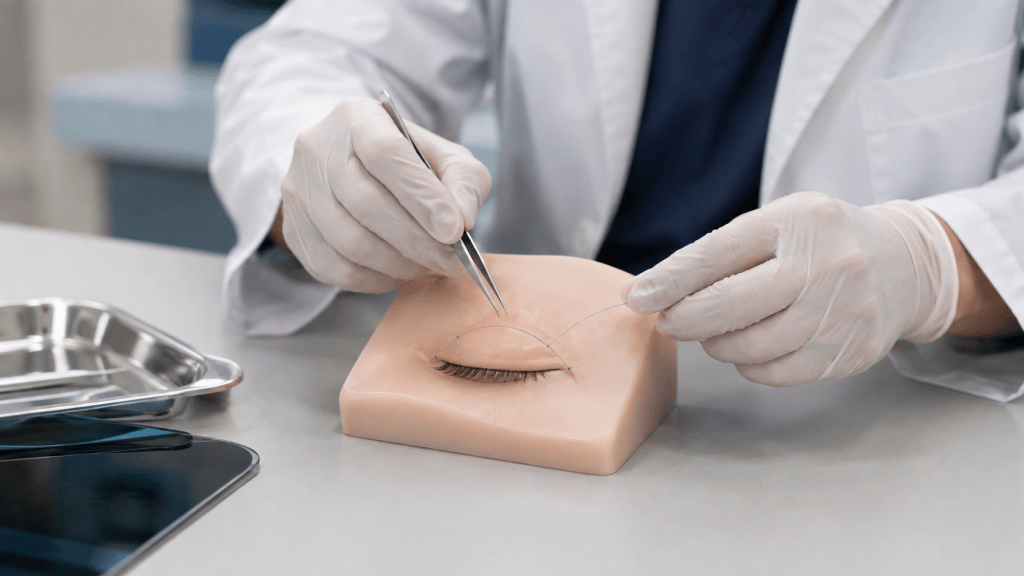
Is Double Eyelid Surgery in Korea Good Value?
In medical care, value should not simply mean “cheap.” A more responsible definition is:
Qualified medical care + individualized surgical design + safety systems + aftercare + international patient support at a competitive total cost
Some published price comparisons suggest that Korean eyelid surgery can cost substantially less than comparable treatment in the United States. However, comparisons may differ depending on whether anesthesia, facility charges, medication, and follow-up care are included. For that reason, claims that Korea is always a fixed percentage cheaper should be treated cautiously. (www.clinicseoul.net)
International patients should also include airfare, accommodation, local transportation, meals, and possible extended-stay costs in their total budget.
Even after these expenses, Korea may remain attractive for patients seeking access to a large, competitive cosmetic surgery market and multilingual medical services.
Korea’s Growing International Healthcare Market
According to Medical Korea, approximately 1.17 million international patients received medical care in Korea in 2024, and plastic surgery accounted for approximately 12% of international patient visits by medical specialty. (www.medicalkorea.or.kr)
Medical Korea also provides searchable information about registered and accredited medical institutions serving international patients. Some accredited institutions offer multilingual interpretation, airport transportation, accommodation assistance, and dedicated international patient coordinators. (www.medicalkorea.or.kr)
These figures demonstrate the scale of Korea’s international healthcare market, but they do not guarantee that every clinic or surgeon provides the same level of quality. Each provider must be evaluated individually.
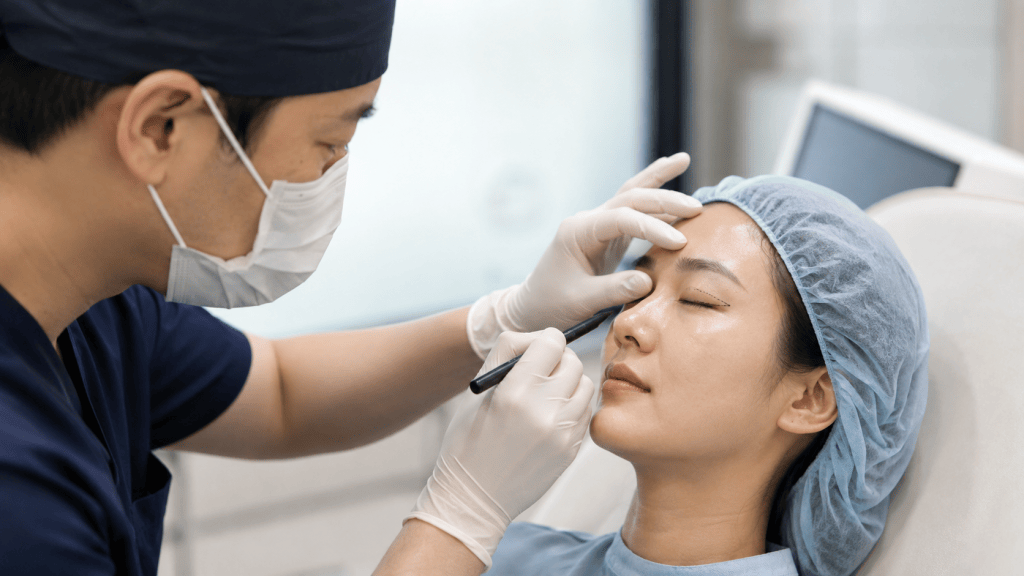
Seven Checks Before Choosing a Clinic
1. Confirm the Surgeon’s Specialist Credentials
A clinic’s name or marketing language does not automatically prove that the doctor is a board-certified plastic surgery specialist.
Patients should verify the surgeon’s full name, qualifications, specialist status, and professional membership. The Korean Association of Plastic Surgeons operates a searchable specialist directory in Korean. (www.prskorea.co.kr)
2. Confirm Who Will Perform the Surgery
Ask whether the doctor conducting the consultation will also perform the operation. Request written confirmation of the operating surgeon and ask whether the surgeon could be changed on the day of surgery.
3. Check the Clinic’s International Patient Registration
International patients can use Medical Korea’s registered hospital directory to check whether a provider is registered to serve foreign patients.
Registration should be treated as one screening criterion—not as proof of a specific surgical outcome.
4. Review Cases Similar to Your Own
Before-and-after photographs are most useful when the patients have eyelid conditions similar to yours. Consider differences in skin thickness, eyelid fat, asymmetry, eye-opening function, lighting, camera angles, makeup, and photo retouching.
5. Ask About Anesthesia and Emergency Systems
If sedation is involved, ask:
- Who administers and monitors the anesthesia?
- What monitoring equipment is used?
- Is emergency equipment immediately available?
- What is the transfer procedure if hospital treatment is required?
6. Be Cautious with Extremely Low Promotional Prices
A very low advertised price may exclude anesthesia, VAT, medication, interpretation, follow-up care, or additional procedures.
If the clinic recommends ptosis correction, epicanthoplasty, fat removal, or another procedure, ask why it is necessary and whether the recommendation is functional, aesthetic, or both.
7. Plan for Care After Returning Home
International patients may be unable to revisit the clinic quickly after departure. Before surgery, confirm:
- The clinic’s emergency contact method
- Whether remote follow-up is available
- Who will respond to postoperative concerns
- How complications are handled
- Whether revision treatment requires another trip
- Which expenses the patient must pay

What Is the Recovery Timeline?
| Period | What Patients May Experience | General Considerations |
|---|---|---|
| First 1–3 days | Swelling, bruising, tightness, and temporary asymmetry | Follow the clinic’s medication and cold-compress instructions |
| Around days 5–7 | Swelling may begin to decrease; some incisional patients may have sutures removed | Attend scheduled follow-up visits |
| Weeks 1–2 | Major swelling and bruising usually continue to improve | Avoid alcohol, smoking, strenuous exercise, and eye rubbing |
| Around 1 month | The eyelids may begin to look more natural | The crease can continue changing |
| Months 3–6 | Residual swelling and scars may gradually settle | Final healing varies by patient and procedure |
This is a general reference only. Recovery depends on the surgical method, tissue condition, healing response, health history, and postoperative care.
Patients should remain in Korea long enough for the surgeon’s recommended postoperative examination and, when required, suture removal.
Possible Risks and Limitations
Double eyelid surgery is a medical procedure and cannot be guaranteed to produce a specific result. Possible complications and limitations include:
- Bleeding or infection
- Prolonged swelling and bruising
- Visible or raised scarring
- Asymmetry
- A crease that is too high, low, deep, or weak
- Loss or loosening of the crease
- Difficulty closing the eyes completely
- Dry eyes or irritation
- Unwanted adhesions
- Differences between expected and actual results
- The need for correction or revision surgery
Patients should disclose medications, allergies, previous eye surgery, dry-eye symptoms, smoking, medical conditions, and relevant health history during the consultation.

The Real Strength of K-Medical Beauty
The competitiveness of Korean double eyelid surgery should not be reduced to the claim that it is simply “cheap and fast.”
Its real strength lies in the combination of:
- Extensive experience with diverse eyelid anatomy
- Multiple, highly differentiated surgical approaches
- Individualized design
- A strong preference for balanced, natural-looking results
- Competitive treatment costs
- A large and diverse medical market
- Multilingual services for international patients
- Structured consultation and aftercare options
Price is an important consideration, but the safest decision begins with verifying the surgeon, understanding the recommended procedure, reviewing the clinic’s safety system, and receiving a complete written quotation.
A good K-Medical experience is not about finding the lowest price. It is about finding an appropriate procedure and qualified medical team while receiving safe, transparent, and patient-centered care.

Medical Disclaimer
This article provides general educational information and does not constitute medical advice, diagnosis, treatment, or an endorsement of any particular doctor or medical institution.
Prices and currency conversions are approximate reference figures. Actual fees depend on the clinic, surgeon, anesthesia, surgical complexity, required tests, additional procedures, taxes, and aftercare. Individual suitability, risks, recovery, and expected outcomes must be discussed directly with a qualified medical professional.


Leave a Reply