
Korea’s real medical advantage lies not only in advanced technology, but in how the entire patient journey is connected.

When people talk about Korean healthcare, they often mention highly trained medical professionals, advanced medical technology, efficient health screenings, cosmetic procedures, and competitive treatment costs.
All of these are important. However, they do not fully explain what makes the Korean medical experience distinctive.
The deeper strength of K-Medical lies in connection.
From the first inquiry and medical consultation to diagnostic testing, specialist collaboration, treatment, recovery, and post-treatment follow-up, the different stages of care can be organized as one continuous patient journey.
For international patients, this connected experience is especially valuable. Receiving treatment in another country involves much more than choosing a hospital or meeting a doctor. Patients must navigate language differences, medical records, travel arrangements, treatment schedules, financial decisions, recovery, and communication after returning home.
Korea’s emerging advantage is its ability to bring these elements together.
K-Medical at a Glance
| Dimension | Conventional Medical Tourism | The Evolving K-Medical Approach |
|---|---|---|
| Primary focus | Individual treatment or procedure | The complete patient journey |
| Patient support | Basic appointment assistance | Coordinated medical and non-medical support |
| Diagnosis | Separate tests and consultations | Connected testing, interpretation, and specialist review |
| Communication | Translation during treatment | Medical interpretation and cultural coordination |
| Recovery | Discharge after treatment | Recovery planning, rehabilitation, and daily-life guidance |
| Technology | Advanced equipment | Technology integrated into the patient experience |
| Follow-up | Limited after departure | Continued communication after returning home |
| Value proposition | Cost and technical quality | Quality, speed, convenience, trust, and continuity |
1. Healthcare as a Connected Journey
A medical experience does not begin when a patient enters an operating room. It begins when the patient first searches for information and asks, “Can this hospital treat my condition?”
Likewise, care does not necessarily end when the patient leaves the hospital.
A well-connected international patient journey may include:
- Preliminary review of medical records
- Recommendation of an appropriate department or specialist
- Appointment and examination scheduling
- Medical interpretation and patient guidance
- Diagnostic testing and specialist consultation
- Multidisciplinary review when required
- Treatment and procedure planning
- Recovery, medication, and rehabilitation support
- Discharge and travel-readiness assessment
- Follow-up after the patient returns home
The difference is subtle but significant.
Instead of asking only, “How good is the treatment?” the K-Medical model can ask a broader question:
“How well is the patient supported throughout the entire experience?”
This shift—from delivering a procedure to managing a journey—can become one of Korea’s strongest international healthcare advantages.
2. The Value of the Patient’s Time
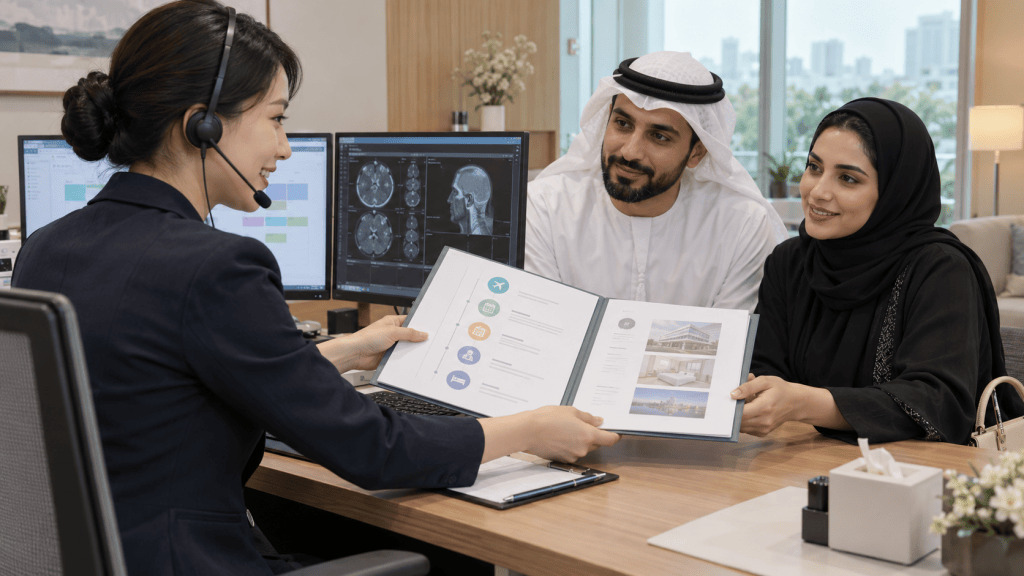
Medical travelers do not pay only with money. They also pay with time, uncertainty, physical energy, and emotional stress.
An unclear treatment schedule can result in additional hotel expenses, changed airline reservations, delayed work, and greater anxiety for both patients and their families.
For this reason, efficiency should not simply mean “fast treatment.” True medical efficiency means reducing unnecessary waiting and uncertainty while maintaining safety and clinical quality.
A well-organized medical journey allows patients to understand:
- What will happen during each stage
- How long each examination may take
- When results are likely to become available
- Which specialists may be involved
- How long they should remain in Korea
- When they may be able to travel safely
- What follow-up care will be required at home
Korea’s compact urban infrastructure can also contribute to this experience. Major hospitals, pharmacies, transportation networks, accommodation, restaurants, and other essential services are often located within accessible urban areas.
In this sense, the city itself becomes part of the healthcare experience.
3. Medical Coordinators: The People Who Connect the System
One of the most important figures in international healthcare is not always a doctor.
It is often the international medical coordinator.
A medical coordinator may help connect the patient with doctors, nurses, interpreters, administrative staff, recovery services, and other support providers. This role goes beyond scheduling an appointment.
Depending on the institution and service, coordination may include:
- Collecting and organizing medical records
- Identifying the appropriate medical department
- Coordinating appointments and examinations
- Explaining treatment schedules
- Supporting communication between patients and medical teams
- Helping patients understand administrative procedures
- Providing guidance related to admission and discharge
- Coordinating follow-up communication
For international patients, medical uncertainty is often intensified by unfamiliar language and culture. A capable coordinator helps turn a complicated hospital system into a more understandable and manageable experience.
The coordinator does not replace the doctor. Instead, the coordinator helps ensure that the patient can reach the right medical professional, understand the process, and move safely from one stage to the next.
4. Translation Is Not Enough: Healthcare Requires Cultural Understanding

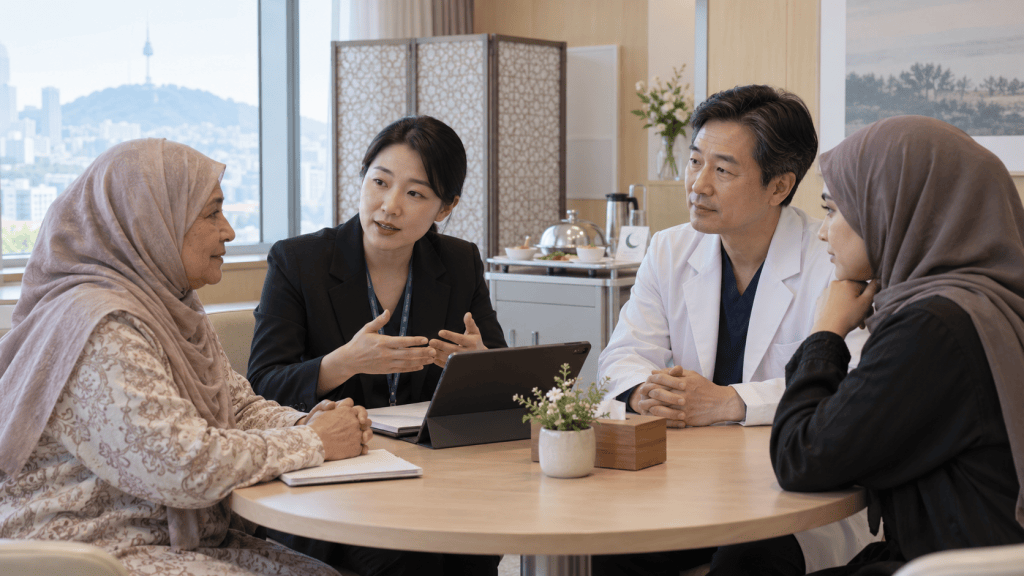
Providing interpretation is essential, but translating words alone does not always create genuine understanding.
Patients from different cultural backgrounds may have different expectations regarding:
- How medical decisions are made
- The role of family members
- Privacy and physical exposure
- Gender preferences for medical professionals
- Religious practices
- Food and dietary restrictions
- The expression of pain
- Medication use
- End-of-life discussions
- Communication of risk
For example, some patients prefer to make decisions independently, while others expect the entire family to participate. Some want direct and detailed explanations, while others may rely heavily on a family representative.
Culturally responsive healthcare recognizes these differences without stereotyping the patient.
The next stage of K-Medical should therefore move from simple multilingual support to culturally intelligent patient care.
This means not only speaking the patient’s language, but also understanding how the patient experiences illness, trust, family, dignity, and recovery.
5. Recovery Should Be Designed, Not Left to Chance
The success of treatment is not determined only in the operating room.
Recovery may depend on pain management, medication, nutrition, sleep, physical movement, rehabilitation, emotional stability, and the patient’s ability to follow medical instructions.
For international patients, recovery can be more complicated because they are staying in an unfamiliar environment and may need to travel long distances shortly after treatment.
A more complete K-Medical recovery model can address questions such as:
| Recovery Area | Important Questions |
|---|---|
| Pain management | Does the patient understand how and when to use medication? |
| Nutrition | Are there dietary restrictions or recommended foods? |
| Mobility | Can the patient walk, use public transportation, or travel independently? |
| Rehabilitation | Is physical therapy or continued rehabilitation required? |
| Accommodation | Is the recovery environment suitable for the patient’s condition? |
| Travel | When is the patient medically ready to fly? |
| Documentation | Does the patient have records for a doctor in their home country? |
| Follow-up | Who should the patient contact if symptoms appear after departure? |
This is where Korean healthcare can evolve from a treatment-centered model into a recovery-centered model.
The goal is not simply to discharge the patient. It is to help the patient return safely to everyday life.
6. Digital Convenience Inside the Medical Experience
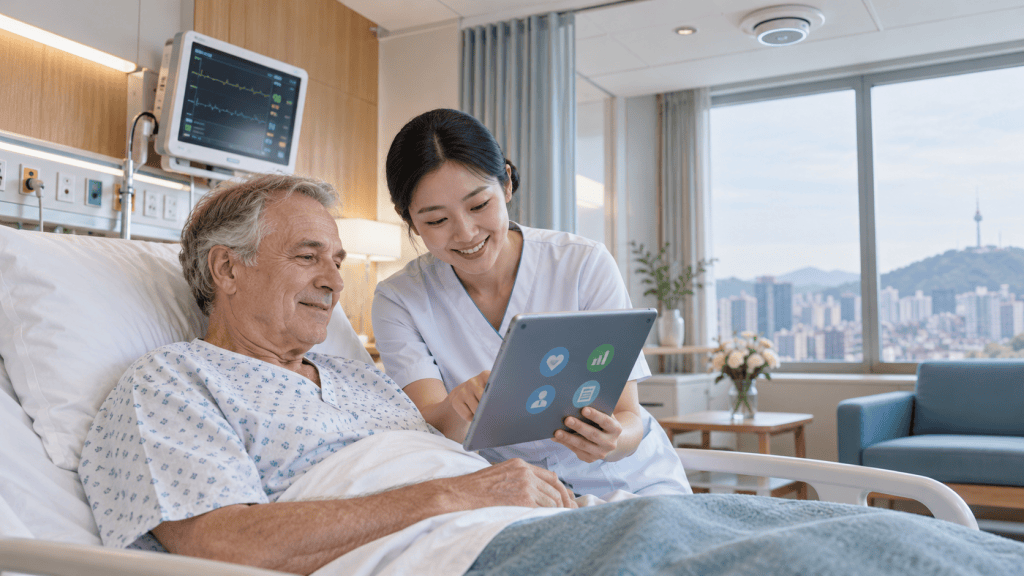
Korea is widely associated with fast digital services and highly connected daily life. The same expectations increasingly influence healthcare.
Potential digital touchpoints include:
- Online appointment requests
- Digital pre-consultation questionnaires
- Electronic medical record transfer
- Mobile registration and patient guidance
- Digital access to examination results
- AI-assisted diagnostic support
- Smart patient monitoring
- Remote follow-up communication
- Digital rehabilitation and health-management tools
However, digital transformation in healthcare should not be evaluated by the number of technologies a hospital possesses.
The more meaningful question is:
“Does technology make the patient’s experience safer, clearer, and more convenient?”
The best digital healthcare is often invisible. It reduces repetitive paperwork, prevents information from being lost, helps medical professionals make informed decisions, and allows patients to understand what comes next.
Korea’s future opportunity is therefore not simply to build “smart hospitals,” but to create smart patient journeys.
7. Cooperation Across Medical Specialties
Many medical conditions cannot be addressed effectively by a single department.
Cancer treatment, complex surgery, neurological conditions, rehabilitation, chronic diseases, and rare diseases may require cooperation among several specialists.
A multidisciplinary approach may bring together professionals from areas such as:
- Internal medicine
- Surgery
- Radiology
- Pathology
- Oncology
- Rehabilitation medicine
- Nutrition
- Nursing
- Mental health support

For an international patient, this collaboration can be particularly valuable. Traveling repeatedly between countries to receive separate medical opinions can be costly and difficult.
When multiple specialists can review a case within a coordinated system, the patient may receive a more comprehensive understanding of the condition and available treatment options.
The key distinction is not simply having many famous doctors in one hospital. It is whether those professionals can effectively share information and build a coherent plan around the patient.
8. A Bridge Between Modern Medicine and Korean Medical Traditions
Another distinctive characteristic of Korea is the coexistence of conventional medicine and traditional Korean medicine.
Patients may encounter different approaches to pain management, rehabilitation, chronic-condition support, or general well-being. This does not mean that the two systems are interchangeable or that every treatment should be combined.
Safe integration requires:
- Clear medical evidence
- Accurate disclosure of medications and treatments
- Communication among healthcare professionals
- Awareness of possible interactions
- Realistic expectations
- Patient-specific clinical judgment
Presented responsibly, this coexistence can introduce international patients to the diversity of Korea’s healthcare environment.
The value lies not in claiming that one system can solve every problem, but in helping patients make informed and medically appropriate choices.
9. Trust Is the Foundation of International Healthcare
Advanced equipment may attract attention, but trust determines whether a patient ultimately chooses a hospital.
International patients need clear answers to practical questions:
- Is the institution properly authorized?
- Does the medical professional have relevant experience?
- What is included in the estimated cost?
- What additional expenses may occur?
- What are the risks and alternatives?
- Who will provide interpretation?
- How will personal medical information be protected?
- What happens if complications arise?
- What support is available after returning home?
Transparent communication is therefore not an additional service. It is a core part of medical quality.
A trustworthy provider should not promise perfect results. It should explain possible benefits, risks, limitations, alternatives, and responsibilities in language the patient can understand.
The future reputation of K-Medical will depend not only on successful treatments, but also on how consistently Korean healthcare organizations demonstrate transparency, patient safety, and ethical responsibility.
10. From Medical Tourism to a Healthcare Partnership
The term “medical tourism” often emphasizes travel and treatment. However, patients with serious or chronic conditions may need something more enduring than a short hospital visit.
They may need a healthcare partnership that connects:
- The patient
- The Korean medical institution
- The patient’s family
- The physician in the patient’s home country
- Rehabilitation and recovery providers
- Digital follow-up services
This partnership model recognizes that healthcare continues across borders.
Before visiting Korea, patients need reliable information and appropriate case review. While in Korea, they need safe treatment and coordinated support. After returning home, they may need medical records, follow-up consultations, medication guidance, or cooperation with a local physician.
K-Medical can distinguish itself by building this continuity into the service from the beginning.

What Truly Makes K-Medical Different?
Korea’s medical competitiveness cannot be explained by a single hospital, doctor, device, or procedure.
Its greater potential lies in the combination of many elements:
| Korean Healthcare Strength | Value for International Patients |
|---|---|
| Coordinated medical journey | Less confusion between different stages of care |
| Efficient scheduling | Reduced uncertainty and more predictable travel planning |
| Multidisciplinary collaboration | More comprehensive evaluation of complex conditions |
| Medical coordination | Easier communication with the healthcare system |
| Cultural understanding | Greater comfort, dignity, and trust |
| Digital integration | More convenient access to information and services |
| Recovery planning | Safer transition from treatment to daily life |
| International follow-up | Better continuity after returning home |
| Transparent communication | More informed and confident decisions |
The most powerful future message for K-Medical may therefore be:
Korea does not simply provide treatment. It connects the entire journey of care.
Conclusion: The Next Chapter of K-Medical
The global healthcare market is changing.
Patients are no longer satisfied with choosing a destination based only on price, technology, or the reputation of a famous doctor. They want clarity, safety, convenience, respect, and continuity.
Korea has an opportunity to lead this change.
The next chapter of K-Medical should not be defined only by how advanced a treatment is or how quickly it can be delivered. It should be defined by how carefully every stage of the patient’s experience is connected.
From the first online inquiry to the final follow-up after returning home, every interaction contributes to medical trust.
That is the real difference Korea can offer.
Advanced treatment may bring a patient to Korea.
A connected and trustworthy experience is what makes K-Medical unforgettable.


Leave a Reply