
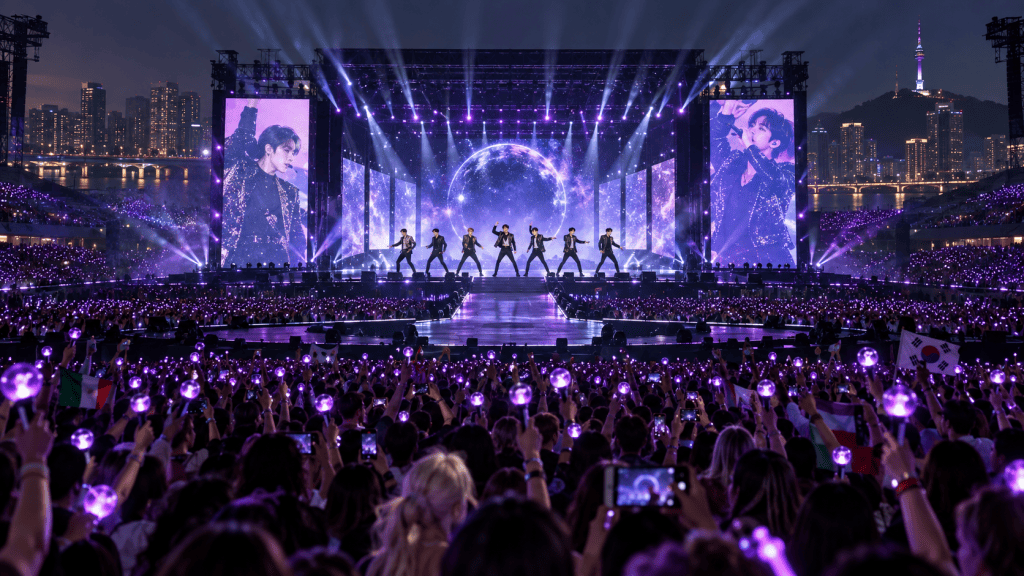
Seven members. One historic comeback. And a global K-POP wave that feels bigger than ever.
For millions of fans around the world, 2026 has delivered one of the biggest moments in pop culture:
BTS is back.
But this is more than the return of one famous group.
The comeback of RM, Jin, SUGA, j-hope, Jimin, V and Jung Kook is reminding the world of something much bigger — why people fell in love with K-POP, Korea and Korean culture in the first place.
BTS released their fifth studio album, ARIRANG, on March 20, 2026. The 14-track album quickly became a major global event. Spotify says ARIRANG became the most-streamed K-POP album in the platform’s history, while the album’s songs and performances helped launch a new chapter in BTS’s global career.
And the numbers tell only part of the story.
BTS in 2026: The Comeback by the Numbers
| BTS 2026 Highlight | What Happened | Why It Matters |
|---|---|---|
| New Album | ARIRANG released March 20, 2026 | BTS’s first major group album of their new era |
| Billboard 200 | No. 1 for two weeks | Demonstrates massive U.S. album demand |
| Billboard Hot 100 | “SWIM” debuted at No. 1 | Another major mainstream milestone |
| Spotify | ARIRANG became Spotify’s most-streamed K-POP album | Shows the scale of global digital listening |
| Netflix Live | 18.4 million viewers watched their Seoul concert livestream | A Korean concert became a worldwide digital event |
| Spotify Playlists | BTS songs appear in more than 130 million user-generated playlists | Their music lives far beyond the traditional K-POP audience |
| Global Listening | The U.S., Japan and Peru are among BTS’s top streaming markets | The fandom truly crosses continents |
BTS’s Seoul concert livestream alone attracted 18.4 million viewers worldwide and entered Netflix’s weekly Top 10 in 80 countries.
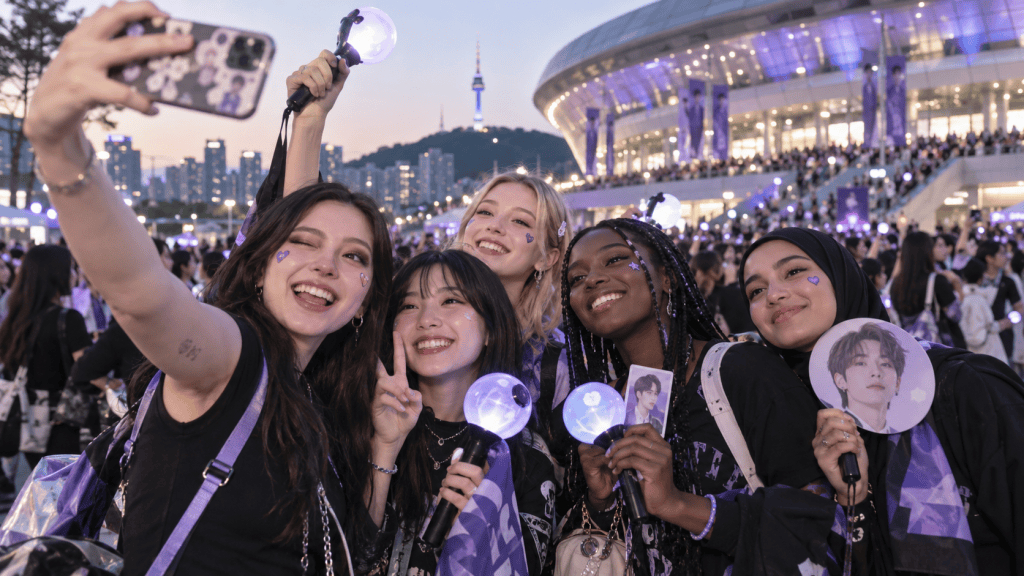
So what makes BTS — and K-POP — so irresistible?
Here are seven reasons the world is falling in love with K-POP all over again.
1. BTS Didn’t Simply Come Back — They Came Back Bigger
Most artists worry that a long break will make the public forget them.
BTS experienced almost the opposite.
After the members completed their mandatory military service and reunited, anticipation had been building for years.
Then came ARIRANG.
The album reached No. 1 on the Billboard 200 and remained there for two weeks, while its lead single “SWIM” debuted at No. 1 on the Billboard Hot 100.
Their first major U.S. performance in four years, at New York’s Pier 17, showed something extraordinary: fans were already singing along to the new songs even though the album had been released less than a week earlier.
This wasn’t nostalgia.
It was the beginning of a new BTS era.
2. “ARIRANG” Connects Global Pop with Korean Identity
Even the title of the album matters.
Arirang is one of Korea’s most iconic traditional folk songs and one of the strongest musical symbols of Korean identity.
Choosing ARIRANG as the title of a globally anticipated BTS album sends a powerful message:
You don’t have to hide where you come from to become global.
You can become global because of where you come from.
That is one of the most fascinating things about modern Korean culture.
K-POP does not simply imitate Western pop music. At its best, it takes global sounds and mixes them with Korean language, aesthetics, storytelling, emotion and cultural references.
During the ARIRANG era, even BTS’s performances have incorporated elements connected to Korea’s traditional “Arirang” heritage.
For international fans, that creates something familiar enough to enjoy — but different enough to discover.

3. K-POP Is No Longer Just Music
Imagine becoming interested in BTS.
You listen to one song.
Then you watch a music video.
Then another.
Soon, you notice the fashion.
Then the hairstyles.
Then the skincare.
Then Korean food.
You start learning Korean words.
You watch Korean dramas.
And eventually you find yourself searching:
“Flights to Seoul.”
That is the real power of K-POP.
One K-POP Song Can Open the Door to an Entire Culture
| You Discover | Then You May Become Interested In |
|---|---|
| K-POP | Korean language |
| Idol fashion | Korean street fashion |
| Idol makeup | K-Beauty |
| Music videos | Seoul neighborhoods |
| Korean food scenes | K-Food |
| Variety shows | Korean entertainment |
| Fan culture | Korean cafés and pop-up stores |
| Concerts | Travel to Korea |
K-POP has become a cultural gateway.
And BTS may be the world’s most powerful example of it.

4. The Fans Are Part of the Story
Traditional pop culture usually works in one direction:
Artist → Audience
K-POP works differently.
Artist ↔ Fans ↔ Community
Fans translate lyrics.
They create dance covers.
They make reaction videos.
They organize birthday cafés.
They trade photocards.
They create fan art.
They travel across countries for concerts.
They meet people online whom they may eventually meet in real life.
BTS’s ARMY is not simply a consumer group.
It is a global community.
Spotify reports that BTS tracks have been added to more than 130 million user-generated playlists, while fans in countries including the United States, Japan and Peru rank among the group’s biggest listeners.
That global community is one reason a BTS comeback can feel less like an album release and more like an international festival.
5. BTS Has Turned Entire Cities Into K-POP Experiences

This may be one of the most interesting developments of the new K-POP era.
The concert is no longer the entire experience.
The city becomes part of the concert.
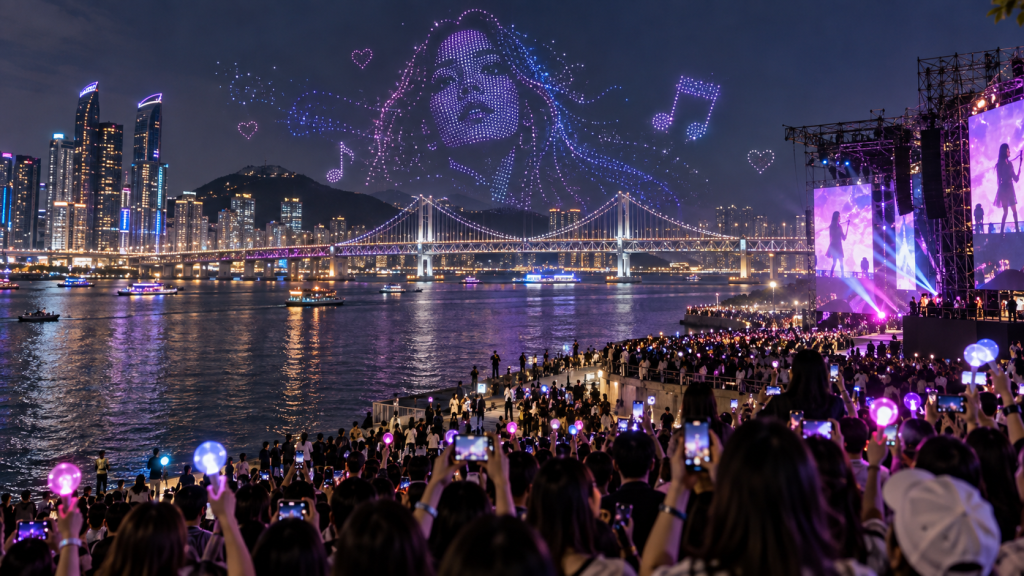
During BTS’s 2026 ARIRANG activities in Busan, fans could experience programs across the city, including concerts, installations, media art and landmark events.
A drone light show illuminated Gwangan Bridge, while media installations and fan experiences appeared at locations across Busan.
Similar BTS THE CITY ARIRANG experiences were later organized around the New York-area tour stop.
That changes the relationship between music and travel.
A fan doesn’t simply buy a concert ticket.
They may also book:
- a flight
- a hotel
- Korean restaurants
- K-Beauty experiences
- shopping
- cafés
- pop-up stores
- museums
- local attractions
- fan events
K-POP is increasingly becoming experience tourism.
6. BTS Makes Korea Feel Closer

Twenty years ago, many international travelers knew Korea mainly through companies such as Samsung, Hyundai or LG.
Today, the first emotional connection may be very different.
BTS. BLACKPINK. K-dramas. Korean beauty. Korean food. Korean fashion.
Entertainment creates curiosity.
Curiosity creates familiarity.
And familiarity creates travel.
The economic impact has become so large that analysts have even used the term “BTSnomics.”
Reuters reported that BTS fans traveling for the group’s 2026 activities were spending not only on concerts but also on hotels, merchandise, tourism and beauty services.
For a young traveler in New York, Paris, Tokyo, Bangkok or Mexico City, Seoul may no longer feel like a distant foreign city.
It can feel like a place they already know through music.

7. K-POP Gives Fans Something Pop Music Sometimes Forgets: Emotion
Spectacular performances are important.
Perfect choreography is impressive.
Fashion matters.
Visuals matter.
But none of those alone explain BTS.
The deeper connection comes from emotion.
Songs about:
dreams
fear
youth
failure
loneliness
friendship
self-love
pressure
growing up
and hope.
Different countries have different languages.
But people recognize the same emotions.
That may be the ultimate secret behind BTS’s global success.
You don’t need to be Korean to understand the feeling of being uncertain about your future.
You don’t need to speak Korean fluently to understand loneliness.
And you don’t need to come from Seoul to understand the desire to be accepted for who you are.
That emotional universality turns listeners into fans — and fans into communities.
From BTS to Korea: The Journey Doesn’t End with the Music
So, what happens after you fall in love with K-POP?
Maybe you visit Seoul.
Maybe you walk along the Han River with BTS songs in your headphones.
Maybe you explore Hongdae at night.
Maybe you discover the fashion and cafés of Seongsu.
Maybe you take photos in a Korean photo booth.
Maybe you visit an album store and buy your first physical K-POP album.
Maybe you try Korean barbecue for the first time.
Maybe you start learning Hangul.
And somewhere along the way, something interesting happens.
You came to Korea because of K-POP.
But you leave loving much more than K-POP.

The New K-POP Era Has Begun
BTS’s 2026 return matters because it represents something much larger than the reunion of seven global superstars.
It shows how far Korean culture has traveled.
A Korean-language music industry that was once considered niche has become part of mainstream global culture.
And now the movement is evolving again.
Music is becoming travel.
Fandom is becoming community.
Concerts are becoming citywide experiences.
K-POP is connecting with K-Beauty, K-Fashion, K-Food and Korean tourism.
And Korea itself is becoming part of the experience.
So perhaps the real question isn’t:
“Why is BTS still so popular?”
The better question is:
“How much bigger can the K-POP world become?”
In 2026, we may only be seeing the beginning.
BTS is back.
K-POP is moving again.
And the world is watching Korea. 🇰🇷💜
If You’re Visiting Korea Because of K-POP…
Don’t just attend a concert.
Experience Korea.
🎵 Listen to K-POP in Seoul
💄 Discover K-Beauty
👗 Try Korean fashion
🍜 Taste real K-Food
📸 Visit the neighborhoods you see online
💃 Take a K-POP dance class
🇰🇷 Learn a little Korean
💜 And make your own Korean story.
Because K-POP isn’t something you only listen to anymore.
It’s something you can experience.


Leave a Reply