

A Practical Business Culture & Conversation Guide for International Visitors
Doing business in Korea is not just about having a good product, a strong presentation, or the right price.
Communication matters.
Relationships matter.
Timing matters.
And understanding what is not said can sometimes be as important as understanding what is said.
For first-time international business visitors, Korean meetings may feel formal at first. But once the relationship develops, communication can become surprisingly warm, fast, and personal.
This guide will help you understand:
- how to greet Korean business partners,
- how to address people,
- what to talk about before a meeting,
- how Koreans may express agreement or disagreement,
- how to read indirect responses,
- how to communicate by email and messaging apps,
- how to behave at business lunches and dinners,
- and most importantly, how to build comfortable, genuine relationships.
1. First Rule: Korea Is Changing
Before learning Korean business etiquette, remember one thing:
There is no single “Korean business culture.”

A traditional manufacturing company, a major conglomerate, a government organization, a multinational corporation, and a Seoul technology startup may communicate very differently.
Younger Korean professionals may prefer first names, open discussion, casual coffee meetings, and relatively horizontal communication.
More traditional organizations may place greater importance on titles, seniority, formal greetings, and decision-making hierarchy.
Therefore, the best approach is:
Start slightly formal. Become more relaxed when your Korean counterpart does.
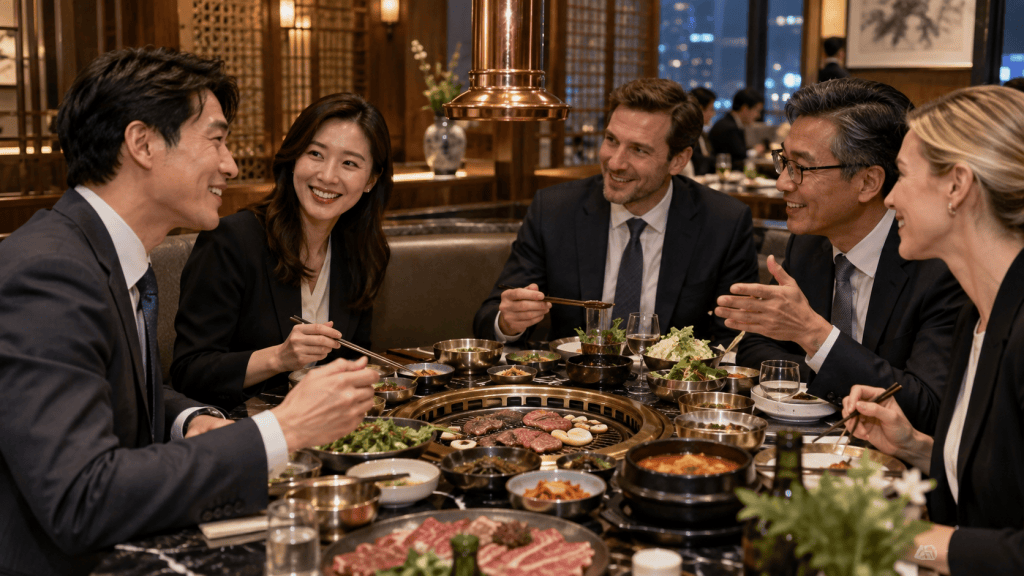
That simple rule prevents many cultural mistakes.
2. The Five Things That Matter Most
| Korean Business Value | What It Means for You | What You Should Do |
|---|---|---|
| Respect | Professional courtesy matters | Be polite, punctual and prepared |
| Relationship | Trust often develops beyond one meeting | Invest time in conversation and meals |
| Hierarchy | Position and responsibility can influence communication | Know who the senior decision-maker is |
| Harmony | Open confrontation may sometimes be avoided | Disagree professionally rather than aggressively |
| Speed | Once a project moves, communication can become very fast | Respond promptly and follow up clearly |
The interesting thing about Korean business is that hierarchy and speed can exist at the same time.
A first meeting may be formal.
Three weeks later, your Korean partner may be messaging you quickly about an urgent project.
3. How Should You Address a Korean Businessperson?

This is one of the most common questions foreign visitors have.
Korean companies frequently use:
Family name + title
For example:
- 김 부장님 — Manager/Director Kim
- 박 대표님 — CEO/Representative Park
- 이 팀장님 — Team Leader Lee
- 최 과장님 — Manager Choi
The suffix “-nim” (님) adds respect.
However, international companies may simply use English names or first names.
What Should a Foreigner Do?
| Situation | Safest Approach |
|---|---|
| You know the person’s preferred English name | Use it |
| They introduce themselves by first name | Use the first name |
| Formal Korean company | Use Mr./Ms. + family name or professional title |
| Senior executive | Start more formally |
| They say “Please call me James” | Call them James |
| Unsure | Ask politely |
A very useful sentence is:
“How would you prefer me to address you?”
This is completely professional and removes uncertainty immediately.
4. Understanding Korean Names

A traditional Korean name is normally presented:
Family Name + Given Name
For example:
Kim Min-su
Kim = family name
Min-su = given name
Common Korean family names include:
Kim
Lee
Park
Choi
Jung/Jeong
Kang
Cho/Jo
Yoon
But romanization varies.
For example, the same Korean surname may appear as:
Lee / Yi / Rhee
Do not assume that the last word written in English is always the family name.
When in doubt, ask.
5. Your First 30 Seconds Matter
When meeting a Korean business partner for the first time:
A good sequence is:
1. Smile
2. Make eye contact naturally
3. Give a small nod or slight bow
4. Shake hands
5. Introduce yourself clearly
6. Exchange business cards if appropriate
You do not need to perform a deep traditional bow.
A natural slight bow combined with a handshake is completely appropriate in many modern business situations.
6. What Should You Say?
A very safe opening is:
English
“It’s a pleasure to meet you. Thank you for taking the time to meet with us today.”
You can add one Korean phrase:
Korean
안녕하세요. 만나서 반갑습니다.
Pronunciation
Annyeonghaseyo. Mannaseo bangapseumnida.
Meaning
Hello. It’s nice to meet you.
Even if your pronunciation is not perfect, making the effort is usually appreciated.
7. Five Korean Expressions Every Business Visitor Should Know

You do not need to speak Korean to do business successfully in Korea.
But these expressions can immediately reduce distance.
| Korean | Pronunciation | Meaning | When to Use |
|---|---|---|---|
| 안녕하세요 | Annyeonghaseyo | Hello | Almost any greeting |
| 만나서 반갑습니다 | Mannaseo bangapseumnida | Nice to meet you | First meeting |
| 감사합니다 | Gamsahamnida | Thank you | Frequently |
| 잘 부탁드립니다 | Jal butakdeurimnida | I look forward to working with you / Please take good care of us | Beginning a relationship |
| 수고하셨습니다 | Sugohasyeotseumnida | Thank you for your effort | After a meeting or activity |
One particularly useful phrase is:
잘 부탁드립니다
Jal butakdeurimnida
There is no perfect English translation.
It can communicate something like:
“I look forward to working well together.”
or
“I appreciate your support going forward.”
It is a very Korean way of expressing cooperative intent.
8. Business Cards: Still Useful
Korea is one of the world’s most digitally connected societies.
But business cards are still useful, particularly during formal introductions.
When receiving a business card:
Take a moment to look at:
Name
Company
Title
Department
This is practical, not merely ceremonial.
The title can tell you a great deal about the person’s role in the meeting.
Best Practice
| Do | Avoid |
|---|---|
| Receive the card attentively | Immediately putting it away without looking |
| Read the name and position | Writing on it immediately in front of the person |
| Place it neatly on the table during a formal meeting | Treating it casually |
| Bring enough cards | Arriving at a major meeting without any |
For important Korean relationships, consider a bilingual card:
English on one side
Korean on the other
9. Small Talk Is Not Wasted Time
Foreign executives sometimes want to begin:
“Let’s get straight to business.”
That can work.
But five or ten minutes of conversation can help create a much better atmosphere.
Good topics include:
| Good Small-Talk Topics | Example |
|---|---|
| Korea | “This is my first visit to Seoul.” |
| Food | “I’ve been looking forward to trying Korean food.” |
| Travel | “I arrived yesterday from Singapore.” |
| Business environment | “Seoul feels incredibly dynamic.” |
| Your host’s company | “I read about your recent expansion.” |
| Industry | “The Korean market is moving very quickly.” |
| Sports | Safe if you know there is mutual interest |
| Cultural experiences | “I’d love to experience more of Seoul while I’m here.” |
10. Topics to Approach Carefully

You do not need to be nervous about conversation.
But in a first business meeting, avoid immediately entering highly personal or contentious territory.
Be careful with:
- domestic politics,
- North/South Korean politics unless relevant,
- salary,
- highly personal family questions,
- criticizing Korea,
- historical disputes,
- religion,
- comparing Korea negatively with another Asian country.
That does not mean Koreans never discuss these things.
They certainly do.
It simply means:
Build the relationship first.
11. An Important Difference: “Yes” May Mean “I Hear You”
This is one of the most useful communication lessons for foreign visitors.
A Korean person may say:
“Yes.”
or
“네 — Ne.”
But depending on context, it can mean:
“Yes.”
or
“I understand.”
or
“I’m listening.”
It does not always mean:
“I agree with your proposal.”
Therefore, instead of asking:
“Do you understand?”
ask:
“Would this approach work for your team?”
or:
“Would you be comfortable proceeding this way?”
The second question produces much clearer information.
12. What Koreans Say — And What You Should Clarify
This is where many cross-cultural misunderstandings happen.
The following are possible interpretations, not rigid rules.
| You May Hear | Possible Meaning | Best Response |
|---|---|---|
| “We’ll review it.” | Genuine review, uncertainty, or a polite delay | “Of course. When would be a good time for us to follow up?” |
| “It may be difficult.” | There is a significant problem | “I understand. Which part is the most difficult?” |
| “We’ll discuss internally.” | More stakeholders need to agree | “Would additional information help the internal discussion?” |
| “We’ll think about it.” | Not ready to commit | “Certainly. Is there anything we can clarify?” |
| “That’s interesting.” | Interest, politeness, or simply acknowledgment | Ask a specific follow-up question |
| “Maybe later.” | Timing may be wrong | “Would Q1 or Q2 be more realistic?” |
| “Yes, I understand.” | Message understood | Do not automatically treat it as agreement |
The Key Technique
Don’t challenge the indirect answer.
Clarify it.
Instead of:
“So is that a no?”
try:
“What would need to change for this to become workable?”
That keeps the conversation constructive.
13. How to Disagree With a Korean Business Partner

You can absolutely disagree.
What matters is how.
Too Direct
“That won’t work.”
Better
“I understand the reasoning. One concern we have is…”
or:
“Could we explore another approach?”
or:
“I see your point. From our side, the challenge would be…”
This approach works well internationally, not just in Korea.
14. The Magic Formula for Difficult Conversations
Use this sequence:
Respect → Reason → Alternative
For example:
Respect
“That’s an interesting approach.”
Reason
“Our concern is that implementation would require another three months.”
Alternative
“Could we launch Phase 1 first and complete Phase 2 afterward?”
This avoids making the other person feel that their idea was simply rejected.
15. Hierarchy: Understand It Without Obsessing Over It
Traditional Korean organizations can have clearly defined levels.
A simplified example might look like:
CEO / President
Executive
Department Head
Team Leader
Manager
Staff
But titles vary enormously by company.
And many modern Korean companies are simplifying titles or adopting more horizontal systems.
Therefore:
Understand the hierarchy, but do not stereotype every Korean organization as rigidly hierarchical.
KOTRA itself has publicly described efforts to strengthen horizontal and two-way communication within its organization, illustrating the broader evolution of Korean workplace culture.
16. Find Out Who Makes the Decision
The most vocal person in the room is not always the decision-maker.
And the most senior person may not conduct most of the discussion.
A typical business meeting might include:
| Person | Possible Role |
|---|---|
| Executive | Final approval |
| Team leader | Project ownership |
| Manager | Evaluation and coordination |
| Staff member | Research and implementation |
| International business manager | Main communication contact |
Treat everyone respectfully.
The junior person who coordinates your project today may become one of your most important internal champions tomorrow.
17. Korean Meetings: What to Expect
A typical first business meeting may follow this pattern:
1. Greetings
2. Business-card exchange
3. Small talk
4. Company introduction
5. Main presentation
6. Questions
7. Discussion
8. Next steps
9. Lunch, coffee or dinner
Do not assume that the formal meeting is the entire relationship.
Sometimes the conversation after the presentation becomes more important than the presentation itself.
18. Listen to the Questions

Questions can reveal where the real interest lies.
If the Korean team repeatedly asks about:
price
→ commercial feasibility may be the issue.
If they repeatedly ask about:
case studies
→ they may need proof before supporting the idea internally.
If they ask about:
implementation
→ they may already be thinking seriously about adoption.
If they ask:
“Which Korean companies are already using this?”
→ local references may be extremely important.
19. Silence Does Not Necessarily Mean Rejection
If nobody immediately reacts after your proposal, don’t panic.
Silence can mean many things:
- people are thinking,
- they are waiting for a senior colleague,
- they are processing unfamiliar information,
- they don’t want to interrupt,
- they are unsure.
Give the room a moment.
Then ask:
“I’d be very interested in your initial reactions.”
That invites discussion without pressure.
20. How to Ask Better Questions
Instead of asking questions that produce only “yes” or “no,” ask questions that encourage explanation.
| Avoid | Better |
|---|---|
| “Do you like our proposal?” | “Which part of the proposal is most relevant to your organization?” |
| “Is the price okay?” | “How does the pricing compare with your expectations?” |
| “Can we start next month?” | “What would need to happen internally before we could begin?” |
| “Is management interested?” | “Who else should be involved in the discussion?” |
| “Do you understand?” | “Would you like me to clarify any part?” |
| “Can we sign this week?” | “What does your internal approval process look like?” |
These questions are particularly valuable in Korea because they help uncover the internal process behind the answer.
21. Email Communication
Korean business emails are often concise.
A strong follow-up email should include:
Thank you
Key points
Agreed actions
Owner
Deadline
Next meeting
For example:
Thank you for today’s productive discussion.
As agreed, we will send the revised proposal by Friday.
Your team will review the implementation timeline internally.
We suggest reconnecting next Wednesday.
This prevents ambiguity.
22. Messaging Apps: Korea Moves Fast
KakaoTalk is enormously familiar in Korea.
However, do not immediately assume that every business relationship should move to personal messaging.
Start with the communication channel your counterpart uses.
Communication Progression
Formal relationship
↓
Active project
Email + phone
↓
Closer working relationship
Possibly messaging apps
Once a Korean business relationship becomes active, responses may become considerably faster and more informal.
23. Response Speed Matters
Korea has a reputation for fast-moving business environments.
If someone sends an urgent project question and you need two days to research the answer, you do not necessarily need to produce the answer immediately.
But acknowledge the message.
For example:
“Thank you. We’ve received this and are reviewing it. I’ll send you a detailed response by Thursday.”
That small response builds confidence.
24. Business Lunches and Dinners

Meals can be important relationship-building opportunities.
Do not think of dinner simply as:
“food after the meeting.”
It can be part of the business relationship itself.
At dinner, you may learn:
- what the client really thinks,
- what concerns were not discussed in the meeting,
- who influences the project,
- what the internal obstacles are,
- and whether genuine trust is developing.
25. Korean Dining Culture
You do not need to memorize complicated rules.
Remember these basics:
| Situation | Good Practice |
|---|---|
| Seating | Let your host guide you |
| Starting | Wait briefly until everyone is ready |
| Shared dishes | Follow the table’s lead |
| Chopsticks | Ask if you need help |
| Alcohol | Drinking is not mandatory |
| Toast | Join politely if comfortable |
| Dietary restrictions | Tell your host in advance |
| Bill | The host may offer to pay; you can politely offer once |
Modern Korean business dining is much more flexible than old stereotypes sometimes suggest.
26. What If You Don’t Drink Alcohol?
No problem.
You can simply say:
“Thank you, but I don’t drink.”
or:
“I’ll have sparkling water, thank you.”
You do not need to invent a medical reason.
You can still participate in a toast using a non-alcoholic drink.
The important thing is participation in the social moment—not the alcohol itself.
27. The Korean Toast

The most common expression is:
건배!
Geonbae!
Meaning:
Cheers!
Easy to remember.
You will probably hear it during a business dinner.
28. Coffee Is Also Business

Do not underestimate coffee.
A typical sequence might be:
Meeting → Lunch → Coffee
The coffee conversation can be considerably more relaxed than the formal meeting.
This may be where someone finally says:
“Actually, our real concern is…”
That sentence can be worth more than twenty PowerPoint slides.
29. Relationship Before Transaction

Many successful Korean business relationships develop in stages.
Stage 1
Who are you?
↓
Stage 2
Can I trust you?
↓
Stage 3
Can your company deliver?
↓
Stage 4
Can we work comfortably together?
↓
Stage 5
Let’s do business.
Price matters.
Technology matters.
Quality matters.
But so does this question:
“Will working with these people be easy and reliable?”
30. Don’t Confuse Warmth With Agreement
After a wonderful dinner, your Korean counterparts may be extremely friendly.
That is a positive sign.
But it does not necessarily mean:
the contract has been approved.
Keep the relationship and the commercial process separate.
Always confirm:
Decision
Next step
Owner
Timeline
in writing afterward.
31. What Korean Clients Often Want From Foreign Partners
Every company differs, but foreign suppliers and partners are often stronger when they can demonstrate:
| What They Want | How You Can Show It |
|---|---|
| Reliability | Respond when promised |
| Evidence | Provide data and cases |
| Local relevance | Explain why it works in Korea |
| Speed | Follow up promptly |
| Flexibility | Adapt when necessary |
| Commitment | Don’t disappear after the first meeting |
| Senior involvement | Bring leadership into important discussions |
| Long-term intent | Demonstrate commitment beyond one sale |
32. The Power of Korean Case Studies
One question you may hear is:
“Do you have any Korean clients?”
There is a reason.
An international case study proves that your solution works.
A Korean case study proves that it can work here.
If you are entering Korea for the first time, be transparent.
Say:
“This would be our first Korean partnership, which is why we are prepared to invest additional resources in making it successful.”
That turns a weakness into a potential partnership opportunity.
33. A Realistic First-Meeting Conversation
Korean Host
“Welcome to Seoul. Was your flight okay?”
You
“Very good, thank you. It’s my first time in Korea, so I’m excited to be here.”
Korean Host
“Is this really your first time?”
You
“Yes. I arrived yesterday. I haven’t seen much yet, but Seoul is incredibly impressive.”
Korean Host
“Have you tried Korean food?”
You
“Yes, I had Korean barbecue last night. It was excellent. My team is now trying to convince me to try something spicier tonight.”
Everyone laughs.
You
“Thank you again for meeting with us. I’ve been looking forward to learning more about your organization and exploring what we might be able to do together.”
This is simple.
But it creates warmth before business begins.
34. When You Don’t Understand
Never pretend to understand something important.
Say:
“Could you explain that one more time?”
or:
“Just to make sure I understood correctly…”
Then repeat your interpretation.
For example:
“Just to make sure I understood correctly, you would like us to revise the pricing first, and then your team will present it to management. Is that correct?”
This technique is extremely valuable in cross-cultural business.
35. English Communication With Korean Partners
Many Korean professionals speak excellent English.
Others may understand much more English than they feel comfortable speaking.
Therefore:
Speak clearly.
Not unnaturally slowly.
Avoid excessive slang.
Instead of:
“Let’s circle back and take this offline before we boil the ocean.”
say:
“Let’s discuss this separately after the meeting.”
Much easier.
36. Avoid Too Much Native-Speaker Humor
Humor helps relationships.
But jokes involving:
- wordplay,
- sarcasm,
- cultural references,
- rapid slang,
can easily disappear in translation.
Simple humor works better.
And never make someone the target of the joke in an early business relationship.
37. Korean Communication: Read the Whole Room
Do not focus only on the person speaking.
Observe:
Who asks questions?
Who takes notes?
Who stays quiet?
Who looks to whom before answering?
Who summarizes the decision?
These signals can help you understand the organization.
But do not overinterpret individual gestures.
Look for patterns.
38. What Not to Do
Avoid these common mistakes:
1. Talking only to the most senior person
Everyone matters.
2. Assuming silence means agreement
Confirm.
3. Assuming friendliness means a deal is done
Confirm commercial steps separately.
4. Pressuring someone to say “yes” immediately
Give them room for internal discussion.
5. Ignoring junior team members
They may be implementing or championing your project.
6. Criticizing Korean culture
Ask questions instead.
7. Assuming every Korean company is hierarchical
Companies vary enormously.
8. Making every conversation transactional
Relationships matter.
9. Disappearing after the meeting
Follow up.
10. Overcomplicating communication
Clear language wins.
39. Ten Sentences That Work Extremely Well in Korea
Save these.
1.
“Thank you for taking the time to meet with us.”
2.
“I’d be very interested in hearing your perspective.”
3.
“How does your organization normally handle this?”
4.
“What would make this easier for your team?”
5.
“Who else should we involve in the discussion?”
6.
“Is there anything we should adapt specifically for the Korean market?”
7.
“I understand your concern.”
8.
“Let me make sure I’ve understood correctly.”
9.
“What would be the best next step from your perspective?”
10.
“We hope this can become a long-term partnership.”
These expressions are respectful without being overly formal.
40. The Best Korean Business Conversation Formula
If you remember nothing else, remember this:
Ask → Listen → Clarify → Confirm
ASK
“What is your biggest priority?”
LISTEN
Do not prepare your next sales pitch while they are speaking.
CLARIFY
“When you say implementation is difficult, is the main concern budget or timing?”
CONFIRM
“So our next step is to revise the schedule by Friday. Correct?”
This simple cycle prevents a huge number of international business misunderstandings.
41. Before You Leave the Meeting
Never leave without understanding:
| Question | You Need an Answer |
|---|---|
| What happens next? | ✓ |
| Who is responsible? | ✓ |
| What do we need to send? | ✓ |
| What do they need to review? | ✓ |
| When should we follow up? | ✓ |
| Who else needs to approve? | ✓ |
The phrase:
“What would be the best next step?”
is one of the most valuable questions you can ask.
42. The Follow-Up
Within a reasonable period after the meeting, send a short message.
A simple structure:
Thank you
→ What we discussed
→ What we agreed
→ What we will do
→ What they will do
→ Next date
Do not write five pages unless five pages are required.
Make the next action obvious.
43. Korea Business Culture Cheat Sheet
| Situation | Best Approach |
|---|---|
| First introduction | Polite and slightly formal |
| Greeting | Handshake + natural slight bow |
| Names | Confirm preferred form of address |
| Business cards | Still useful |
| Small talk | Recommended |
| Presentation | Clear, evidence-based |
| Questions | Encourage discussion |
| Disagreement | Respectful and solution-oriented |
| Silence | Don’t immediately interpret it negatively |
| Indirect response | Clarify politely |
| Hierarchy | Be aware, don’t stereotype |
| Concise and clear | |
| Messaging | Follow your partner’s lead |
| Response time | Prompt acknowledgment helps |
| Lunch/dinner | Relationship opportunity |
| Alcohol | Optional |
| Follow-up | Essential |
| Decision | Confirm in writing |
| Relationship | Think long-term |
44. Seven Korean Words Worth Remembering
| Korean | Pronunciation | English |
|---|---|---|
| 안녕하세요 | Annyeonghaseyo | Hello |
| 감사합니다 | Gamsahamnida | Thank you |
| 반갑습니다 | Bangapseumnida | Nice to meet you |
| 네 | Ne | Yes / I understand |
| 괜찮습니다 | Gwaenchanseumnida | It’s okay |
| 건배 | Geonbae | Cheers |
| 잘 부탁드립니다 | Jal butakdeurimnida | I look forward to working together |
You do not need perfect Korean.
The purpose is not to impress someone with your language ability.
The purpose is to show:
interest, respect and willingness to connect.
45. The Most Important Lesson
Successful communication in Korea is not about memorizing hundreds of etiquette rules.
It is about understanding people.
Be respectful without becoming stiff.
Be confident without being aggressive.
Be curious instead of judgmental.
Be clear without being confrontational.
Listen carefully.
Clarify ambiguous answers.
Follow through on what you promise.
And invest enough time to allow trust to develop.
The goal is not to “act Korean.”
The goal is to make it easy for Korean partners to:
understand you,
trust you,
communicate with you,
and enjoy working with you.
That is good business culture anywhere in the world.
And it works particularly well in Korea.

Welcome to Korea.
좋은 비즈니스 파트너가 되시길 바랍니다.
We hope you build great business partnerships in Korea.


Leave a Reply