
Doing Business in Korea

A Practical Guide to Meetings, Relationships, Dining, and Business Etiquette
For many foreign professionals, doing business in Korea is both exciting and challenging.
Korea is one of the world’s most dynamic business environments. It is fast-moving, highly connected, globally competitive, and home to major corporations, innovative startups, and world-class industries. However, foreign businesspeople who are new to Korea often discover that success here depends on more than product quality, pricing, or technical expertise.
In Korea, business is often built not only on contracts, but also on trust, relationships, respect, and smooth communication.
This does not mean that all Korean companies behave in exactly the same way. Korean business culture is changing quickly. Younger professionals, startups, multinational firms, and global teams may communicate more directly and flexibly than traditional organizations. Even so, many foreign professionals still benefit from understanding the cultural patterns that commonly influence meetings, introductions, dining, follow-up, and relationship-building in Korea.
The most important thing to remember is this:
In Korea, a successful business relationship often begins before the contract is signed.
1. Why Relationships Matter in Korean Business
In some countries, business can begin immediately once the proposal, price, and terms look right.
In Korea, business often develops through a slightly broader process:
Introduction → Trust → Relationship → Business → Long-Term Partnership
Korean companies naturally care about:
- Whether you are reliable
- Whether communication will be smooth
- Whether you understand business manners
- Whether you are respectful and trustworthy
- Whether the partnership will work in the long term
That is why first impressions, follow-up behavior, and relationship management can strongly influence how business develops.
What Korean business partners often look for
| What They Evaluate | Why It Matters |
|---|---|
| Professionalism | Shows reliability and seriousness |
| Respectful communication | Helps build trust and smooth cooperation |
| Responsiveness | Korea’s business environment moves quickly |
| Long-term mindset | Partnerships are often valued over one-time deals |
| Cultural awareness | Reduces friction and misunderstanding |
| Consistency | Trust grows when words and actions match |
In other words, your behavior before, during, and after meetings may matter almost as much as the proposal itself.
2. The First Meeting: More Than Just a Meeting
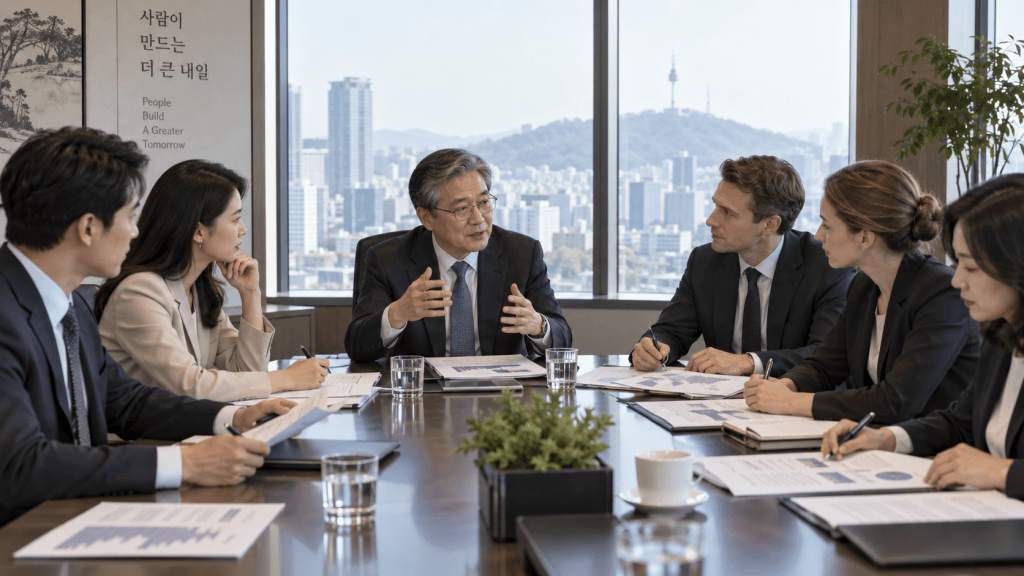
In Korea, a first meeting is often not only about business details. It is also about assessing:
- Who you are
- How you communicate
- Whether you are trustworthy
- Whether working with you will be easy and comfortable
The first meeting can therefore carry both a business purpose and a relationship-building purpose.
What often happens in a first Korean business meeting
| Stage | What Usually Happens | What It Means |
|---|---|---|
| Greeting | Polite introduction and exchange of names/cards | Establishes respect and first impression |
| Small talk | Light conversation before the main topic | Helps reduce distance |
| Company introduction | Background, company overview, key strengths | Builds credibility |
| Main discussion | Product, service, partnership, proposal | Core business content |
| Questions and comments | Clarification, reactions, internal concerns | Helps test fit |
| Closing | Appreciation, next steps, possible meal/follow-up | Important for relationship development |
A foreign professional may want to “get to the point” immediately, but in Korea, jumping too quickly into price or pressure-driven negotiation without any rapport can sometimes feel too abrupt.
A better approach is to balance:
Warmth + professionalism + clarity
3. Greetings, Introductions, and First Impressions
In Korea, first impressions still matter a great deal, especially in formal business settings.
Practical guidelines for greetings
| Situation | Recommended Approach |
|---|---|
| First greeting | Offer a polite greeting with a slight bow |
| Handshake | Common in international business settings |
| Greeting senior people | Be slightly more formal and respectful |
| Self-introduction | State your name, role, and company clearly |
| Tone | Warm, professional, calm |
| Eye contact | Natural and respectful, not overly aggressive |
A slight bow is a common sign of courtesy in Korea. In international settings, it is often combined with a handshake.
Example self-introduction
“Hello, it’s a pleasure to meet you. My name is David Miller, and I’m the Regional Business Director at ABC Global.”
That is simple, polite, and professional.
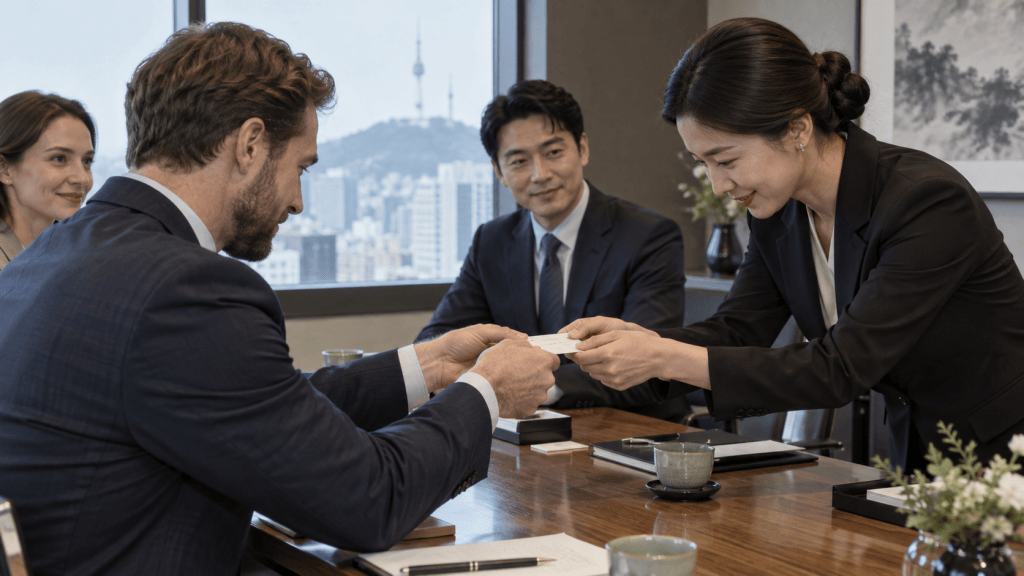
4. Business Cards Still Matter in Korea
Although digital communication is widespread, business cards are still meaningful in Korean business culture.
A business card is not just a contact card. It helps the other side quickly understand:
- Your name
- Your title
- Your position
- Your company
- Your level of authority
Business card etiquette
| Do | Why |
|---|---|
| Present your card respectfully | Shows professionalism |
| Offer and receive it with both hands if possible | A common sign of courtesy |
| Take a moment to read the card | Shows respect for the person and role |
| Keep the card on the table during the meeting if appropriate | Helps remember names and roles |
| Store it carefully | Avoids seeming careless |
What to avoid
| Avoid | Why |
|---|---|
| Putting it directly into your pocket without looking | Can seem dismissive |
| Writing on it immediately in front of the person | Can feel disrespectful in some settings |
| Handling it too casually | May make you appear indifferent |
Even if some younger professionals are more relaxed about this, using good business card manners is still a safe and positive habit.
5. Titles, Roles, and Hierarchy
Korea is becoming more flexible and modern in workplace culture, but titles and hierarchy can still play an important role in many organizations.
This affects:
- Who speaks first
- Who makes the final decision
- Who should receive attention in meetings
- How formal the tone should be
Common Korean business titles
| Korean Title | Common English Equivalent | Typical Meaning |
|---|---|---|
| 대표이사 | CEO / President | Chief executive |
| 사장 | President / CEO | Top executive |
| 부사장 | Vice President / EVP | Senior executive |
| 전무 | Executive Director / EVP | Executive |
| 상무 | Managing Director / VP | Executive |
| 본부장 | Division Head | Division leader |
| 실장 | Director / Head | Functional leader |
| 부장 | General Manager | Department head |
| 팀장 | Team Leader | Team manager |
| 차장 | Deputy General Manager | Mid-level manager |
| 과장 | Manager | Working manager |
| 대리 | Assistant Manager | Junior/mid-level employee |
| 사원 | Staff / Associate | Working-level employee |
That said, many firms today use simplified structures or English titles. Some even use first names or the suffix “-nim” to create a more horizontal culture.
Still, foreign professionals should remember:
Understanding who holds influence and who makes decisions is essential in Korea.
6. How Meetings Often Work in Korea
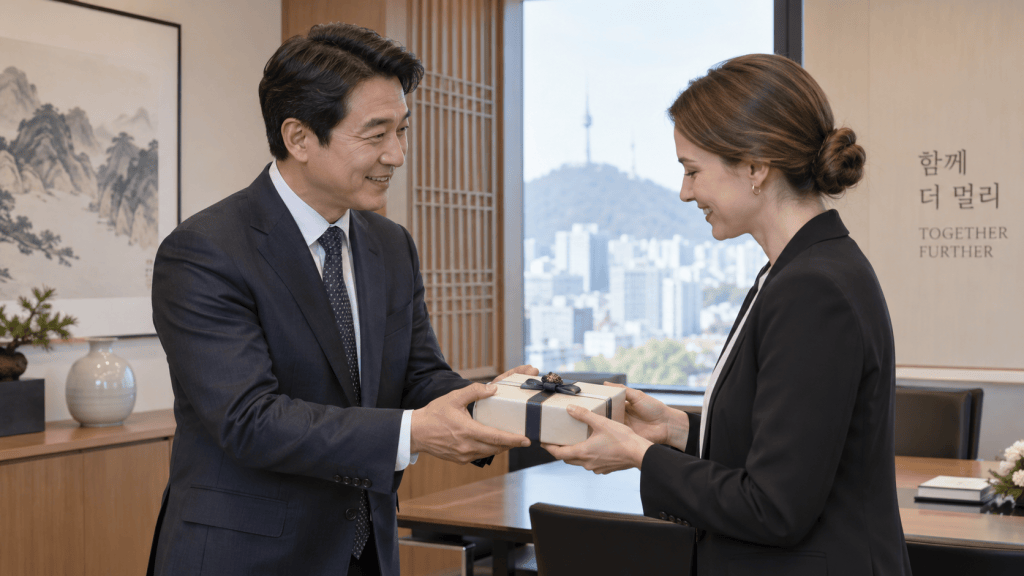
Korean meetings can vary greatly depending on the company, but some common patterns appear.
Typical meeting characteristics
| Feature | What It Often Looks Like |
|---|---|
| Preparation | Participants may review materials in advance |
| Structure | Meetings can be formal and goal-oriented |
| Respect for seniority | Senior people may speak first or last |
| Careful responses | Participants may avoid open confrontation |
| Follow-up importance | Many key decisions are clarified after the meeting |
Some foreign professionals misunderstand meetings in Korea because:
- People may not interrupt much
- People may not disagree openly
- Some participants may speak less
- The final answer may not come immediately
This does not necessarily mean disinterest.
It may mean:
- They are being careful
- They need internal approval
- They prefer to think first
- They want to avoid public disagreement
- They need to consult others internally
How to communicate effectively in Korean meetings
| Instead of… | Try… |
|---|---|
| Pushing for an immediate answer | Asking about the next step |
| Assuming silence means agreement | Confirming opinions after the meeting |
| Being too aggressive in debate | Using diplomatic language |
| Focusing only on executives | Also building trust with working-level staff |
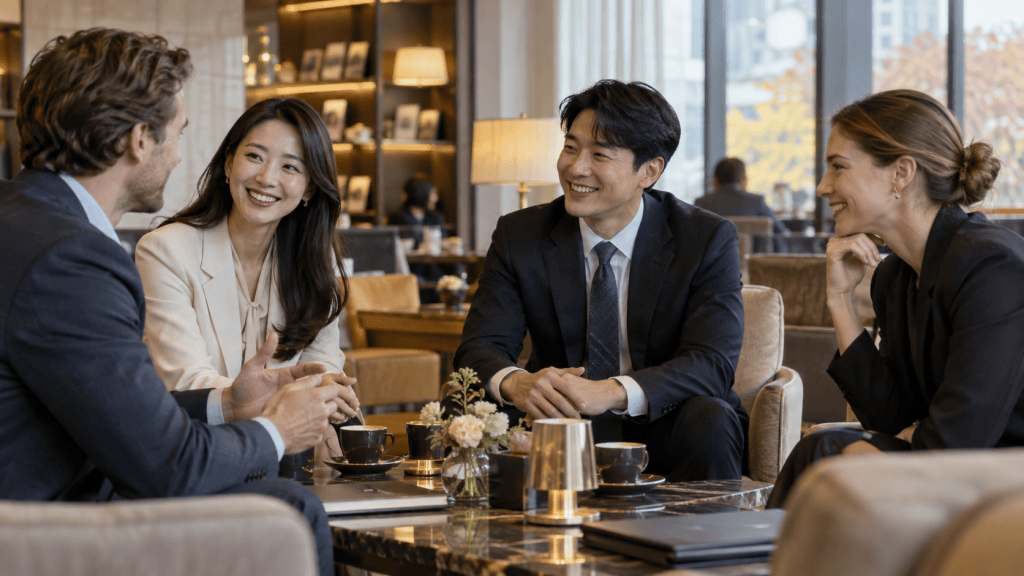
7. Small Talk Is Not a Waste of Time
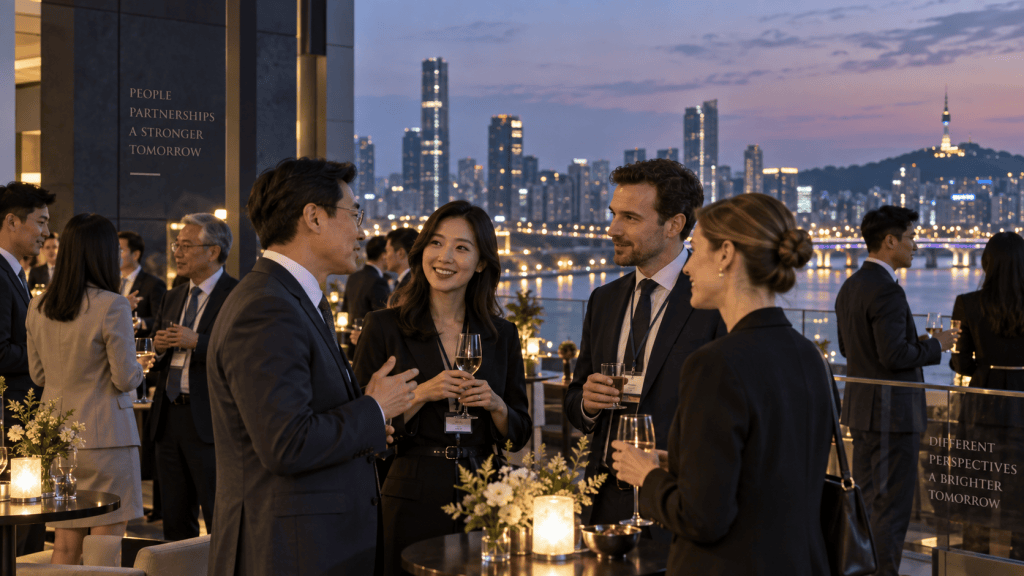
In many Korean business settings, small talk helps create comfort and connection.
It is not meaningless. It often serves an important relational purpose.
Good small-talk topics
| Topic | Why It Works |
|---|---|
| Your visit to Korea | Easy and natural |
| Korean food | Friendly and relatable |
| Travel in Korea | Good conversation starter |
| Weather / city impressions | Light and safe topic |
| Industry trends | Business-relevant |
| The other company’s work | Shows respect and preparation |
| Sports / global culture | Good shared topic |
| K-culture (carefully and naturally) | Can help if genuine |
Topics to approach carefully
| Topic | Why Caution Is Helpful |
|---|---|
| Politics | Can be sensitive |
| Religion | Personal and potentially divisive |
| Historical disputes | May be emotionally sensitive |
| Strong criticism of Korea | Can create discomfort |
| Salary / personal finances | Too personal in early meetings |
A key rule:
Be genuinely interested, but not intrusive.
8. Building Trust After the Meeting
In Korea, what happens after the meeting is extremely important.
Follow-up often shapes the other party’s impression of your professionalism.
Good follow-up behavior
| Action | Why It Matters |
|---|---|
| Send a thank-you email | Shows appreciation |
| Summarize key points | Prevents misunderstanding |
| Confirm next steps | Adds clarity |
| Respond quickly | Matches Korean business speed |
| Keep promises | Builds trust |
| Share requested documents promptly | Shows reliability |
A good follow-up email should include
| Section | Suggested Content |
|---|---|
| Appreciation | Thank them for the meeting |
| Summary | Main discussion points |
| Agreed items | What both sides discussed or tentatively agreed |
| Action items | Who will do what |
| Timeline | When next contact or review will happen |
Example:
“Thank you again for your time today. We appreciated the opportunity to meet your team. As discussed, we will send the revised proposal by Friday and follow up next Tuesday regarding the next stage.”
This kind of message is simple, clear, and highly useful.

9. Dining Is Often Part of Business Culture
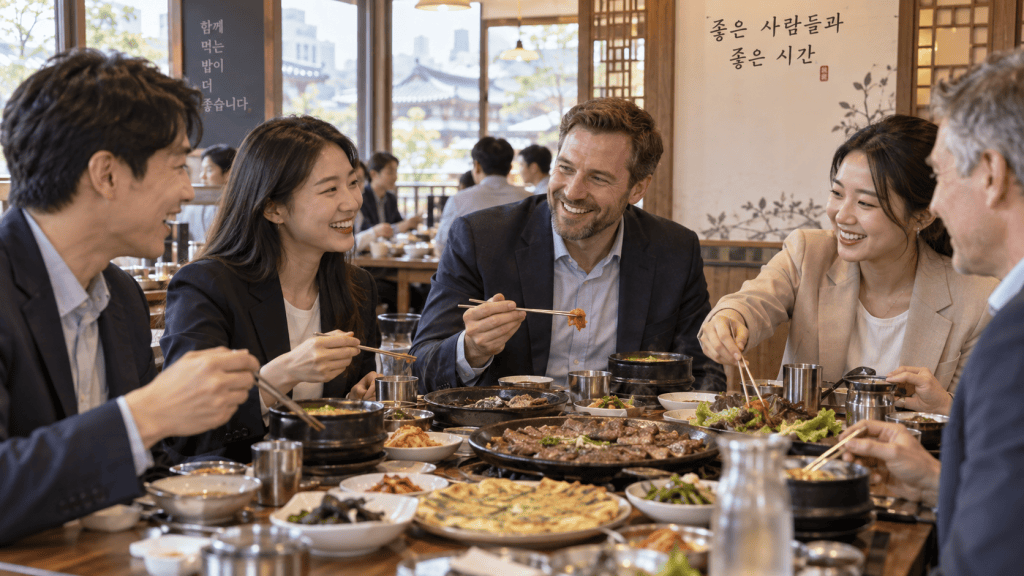
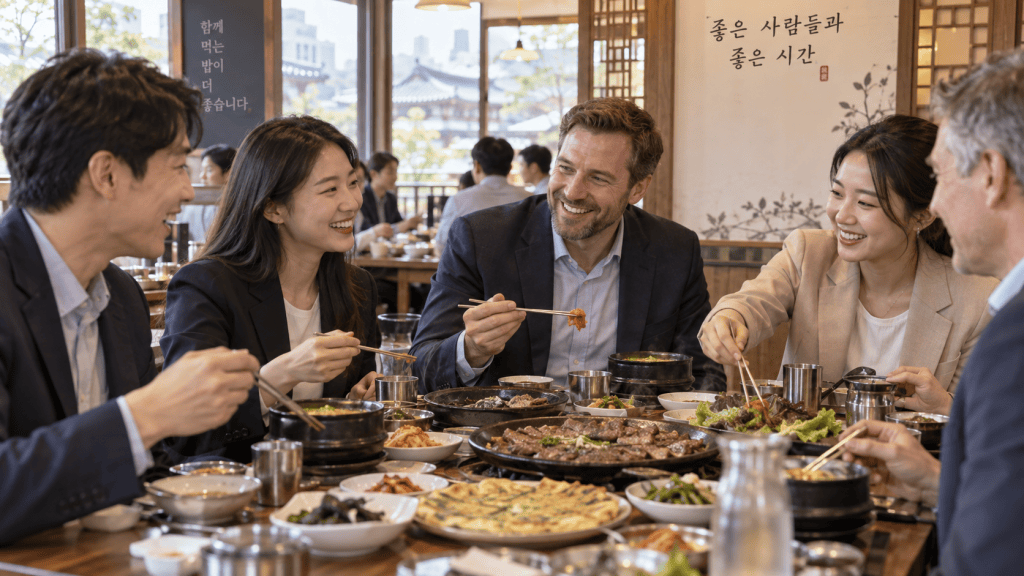
One of the most important things foreign professionals should understand is that in Korea, business meals are often part of relationship-building.
A lunch, dinner, or coffee meeting may not be “extra.” It may be part of the business process itself.
Meals can help people:
- Speak more openly
- Build familiarity
- Create warmth
- Reduce formal distance
- Explore compatibility for long-term cooperation
Types of business dining situations
| Situation | Meaning |
|---|---|
| Coffee meeting | Light introduction or informal follow-up |
| Business lunch | Moderate formality, practical discussion |
| Business dinner | Stronger relationship-building opportunity |
| Group dining | Builds team familiarity |
| Private dining room | More formal or important relationship setting |
In some cases, the real trust-building begins after the formal meeting ends.
10. Korean Dining Etiquette: What Foreigners Should Know

You do not need to become an expert in Korean table culture overnight. However, knowing a few basic points helps greatly.
Useful dining etiquette
| Situation | Recommended Behavior |
|---|---|
| Seating | Wait to be guided if the setting is formal |
| Starting the meal | Usually wait until the senior person begins |
| Pouring drinks | In some settings, people may pour for each other |
| Receiving a drink | Accept politely if appropriate |
| Using both hands | A polite gesture when giving/receiving drinks or items |
| Sharing food | Very common in Korean meals |
| Gratitude | Showing appreciation is important |
What you may notice
- Dishes are often shared
- Multiple side dishes are served
- The host may order for the group
- The atmosphere may become warmer and less formal over time
- Food may be used as a way of caring for guests
What to avoid
| Avoid | Why |
|---|---|
| Refusing everything immediately without explanation | May seem closed-off |
| Acting uncomfortable about shared dining traditions | Can create distance |
| Starting to eat before others in a formal situation | May seem impolite |
| Treating the meal as irrelevant to business | You may miss an important relationship opportunity |
11. Do You Have to Drink Alcohol?
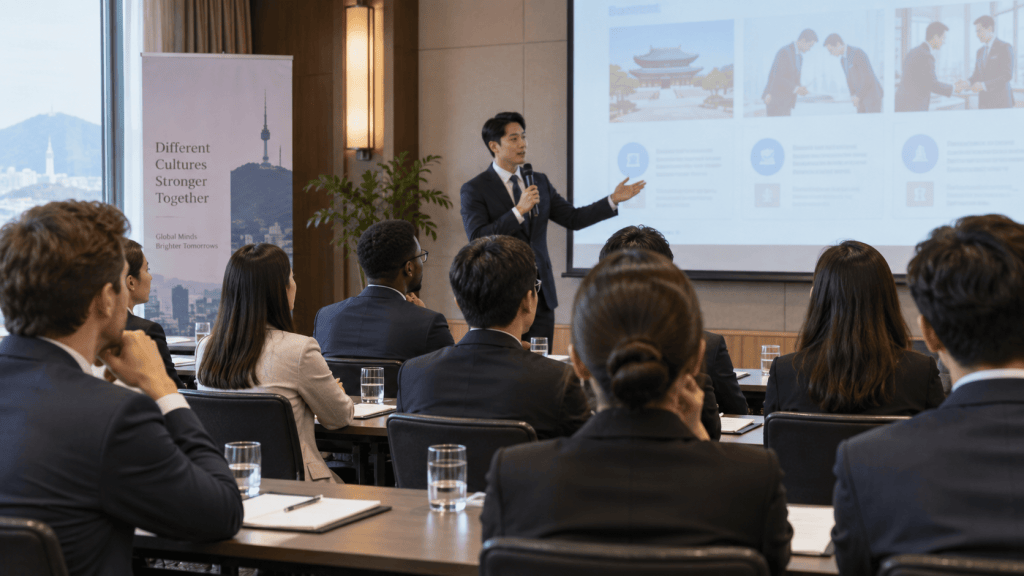
Not necessarily.
Korean business culture used to be more strongly associated with after-work drinking, but this has changed significantly. Many Korean professionals today either drink lightly or do not drink at all.
If someone offers a drink, you may accept if comfortable, but you do not have to drink.
Polite ways to decline
| Expression | Use |
|---|---|
| “Thank you, but I don’t drink.” | Direct and polite |
| “Thank you, but I’ll stay with water today.” | Soft and natural |
| “I appreciate it, but I don’t drink alcohol.” | Clear and respectful |
| “Thank you. I’m fine with tea/soft drinks.” | Friendly alternative |
The key is to decline politely, calmly, and confidently.
12. The Role of “Jeong” in Korean Relationships
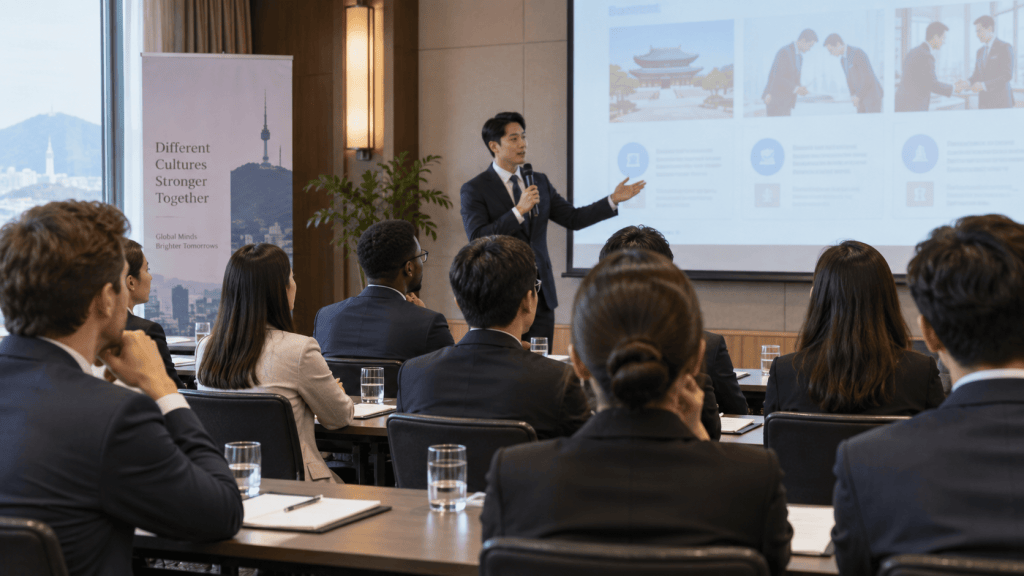
A difficult but important Korean concept is 정 (Jeong).
There is no perfect one-word English translation for it.
It can include elements of:
- Emotional warmth
- Familiarity
- Human connection
- Trust developed over time
- Loyalty and goodwill
In business, this means that Korean partners may value not only whether you are competent, but also whether you are someone they feel comfortable working with over time.
This does not mean business is irrational or purely emotional.
It means that business relationships in Korea often become stronger when professional trust is supported by human warmth.
13. How Korean Business Relationships Deepen
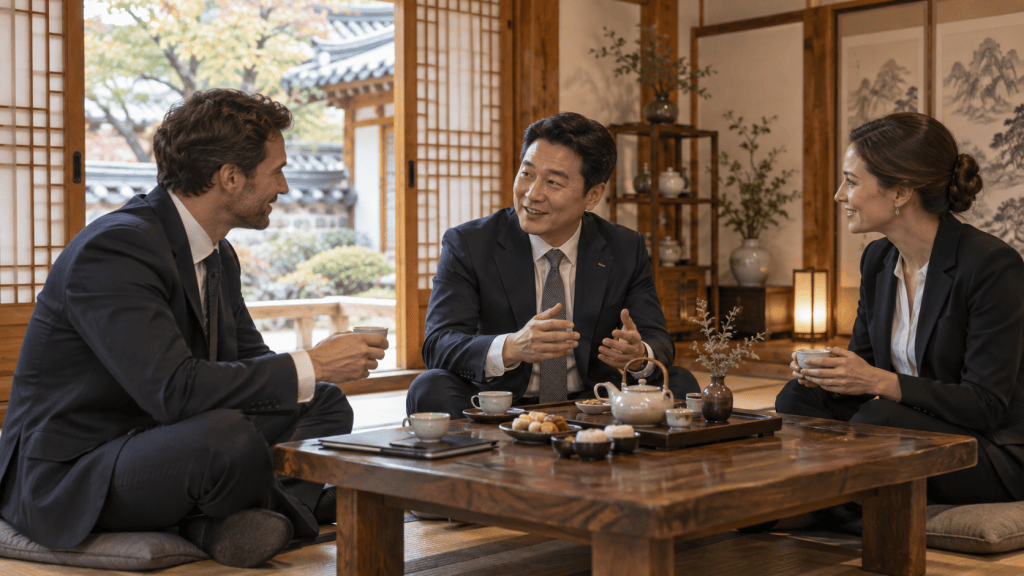
Business relationships in Korea often develop in stages.
| Stage | What It Feels Like |
|---|---|
| First contact | Formal and cautious |
| Initial meetings | Professional and polite |
| Early follow-up | Trust begins forming |
| Repeated interaction | Greater comfort and openness |
| Meal / informal interaction | Warmer relationship |
| Continued consistency | Long-term trust develops |
A foreign professional who expects instant closeness may feel frustrated.
But in Korea, trust often grows through repeated, respectful, reliable interaction.
14. Communication Channels: Email, Phone, and KakaoTalk

Foreign professionals are often surprised by how quickly Korean business communication can move between channels.
Common channels
| Channel | Typical Use |
|---|---|
| Formal documents, proposals, summaries | |
| Phone | Urgent clarification |
| Messaging apps | Fast coordination |
| KakaoTalk | Common personal/professional communication in Korea |
| In-person meeting | Relationship building and important discussions |
KakaoTalk is especially common in Korea. Some companies use it informally for business coordination, while others prefer official tools.
Best practice
Use quick channels for speed, but confirm important business matters in writing.
| Important Issue | Best Practice |
|---|---|
| Price changes | Confirm by email |
| Contract terms | Use formal documentation |
| Responsibilities | Summarize in writing |
| Timelines | Confirm clearly after verbal discussion |
15. Gift-Giving: Is It Necessary?
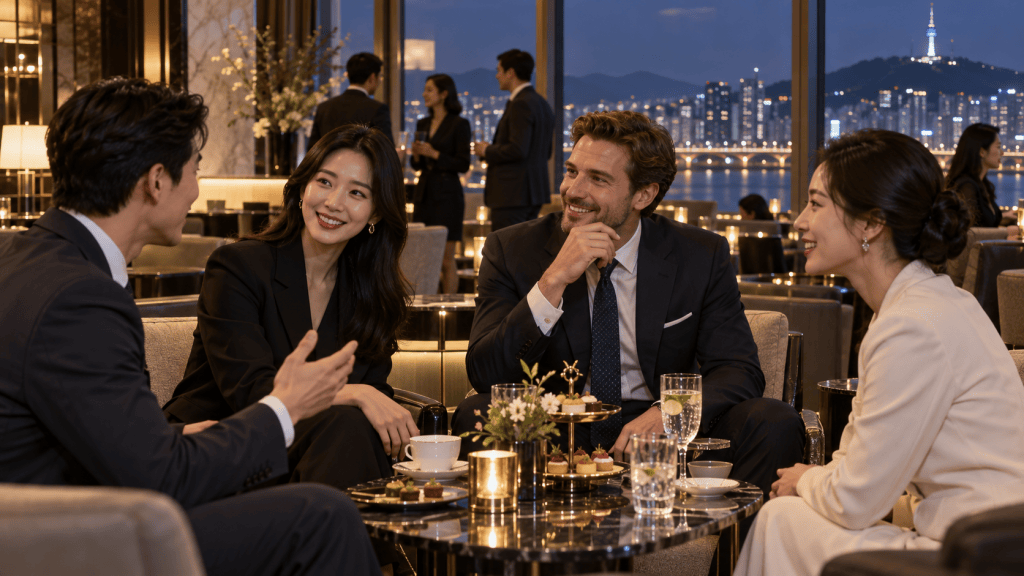
Gift-giving is not always necessary, especially in modern or multinational corporate contexts. However, in some industries or situations, a small gift may be appreciated.
Appropriate gift principles
| Guideline | Why |
|---|---|
| Keep it modest | Avoid discomfort or ethical concerns |
| Choose something thoughtful | Quality matters more than size |
| Consider your company policy | Compliance is important |
| Give respectfully | Presentation matters |
Good examples
- Small premium snacks
- Local specialty items from your country
- Branded but tasteful corporate gifts
- High-quality tea or coffee
- Simple cultural gifts
Avoid
- Very expensive gifts
- Gifts that may create ethical concerns
- Overly personal items
- Anything that may look like a bribe
When in doubt, keep it simple and professional.
16. Common Mistakes Foreign Professionals Make in Korea
| Mistake | Why It Causes Problems |
|---|---|
| Focusing only on the deal | Relationship matters too |
| Being too blunt too early | Can feel overly aggressive |
| Ignoring hierarchy | You may misread the organization |
| Assuming a meal is “just social” | It may be an important trust-building moment |
| Not following up clearly | Creates uncertainty |
| Interpreting politeness as commitment | The decision may not be final |
| Overlooking working-level staff | They often drive execution |
| Comparing Korea negatively to other countries | Can create resistance |
17. What Foreign Professionals Should Do Instead
| Best Practice | Benefit |
|---|---|
| Be respectful and calm | Creates trust |
| Learn basic etiquette | Shows cultural awareness |
| Balance warmth and efficiency | Works well in Korean settings |
| Take meals seriously | Helps relationship-building |
| Follow up quickly and clearly | Improves credibility |
| Be patient with process | Reflects professionalism |
| Respect both senior leaders and practical managers | Builds stronger business support |
| Think long-term | Aligns with Korean partnership culture |
18. Sample Situations and How to Handle Them
Situation 1: You are invited to dinner after a meeting
Meaning:
The Korean side may want to continue building familiarity and trust.
Good response:
Accept if possible and participate positively.
Why:
This may help the relationship much more than ending the interaction immediately after the meeting.

Situation 2: The meeting was polite, but no final answer was given
Meaning:
Internal review may still be needed.
Good response:
Send a professional follow-up email and ask about next steps and timing.
Why:
This shows maturity and avoids unnecessary pressure.
Situation 3: A junior employee communicates with you more than the executive
Meaning:
That person may be the key working-level contact.
Good response:
Respect them fully and build a strong working relationship.
Why:
Execution often depends on these relationships.
Situation 4: You are offered alcohol, but you do not drink
Meaning:
It is often a gesture of hospitality, not pressure.
Good response:
Decline politely and confidently.
Why:
You can maintain respect without drinking.
19. A Simple Formula for Success in Korea
A practical way to think about Korean business culture is:
Respect + Trust + Consistency + Clarity + Relationship

Respect
Show courtesy in communication, meetings, and etiquette.
Trust
Build confidence through professionalism and reliability.
Consistency
Do what you say you will do.
Clarity
Confirm next steps, timelines, and responsibilities.
Relationship
Understand that human connection often supports long-term success.
20. Final Takeaways
If you remember only a few things, remember these:
1. Business in Korea is often relationship-driven as well as result-driven.
2. Meals, introductions, and small talk can play an important business role.
3. Respect, follow-up, and reliability build trust faster than aggressive selling.
4. Korean companies may be modern and global, but etiquette and relationship skills still matter.
5. Long-term partnership is often more important than short-term transaction.
One Sentence to Remember
In Korea, successful business is built not only through good proposals, but through trust, respect, and relationships.
If you are doing business in Korea, do not ask only:
“What is the offer?”
Also ask:
“How is trust built here?”
“Who are the key people?”
“How can we become a long-term partner?”
That mindset will help you work far more effectively in the Korean business environment.
If you want, I can next turn this into one of these formats:
- a more polished blog article version
- a LinkedIn article version with a stronger title and hook
- a website post with shorter sections and cleaner layout
- an English-Korean bilingual version
And if you want, I can also create 10 related image concepts for this Topic 2 article.


Leave a Reply