
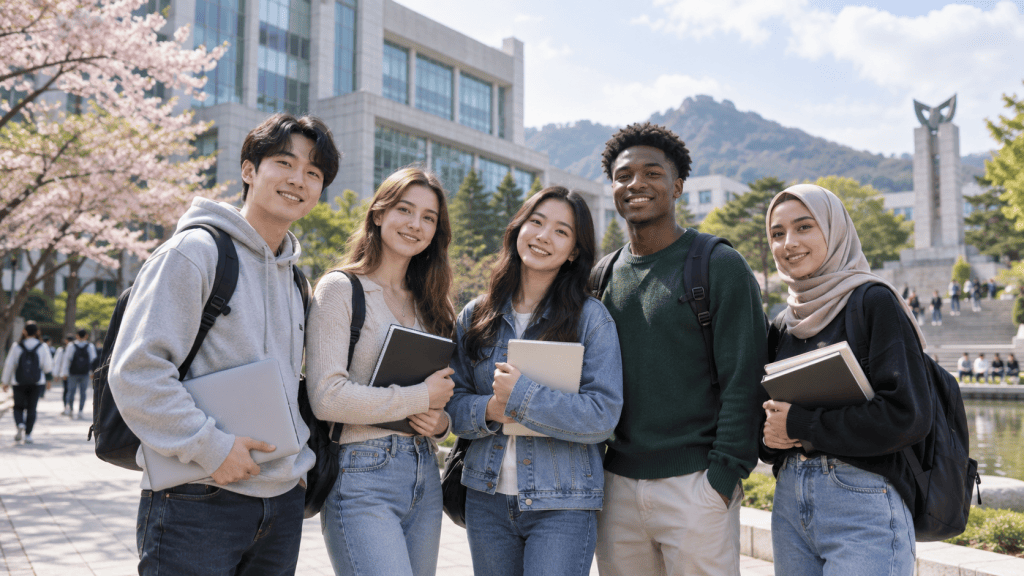
Studying in South Korea can be exciting, inspiring, and sometimes confusing.
Korean universities are known for strong academics, advanced technology, active campus life, and a highly organized education system. However, international students may discover that classroom culture, communication with professors, group projects, attendance rules, and even course registration work differently from what they are used to.
This guide will help you understand how Korean university life actually works — and how to avoid common mistakes during your first semester.
1. Understanding the Korean University Semester

Most Korean universities operate on a two-semester academic calendar.
| Semester | Typical Period | Major Events |
|---|---|---|
| Spring Semester | March – June | Orientation, midterms, festivals, finals |
| Summer Vacation | Late June – August | Summer classes, internships, travel |
| Fall Semester | September – December | Midterms, university festivals, finals |
| Winter Vacation | Late December – February | Winter classes, internships, preparation for the next semester |
Most semesters last approximately 15 to 16 weeks.
Students usually take midterm examinations around the middle of the semester and final examinations near the end.
2. Course Registration Can Be Competitive

One of the first surprises for international students is course registration.
At many Korean universities, popular courses can fill within seconds or minutes after registration opens.
Students sometimes compare the process to buying concert tickets.
What You Should Know
| Term | Meaning |
|---|---|
| 수강신청 (Sugangsinchung) | Course registration |
| 수강정정 | Course add/drop or adjustment period |
| 전공필수 | Required major course |
| 전공선택 | Major elective |
| 교양 | General education course |
| 학점 | Academic credit |
| 공강 | A period between classes when you have no class |
Tips for Successful Course Registration
Prepare your course list before registration day.
Check:
- Course number
- Professor
- Classroom
- Number of credits
- Language of instruction
- Prerequisites
- Alternative courses
It is also useful to prepare a second-choice and third-choice course in case your preferred class becomes full.
Important
Do not assume that course registration is automatically completed because you are an exchange or international student.
Procedures vary by university.
Always check your university’s international office and academic portal.
3. Attendance Is More Important Than Many Students Expect
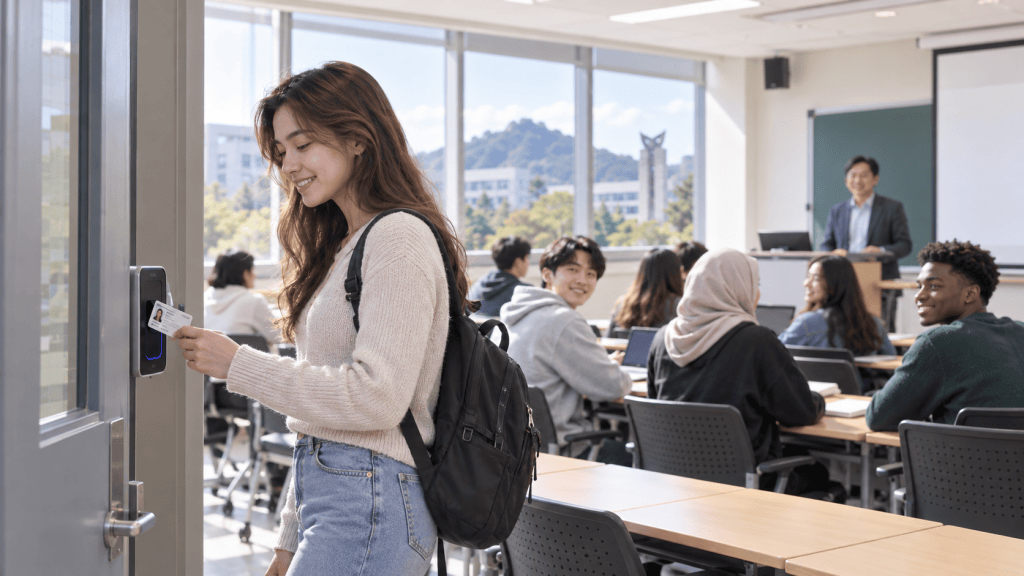
Attendance can significantly affect your grade in Korea.
Many universities monitor attendance electronically through:
- Student ID cards
- QR codes
- Mobile apps
- Online university systems
- Professor attendance checks
Repeated absences may reduce your grade or even result in failure.
Typical Attendance Situation
| Situation | Possible Result |
|---|---|
| Arriving on time | Normal attendance |
| Arriving several minutes late | May be recorded as late |
| Repeated lateness | Several late arrivals may count as one absence |
| Missing class | Absence |
| Missing too many classes | Possible automatic failure |
| Medical absence | Documentation may be required |
Exact rules vary by university and professor.
Therefore, always check the syllabus.
4. Understanding Korean University Grades

The grading system usually follows a letter-grade format.
A common example is:
| Grade | Typical GPA | General Meaning |
|---|---|---|
| A+ | 4.5 | Excellent |
| A0 | 4.0 | Excellent |
| B+ | 3.5 | Very Good |
| B0 | 3.0 | Good |
| C+ | 2.5 | Satisfactory |
| C0 | 2.0 | Satisfactory |
| D+ | 1.5 | Minimum Passing Level |
| D0 | 1.0 | Minimum Passing Level |
| F | 0 | Fail |
Some universities use a 4.3 scale instead of a 4.5 scale.
Always check your university’s official grading policy.
5. Relative Grading vs. Absolute Grading

One important concept in Korean universities is relative grading.
Relative Grading
Your performance may be evaluated partly in comparison with other students in the class.
For example, only a certain percentage of students may receive an A-range grade.
Absolute Grading
Your grade depends primarily on your own score.
| System | How It Works |
|---|---|
| Relative Grading | Your performance may be compared with classmates |
| Absolute Grading | Your grade mainly depends on your individual score |
This means that getting 90 points out of 100 does not always guarantee an A if the course uses relative grading.
6. Read the Syllabus Carefully

In Korea, the syllabus can contain information that directly affects your final grade.
Check the syllabus during the first week.
Look for:
| Item | Why It Matters |
|---|---|
| Attendance | May represent 10–20% or more of the grade |
| Midterm | Major examination |
| Final Exam | Major examination |
| Assignments | Individual or group work |
| Presentation | May significantly affect the grade |
| Participation | Speaking, discussion, class activity |
| Late Submission Policy | Late work may lose points |
| AI Policy | Rules for using ChatGPT or other AI tools |
A professor may change certain details during the semester, so check announcements regularly.
7. Midterms and Finals
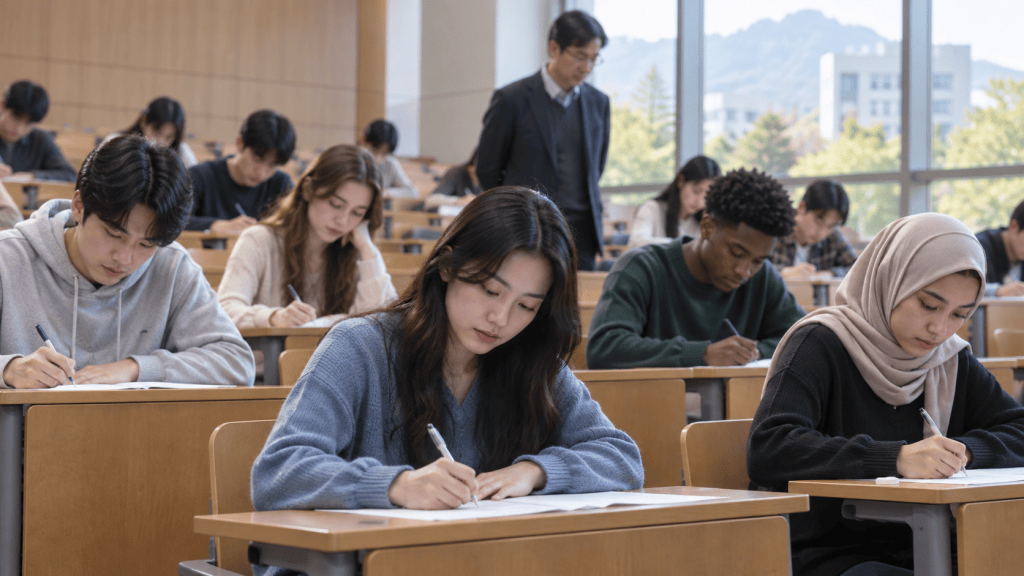
Korean university courses often include:
Midterm Examination
Usually held approximately halfway through the semester.
Final Examination
Usually held during the final week or final examination period.
Tests may include:
- Multiple-choice questions
- Short-answer questions
- Essays
- Presentations
- Open-book exams
- Project submissions
- Take-home exams
Some professors replace exams with projects or reports.
8. Group Projects: The Famous Korean “Team Project”

Group projects are extremely common in Korean universities.
The Korean word commonly used is:
팀플 (Team-play / Team Project)
International students sometimes find Korean group projects challenging because communication can happen quickly through KakaoTalk.
Typical Group Project Process
| Stage | What Usually Happens |
|---|---|
| 1 | Team members are assigned or chosen |
| 2 | A KakaoTalk group chat is created |
| 3 | Roles are divided |
| 4 | Research is conducted |
| 5 | PPT slides are created |
| 6 | Presentation practice |
| 7 | Final presentation |
| 8 | Peer evaluation may be conducted |
9. How to Be a Good Team Member

In Korean group projects, reliability is extremely important.
Try to:
- Respond to group messages
- Attend meetings
- Complete your assigned work
- Meet deadlines
- Inform teammates early if there is a problem
- Participate in presentation preparation
One of the fastest ways to create frustration in a Korean team project is to disappear from the group chat and respond only shortly before the deadline.
Even if your Korean is limited, active communication is usually appreciated.
10. KakaoTalk Is Almost Essential
KakaoTalk is the dominant messaging platform used in Korean university life.
Students may use KakaoTalk for:
- Group projects
- Club activities
- Department announcements
- Social gatherings
- Study groups
- Class communication
A group chat is commonly called:
단톡방 — Group Chat Room
It is a good idea to create a KakaoTalk account soon after arriving in Korea.
11. How to Communicate With Korean Professors
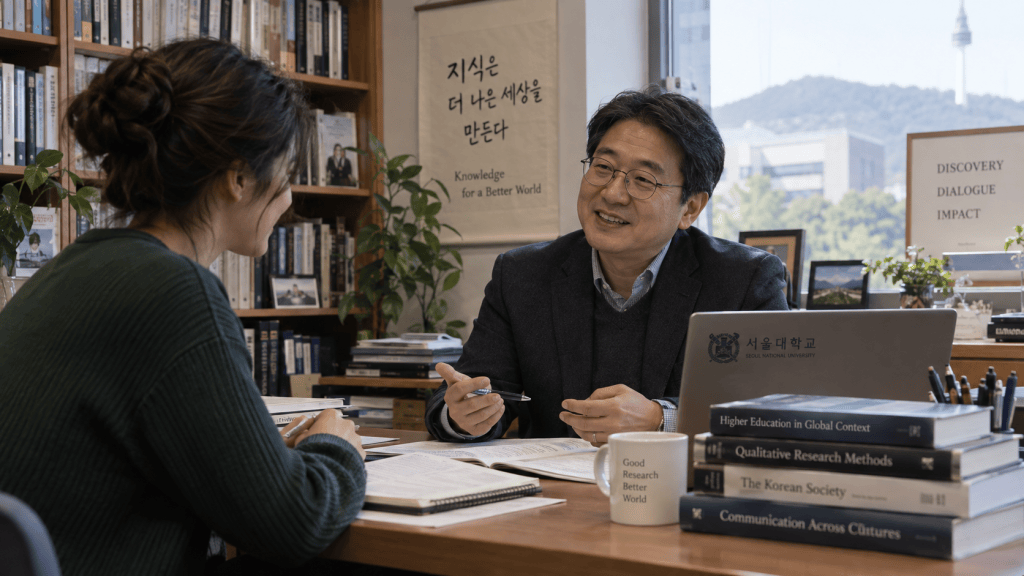
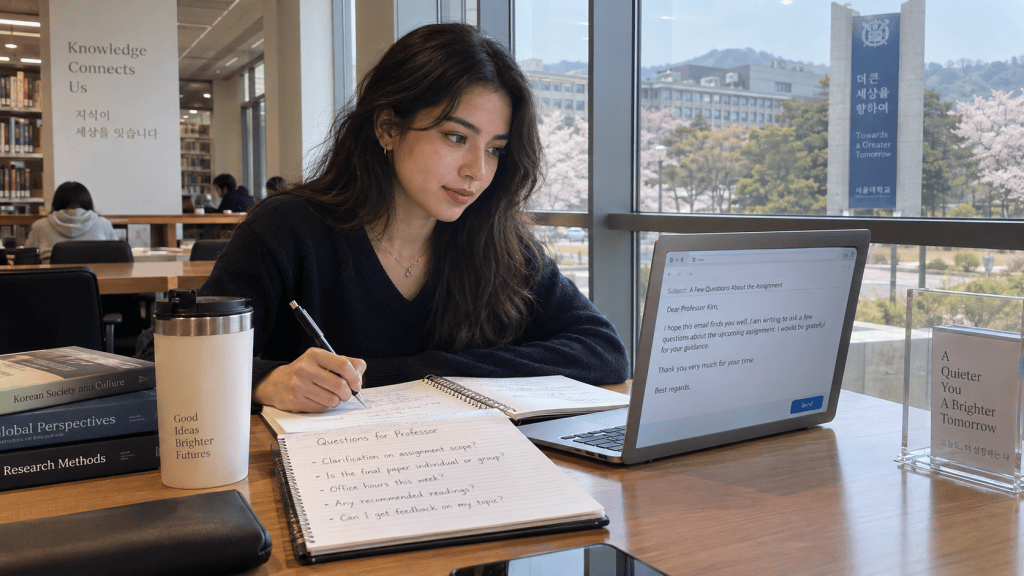
Communication with professors in Korea tends to be polite and relatively formal.
When emailing a professor, avoid writing something like:
“Hi, I missed class. What did I miss?”
Instead, use a respectful structure.
Recommended Email Structure
| Part | Example |
|---|---|
| Greeting | Dear Professor Kim, |
| Introduction | My name is Alex Smith from your International Marketing class. |
| Reason | I am writing to ask about… |
| Request | Would it be possible to… |
| Closing | Thank you for your time and consideration. |
| Name | Alex Smith |
12. Example Email to a Professor
Subject: Question Regarding International Marketing Assignment
Dear Professor Kim,
My name is Alex Smith, and I am an international student in your International Marketing course.
I am writing to ask for clarification regarding the assignment due next Friday.
Could you please confirm whether the final report should be submitted individually or as a group?
Thank you very much for your time.
Best regards,
Alex Smith
13. Professor Titles Matter
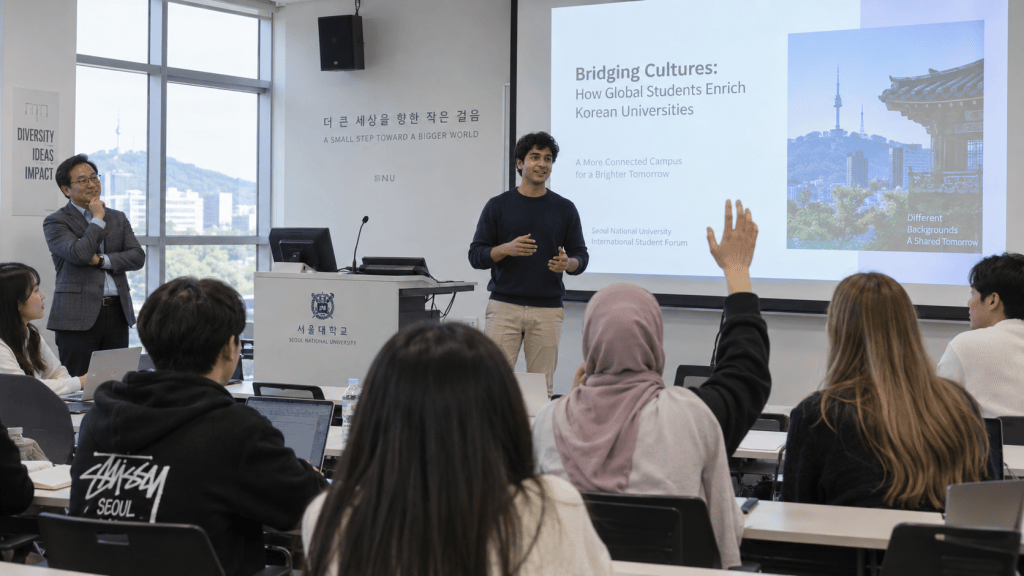
It is usually safer to address your professor as:
Professor + Family Name
For example:
Professor Kim
Professor Lee
Professor Park
In Korean:
교수님 (Gyosu-nim)
The suffix -nim is an honorific.
Avoid immediately calling professors by their first names unless the professor specifically tells students to do so.
14. Office Hours and Professor Meetings
Professors may offer office hours or meetings by appointment.
Students can request meetings regarding:
- Academic questions
- Research
- Assignments
- Career advice
- Graduate school
- Recommendation letters
Always request an appointment politely rather than appearing unexpectedly whenever possible.
15. Assignments and Reports
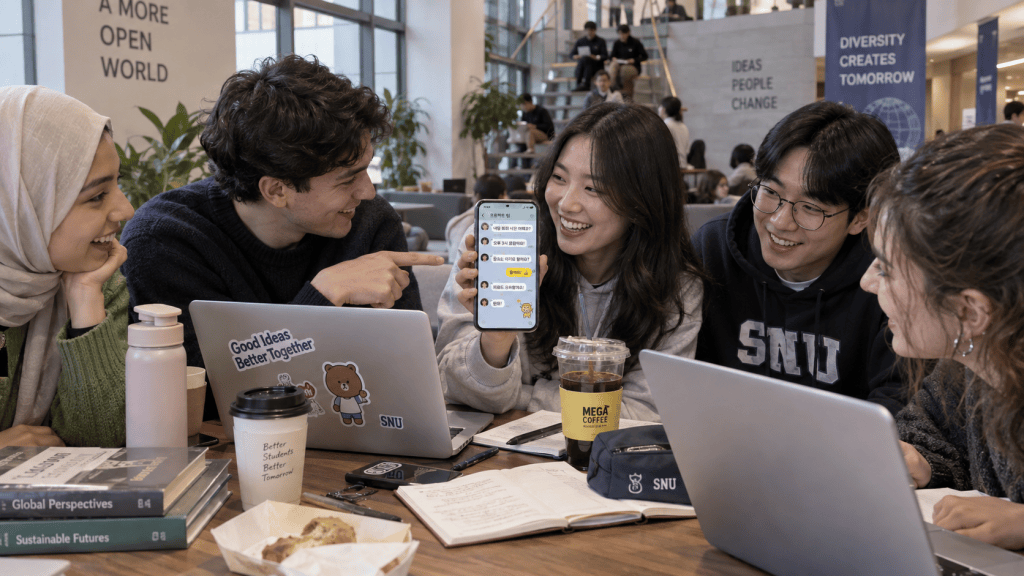
Common assignments include:
- Essays
- Research reports
- Case studies
- PowerPoint presentations
- Reflection papers
- Group projects
- Field research
- Online discussion posts
Professors may have specific expectations regarding:
- Font size
- Page length
- Citation format
- Cover page
- File format
- Submission method
Follow these instructions carefully.
16. Plagiarism Is a Serious Academic Issue
Copying text without attribution can create serious problems.
This includes content from:
- Websites
- Books
- Academic papers
- Blogs
- Other students
- AI-generated material
Even translated content can potentially constitute plagiarism if the original source is not properly acknowledged.
Safe Academic Practice
Always clearly distinguish between:
- Your own ideas
- Paraphrased ideas
- Direct quotations
- Data
- AI-assisted content
- External sources
Use the citation style required by your course.
17. Using ChatGPT and Generative AI
AI tools are increasingly used by university students, but rules differ significantly between professors.
Some professors allow AI for:
- Brainstorming
- Language correction
- Translation
- Research organization
Others may prohibit AI-generated assignments.
Before Using AI
Ask yourself:
| Question | Why It Matters |
|---|---|
| Does the professor allow AI? | Course policies vary |
| Must AI use be disclosed? | Some courses require disclosure |
| Did I verify the facts? | AI can make errors |
| Did I rewrite the content in my own understanding? | Academic integrity matters |
| Did I cite required sources? | AI is not a substitute for academic references |
Never assume AI use is automatically acceptable.
18. Presentation Culture in Korean Universities
Presentations are common in Korean university courses.
Students often prepare highly visual PowerPoint presentations.
A typical presentation may include:
- Introduction
- Topic overview
- Research
- Analysis
- Case examples
- Conclusion
- Q&A
Presentation appearance can sometimes matter almost as much as content.
Korean students often spend significant time making slides visually organized and professional.
19. What Happens During Q&A?
After a presentation, the professor or classmates may ask questions.
Useful phrases include:
“That’s a very interesting question.”
“Based on our research…”
“We did not specifically examine that issue, but…”
“Could you please clarify your question?”
You do not need to know every answer.
It is usually better to admit that something was outside the scope of your research than to invent an answer.
20. Understanding Korean Classroom Culture
Korean classroom culture has changed significantly and varies by university and professor.
However, international students may notice that some students are relatively quiet during lectures.
Silence does not necessarily mean that students are uninterested.
Students may prefer asking questions:
- After class
- Through email
- During office hours
- Through online university systems
International students should not be afraid to participate, but it is useful to observe each professor’s classroom style.
21. Korean University Vocabulary You Should Know
Here are useful words you may hear constantly.
| Korean | Pronunciation | Meaning |
|---|---|---|
| 학기 | Hakgi | Semester |
| 학점 | Hakjeom | Academic credit / GPA |
| 수강신청 | Sugangsinchung | Course registration |
| 전공 | Jeongong | Major |
| 교양 | Gyoyang | General education |
| 과제 | Gwaje | Assignment |
| 시험 | Siheom | Exam |
| 중간고사 | Junggangosa | Midterm exam |
| 기말고사 | Gimalgosa | Final exam |
| 출석 | Chulseok | Attendance |
| 결석 | Gyeolseok | Absence |
| 지각 | Jigak | Late arrival |
| 휴강 | Hyugang | Class cancellation |
| 보강 | Bogang | Make-up class |
| 공강 | Gonggang | Free period between classes |
| 팀플 | Timpeul | Team project |
| 발표 | Balpyo | Presentation |
| 학식 | Haksik | Campus cafeteria meal |
| 과방 | Gwabang | Department student room |
| 동아리 | Dongari | Student club |
22. “공강” — The Famous Free Period
You may quickly hear Korean students say:
“오늘 공강이야.”
It means:
“I don’t have class today.”
Or:
“I have a free period.”
Students often use 공강 time to:
- Study
- Visit cafés
- Eat
- Meet friends
- Work on assignments
- Sleep in the library lounge
- Prepare group projects
23. University Libraries
Korean university libraries can be excellent study environments.
Many provide:
- Individual study desks
- Group study rooms
- Computers
- Printing facilities
- Electronic journals
- Academic databases
- Cafés
- 24-hour study areas during exams
During midterm and final examination periods, popular seats may fill very quickly.
24. Campus Cafeterias
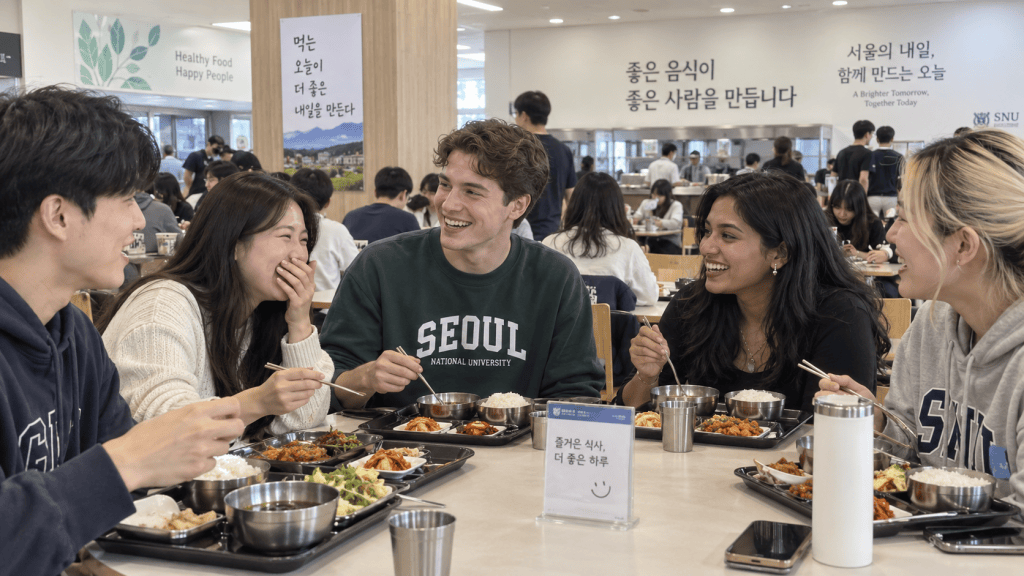
The university cafeteria is usually called:
학생식당 or 학식
Campus meals are often cheaper than restaurants outside the university.
Meals commonly include:
- Rice
- Soup
- Kimchi
- Main dish
- Side dishes
Menus may change daily.
International students should check whether vegetarian, halal, or allergy-friendly options are available at their university.
25. Student Clubs Can Transform Your Korean Experience
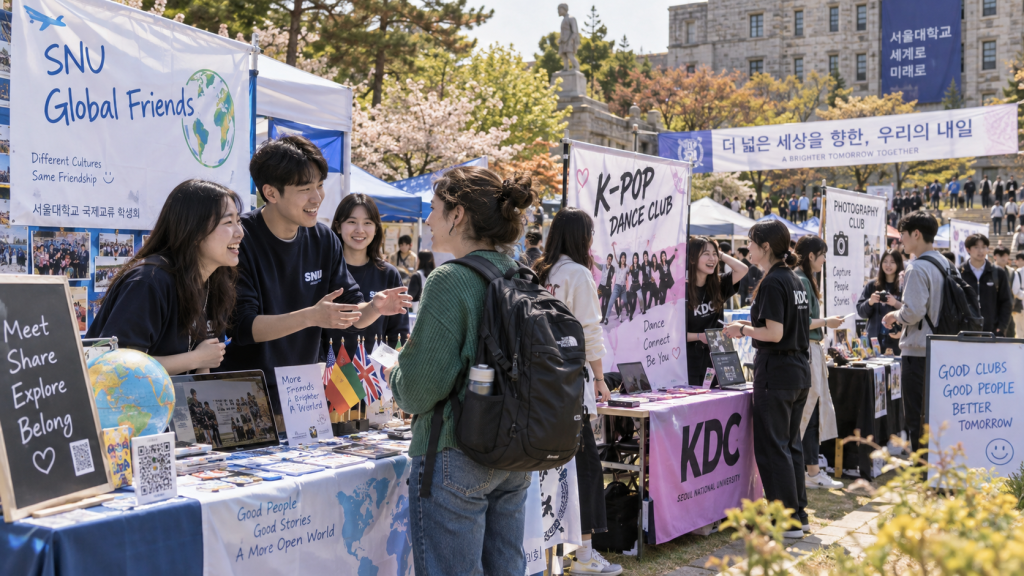
Student clubs are called:
동아리 (Dongari)
Joining a club can be one of the easiest ways to meet Korean students.
Popular clubs include:
- Sports
- Music
- Dance
- Photography
- Travel
- Volunteering
- Debate
- Business
- Entrepreneurship
- Language exchange
International students who only attend classes may find it harder to develop close friendships with Korean students.
Joining activities outside the classroom can make a major difference.
26. Don’t Ignore University Announcements
Important information may be posted through:
- University portal
- Department website
- KakaoTalk
- LMS
- International student office
Announcements may include:
- Scholarship deadlines
- Course changes
- Visa information
- Graduation requirements
- Exam schedules
- Internship opportunities
Checking university announcements regularly is an important habit.
27. Academic Warning
Students with very low grades may receive an academic warning.
In Korean, this is:
학사경고
Repeated academic warnings may affect:
- Scholarships
- Student status
- Graduation
- Visa-related academic requirements
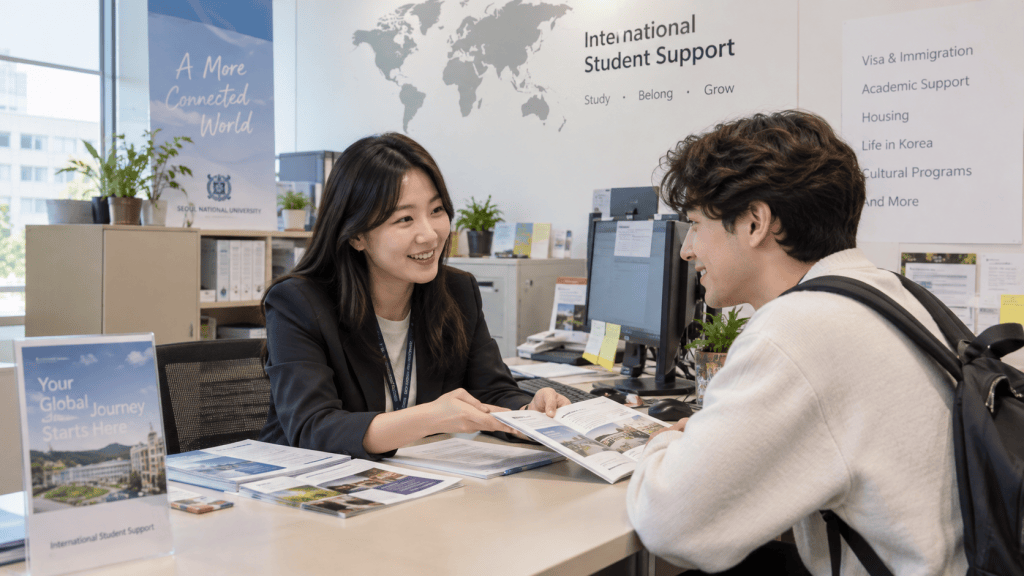
If you are struggling academically, contact your academic advisor or international student office early.
28. Asking for Help Is Normal
If you experience academic difficulties, there are usually several places you can ask for help.
| Problem | Where to Ask |
|---|---|
| Course registration | Academic Affairs Office |
| Visa or immigration | International Office |
| Language difficulty | Korean Language Center |
| Academic difficulty | Professor or Academic Advisor |
| Emotional stress | University Counseling Center |
| Housing | Dormitory Office |
| Scholarship | International Office / Scholarship Office |
| Career | University Career Center |
Do not wait until the situation becomes serious.
29. Common Mistakes International Students Should Avoid
1. Ignoring attendance
Attendance may directly affect your grade.
2. Missing course registration deadlines
Courses may become unavailable.
3. Not checking KakaoTalk
Important team-project messages may be missed.
4. Copying material from the internet
This may be considered plagiarism.
5. Assuming AI-generated work is automatically allowed
Check the professor’s policy.
6. Sending overly casual messages to professors
Use polite and professional communication.
7. Staying silent during team projects
Communicate even if your Korean is limited.
8. Waiting until the deadline to ask questions
Ask early when possible.
9. Only spending time with students from your home country
International friendships are valuable, but interacting with Korean students can greatly improve your experience.
10. Being afraid of making mistakes
Korean university life becomes much easier once you understand how the system works.
30. Survival Checklist for Your First Month

Use this checklist during your first month in Korea.
| Task | Check |
|---|---|
| Complete university registration | □ |
| Confirm course registration | □ |
| Check your university portal | □ |
| Download KakaoTalk | □ |
| Learn how the LMS works | □ |
| Check attendance policies | □ |
| Read every course syllabus | □ |
| Locate the university library | □ |
| Locate the international office | □ |
| Learn your professor’s contact method | □ |
| Join at least one student activity | □ |
| Understand assignment deadlines | □ |
| Check academic calendar | □ |
| Learn basic Korean campus vocabulary | □ |
31. Ten Useful Korean Expressions for Campus Life
| Korean | English |
|---|---|
| 안녕하세요, 교수님. | Hello, Professor. |
| 질문이 있습니다. | I have a question. |
| 다시 설명해 주실 수 있나요? | Could you explain that again? |
| 과제 마감일이 언제인가요? | When is the assignment deadline? |
| 팀 미팅은 언제 할까요? | When should we have our team meeting? |
| 제가 이 부분을 맡겠습니다. | I will take this part. |
| 자료를 공유해 주세요. | Please share the materials. |
| 오늘 수업이 휴강인가요? | Is today’s class cancelled? |
| 시험 범위가 어디까지인가요? | What material will be covered on the exam? |
| 감사합니다. | Thank you. |
32. Your First Semester Strategy
If you are starting university in Korea, focus on five things:
First, understand the system.
Learn how course registration, attendance, grading, and assignments work.
Second, communicate.
Ask professors and classmates when you do not understand something.
Third, participate.
Join clubs, group projects, language exchanges, and campus events.
Fourth, manage your deadlines.
Korean university semesters can become extremely busy around midterms and finals.
Fifth, enjoy the experience.
Studying abroad is not only about grades. It is also about learning a new culture, building relationships, and discovering a different way of life.
Final Advice for International Students
Your first few weeks at a Korean university may feel overwhelming.
You may encounter unfamiliar systems, new social rules, language barriers, and different academic expectations.
That is completely normal.
The key is to learn how the university works as early as possible.
Check announcements.
Read your syllabus.
Communicate with your professors.
Respond to your teammates.
Ask questions.
And most importantly, take advantage of the opportunity to experience Korea both inside and outside the classroom.
A successful study-abroad experience in Korea is not simply about surviving university.
It is about learning how to study, communicate, build relationships, and grow in an entirely new environment.
Welcome to university life in Korea — and enjoy your academic journey!


Leave a Reply