

A Practical Guide to Korean Business Communication
Doing business in Korea can be highly rewarding, but it can also be confusing for foreign executives, managers, and business travelers.
One of the biggest challenges is that understanding the words alone may not always be enough.
In Korean business culture, communication can sometimes be influenced by:
- Context
- Relationships
- Hierarchy
- Respect
- Face-saving
- Internal approval processes
- Speed of execution
This does not mean that all Koreans communicate indirectly or that every Korean company works the same way. Korean companies vary significantly depending on industry, generation, company size, leadership style, and global experience.
However, understanding several common communication patterns can help foreign professionals avoid unnecessary misunderstandings.
The most important principle is simple:
In Korean business, do not only ask, “What did they say?” Also ask, “What did they mean, who decides, and what happens next?”
1. Does “Yes” Really Mean Yes?

One of the first expressions foreign professionals encounter in Korea is:
“네.” — Ne. — Yes.
But “네” can carry several different meanings depending on the situation.
It may mean:
- Yes, I agree.
- Yes, I understand.
- Yes, I heard you.
- Yes, I acknowledge what you said.
- Okay, I will check.
- Okay, I understand your request.
That is why hearing “yes” does not always mean that a final decision has been made.
| Korean Expression | What a Foreigner May Hear | What It May Actually Mean | What You Should Confirm |
|---|---|---|---|
| 네 | Yes, I agree | I heard you / I understand | “So, are we agreed on this?” |
| 네, 알겠습니다 | Yes, I agree | I understand what you are asking | “Can we proceed with this plan?” |
| 좋습니다 | Approved | Sounds good, but approval may still be required | “Is this officially approved?” |
| 그렇게 하시죠 | Let’s do it | Strong agreement to proceed | Confirm responsibilities and dates |
| 한번 해보죠 | We will do it | Let’s try it | Confirm scope and commitment |
| 고려해 보겠습니다 | We will consider it | No decision yet | Ask when a decision is expected |
| 검토해 보겠습니다 | We will review it | Internal review is needed | Ask about the review process |
| 생각해 보겠습니다 | I will think about it | Could mean hesitation or delay | Agree on a follow-up date |
The Key Difference
Always distinguish between:
Understanding → Agreement → Commitment
These are three different stages.
Someone may understand your proposal without agreeing to it.
Someone may agree with the idea without having the authority to approve it.
And someone may approve the concept while still needing internal approval before implementation.

2. “We Will Review It” Does Not Mean the Deal Is Done
Imagine this situation.
You have just finished an excellent presentation to a Korean company.
The senior manager says:
“This looks very good. We will review it internally.”
You return to your hotel thinking:
“The meeting went extremely well. The deal is almost done.”
Maybe.
But not necessarily.
“We will review it” may simply mean that the proposal now has to go through internal discussions, budget reviews, procurement procedures, legal reviews, IT security checks, or senior-management approval.
How Strong Are Common Korean Business Expressions?
| Expression | General Level of Commitment | Possible Meaning |
|---|---|---|
| We will actively move forward with this | ★★★★★ | Strong intention to proceed |
| Let’s proceed this way | ★★★★★ | Close to an execution decision |
| This looks like a good direction | ★★★★☆ | Positive, but more review may be needed |
| We will discuss it internally | ★★★☆☆ | Decision has not been made |
| We will review it | ★★★☆☆ | Still under consideration |
| We need more time to think | ★★☆☆☆ | Hesitation or delay |
| It may be difficult at the moment | ★☆☆☆☆ | Could be a soft rejection |
| Perhaps we can discuss this another time | ★☆☆☆☆ | Low likelihood of immediate progress |
These ratings are only a guide to linguistic nuance. Never assume intent based only on one phrase.
The better approach is to ask:
“What would be the next step in your internal review process?”
or:
“When would be a good time for us to follow up?”
3. Why Do Koreans Sometimes Avoid Saying “No” Directly?
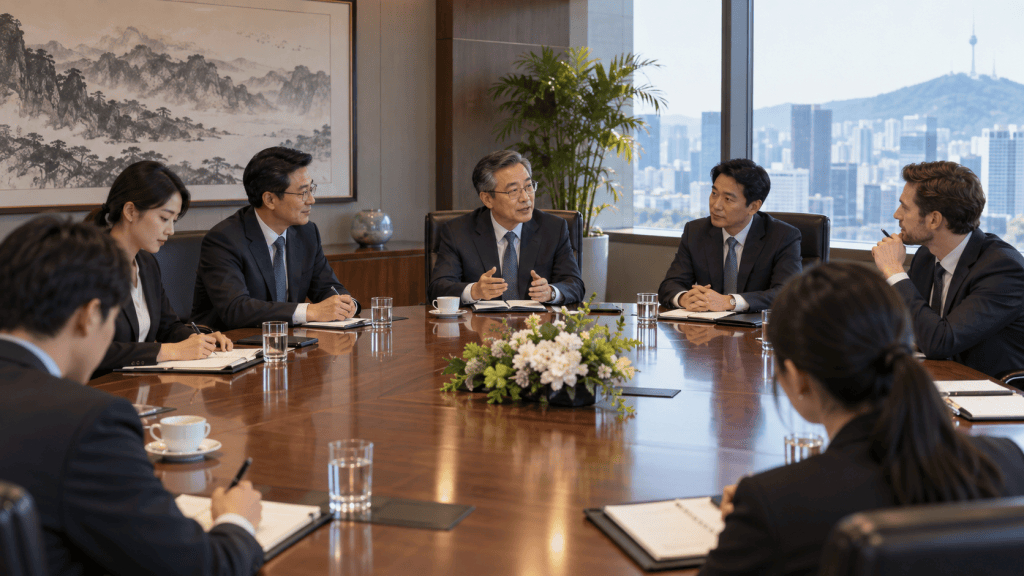
In many business situations, maintaining the relationship is considered important.
For that reason, some Korean professionals may prefer to express disagreement or rejection indirectly rather than giving a direct “No.”
This is especially common:
- With new business partners
- With customers
- In hierarchical organizations
- In formal meetings
- When someone wants to avoid embarrassing another person publicly
Common Soft-Rejection Expressions
| Expression | Literal Meaning | What You Should Consider |
|---|---|---|
| It may be a little difficult | It is somewhat difficult | It may actually be very difficult |
| It may not be easy at the moment | There may be some difficulty | It may not be possible right now |
| We need more internal review | More discussion is required | The decision may be delayed |
| The situation is difficult this time | There are some challenges | The proposal may be rejected |
| Perhaps we can discuss it another time | Let’s talk later | There may be little interest at present |
| It is a good proposal, but… | The idea is good | Pay close attention to what follows “but” |
| We understand your position | We understand your intention | Understanding does not equal agreement |
Instead of forcing a yes-or-no answer, try to identify the real obstacle.
For example:
“Is the main issue the budget, timing, internal approval, or the proposal itself?”
This makes it easier for the other person to explain the real concern.
4. Nobody Disagreed in the Meeting. Does That Mean Everyone Agreed?

Not necessarily.
In some Korean organizations, employees may feel uncomfortable openly disagreeing with a senior executive during a formal meeting.
Consider this example.
A senior executive says:
“Why don’t we launch this project in October?”
Nobody objects.
A foreign participant may conclude:
“Everyone agreed.”
But some employees may be thinking:
- The timeline is too aggressive.
- The budget has not been approved.
- The IT team has not been consulted.
- The client has not confirmed the schedule.
- The operations team does not have enough resources.
Silence may therefore mean many things.
Ask Questions That Make It Easier to Raise Concerns
| Less Effective Question | Better Question |
|---|---|
| Everyone agrees, right? | Does anyone see any potential risks? |
| Is there any problem? | What challenges should we anticipate? |
| Can you do it? | What would you need to make this possible? |
| Why didn’t you say that earlier? | Is there anything we should discuss before moving forward? |
The goal is not to force someone to disagree.
The goal is to create a safe way for people to raise practical concerns.
5. Silence Does Not Always Mean Lack of Interest
Foreigners sometimes interpret silence in a meeting as:
“They are not interested.”
But silence can have many different meanings.

| Possible Reason for Silence | What May Be Happening |
|---|---|
| Listening carefully | Participants want to hear the full presentation first |
| Thinking before responding | They may prefer to organize their thoughts |
| Speaking in a second language | They may need time to formulate an English response |
| Waiting for a senior person | Hierarchy may affect who speaks first |
| Avoiding public disagreement | They may prefer to raise concerns later |
| Internal discussion is needed | Multiple departments may be involved |
| Genuine lack of interest | This is also possible |
The key lesson is:
Do not interpret silence too quickly.
You may receive more detailed and honest feedback later by email, in a smaller meeting, or in a one-on-one conversation.
6. Understanding Titles Helps You Understand the Meeting
When meeting a Korean company, knowing someone’s name is useful.
Knowing their role can be even more useful.
Traditional Korean companies may use titles such as:
| Korean Title | Common English Equivalent | Typical Role |
|---|---|---|
| 대표이사 | CEO / President | Chief executive |
| 부사장 | Executive Vice President | Senior executive |
| 전무 | Executive Director / EVP | Executive |
| 상무 | Managing Director / VP | Executive |
| 본부장 | Division Head | Leads a major division |
| 실장 | Head / Director | Functional leader |
| 부장 | General Manager | Department manager |
| 팀장 | Team Leader | Leads a team |
| 차장 | Deputy General Manager | Mid-level manager |
| 과장 | Manager | Operational manager |
| 대리 | Assistant Manager | Working-level professional |
| 사원 | Staff / Associate | Working-level employee |
However, many Korean companies today have simplified their title systems.

Some use:
- Manager
- Professional
- Partner
- English names
- First-name culture
- “Nim,” an honorific suffix
Therefore, do not focus too heavily on the title itself.
Focus on the decision-making structure.
7. Identify These Four People
When doing business with a Korean organization, try to identify four roles.
| Role | Meaning | Why It Matters |
|---|---|---|
| Decision Maker | Final authority | Approves budget or contract |
| Influencer | Shapes the decision | Can strongly affect internal opinion |
| Working-Level Manager | Handles execution | Makes the project actually happen |
| Gatekeeper | Controls access and information | Connects you to key stakeholders |
A foreign CEO may build an excellent relationship with a working-level manager.
That is valuable.
But it does not necessarily mean the contract has been approved.
The opposite mistake is also common: focusing only on executives and ignoring working-level employees.
That can also create problems.
In Korea, successful business relationships often require respect for both senior decision-makers and working-level professionals.
8. Avoid Publicly Embarrassing Someone

Saving face can still matter in Korean business culture.
Imagine that you notice an error in a presentation during a meeting with ten people.
You could say:
“This number is wrong.”
That may be factually correct, but it can sound unnecessarily confrontational.
A softer approach might be:
“Could we double-check this figure?”
or:
“I may be missing something, but could we review this number together?”
Useful Alternatives
| Situation | Very Direct | More Diplomatic |
|---|---|---|
| A number is incorrect | This is wrong | Could we double-check this figure? |
| You disagree | I disagree | I see it a little differently |
| The proposal seems unrealistic | That’s impossible | That could be challenging under the current conditions |
| You do not understand | I don’t understand | Could you walk me through that part again? |
| The schedule is unrealistic | We can’t do that | Could we explore an alternative timeline? |
The objective is not to avoid disagreement.
It is to solve the problem without unnecessarily damaging the relationship.
9. Understand Korea’s “Ppalli-Ppalli” Speed
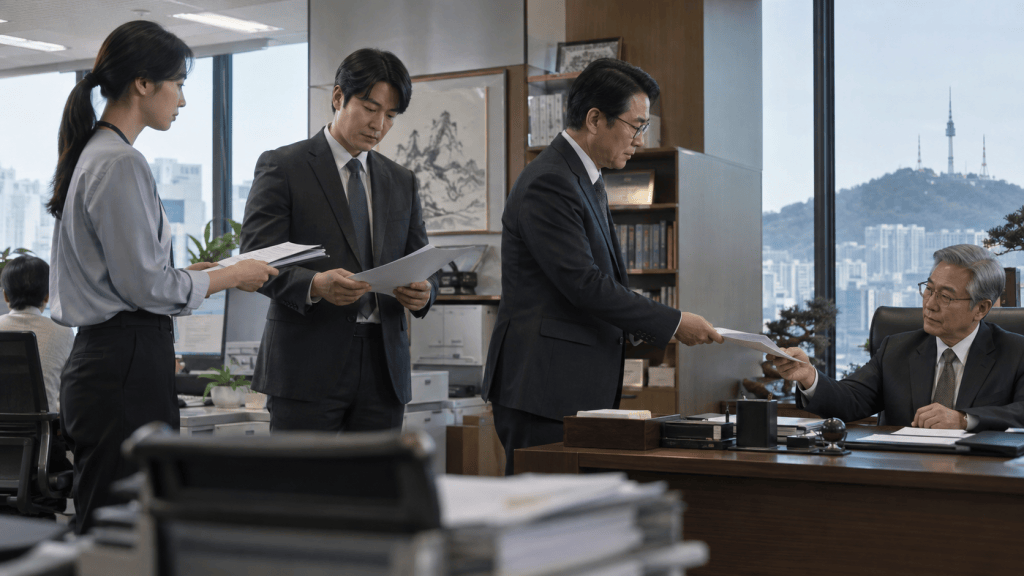
One expression often associated with Korea is:
“빨리빨리 — ppalli-ppalli”
It means:
“Quickly, quickly.”
Korean business culture is often known for fast execution.
Companies may expect quick responses regarding:
- Quotations
- Revised presentations
- Samples
- Customer requests
- Pricing
- Schedules
- Documents
- Technical questions
A request received in the afternoon may sometimes be expected by the next morning.
But fast does not mean careless.
The best formula is:
Speed + Accuracy + Communication
Weak Response
“Okay.”
Then no communication for 24 hours.
Better Response
“We can send the revised version by 10:00 a.m. tomorrow.”
Even when you cannot complete something immediately, giving a clear delivery time creates confidence.
10. Email May Not Be the Only Communication Channel

Depending on the company and the relationship, Korean professionals may use multiple communication channels.
| Channel | Typical Use |
|---|---|
| Contracts, proposals, official documents, records | |
| Phone | Urgent questions and quick clarification |
| KakaoTalk | Quick coordination and schedule confirmation |
| Video Meeting | Overseas meetings and project discussions |
| Face-to-Face Meeting | Important negotiations and relationship building |
KakaoTalk is particularly common in Korea, although company policies vary.
For important issues such as:
- Pricing
- Contract terms
- Project scope
- Deadlines
- Changes in responsibility
it is wise to confirm the final agreement in writing, usually by email or formal documentation.
11. A Slow Response Does Not Always Mean Rejection

Korean companies can move extremely quickly.
They can also move slowly when internal approval is required.
A decision may need to move through several levels:
Working-Level Employee → Team Leader → Department Head → Executive → Related Departments
Some issues naturally require more time.
Examples include:
- New contracts
- Large budgets
- Vendor registration
- Price changes
- Legal review
- IT security review
- Personal-data compliance
- Major purchases
- Long-term partnerships
So if you do not receive an immediate reply, do not automatically assume:
“They are not interested.”
A polite follow-up is usually better than guessing.
12. The Best Way to Follow Up After a Meeting

After an important business meeting in Korea, send a short summary email.
Include these five items:
| Item | What to Include |
|---|---|
| Thank You | Thank participants for the meeting |
| Key Points | Summarize major discussion topics |
| Agreement | Confirm what was agreed |
| Action Items | Clarify who will do what |
| Timeline | Confirm deadlines and next meeting |
For example:
“Today, we agreed on the following three points…”
This simple step can prevent many misunderstandings.
13. Common Mistakes Foreign Professionals Should Avoid
| Mistake | Why It Can Cause Problems |
|---|---|
| Being overly direct from the first meeting | It may feel unnecessarily confrontational |
| Ignoring titles and roles | You may misunderstand the decision structure |
| Ignoring working-level staff | They are often essential to project execution |
| Treating silence as agreement | Participants may still have concerns |
| Treating “yes” as final approval | Agreement and commitment may differ |
| Correcting someone publicly and harshly | It may create embarrassment |
| Demanding an immediate answer | Internal approval may be required |
| Failing to summarize the meeting | Different interpretations may remain |
14. What You Should Do Instead
| DO | Why It Works |
|---|---|
| Identify titles and roles | Helps you understand the decision process |
| Confirm important points | Reduces cultural and language misunderstandings |
| Send a post-meeting summary | Creates a shared record |
| Respect working-level employees | They often drive execution |
| Disagree diplomatically | Protects both the relationship and the discussion |
| Confirm exact dates | Avoids vague expectations |
| Ask open-ended questions | Encourages honest feedback |
| Think long-term | Korean business relationships often develop over time |
15. Ten Korean Business Words Worth Knowing

Even when meetings are conducted in English, you may hear these Korean terms.
| Korean | Meaning | Business Significance |
|---|---|---|
| 회의 | Meeting | Formal or informal discussion |
| 보고 | Report | Reporting progress to a superior |
| 결재 | Approval | Formal internal approval |
| 검토 | Review | Often means the decision is not final |
| 협의 | Consultation / Discussion | Coordination between stakeholders |
| 공유 | Sharing | Distributing information |
| 일정 | Schedule | Timing and deadlines |
| 담당자 | Person in Charge | Working-level contact |
| 대표님 | CEO / President | Respectful title for the top executive |
| 팀장님 | Team Leader | Respectful title for a team leader |
One term is especially important:
결재 — Approval
A working-level employee may genuinely like your proposal.
But if the internal approval process has not been completed, the deal may still not be final.
16. Three Realistic Business Scenarios
Case 1: “This Looks Good”
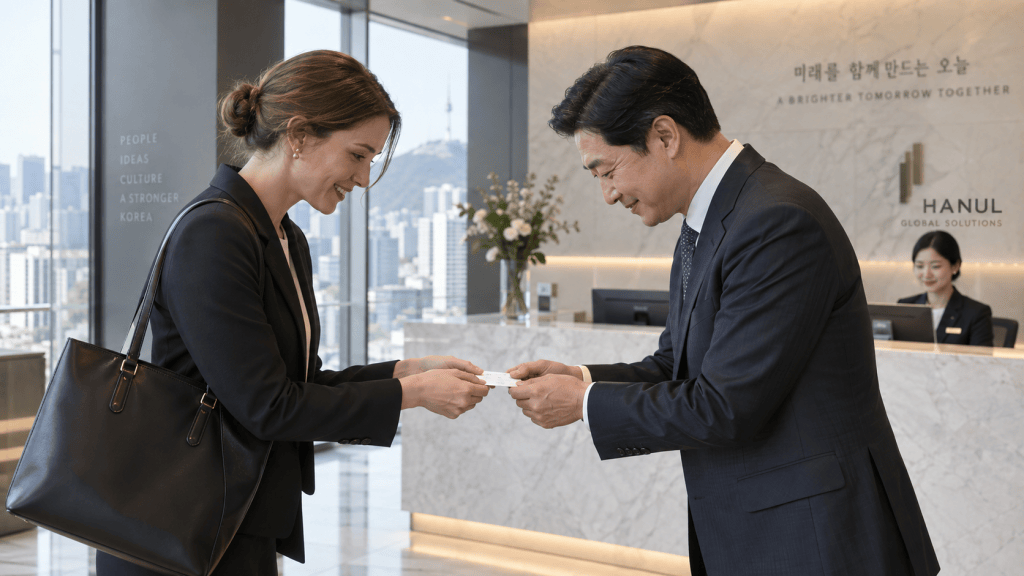
A U.S. company presents a new service to a Korean client.
At the end of the meeting, the Korean executive says:
“This looks good. We will review it internally.”
The U.S. company assumes the contract is nearly complete.
However, the Korean company still needs:
- Budget approval
- Procurement review
- IT-security approval
- Legal review
- Executive sign-off
Lesson
Positive Reaction ≠ Final Approval
Case 2: Everyone Is Quiet
A foreign CEO presents a major project.
The Korean participants ask very few questions.
The CEO assumes they are not interested.
Two hours later, however, the Korean project manager sends a detailed email with 15 specific questions.
Lesson
Silence ≠ Lack of Interest
Case 3: “That May Be a Little Difficult”

A foreign supplier requests a 20% price increase.
The Korean buyer responds:
“Twenty percent may be a little difficult.”
The supplier assumes that 18% might be acceptable.
But the buyer was actually thinking that anything above 5% would be difficult.
Lesson
The Korean expression:
“A little difficult”
does not always mean:
“Reduce it just a little.”
17. Seven Questions You Should Ask Before Leaving the Meeting

These questions can prevent a surprising number of misunderstandings.
1. Who will make the final decision?
This helps identify the true decision-maker.
2. What is the next step?
Never leave an important meeting without knowing what happens next.
3. Is there an internal approval process?
This tells you whether the person you are meeting has final authority.
4. When do you expect to make a decision?
This creates a realistic timeline.
5. Do you see any potential challenges?
This often produces more useful information than asking, “Is everything okay?”
6. Is there anything we should revise?
This gives the Korean side a comfortable way to raise concerns.
7. When should we follow up?
Agreeing on a follow-up date prevents unnecessary uncertainty.
18. The Korean Business Communication Formula

A useful way to remember Korean business communication is:
Words + Context + Relationship + Role + Confirmation

Words
What exactly was said?
Context
In what situation was it said?
Relationship
What is the relationship between the people involved?
Role
Does this person have the authority to make the decision?
Confirmation
Have the next steps, responsibilities, and timeline been clearly confirmed?
Final Takeaways
If you remember only five things, remember these:
1. “Yes” does not always mean final agreement.
2. “We will review it” does not mean the contract is confirmed.
3. Silence does not automatically mean agreement or rejection.
4. The person in the meeting may not be the final decision-maker.
5. Do not guess. Confirm the next step, responsibility, and timeline.
The goal is not to stereotype Korean businesspeople.
Korean companies today are diverse, global, and rapidly changing.
The real advantage comes from understanding that communication can involve more than the literal meaning of words.
One Sentence to Remember

“In Korean business, don’t just listen to the words. Understand the context, identify the decision-maker, and confirm the next step.”
Before leaving any important meeting in Korea, ask yourself three questions:
What do they really mean?
Who makes the final decision?
What happens next?
If you can answer those three questions clearly, you are much less likely to misunderstand your Korean business partner.


Leave a Reply