
A Practical Guide for Foreign Business Travelers Visiting Korea for the First Time
Doing business successfully in Korea is not only about having a great product, a strong proposal, or an impressive presentation.
In many Korean business settings, trust, relationships, respect, responsiveness, and communication style can play an important role in how business relationships develop.
For first-time visitors, some behaviors that feel completely normal at home may be interpreted differently in Korea.
Of course, not every Korean company works the same way. Business culture can differ significantly between large corporations, startups, multinational companies, public organizations, and younger or more traditional workplaces.
So think of the following points not as rigid rules, but as a practical guide to navigating Korean business culture more smoothly and confidently.
Korea Business Culture at a Glance
| Situation | What You May Commonly See in Korea | What Foreign Visitors Should Watch For | Recommended Approach |
|---|---|---|---|
| First meeting | Politeness and first impressions matter | Avoid being overly casual too quickly | Begin professionally and warmly |
| Titles | Job titles may still matter | Avoid immediately using first names | Check how the person prefers to be addressed |
| Business cards | Cards help identify role and status | Do not immediately put the card away | Take a moment to read it |
| Meeting time | Punctuality is valued | Arriving late can create a poor impression | Arrive 5–10 minutes early |
| Agreement | Direct rejection may sometimes be avoided | Do not assume a positive response means approval | Confirm the next step |
| Decision-making | Several internal approvals may be required | The person in the meeting may not be the final decision-maker | Ask about the process |
| Communication | Email, phone, messaging apps, and video calls may all be used | Do not always rely on one email | Follow up appropriately |
| Business meals | Meals can help build relationships | Do not treat dinner as irrelevant | Use the time to build rapport |
| Speed | Fast responses are often appreciated | Slow responses may create uncertainty | Acknowledge requests quickly |
| Trust | Relationships can matter alongside contracts | Avoid focusing only on price and terms | Demonstrate long-term commitment |
1. First Impressions Matter More Than You May Expect

In Korean business culture, the first meeting can influence how the relationship develops.
When meeting someone for the first time, it is usually safer to begin slightly more formally and then adjust to the other person’s style.
Avoid becoming overly casual too quickly, especially with senior executives or people you have just met.
A Good Opening
“Nice to meet you. Thank you very much for taking the time to meet with us.”
This is simple, professional, and respectful.
Once the other person begins speaking more casually or says something like:
“Please call me James.”
you can naturally adjust.
Key Point
Start formal. Become more informal as the relationship develops.
2. Understand Titles Before Using First Names
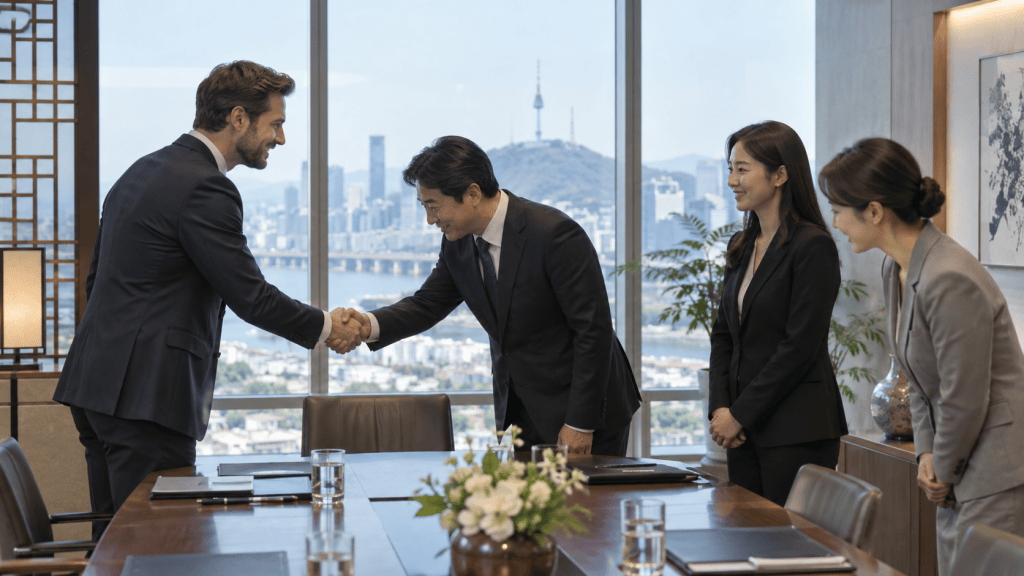
Job titles can still be important in many Korean companies.
You may hear titles such as:
- CEO
- President
- Vice President
- Executive Director
- Managing Director
- General Manager
- Team Leader
- Department Manager
Foreign visitors do not need to memorize the entire Korean corporate hierarchy.
However, it is helpful to understand who is responsible for what and who may have greater decision-making authority.
When someone introduces themselves, pay attention to both their name and title.
If you are unsure how to address someone, a professional form of address is usually safer until they tell you otherwise.
Once the person says:
“Please call me David.”
you can comfortably use David from that point forward.
Key Point
Do not assume that first-name culture applies everywhere. Let the other person guide you.
3. Treat Business Cards with Respect

In Korea, a business card is more than a piece of contact information.
It often tells you several important things immediately:
- The person’s company
- Their position
- Their department
- Their level of responsibility
- Their contact information
When receiving a business card, avoid immediately placing it in your pocket without looking at it.
Take a moment to read the card.
If several people are attending the meeting, keeping the cards neatly in front of you can also help you remember names and positions.
A simple response works well:
“Thank you. It’s a pleasure to meet you.”
Avoid
Do not casually fold the card, write all over it in front of the person, or place objects on top of it.
The important message is not really about the paper itself.
It is about communicating:
“I respect who you are and the role you represent.”
4. Arrive a Little Early

Punctuality is generally important in Korean business meetings.
For a first meeting, arriving 5 to 10 minutes early is a good rule of thumb.
This is particularly important in Seoul, where traffic can be unpredictable.
Large office buildings may also require:
- Visitor registration
- Identification
- Security access
- Elevator transfers
- Reception check-in
If your meeting starts at 10:00 a.m., arriving at the building around 9:45–9:50 a.m. can be a smart choice.
However, arriving at the actual office far too early may create unnecessary pressure for your host.
If you are very early, consider waiting in the lobby or a nearby café.
Key Point
Being early shows preparation. Being too early can be inconvenient.
5. A Positive Response Is Not Always Final Approval

This is one of the most important things for foreign professionals to understand.
In some Korean business situations, people may avoid giving an immediate and direct “No.”
Instead, you may hear phrases such as:
- “We will review it.”
- “We need to discuss it internally.”
- “It may be a little difficult.”
- “We will check again.”
- “It sounds like an interesting proposal.”
These responses do not necessarily mean the proposal has been approved.
A positive atmosphere during the meeting should not automatically be interpreted as a final agreement.
A Better Way to Confirm
You could say:
“So, would it be correct to say that your team will review the proposal internally and get back to us next week?”
This confirms the next step without putting unnecessary pressure on the other party.
Remember
Positive reaction ≠ Final approval
6. The Person in the Meeting May Not Be the Final Decision-Maker

In larger Korean companies, several levels of internal approval may be involved.
A typical decision-making process could look something like:
Staff Member → Team Leader → Department Head → Executive → CEO
The exact structure differs by company.
Even when your main contact strongly supports your proposal, additional approval may still be required.
This is why pushing too aggressively for an immediate answer can be counterproductive.
Instead, ask questions such as:
“What would be the next step after today’s meeting?”
or:
“Who else would normally be involved in the decision-making process?”
These questions help you understand the internal process without sounding demanding.
Key Point
The goal of the first meeting is not always to close the deal.
Sometimes the most important outcome is simply:
Moving successfully to the next stage.
7. Do Not Send One Email and Simply Wait

Business communication in Korea can move quickly.
Depending on the company and relationship, professionals may use several communication channels:
- Phone
- Text message
- KakaoTalk
- Corporate messenger
- Video conferencing
If an important matter requires a response, sending one email and waiting several days may not always be the most effective approach.
A polite follow-up is perfectly reasonable.
For example:
“Just checking whether you had a chance to review my email.”
That said, personal messaging apps such as KakaoTalk should normally be used only when your Korean counterpart has shared their contact information or indicated that this form of communication is acceptable.
Key Point
In Korea, appropriate follow-up may be seen not as pressure, but as a sign of interest, responsibility, and momentum.
8. A Business Dinner Can Be Another Kind of Meeting
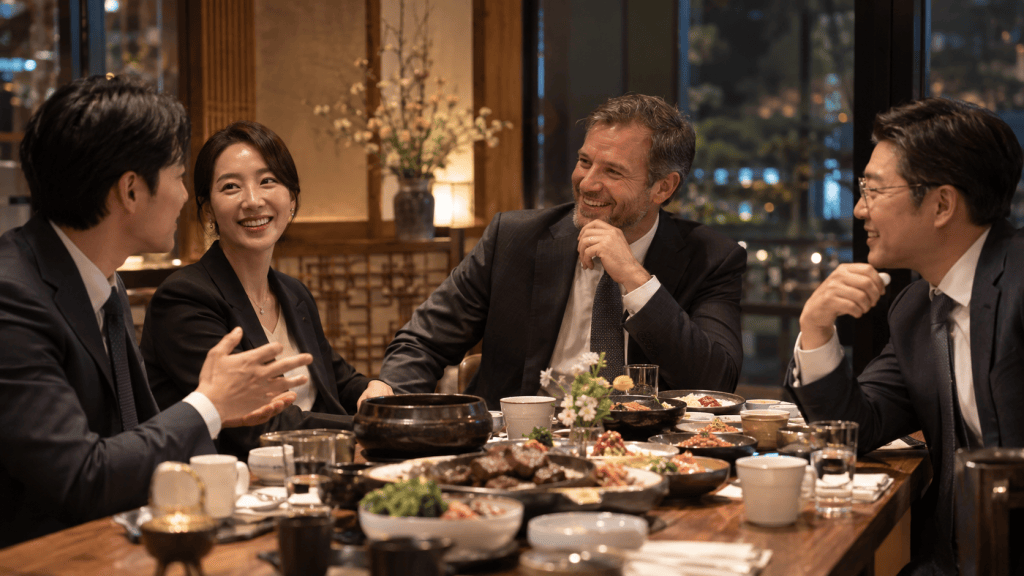
Lunch or dinner can play an important role in building business relationships in Korea.
The atmosphere outside the office is often more relaxed.
As a result, people may discuss subjects during dinner that never came up during the formal meeting.
This does not mean you need to talk about business throughout the entire meal.
In fact, starting with lighter topics can be helpful:
- Your impressions of Korea
- Korean food
- Travel
- Sports
- Culture
- Your home country
- Interesting experiences during your visit
Alcohol may sometimes be offered, but drinking is not a requirement.
If you do not drink, it is perfectly acceptable to say:
“No, thank you. I don’t drink, but I’d be happy to have some water.”
Modern Korean workplace culture has changed significantly, and many professionals are comfortable with colleagues or guests choosing not to drink.
Key Point
The purpose of a business meal is not the alcohol.
It is the relationship.
9. Be Ready for the Speed of Korean Business

One expression closely associated with Korea is:
“Ppalli-Ppalli” — 빨리빨리
It literally means:
“Quickly, quickly.”
Korean business environments are diverse, but many organizations place a high value on responsiveness and speed.
You may receive:
- A document request in the morning
- A revision request in the afternoon
- A meeting invitation for the next day
- A request for confirmation within a short period
For international companies with slower internal approval processes, this can sometimes feel challenging.
If you cannot provide a complete answer immediately, do not disappear.
Instead, acknowledge the request.
For example:
“We have received your request. We are reviewing it now and will send you a full response by tomorrow.”
This simple message can make a big difference.
Best Practice
Receive → Acknowledge → Give a Timeline → Deliver
In many business situations, responsiveness itself contributes to trust.
10. In the End, Trust Matters More Than the Transaction

A contract is important.
Price is important.
Terms and conditions are important.
But long-term business relationships often depend on something deeper:
Trust.
Your Korean counterpart may naturally be thinking:
“Can we work with this company for the long term?”
“Will they respond responsibly if something goes wrong?”
“Do they see us only as a customer, or as a business partner?”
Small actions can answer these questions more effectively than a sales presentation.
For example:
- Send promised materials on time.
- Follow up when you said you would.
- Admit problems clearly when they occur.
- Keep even small promises.
- Respond quickly when your partner needs help.
- Show interest in the long-term relationship.
A simple statement such as:
“We hope this can be the beginning of a long-term partnership in Korea.”
can communicate the right mindset.
Key Point
Trust is built through consistency, not slogans.
One Sentence to Remember When Doing Business in Korea
Respect first. Relationship second. Business follows.
Successful business in Korea does not begin only when a contract is signed.
It develops through respectful communication, understanding the decision-making process, responding quickly, keeping promises, and gradually building trust.
Products may open the door.
Price may attract attention.
A good presentation may create interest.
But in many cases, trust is what turns a business opportunity into a lasting partnership.


Leave a Reply