
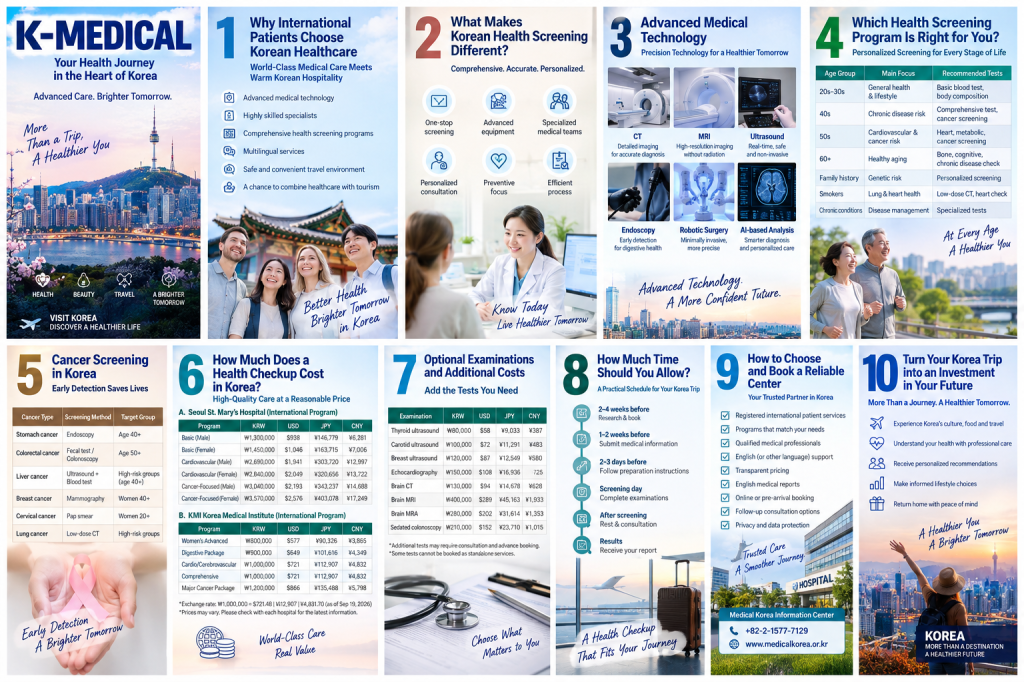
Experience the Excellence of K-Medical: Advanced Health Screening, Personalized Preventive Medicine, and a Healthier Future
Discover how South Korea combines advanced medical technology, professional healthcare services, and comprehensive health screening programs to help international visitors better understand their health.
INTRODUCTION: What If One Day in Korea Could Help You Build a Healthier Future?
For international visitors, South Korea is an extraordinary travel destination.
From Seoul’s spectacular skyline and world-famous K-pop to Korean cuisine, traditional culture, and innovative technology, the country offers unforgettable experiences.
But there is another remarkable experience that international visitors may want to consider.
K-Medical: Korea’s advanced healthcare and comprehensive health screening services.
South Korea is becoming more than a destination for beauty, entertainment, and tourism.
It is also attracting international visitors who want to understand their health, receive professional medical consultations, and explore preventive healthcare services.
According to figures announced by South Korea’s Ministry of Health and Welfare in April 2026, approximately 2.01 million international patients visited Korea in 2025.
This represented a 71.9% increase compared with approximately 1.17 million in 2024 and was the highest annual figure since international patient statistics were first collected in 2009.
The figures include international patients receiving dermatology, cosmetic surgery, dental care, health screening, and other medical services.
Why are so many international patients choosing Korean healthcare?
What makes Korea’s health screening services attractive?
And how can international visitors arrange a comprehensive health checkup during their trip?
This guide explores 10 essential topics, including advanced medical technology, health screening programs, actual published prices, hospital selection, appointment procedures, and practical travel planning.
1. Why International Patients Are Discovering Korean Healthcare

Why Korea Is Becoming a Global Healthcare Destination
Korea’s healthcare capabilities extend far beyond cosmetic surgery and dermatology.
The country has a diverse medical infrastructure that includes university hospitals, specialized medical institutions, comprehensive health screening centers, and private healthcare providers.
Many major hospitals and specialized centers offer coordinated screening services that allow patients to complete multiple examinations during a scheduled visit.
Some institutions also provide international healthcare services, including multilingual assistance, appointment coordination, and medical consultations.
Key Features of Korean Healthcare
| Category | Key Features | Benefits for International Visitors |
|---|---|---|
| Medical Infrastructure | University hospitals, specialized hospitals, and health screening centers | Access to a wide range of medical services |
| Advanced Equipment | CT, MRI, ultrasound, and endoscopy | Detailed examinations when medically appropriate |
| Medical Professionals | Specialists across multiple medical fields | Professional health assessments |
| Health Screening Programs | Basic, comprehensive, and specialized examinations | Options tailored to individual needs |
| International Patient Services | Appointment assistance and medical interpretation | Easier access for international visitors |
| Follow-Up Care | Referrals and additional medical consultations | Support when screening results require further evaluation |
| Accessibility | Medical institutions in Seoul and other major cities | Opportunities to combine healthcare with business or leisure travel |
K-Medical Insight
The value of Korean healthcare is not simply the availability of advanced medical equipment.
It also lies in combining appropriate examinations, professional interpretation, and personalized recommendations to help individuals make informed decisions about their health.
2. What Makes Comprehensive Health Screening in Korea Different?
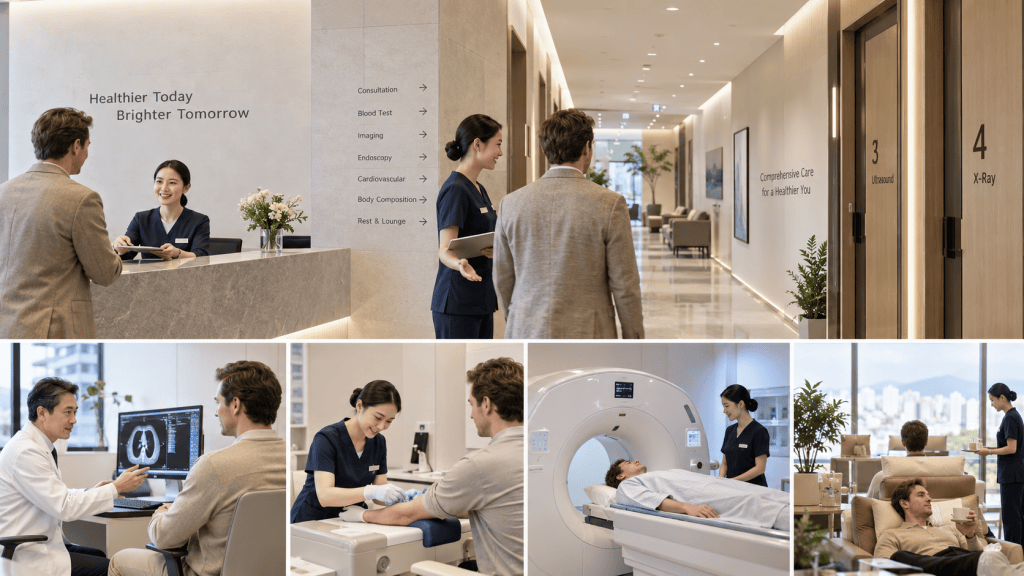
Discover Korea’s Comprehensive Health Screening System
Korean health screening centers provide a variety of programs designed to assess general health, identify certain risk factors, and support preventive healthcare.
Depending on the medical institution and selected package, international visitors may be able to complete several examinations during a single appointment.
These can include blood tests, urine tests, ultrasound examinations, endoscopy, and other medically appropriate assessments.
Health screening programs can generally be divided into three categories:
Basic health screening, comprehensive health screening, and specialized examinations.
Types of Health Screening Programs in Korea
| Screening Type | Typical Examinations | Main Purpose |
|---|---|---|
| Basic Health Screening | Blood pressure, blood tests, urine tests | Evaluate general health indicators |
| Comprehensive Health Screening | Basic tests and selected imaging or endoscopic examinations | Assess major health concerns and risk factors |
| Cancer-Focused Screening | Age- and risk-appropriate cancer screening | Support early detection of cancers for which screening is recommended |
| Cardiovascular Screening | Blood pressure, cholesterol testing, ECG | Assess cardiovascular health |
| Digestive Health Screening | Upper gastrointestinal and colorectal examinations | Evaluate digestive health |
| Women’s Health Screening | Cervical cancer screening, breast examinations | Support women’s preventive healthcare |
| Men’s Health Screening | Individualized urological and metabolic assessments | Support men’s health management |
| Senior Health Screening | Chronic disease, bone health, and functional assessments | Support healthy aging |
What Happens During a Korean Health Checkup?
A typical health screening process includes six stages.
STEP 1. Make an Appointment
Contact the medical institution and discuss which screening program may be appropriate for your health needs.
STEP 2. Provide Your Medical History
Inform the hospital about previous illnesses, current medications, family medical history, and previous examination results.
STEP 3. Complete Your Health Examinations
Undergo the examinations included in your selected program.
STEP 4. Medical Review
Medical professionals interpret the examination results and assess relevant health indicators.
STEP 5. Consultation
Discuss your results and determine whether additional examinations or treatment may be necessary.
STEP 6. Develop a Health Management Plan
Receive recommendations for lifestyle management, medical follow-up, or further evaluation when appropriate.
Important Tip
Ask your chosen medical institution whether your results consultation can take place before you leave Korea.
Some laboratory, pathology, or specialized examination results may take several days or longer.
3. Experience Advanced Medical Technology: CT, MRI, Ultrasound, and Endoscopy
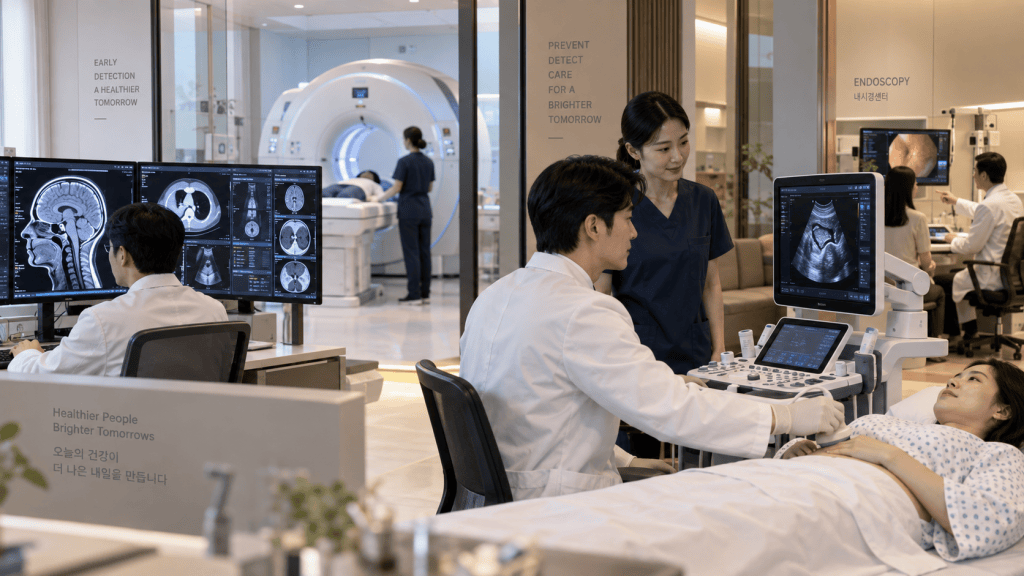
Advanced Medical Technology for a More Informed Future
Many major Korean hospitals and health screening centers use advanced diagnostic equipment.
These technologies can provide detailed information about the human body and help medical professionals evaluate various health conditions.
However, advanced technology does not mean that every examination is necessary for every patient.
The appropriate tests depend on your age, symptoms, medical history, family history, and individual risk factors.
Medical Technologies Available in Korea
| Medical Technology | Key Features | Common Applications |
|---|---|---|
| CT Scan | Produces cross-sectional images using X-rays | Evaluation of the lungs, abdomen, blood vessels, and other areas |
| MRI | Produces detailed images using magnetic fields | Brain, spine, joints, and other structures |
| MRA | MRI-based examination of blood vessels | Assessment of selected vascular conditions |
| Ultrasound | Uses sound waves to examine internal structures | Liver, thyroid, heart, gallbladder, and other organs |
| Upper Gastrointestinal Endoscopy | Allows direct examination of the upper digestive tract | Evaluation of the esophagus, stomach, and duodenum |
| Colonoscopy | Allows direct examination of the colon | Evaluation of colorectal conditions and polyps |
| Electrocardiogram (ECG) | Records the heart’s electrical activity | Assessment of certain heart rhythm abnormalities |
| Blood Tests | Analyze various components of blood | Assessment of diabetes, anemia, cholesterol, and other conditions |
Three Medical Technologies Worth Understanding
① MRI: Detailed Imaging of Internal Structures
MRI is widely used to examine the brain, spine, joints, and other parts of the body.
Unlike CT, MRI does not use ionizing radiation.
However, it is not a universal screening test and cannot detect every medical condition.
② CT: Detailed Imaging When Medically Appropriate
CT scans provide detailed images that can help diagnose and evaluate various conditions.
Low-dose chest CT is also used for lung cancer screening in certain high-risk populations.
③ Endoscopy: Examining the Digestive System
Upper gastrointestinal endoscopy and colonoscopy allow doctors to examine parts of the digestive tract directly.
During a colonoscopy, doctors may also remove polyps or collect tissue samples when appropriate.
Important Medical Note: More testing is not always better. Unnecessary imaging can lead to radiation exposure, false-positive findings, additional procedures, and avoidable costs.
The U.S. Food and Drug Administration does not recommend routine whole-body CT screening for healthy individuals without symptoms as a general preventive measure.
4. Which Health Screening Program Is Right for You?
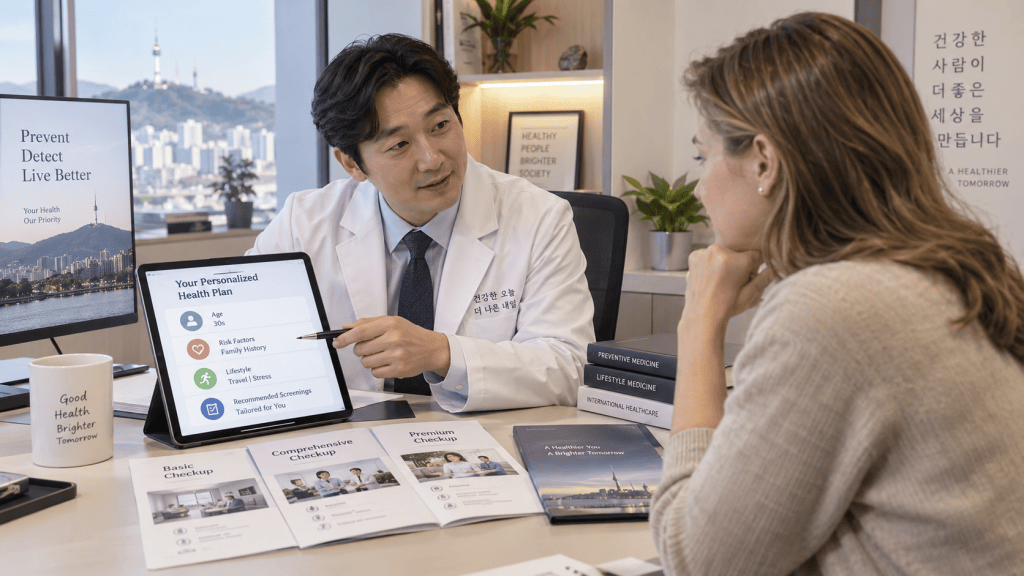
Personalized Health Screening Based on Your Age and Health Risks
One of the appealing features of Korean health screening services is the variety of available programs.
However, the most expensive package is not necessarily the most appropriate choice.
A comprehensive examination should be selected according to your individual health needs.
Health Screening Considerations by Age and Risk Profile
| Target Group | Main Health Considerations | Examinations That May Be Considered |
|---|---|---|
| Adults in Their 20s–30s | General health and lifestyle-related risk factors | Blood pressure, blood glucose, and cholesterol testing when appropriate |
| Adults in Their 40s | Chronic disease risks and age-appropriate cancer screening | Metabolic assessments and recommended cancer screening |
| Adults in Their 50s | Cardiovascular risks and cancer screening | Blood pressure, glucose, cholesterol, and appropriate cancer screening |
| Adults Aged 60+ | Chronic diseases, bone health, and functional health | Individualized medical and functional assessments |
| Individuals with Family History | Conditions associated with family medical history | Personalized examinations following medical consultation |
| Current or Former Smokers | Cardiovascular and lung health | Risk-based assessments and screening when indicated |
| Individuals with Chronic Conditions | Management of existing medical conditions | Follow-up examinations recommended by their healthcare providers |
Information to Prepare Before Your Appointment
| Information | Why It Matters |
|---|---|
| Age | Helps determine appropriate screening recommendations |
| Previous Medical Conditions | Provides important medical context |
| Family Medical History | Helps identify inherited or familial risk factors |
| Current Medications | Helps identify potential examination precautions |
| Smoking and Alcohol History | Supports individual risk assessment |
| Previous Health Screening Results | Allows comparison over time |
| Current Symptoms | Helps determine whether diagnostic medical care is needed |
Important
If you are experiencing concerning symptoms such as chest pain, difficulty breathing, gastrointestinal bleeding, or persistent severe abdominal pain, seek appropriate medical care rather than relying on a routine health screening package.
5. Discover Cancer Screening Services in Korea
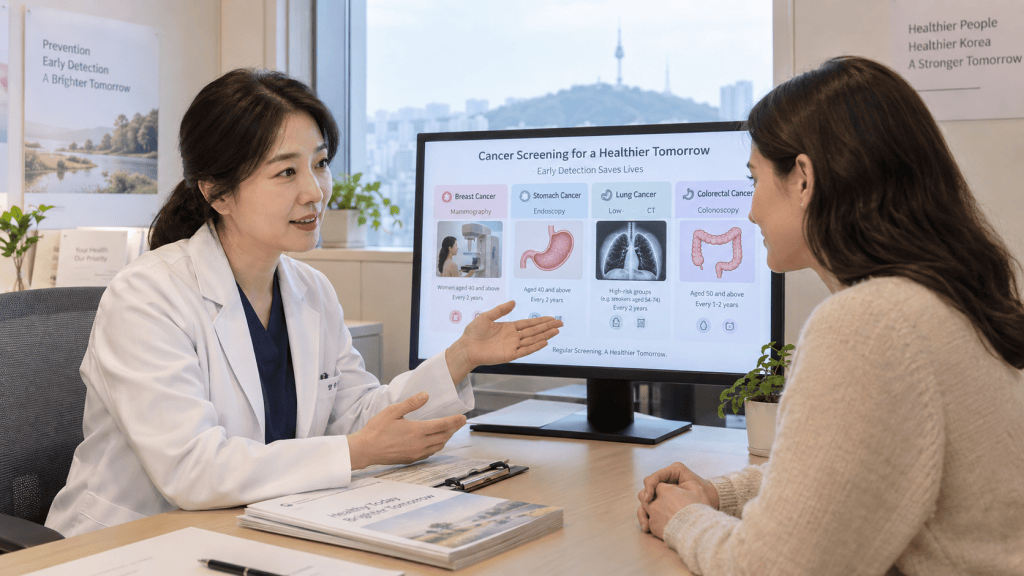
Understanding Cancer Screening in Korea
Cancer screening is one of the healthcare topics that attracts considerable interest among international patients.
South Korea operates a national cancer screening program covering six major cancer categories:
Stomach cancer, colorectal cancer, liver cancer, breast cancer, cervical cancer, and lung cancer.
However, eligibility for Korea’s national screening benefits depends on applicable healthcare and insurance requirements.
International visitors should not assume that they qualify for the same publicly supported services as eligible Korean residents.
Understanding Korea’s National Cancer Screening Program
| Cancer Type | Representative Screening Method | Main Screening Population |
|---|---|---|
| Stomach Cancer | Upper gastrointestinal endoscopy or other approved methods | Adults aged 40 and older |
| Colorectal Cancer | Fecal occult blood testing, followed by colonoscopy when indicated | Adults aged 50 and older under the national program |
| Breast Cancer | Mammography | Women aged 40 and older |
| Cervical Cancer | Cervical cytology testing | Women aged 20 and older |
| Liver Cancer | Liver ultrasound and blood testing | High-risk individuals aged 40 and older |
| Lung Cancer | Low-dose chest CT | Individuals meeting specific age and smoking-risk criteria |
Source: National Cancer Center, Korea — National Cancer Screening Program.
Screening eligibility, intervals, and detailed requirements may change.
What International Visitors Should Know
Cancer screening recommendations differ between countries.
Before arranging cancer screening in Korea, consider bringing your previous screening records.
You should also understand that tumor marker tests and extensive imaging examinations included in certain premium packages are not necessarily recommended routine screening tests for healthy individuals.
Discuss the potential benefits, limitations, and risks of each examination with an appropriate medical professional.
6. How Much Does a Comprehensive Health Checkup Cost in Korea?

Understanding Actual Health Screening Prices
This is one of the most common questions international visitors ask.
Health screening prices in Korea vary depending on the medical institution, program, examinations, specialist consultations, and additional services.
Rather than relying on broad price estimates, the following comparison uses published program prices from Korean health screening providers.
The prices are presented in:
- Korean Won (KRW)
- US Dollars (USD)
- Japanese Yen (JPY)
- Chinese Yuan (CNY)
Currency Conversion Reference
The following approximate exchange rates were used in the original price comparison on September 19, 2026.
| Korean Won | US Dollar | Japanese Yen | Chinese Yuan |
|---|---|---|---|
| ₩1,000,000 | $721.48 | ¥112,907 | ¥4,831.70 |
JPY and CNY are used below to distinguish Japanese yen from Chinese yuan.
Foreign-currency amounts are provided for reference only. Actual payment amounts may vary according to exchange rates and transaction fees.
A. Seoul St. Mary’s Hospital: International Health Screening Programs
Seoul St. Mary’s Hospital operates a health promotion center offering comprehensive screening programs.
Its published international screening options include basic screening, cancer-focused screening, cardiovascular screening, and digestive health screening.
Published Health Screening Prices
| Screening Program | Korean Won | US Dollar | Japanese Yen | Chinese Yuan |
|---|---|---|---|---|
| Basic Screening — Male | ₩1,300,000 | $938 | JPY 146,779 | CNY 6,281 |
| Basic Screening — Female | ₩1,450,000 | $1,046 | JPY 163,715 | CNY 7,006 |
| Cardiovascular Screening — Male | ₩2,690,000 | $1,941 | JPY 303,720 | CNY 12,997 |
| Cardiovascular Screening — Female | ₩2,840,000 | $2,049 | JPY 320,656 | CNY 13,722 |
| Cancer-Focused Screening — Male | ₩3,040,000 | $2,193 | JPY 343,237 | CNY 14,688 |
| Cancer-Focused Screening — Female | ₩3,570,000 | $2,576 | JPY 403,078 | CNY 17,249 |
Source: Seoul St. Mary’s Hospital, Health Promotion Center — Published International Screening Programs.
Official Website: https://healthcare.cmcseoul.or.kr/en/personal/sub01_01.do
B. KMI Korea Medical Institute: Specialized Screening Programs for International Patients
KMI Korea Medical Institute also provides health screening programs for international patients.
Its published specialized programs include women’s health, digestive health, cardiovascular and cerebrovascular health, and cancer-focused screening.
Published Health Screening Prices
| Screening Program | Korean Won | US Dollar | Japanese Yen | Chinese Yuan |
|---|---|---|---|---|
| Women’s Advanced Screening | ₩800,000 | $577 | JPY 90,326 | CNY 3,865 |
| Digestive Disease Package | ₩900,000 | $649 | JPY 101,616 | CNY 4,349 |
| Cardiovascular and Cerebrovascular Package | ₩1,000,000 | $721 | JPY 112,907 | CNY 4,832 |
| Comprehensive Disease Package | ₩1,000,000 | $721 | JPY 112,907 | CNY 4,832 |
| Major Cancer Screening Package | ₩1,200,000 | $866 | JPY 135,488 | CNY 5,798 |
Source: KMI Korea Medical Institute — International Patient Screening Programs.
Official Website: https://global.kmi.or.kr/examination/foreigner_examination
Important Pricing Information
The packages offered by these institutions may contain different examinations and services.
Therefore, comparing prices alone does not establish which program is more appropriate or provides greater value.
The amounts above are published reference prices. Confirm the current price, included examinations, appointment availability, and potential additional charges directly with the medical institution before booking.
7. Can You Add Specific Examinations? Understanding Optional Screening Costs
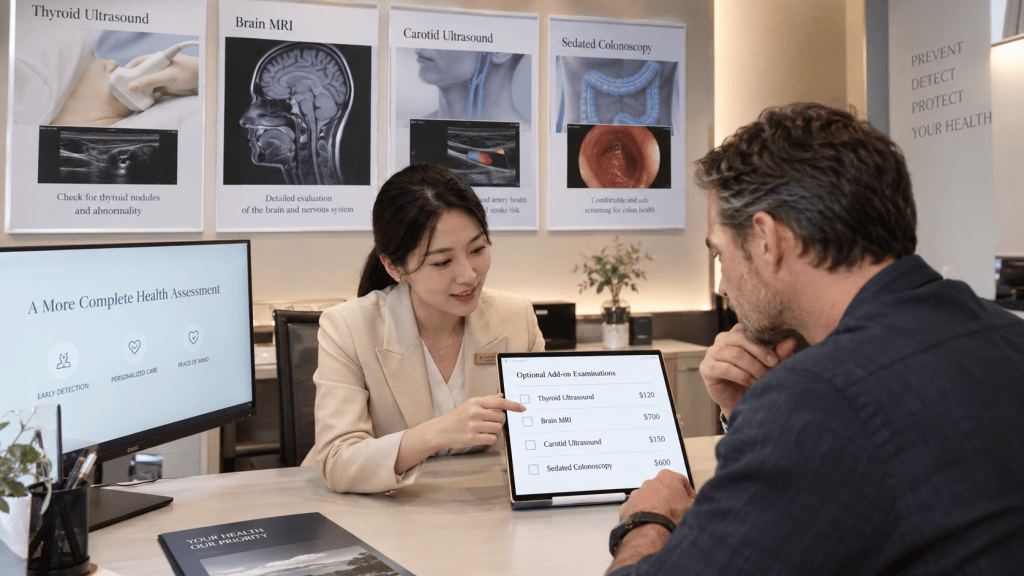
Understanding Additional Health Screening Expenses
Some Korean health screening centers allow patients to add examinations to a basic or comprehensive package.
For example, if a previous health examination identified a concern involving a particular organ, a medical professional may recommend further assessment.
The following table presents published prices for selected additional examinations offered by KMI Korea Medical Institute.
Optional Examination Costs
| Examination | Korean Won | US Dollar | Japanese Yen | Chinese Yuan |
|---|---|---|---|---|
| Thyroid Ultrasound | ₩80,000 | $58 | JPY 9,033 | CNY 387 |
| Carotid Ultrasound | ₩100,000 | $72 | JPY 11,291 | CNY 483 |
| Breast Ultrasound | ₩120,000 | $87 | JPY 13,549 | CNY 580 |
| Echocardiography | ₩150,000 | $108 | JPY 16,936 | CNY 725 |
| Brain CT | ₩130,000 | $94 | JPY 14,678 | CNY 628 |
| Brain MRI | ₩400,000 | $289 | JPY 45,163 | CNY 1,933 |
| Brain MRA | ₩280,000 | $202 | JPY 31,614 | CNY 1,353 |
| Sedated Colonoscopy | ₩210,000 | $152 | JPY 23,710 | CNY 1,015 |
Source: KMI Korea Medical Institute — Published Additional Examination Prices.
Before Adding an Examination
Confirm the following with your medical institution:
- Is the examination medically appropriate for your situation?
- Can it be added to your selected screening package?
- Is advance preparation required?
- Will there be additional fees for sedation, pathology, or other procedures?
- When will the examination results be available?
KMI indicates that the additional examinations listed in its package information cannot be booked as standalone services.
Some procedures may also require advance arrangements and may not be available as same-day additions.
8. How Much Time Should You Allow for a Health Checkup in Korea?

A Practical Health Screening Schedule for International Visitors
Many international visitors have limited time in Korea.
You may be traveling for business, attending an international conference, or enjoying a short vacation.
The good news is that some basic and comprehensive screening examinations can be completed during a scheduled visit.
However, completing all examinations and receiving every result on the same day may not be possible.
Certain laboratory tests, pathology results, and specialist consultations may require additional time.
Recommended Health Screening Timeline
| Timeline | Recommended Activity | Important Considerations |
|---|---|---|
| 2–4 Weeks Before Departure | Research hospitals and book your appointment | Confirm examination programs and prices |
| 1–2 Weeks Before Departure | Submit relevant medical information | Confirm preparation instructions |
| 2–3 Days Before Screening | Follow dietary and medical preparation instructions | Requirements vary by examination |
| The Day Before Screening | Prepare for fasting or bowel preparation if required | Follow your hospital’s instructions carefully |
| Screening Day | Complete your scheduled examinations | Bring your passport and medical records |
| After Screening | Rest and attend consultations as arranged | Allow recovery time after sedation |
| Results Consultation | Review your examination results | Discuss further testing and health management |
Special Considerations for Sedated Endoscopy
If you receive sedation for an endoscopic examination, do not schedule demanding sightseeing activities or important business meetings immediately afterward.
Patients are commonly advised to avoid driving, alcohol, important decisions, and signing significant documents for 24 hours after sedation.
Depending on the medical institution and type of sedation, an accompanying adult may also be required.
Confirm your fitness to fly with your medical team, particularly if you undergo a biopsy or polyp removal.
Example: Combining a Health Checkup with a Four-Day Korea Trip
| Day | Suggested Schedule |
|---|---|
| DAY 1 | Arrival in Korea and hotel check-in |
| DAY 2 | Health screening and sufficient rest |
| DAY 3 | Light sightseeing if medically appropriate, and results consultation if available |
| DAY 4 | Return home after following medical advice and confirming any necessary follow-up care |
This is an illustrative itinerary.
You may need a longer stay if additional tests or medical consultations are necessary.
Travel Tip: Avoid scheduling an intensive business meeting or a long-distance flight immediately after a procedure involving sedation.
9. How to Choose and Book a Reliable Health Screening Center in Korea
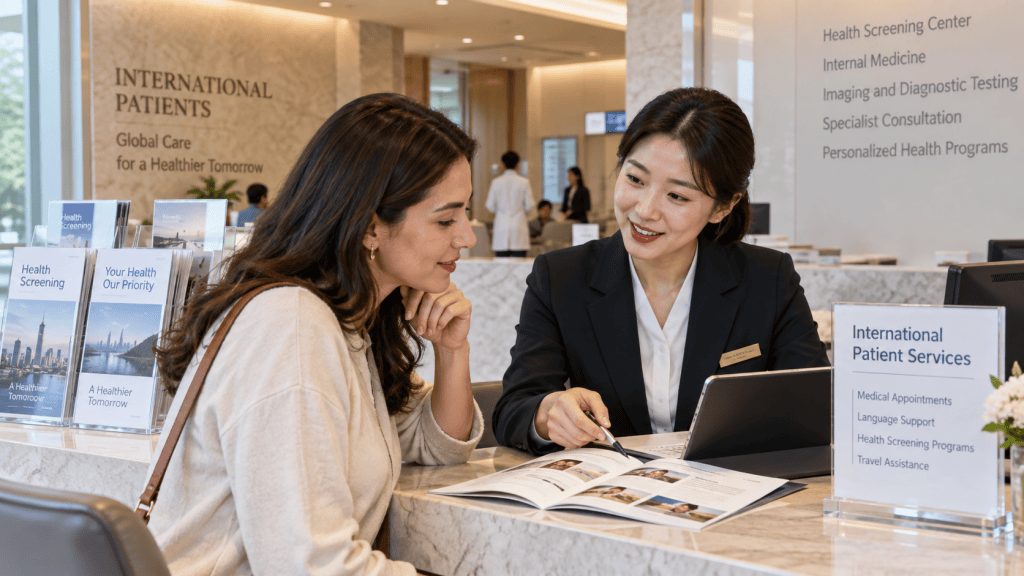
A Practical Guide for International Patients
Selecting the right medical institution is one of the most important steps in planning your health screening experience.
Do not choose a hospital solely because it offers the lowest price or the largest number of tests.
Instead, evaluate whether the institution can provide appropriate examinations, professional consultations, and reliable follow-up arrangements.
Hospital Selection Checklist
| What to Check | Questions International Visitors Should Ask |
|---|---|
| Medical Institution Registration | Is the institution appropriately registered to attract international patients? |
| Screening Programs | Does the program match my individual health needs? |
| Medical Professionals | Who will review and explain my results? |
| Interpretation Services | Is assistance available in English, Chinese, Japanese, or another language? |
| Examination Costs | What is included in the price? |
| Medical Reports | Can I receive my report in English? |
| Appointment System | Can I arrange my appointment before arriving in Korea? |
| Results Consultation | Is remote consultation available after I return home? |
| Additional Medical Care | Can the hospital arrange further evaluation if necessary? |
| Privacy Protection | How are medical records and personal information managed? |
Medical Korea: An Official Information Resource for International Patients
Medical Korea provides information to help international patients understand and access healthcare services in South Korea.
The service is associated with the Korea Health Industry Development Institute.
Medical Korea Information Center
| Category | Information |
|---|---|
| Service Name | Medical Korea Information Center |
| Main Services | Healthcare information and assistance for international patients |
| Language Assistance | English, Chinese, Japanese, Russian, and other supported languages, depending on the service |
| Telephone | +82-2-1577-7129 |
| Official Website | www.medicalkorea.or.kr |
Language availability and operating hours may vary. Confirm the latest service information before contacting the center.
Essential English Questions to Ask Before Booking
| Question | Why You Should Ask |
|---|---|
| Do you offer health screening programs for international patients? | Confirm international patient services |
| What examinations are included in the package? | Understand the scope of screening |
| Is English interpretation available? | Avoid communication difficulties |
| How much does the examination cost? | Confirm the expected price |
| Are there any additional fees? | Avoid unexpected expenses |
| How long will the examination take? | Plan your travel schedule |
| Can I receive my medical report in English? | Prepare for medical follow-up in your home country |
| Can I have a follow-up consultation after returning home? | Understand post-visit care options |
10. Turn Your Korea Trip into an Investment in Your Future Health

Make Your Visit to Korea More Than a Travel Experience
A trip to Korea can create unforgettable memories.
You can explore Seoul’s vibrant neighborhoods, discover Korean cuisine, experience traditional culture, and enjoy some of the world’s most innovative urban environments.
And if your health and travel schedule permit, you may also choose to dedicate part of your trip to preventive healthcare.
The objective is not to undergo as many examinations as possible.
It is to select medically appropriate services, understand your results, and use that information to support your long-term health.
Your Final Health Screening Checklist
| No. | Checklist | Completed? |
|---|---|---|
| 1 | Have I discussed which health examinations are appropriate for me? | ☐ |
| 2 | Have I selected a reliable medical institution? | ☐ |
| 3 | Have I confirmed the examination program and total cost? | ☐ |
| 4 | Is consultation available in a language I understand? | ☐ |
| 5 | Have I prepared my previous medical records? | ☐ |
| 6 | Have I informed the hospital about my medications and medical conditions? | ☐ |
| 7 | Have I reviewed fasting and examination preparation requirements? | ☐ |
| 8 | Have I allowed enough time for recovery? | ☐ |
| 9 | Can I receive my medical report and follow-up recommendations? | ☐ |
| 10 | Have I planned how to continue managing my health after returning home? | ☐ |
What Should You Do After Receiving Your Results?
A normal health screening result does not guarantee that you will never develop a medical condition.
Similarly, an abnormal finding does not automatically mean that you have a serious disease.
The important step is to understand the results and determine whether further evaluation or follow-up care is necessary.
After returning home, share relevant results with your regular healthcare provider.
This can help maintain continuity of care and ensure that important findings are appropriately addressed.
SPECIAL BONUS: Planning Your Health Screening Travel Budget
Understanding the Complete Cost of Your Korea Medical Visit
If you are considering health screening during your trip to Korea, remember that the examination itself is only one component of your total travel budget.
Accommodation, transportation, interpretation, and potential additional medical services should also be considered.
Budget Planning for a Four-Day Health Screening Trip
| Expense Category | How to Estimate the Cost |
|---|---|
| International Flights | Based on departure country, travel season, and airline |
| Accommodation | Based on hotel category and number of nights |
| Health Screening | Official quotation from the selected medical institution |
| Interpretation | Confirm whether language assistance is included |
| Transportation | Airport transfers and travel to the hospital |
| Meals | Consider fasting requirements and recovery arrangements |
| Additional Medical Examinations | Allow for potential follow-up tests or procedures |
| Travel Insurance | Review healthcare coverage and exclusions |
| Contingency Expenses | Prepare for possible changes to your travel or medical schedule |
Important Insurance Reminder
Do not assume that standard travel insurance covers elective comprehensive health screening.
Contact your insurer before traveling and confirm whether the planned medical services, complications, or additional treatment are covered.
CONCLUSION: Discover More Than Korea. Discover a Healthier Future.
South Korea offers international visitors an extraordinary combination of culture, technology, cuisine, and unforgettable travel experiences.
But it can also offer an opportunity to understand your health more deeply.
Korean medical institutions provide a range of health screening programs and professional healthcare services for domestic and international patients.
Advanced diagnostic technologies, medical expertise, and coordinated healthcare services are important parts of Korea’s medical landscape.
However, the true value of health screening does not end when you receive your medical report.
It continues through understanding your results, making informed lifestyle choices, and receiving appropriate medical care when necessary.
If you are planning to visit Korea, consider whether a professionally selected health screening program could fit your health needs and travel schedule.
One day in Korea could become a meaningful first step toward understanding your health and preparing for a healthier future.
Welcome to Korea.
Discover K-Medical. Understand Your Health. Invest in Your Future.
K-MEDICAL: DISCOVER THE EXCELLENCE OF KOREAN HEALTHCARE
Episode 01
One Day in Korea That Could Change Your Life: Discover the Power of Korean Precision Health Checkups
Episode 02
Beyond K-Beauty: Discover Korea’s Advanced Cancer Care and Precision Medicine
Suggested SEO Information
SEO Title:
Health Checkups in Korea: Complete Guide to Medical Screening, Prices, Hospitals, and Booking
Meta Description:
Discover comprehensive health screening in South Korea. Explore advanced medical technology, published health checkup prices in KRW, USD, JPY, and CNY, international patient services, and practical booking tips.
SEO Keywords:
K-Medical, Korean Healthcare, Health Checkup in Korea, Medical Tourism Korea, Health Screening Korea, Comprehensive Health Checkup Seoul, Korean Hospitals, Medical Korea, Preventive Healthcare, Korea Medical Tourism, Health Screening Prices Korea, International Patients Korea.
Suggested Hashtags:
#KMedical #KoreanHealthcare #HealthCheckupInKorea #MedicalTourismKorea #HealthScreening #PreventiveHealthcare #VisitKorea #MedicalKorea #SeoulHealthcare #HealthyFuture #HealthAndWellness


Leave a Reply