
The Ultimate Guide for International Entrepreneurs, CEOs, Investors, and Business Professionals Seeking Successful Partnerships in South Korea
Understanding Korean Corporate Decision-Making, Business Negotiations, and Long-Term Partnerships
INTRODUCTION: Your Business Meeting in Korea Went Well. So Why Hasn’t the Deal Moved Forward?

Imagine this.
You have just completed an important business meeting with a Korean company.
The atmosphere was excellent. The Korean representatives showed genuine interest in your products, carefully reviewed your company profile, and asked several questions about potential cooperation.
At the end of the meeting, they said:
“Your proposal is very interesting.”
“We look forward to working with you.”
“Let’s stay in touch.”
You leave Korea feeling optimistic about the possibility of a new business partnership.
But something unexpected happens.
One week passes.
Then another.
A month later, there is still no concrete discussion about signing a contract.
When you send a follow-up email, the Korean company responds:
“We are still reviewing your proposal internally.”
What exactly happened?
Was the company never interested in the first place? Did you misunderstand the conversation? Or is there something about doing business in Korea that you have not yet fully understood?
The answer may involve more than cultural differences.
In many Korean companies, a positive business meeting, internal approval, budget allocation, and contract execution are separate stages of the decision-making process.
Understanding these stages can help international business visitors avoid misunderstandings, improve their negotiation strategies, and build more productive relationships with Korean companies.
This guide introduces 10 essential strategies for turning your first business meeting in Korea into a meaningful and potentially long-lasting business partnership.
1. Understand How Korean Companies Make Business Decisions
The First Meeting Is Not Always the Final Decision.
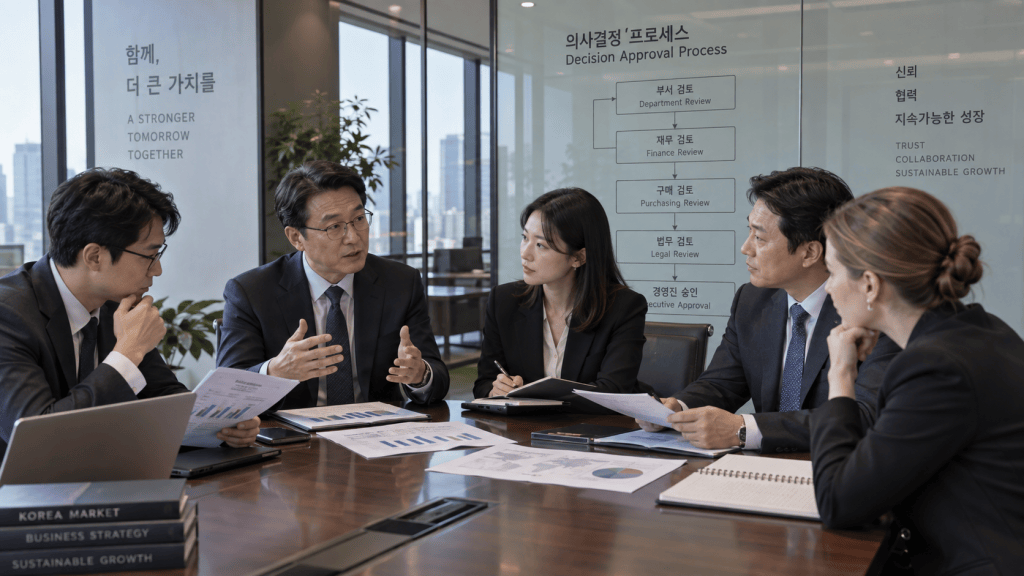
One of the first things international business visitors should understand is that the person attending your meeting may not have the authority to make the final purchasing decision.
A Korean business representative may genuinely appreciate your product or proposal.
However, the company may still need to complete internal evaluations, obtain management approval, confirm its budget, or consult other departments before making a commitment.
This is particularly relevant when working with large corporations, financial institutions, and public organizations.
Understanding the Corporate Decision-Making Process
| Position or Department | Typical Responsibilities | What International Business Visitors Should Know |
|---|---|---|
| Working-Level Representative | Collects information, evaluates products, communicates with suppliers | Often your first point of contact |
| Team Leader | Reviews practical needs and business relevance | May play an important role in moving your proposal forward |
| Department Head | Evaluates business priorities, feasibility, and available resources | May influence whether the project proceeds |
| Purchasing Department | Reviews pricing, supplier registration, and purchasing procedures | Often involved in formal procurement and contract execution |
| Finance Department | Reviews budgets and payment conditions | May need to confirm financial feasibility |
| Legal Department | Reviews contracts and legal risks | May be involved before the agreement is finalized |
| CEO or Senior Management | Approves major investments and strategic decisions | May hold final approval authority for significant contracts |
These are illustrative roles. Actual decision-making procedures vary depending on the company’s size, ownership structure, internal policies, and the value of the proposed transaction.
An Important Question to Ask
Rather than directly asking:
“Are you the decision-maker?”
Consider a more professional approach:
“Could you help me understand the internal decision-making process for this project?”
This question shows respect for your counterpart while helping you understand what needs to happen before the partnership can proceed.
2. Understand the Difference Between a Positive Meeting and a Genuine Purchasing Commitment

Interest Does Not Always Mean Commitment.
One common misunderstanding in international business is interpreting a positive response as a purchasing commitment.
When a Korean representative compliments your product or expresses interest in your proposal, that may certainly be encouraging.
However, it does not necessarily mean that the company has approved a budget, selected your company as its supplier, or decided to proceed with a contract.
The key is to distinguish general interest from concrete business action.
What Korean Business Responses May Actually Mean
| What the Korean Company Says | What You Might Assume | What You Should Confirm |
|---|---|---|
| Your proposal is very interesting. | They are ready to buy. | Is there a specific business need? |
| Your product looks excellent. | They want to purchase the product. | Are they considering replacing or adding a product? |
| We will review it internally. | The contract approval process has started. | Who will review the proposal, and when? |
| Please send us your pricing. | A purchasing decision is approaching. | Is this a preliminary market survey or an active purchasing process? |
| We hope to cooperate in the future. | They want a long-term agreement. | What type of cooperation are they considering? |
| Let’s meet again. | The next meeting will focus on signing a contract. | What is the specific purpose of the next meeting? |
Three Questions to Answer Before Leaving the Meeting
- What specific business problem is the Korean company trying to solve?
- Is there an available budget and a realistic timeline for the proposed project?
- What conditions must be satisfied before the company can proceed?
Key Takeaway: A productive business meeting is not measured only by how friendly the conversation was. It is measured by what both parties have agreed to do next.
3. Adapt Your Business Strategy to the Type of Korean Company
One B
usiness Strategy Does Not Fit Every Korean Company.
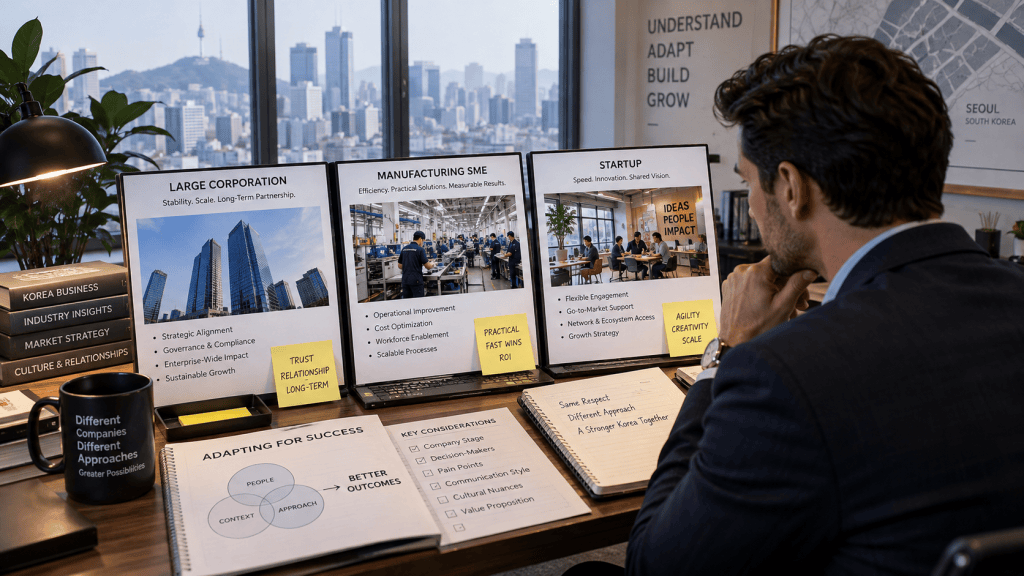
Not all Korean companies operate in the same way.
A global corporation, a medium-sized manufacturer, a small family-owned business, a technology startup, and a public institution may have very different priorities and decision-making procedures.
Therefore, your approach should reflect the type of organization you are meeting.
Business Strategies by Company Type
| Company Type | General Characteristics | Recommended Business Approach |
|---|---|---|
| Large Corporation | Specialized departments and formal approval procedures | Demonstrate product quality, proven results, technical capabilities, and reliability |
| Medium-Sized Company | May combine structured internal reviews with management involvement | Emphasize practical business benefits and cost efficiency |
| Small Business | Senior management may be directly involved in major transactions | Discuss practical cooperation and business value |
| Startup | May be interested in new technologies, market opportunities, and innovation | Explore joint development, market entry, and strategic partnerships |
| Public Institution | Subject to applicable procurement regulations and internal procedures | Understand the organization’s purchasing and tender requirements |
Example: Selling an AI Customer Service Solution in Korea
Imagine you are introducing an AI-powered customer service solution to Korean companies.
Your product is exactly the same, but your business presentation should not necessarily be identical.
For a large corporation:
Focus on system stability, cybersecurity, integration with existing infrastructure, data protection, and measurable business results.
For a small or medium-sized company:
Explain the implementation cost, operational efficiency, potential labor savings, and expected return on investment.
For a technology startup:
Discuss API integration, joint product development, scalability, and new market opportunities.
The objective is not simply to demonstrate how impressive your product is.
It is to explain why your product matters to that particular company.
4. Prepare These Seven Things Before Your First Business Meeting in Korea

Preparation Creates Business Opportunities.
Your first meeting with a Korean company is more than an opportunity to introduce yourself.
It is an opportunity to demonstrate that your organization is a reliable potential business partner.
Being well prepared can help your counterpart understand your company’s capabilities and evaluate the proposed partnership more efficiently.
Seven Essential Preparations
| No. | Preparation | What You Should Include |
|---|---|---|
| 1 | Research the Korean Company | Business activities, products, customers, and international operations |
| 2 | Identify Meeting Participants | Names, departments, and job titles |
| 3 | Prepare Your Company Profile | Business overview, company size, experience, and competitive strengths |
| 4 | Prepare Product Information | Specifications, technical information, and practical applications |
| 5 | Prepare Pricing Information | Pricing structure, supply conditions, and cost components |
| 6 | Develop a Cooperation Proposal | Specific ways your company could work with the Korean partner |
| 7 | Plan the Next Steps | Additional materials, follow-up meetings, and evaluation timelines |
Something International Business Visitors Often Overlook
Imagine that your Korean counterpart searches for your company online after the meeting.
What will they find?
If your company has no professional website, limited corporate information, and few examples of previous projects, it may be difficult for them to evaluate your credibility.
Even an excellent product can face obstacles when the company behind it is difficult to verify.
Your Essential Business Introduction Package
Prepare the following materials before traveling to Korea:
- English company profile
- Professional corporate website
- Major clients and business references
- Product or service catalog
- Relevant certifications
- Contact information for responsible representatives
- Concise business cooperation proposal
A one- or two-page Korean-language summary may also help when your proposal is reviewed internally.
Business Tip: If your presentation is intended for senior management, prepare a short executive summary explaining the business benefits, expected costs, and recommended next steps.
5. Ask These 10 Questions During Your Business Meeting

Ask Better Questions. Build Better Partnerships.
An effective business meeting is not simply about delivering an impressive company presentation.
It is about understanding the other company’s needs, priorities, challenges, and expectations.
Instead of spending the entire meeting explaining your products, ask questions that help identify genuine business opportunities.
10 Essential Questions for Korean Business Meetings
| No. | Question | Why It Matters |
|---|---|---|
| 1 | What are your company’s current business priorities? | Helps you understand the company’s strategic direction |
| 2 | What challenges are you trying to solve? | Identifies potential business needs |
| 3 | Are you currently working with other international partners? | Reveals existing international business experience |
| 4 | What are your expectations for a potential partner? | Clarifies the company’s partnership requirements |
| 5 | What would make our solution valuable to your business? | Helps you connect your proposal to actual needs |
| 6 | Is there an approved budget for this project? | Clarifies financial readiness |
| 7 | Who else would be involved in evaluating this proposal? | Helps identify additional stakeholders |
| 8 | What is your expected decision timeline? | Helps establish realistic expectations |
| 9 | What additional information would help your evaluation? | Identifies the documents and evidence required |
| 10 | What would be the most useful next step? | Helps move the discussion toward concrete action |
The Most Important Question
“What would be the most useful next step?”
Ask this question before concluding your meeting.
The answer may reveal whether the company wants additional product information, a technical demonstration, another management meeting, a factory visit, or a revised proposal.
These details can help you develop a more effective follow-up strategy.
6. Understand Common Expressions Used in Korean Business Meetings

Understanding What Is Said — and What Still Needs to Be Confirmed.
This is one of the most useful topics for international professionals visiting Korea.
During a business meeting, your Korean counterpart may use expressions that sound encouraging but do not clearly indicate what will happen next.
Rather than interpreting these phrases as automatic acceptance or rejection, use them as opportunities to clarify the company’s position.
Common Business Expressions and Recommended Responses
| Common Expression | Possible Meaning | Recommended Response |
|---|---|---|
| We will review it internally. | The proposal requires further consideration. | Ask about the review process and expected timeline. |
| We need some time to discuss. | Additional discussions may be necessary. | Ask whether further information would be helpful. |
| The price is a little challenging. | The proposed price may exceed expectations. | Clarify budget constraints and other commercial conditions. |
| We need management approval. | Senior management approval may be required. | Offer a concise executive summary or supporting materials. |
| We are considering several options. | The company may be comparing different solutions. | Ask about the evaluation criteria. |
| Let’s discuss this further. | There may be interest in additional discussions. | Agree on the purpose and timing of the next meeting. |
| We will get back to you. | The company intends to respond later. | Politely confirm an appropriate follow-up date. |
| We are interested in a long-term relationship. | The company may be considering ongoing cooperation. | Discuss specific partnership models and potential projects. |
These expressions do not have a single universal meaning. Their significance depends on the company, the individuals involved, and the context of the conversation.
Example: Responding Professionally
Korean Company Representative:
“We will review your proposal internally.”
Recommended Response:
“Thank you. Would it be helpful if I provided a brief summary of the expected business benefits and implementation requirements?”
This approach shows that you understand the need for internal evaluation and are willing to support the process.
It also gives your counterpart an opportunity to explain what information is still missing.
7. Understand the Company’s Real Requirements Before Negotiating the Price

Price Is Important, but It Is Not the Only Decision Factor.
When a Korean company asks about pricing, you may feel tempted to offer a discount immediately.
However, price is only one component of a business decision.
Depending on the industry, the company may also evaluate product quality, delivery schedules, technical support, manufacturing capacity, after-sales service, and supply reliability.
A lower price does not automatically represent a better business proposition.
Important Commercial Terms to Discuss
| Negotiation Item | What You Should Confirm | Recommended Approach |
|---|---|---|
| Product Price | Unit price and volume-based discounts | Provide quotations for different order quantities |
| Product Quality | Certifications, performance, and defect rates | Present objective quality documentation |
| Minimum Order Quantity | MOQ requirements | Discuss the possibility of an initial trial order |
| Delivery Schedule | Production and shipping timelines | Propose realistic delivery commitments |
| Payment Conditions | Deposits, balances, and payment currencies | Negotiate mutually acceptable payment terms |
| Technical Support | Installation, operation, and training | Clearly define the scope of support |
| Maintenance | Service periods and response times | Include specific obligations in the agreement |
| Exclusive Distribution | Geographic territory and sales rights | Discuss duration, performance targets, and conditions |
| Business Expansion | Opportunities for additional projects | Propose a phased cooperation plan |
How Should You Present Costs?
For international business transactions, understanding the complete cost structure is often more useful than focusing only on the unit price.
Understanding the Total Cost of a Business Transaction
| Cost Category | Description | What to Confirm |
|---|---|---|
| Product Cost | Purchase price of the products | Unit price and quantity |
| Sample Cost | Cost of producing and delivering samples | Sample production and shipping |
| Development Cost | Customized product development | Design, engineering, or formula development |
| Logistics Cost | Transportation and delivery expenses | International freight and shipping responsibilities |
| Customs Costs | Export and import-related expenses | Applicable duties and clearance charges |
| Technical Support Fee | Installation and training services | Scope and duration |
| Maintenance Fee | After-sales technical services | Service period and response time |
| Inspection Fee | Product testing and quality evaluation | Inspection procedures and responsibilities |
Understanding International Business Currencies
When negotiating a contract with a Korean company, the parties should clearly identify the agreed transaction currency.
| Country | Currency | International Currency Code |
|---|---|---|
| South Korea | Korean Won | KRW |
| United States | US Dollar | USD |
| China | Chinese Yuan | CNY |
| Japan | Japanese Yen | JPY |
If both parties use different currencies, agree on the applicable exchange-rate reference, exchange-rate date, and responsibility for international transfer fees.
A quotation should clearly state whether prices are denominated in KRW, USD, CNY, JPY, or another agreed currency.
Business Tip: When comparing supplier quotations, make sure the prices are based on equivalent delivery conditions, product specifications, payment terms, and service obligations.
8. Make It Easy for Your Korean Partner to Present Your Proposal Internally

Your Proposal Should Work Even When You Are Not in the Room.
Imagine that the Korean representative who attended your meeting genuinely believes your product could benefit the company.
However, that person now needs to explain your proposal to a team leader, department head, or senior executive.
If your materials are unclear or incomplete, internal evaluation may become difficult.
Your proposal must communicate its value even to people who did not attend the original meeting.
This is why a well-structured business proposal can be so important.
Recommended Structure for a Business Proposal
| Section | Key Information | Purpose |
|---|---|---|
| 1. Executive Summary | Concise overview of the proposal | Communicates the main business value |
| 2. Company Profile | Corporate background and business experience | Establishes credibility |
| 3. Business Challenge | The problems the Korean company wants to solve | Demonstrates understanding of its needs |
| 4. Proposed Solution | Your product or service | Explains the proposed approach |
| 5. Expected Benefits | Potential business outcomes | Supports evaluation of the investment |
| 6. Cost Proposal | Pricing and total expected expenses | Supports budget review |
| 7. Implementation Plan | Project schedule and responsibilities | Demonstrates feasibility |
| 8. References | Relevant customers and previous projects | Provides supporting evidence |
| 9. Risk Management | Potential risks and mitigation measures | Addresses implementation concerns |
| 10. Next Steps | Recommended actions and timeline | Helps move the proposal forward |
The Question Your Proposal Must Answer
“Why should your company work with us?”
Your proposal should clearly explain the value your Korean counterpart may gain from the partnership.
For example:
- Reducing existing supply-chain inefficiencies
- Improving operational efficiency
- Lowering relevant business costs
- Developing new products
- Expanding into international markets
- Improving customer service
- Strengthening technological capabilities
- Accessing new distribution channels
Avoid relying entirely on statements such as:
“We are a leading company.”
“Our products are innovative.”
“We provide excellent quality.”
These claims may be useful, but they are not enough on their own.
Explain how your capabilities can help the other company achieve its business objectives.
9. The First Seven Days After Your Business Meeting Matter

Your Follow-Up Strategy Can Make the Difference.
A business meeting does not end when you leave the conference room.
In many cases, the period following the meeting is when the relationship begins to develop into a practical business opportunity.
Your goal is to maintain professional communication without creating unnecessary pressure.
A Seven-Day Follow-Up Strategy
| Timeline | Recommended Action | Objective |
|---|---|---|
| Day 1 | Send a thank-you email | Express appreciation and maintain a positive relationship |
| Day 2 | Provide requested documents | Support the company’s internal review |
| Day 3 | Address outstanding questions | Clarify unresolved matters |
| Day 4 | Prepare additional supporting materials | Reinforce the value of your proposal |
| Day 5 | Check progress if the timing was agreed upon | Understand the evaluation status |
| Day 6 | Prepare an agenda for the next discussion | Make the next meeting productive |
| Day 7 | Confirm future steps and responsibilities | Support continued cooperation |
This schedule is an example, not a recommendation to send emails every day. Respect the review timeline agreed upon with your counterpart.
Sample Follow-Up Email After a Business Meeting in Korea
Subject: Thank You for Our Meeting in Seoul – Next Steps for Business Cooperation
Dear [Name],
Thank you very much for taking the time to meet with me during my recent visit to Korea.
It was a pleasure learning more about your company and discussing potential opportunities for business cooperation.
I particularly appreciated our discussion regarding [Specific Business Topic].
As discussed, I am pleased to share the following materials for your internal review:
- Company Profile
- Product or Service Information
- Business Proposal
- Pricing Information
Please let me know if there is any additional information that would be helpful.
I would also appreciate the opportunity to discuss the next steps at your convenience.
I look forward to developing a mutually beneficial business relationship with your company.
Best regards,
[Your Name]
[Position]
[Company Name]
[Country]
[Email / Phone]
Five Tips for Writing Effective Follow-Up Emails
1. Personalize your message.
Mention something specific that you discussed during the meeting.
2. Keep your email concise.
Make it easy for your counterpart to understand the purpose of your message.
3. Include the promised documents.
Deliver what you agreed to provide.
4. Suggest a clear next step.
For example, propose a technical discussion or a follow-up meeting.
5. Respect the company’s decision-making timeline.
Avoid interpreting a delayed response as an automatic rejection.
10. Build a Long-Term Business Partnership with Your Korean Counterpart

Don’t Just Close a Deal. Build a Partnership That Lasts.
Signing your first contract with a Korean company is an important achievement.
However, turning that initial transaction into a sustainable business relationship requires continued effort.
In international business, trust develops through consistent performance, reliable communication, transparent problem-solving, and mutual respect.
Your objective should not simply be to complete one transaction.
It should be to establish a partnership that creates value for both companies over time.
Seven Strategies for Building Long-Term Business Relationships
| Area | Recommended Practice | Expected Benefit |
|---|---|---|
| Building Trust | Fulfill agreed commitments and deadlines | Strengthens confidence in the partnership |
| Communication | Share relevant information regularly | Reduces misunderstandings |
| Quality Management | Maintain consistent product and service quality | Supports repeat business |
| Problem-Solving | Respond quickly and transparently when problems occur | Helps preserve trust |
| Business Understanding | Learn about your partner’s goals and challenges | Creates opportunities for deeper cooperation |
| Long-Term Planning | Explore future projects and business expansion | Supports sustainable growth |
| Contract Management | Document agreements and important changes | Helps reduce disputes |
Important Contractual Considerations
When establishing a distribution or agency relationship, pay attention to the following matters:
- Contract duration
- Termination conditions
- Geographic territory
- Exclusive or non-exclusive distribution rights
- Intellectual property rights
- Minimum purchase commitments
- Payment conditions
- Product liability
- Dispute resolution procedures
- Governing law
For significant international agreements, consider obtaining appropriate legal advice before signing.
BONUS: Five Signs That Your Business Discussions Are Moving Forward
Look Beyond Positive Words. Pay Attention to Concrete Actions.
International business visitors often wonder whether their Korean counterpart is genuinely considering a business partnership.
Although no single action guarantees that a contract will be signed, certain developments may indicate that the proposal is being evaluated more seriously.
Five Potential Indicators of Business Progress
| Stage | What the Korean Company May Do | What You Should Confirm |
|---|---|---|
| Stage 1 | Request detailed company and product information | Is this preliminary research or an active evaluation? |
| Stage 2 | Ask about pricing and commercial terms | Is there a defined need, budget, or purchasing timeline? |
| Stage 3 | Invite representatives from additional departments | What role does each department play in the evaluation? |
| Stage 4 | Discuss product testing or a pilot project | What are the evaluation criteria, costs, and timeline? |
| Stage 5 | Begin reviewing contracts or purchasing procedures | What approvals remain before the transaction can proceed? |
These developments can help you understand where the discussion stands.
However, they should not be interpreted as a guarantee of final approval.
The most useful approach is to confirm the next action, the responsible person, and the expected timeline.
FINAL BUSINESS CHECKLIST: Are You Ready to Build a Successful Partnership in Korea?
Before leaving Korea, review the following questions.
| No. | Business Checklist | Completed? |
|---|---|---|
| 1 | Do I understand the Korean company’s main business objectives? | ☐ |
| 2 | Have I identified a genuine business need? | ☐ |
| 3 | Do I understand the roles of the key decision-making participants? | ☐ |
| 4 | Have I confirmed the available budget and expected timeline? | ☐ |
| 5 | Have I clearly explained the value of my product or service? | ☐ |
| 6 | Have I provided the information required for internal evaluation? | ☐ |
| 7 | Have we discussed pricing and major commercial terms? | ☐ |
| 8 | Do I understand the remaining evaluation and approval procedures? | ☐ |
| 9 | Have we agreed on the next meeting or follow-up action? | ☐ |
| 10 | Have we discussed opportunities for long-term cooperation? | ☐ |
If you can answer most of these questions confidently, your visit has likely produced useful information for pursuing the next stage of your business relationship.
Even if a contract has not yet been signed, you may have established the foundation for future cooperation.
FINAL THOUGHTS: A Successful Business Partnership in Korea Begins After the First Meeting
For international entrepreneurs, CEOs, investors, and business professionals, South Korea offers opportunities to connect with innovative companies, advanced manufacturers, technology businesses, and internationally active organizations.
A visit to Seoul may introduce you to impressive products, experienced business leaders, and potential partners.
But a successful business meeting does not automatically lead to a successful business deal.
You need to understand your counterpart’s business objectives.
You need to identify genuine commercial needs.
You need to respect the company’s internal decision-making process.
And most importantly, you need to demonstrate why working with your company can create lasting value.
Successful business in Korea is not simply about selling a good product. It is about becoming a valuable and trusted business partner.
Make every meeting meaningful.
Ask thoughtful questions.
Keep your promises.
Understand your partner’s needs.
And communicate the value you can create together.
A conversation that begins in a meeting room in Seoul today could become the foundation of a global business partnership tomorrow.
Welcome to Korea.
Build Trust. Create Opportunities. Grow Together.
BUSINESS IN KOREA — An International Business Guide Series
Explore practical strategies, business opportunities, and essential insights for international professionals visiting South Korea.
Episode 01
Your 3-Day Business Mission in Korea: How to Find Reliable Korean Partners and Suppliers
Episode 02
Why Your Business Meeting in Korea Didn’t Turn Into a Deal: 10 Essential Strategies for Working with Korean Companies
Suggested SEO Title:
Doing Business in Korea: 10 Strategies for Successful Korean Business Meetings and Partnerships
Meta Description:
Planning to do business in South Korea? Discover how Korean companies make decisions, negotiate contracts, evaluate international partners, and build long-term business relationships.
SEO Keywords:
Doing Business in Korea, Korean Business Culture, Korean Business Meetings, Korean Corporate Decision-Making, Business Negotiation in Korea, Korean Business Partners, South Korea Business Guide, Korean Business Etiquette, International Business in Korea, Korean Business Communication, Business Partnerships in Korea.
Suggested Hashtags:
#BusinessInKorea #DoingBusinessInKorea #KoreanBusinessCulture #KoreanBusinessPartners #GlobalBusiness #BusinessNegotiation #KoreanCompanies #InternationalBusiness #SouthKorea #BusinessPartnership #BusinessInSeoul


Leave a Reply