
The Ultimate Business Guide for International Buyers, Entrepreneurs, and Investors Visiting South Korea
Three days in Korea could open the door to years of business opportunities. The key is knowing where to go, whom to meet, and how to turn your visit into a successful partnership.
South Korea is known worldwide for its technology, beauty products, automobiles, electronics, and innovative manufacturing industries.
But for international business visitors, Korea offers something even more valuable: opportunities to discover new products, establish distribution agreements, build manufacturing partnerships, and connect with companies seeking international growth.
Whether you are a business owner, importer, distributor, investor, or entrepreneur, a well-planned visit to Korea can help you discover opportunities that may be difficult to identify from overseas.
This guide will show you how to make the most of a three-day business trip to Korea.
1. Why South Korea Should Be on Your Business Radar

South Korea offers business opportunities across a wide range of industries.
From internationally recognized brands to specialized manufacturers and innovative startups, Korean businesses offer products and technologies for many international markets.
The first step is identifying which industries match your business objectives.
Korean Industries Worth Exploring
| Industry | Products and Business Opportunities | Potential International Partners |
|---|---|---|
| K-Beauty | Skincare, cosmetics, beauty devices, professional beauty products | Beauty retailers, distributors, e-commerce companies |
| K-Food | Instant noodles, snacks, sauces, beverages, packaged foods | Supermarkets, food importers, restaurant chains |
| Medical Devices | Diagnostic equipment, dental products, medical technology | Hospitals, medical distributors, healthcare companies |
| Electronics | Electronic components, smart devices, sensors, consumer electronics | Technology companies, retailers, manufacturers |
| Automotive Parts | Vehicle components, EV-related products, manufacturing equipment | Automotive suppliers, repair networks, distributors |
| Industrial Machinery | Automation equipment, manufacturing systems, precision machinery | Factories, industrial distributors, engineering companies |
| Fashion & Lifestyle | Apparel, accessories, household products, lifestyle brands | Fashion retailers, department stores, online platforms |
| Software & AI | Enterprise software, AI solutions, industrial applications | Corporate clients, technology partners, investors |
Business Tip: Do not limit your search to famous Korean brands. Smaller manufacturers and specialized suppliers may offer opportunities for customized products, private-label production, and long-term distribution partnerships.
2. Where Can Foreigners Find Reliable Korean Business Partners?

One of the biggest challenges for international visitors is finding the right Korean companies before arriving in Korea.
Fortunately, several organizations and digital platforms help international buyers connect with Korean suppliers.
A. KOTRA — Korea Trade-Investment Promotion Agency
KOTRA is one of the most useful starting points for international businesses interested in Korea.
It supports international trade and investment and provides services to help foreign buyers connect with Korean companies.
KOTRA operates buyKOREA, an online B2B marketplace, and organizes business matching events, international trade fairs, and meetings between Korean exporters and international buyers. (KOTRA)
How International Buyers Can Use KOTRA
| Service | What You Can Do | Business Benefit |
|---|---|---|
| buyKOREA | Search for Korean products and suppliers | Discover potential partners before your trip |
| Business Matching | Connect with Korean companies through organized meetings | Meet businesses relevant to your needs |
| Trade Fairs | Attend exhibitions and business events | Discover products and industry trends |
| Import Inquiries | Submit your sourcing requirements | Receive assistance identifying potential suppliers |
| Overseas Offices | Contact KOTRA representatives in your country | Prepare your Korea business mission before departure |
Official Resources:
B. KITA — Korea International Trade Association
Another useful organization is the Korea International Trade Association (KITA).
Its tradeKorea platform helps international buyers discover Korean suppliers and request quotations.
The platform also offers business matching support and assistance arranging meetings and factory tours for global buyers visiting Korea. (한국무역협회)
How to Use tradeKorea
| Step | Action |
|---|---|
| 1 | Register as an international buyer |
| 2 | Search for products or submit sourcing requirements |
| 3 | Review potential suppliers |
| 4 | Request product information and quotations |
| 5 | Arrange meetings with suitable companies |
| 6 | Schedule factory visits when appropriate |
Official Website:
tradeKorea — Find Korean Suppliers
Important: Being listed on a B2B platform does not replace your own supplier verification, product testing, or contractual due diligence.
3. Understanding Korean Manufacturers: OEM, ODM, and Distributors
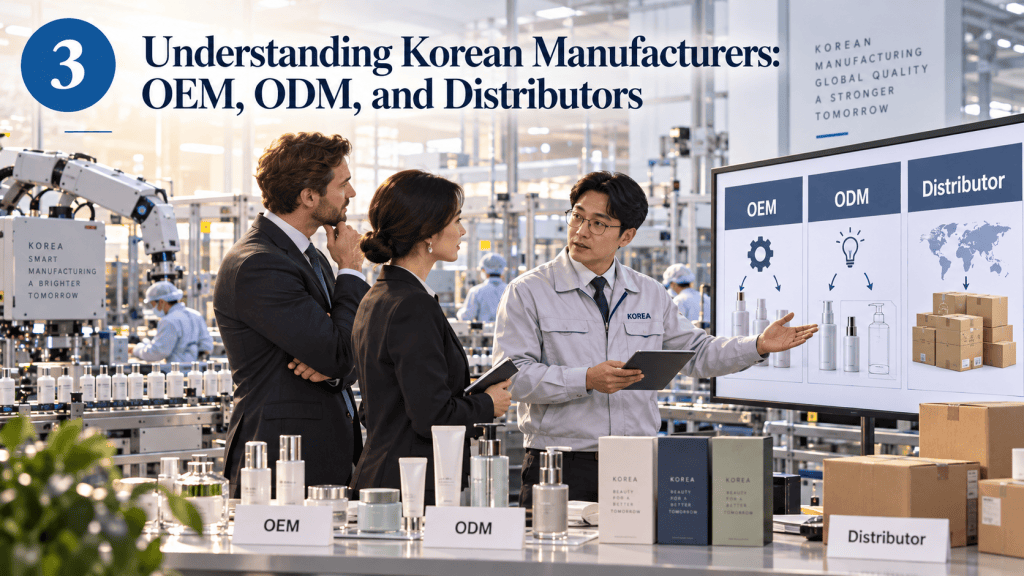
Before contacting Korean companies, you should understand the type of business partner you need.
Not every company selling Korean products is the actual manufacturer.
Some companies manufacture products directly, while others specialize in trading, distribution, product development, or private-label manufacturing.
Understanding Your Business Options
| Business Model | What It Means | Suitable For |
|---|---|---|
| Direct Manufacturer | Produces products at its own manufacturing facilities | Buyers seeking direct manufacturing relationships |
| OEM | Manufactures products according to the buyer’s specifications | Businesses with their own product design |
| ODM | Develops and manufactures products that buyers can sell under their own brands | Entrepreneurs creating private-label brands |
| Distributor | Purchases and resells products from manufacturers | Businesses seeking established products |
| Trading Company | Connects buyers with manufacturers and manages trade activities | Buyers requiring sourcing and export support |
Example: Launching Your Own Korean Skincare Brand
Imagine you are an entrepreneur from Europe who wants to launch a skincare brand using Korean manufacturing technology.
You could:
- Find a Korean ODM cosmetics manufacturer.
- Discuss your target customers and product concept.
- Review available formulas and packaging options.
- Request samples for testing.
- Negotiate manufacturing quantities and prices.
- Confirm product registration requirements in your country.
- Arrange production and international shipping.
Instead of establishing your own manufacturing facility, you could work with a Korean company to develop and produce your products.
The exact process depends on the manufacturer, product category, and destination country’s regulations.
4. Your Three-Day Business Mission in Korea
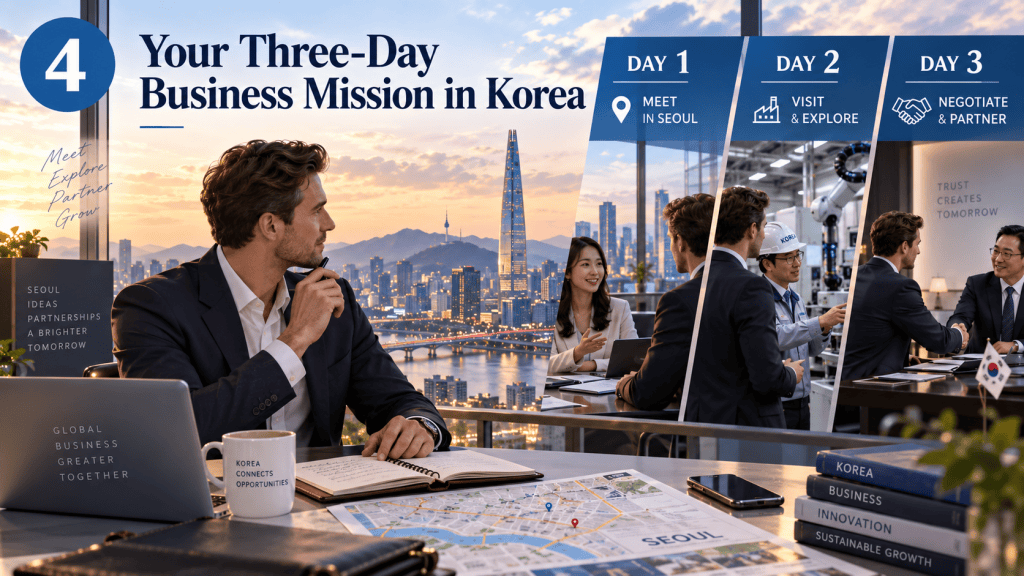
Now comes the most important part.
How can you turn a short visit into meaningful business opportunities?
The following three-day itinerary is designed for international buyers who have already identified potential Korean partners and arranged appointments before arriving.
DAY 1 — Discover the Korean Market and Meet Potential Partners
Mission: Identify companies that match your business objectives.
| Time | Activity | What You Should Accomplish |
|---|---|---|
| 9:00–10:00 AM | Review your business objectives and meeting schedule | Finalize priorities and questions |
| 10:00–11:30 AM | First Korean company meeting | Understand products, capabilities, and export experience |
| 11:30 AM–12:30 PM | Lunch and informal networking | Develop business relationships |
| 1:00–2:30 PM | Second company meeting | Explore alternative products and business models |
| 3:00–4:30 PM | Third company meeting or industry exhibition | Compare suppliers and discover additional opportunities |
| 5:00–6:00 PM | Review meeting results | Identify your most promising potential partners |
Five Questions to Ask Every Korean Supplier
| No. | Important Question |
|---|---|
| 1 | Do you manufacture the products directly? |
| 2 | Which countries do you currently export to? |
| 3 | What is your minimum order quantity? |
| 4 | Can you provide private-label or customized products? |
| 5 | What certifications and quality-control systems do you have? |
Day 1 Goal: Create a shortlist of two or three companies for further evaluation.
DAY 2 — Visit a Korean Factory and Evaluate Product Quality
Mission: Understand how your potential partner actually operates.
A factory visit can provide valuable insights that cannot always be obtained through online meetings or product catalogs.
However, factory tours generally require advance arrangements and approval.
What to Examine During a Factory Visit
| Evaluation Area | What to Look For | Why It Matters |
|---|---|---|
| Manufacturing Facilities | Production lines, equipment, maintenance | Helps assess production capabilities |
| Quality Management | Inspection procedures and testing equipment | Helps evaluate product consistency |
| Production Capacity | Maximum output and current commitments | Indicates ability to meet demand |
| Workforce | Technical expertise and training | Supports understanding of operational capabilities |
| Research & Development | Product development and testing | Indicates customization potential |
| Packaging | Packaging materials and labeling processes | Important for international distribution |
| Export Preparation | Documentation and shipping procedures | Helps identify potential delivery problems |
| Product Samples | Appearance, performance, and specifications | Enables practical product evaluation |
Recommended Day 2 Schedule
| Time | Activity |
|---|---|
| 9:00–10:00 AM | Travel to the manufacturing facility |
| 10:00 AM–12:00 PM | Factory tour and management meeting |
| 12:00–1:00 PM | Lunch with the company |
| 1:00–2:30 PM | Product demonstrations and quality discussions |
| 2:30–3:30 PM | Pricing, order quantity, and delivery discussions |
| 3:30–5:00 PM | Travel and follow-up meetings, if practical |
| Evening | Review supplier documentation and outstanding questions |
Allow additional travel time if the factory is outside Seoul.
Day 2 Goal: Understand your potential supplier’s manufacturing capabilities and identify the information needed before making a purchasing decision.
DAY 3 — Negotiate, Compare, and Build Your Partnership
Mission: Turn business conversations into a practical action plan.
Your final day should focus on evaluating suppliers, comparing offers, and agreeing on the next steps.
Business Negotiation Checklist
| Negotiation Item | What You Should Confirm |
|---|---|
| Product Price | Unit price and available volume discounts |
| MOQ | Minimum order quantity |
| Payment Terms | Deposit, balance, and acceptable payment methods |
| Lead Time | Production and delivery schedule |
| Product Customization | Available modifications and associated costs |
| Packaging | Standard and customized packaging options |
| Shipping | Agreed shipping responsibilities and destination |
| Quality Assurance | Inspection procedures and defect-handling process |
| Distribution Rights | Territory, exclusivity, and sales conditions |
| After-Sales Service | Warranty, replacement, and customer support |
Day 3 Schedule
| Time | Activity |
|---|---|
| 9:00–10:30 AM | Compare supplier proposals |
| 10:30 AM–12:00 PM | Meet your preferred potential partner |
| 12:00–1:00 PM | Business lunch |
| 1:00–2:30 PM | Negotiate commercial terms |
| 2:30–4:00 PM | Discuss samples, documentation, and next steps |
| 4:00–5:00 PM | Confirm follow-up responsibilities and timelines |
Day 3 Goal: Leave Korea with a clear understanding of which companies you want to work with and what must happen before a transaction can proceed.
5. How Much Does It Cost to Work with a Korean Manufacturer?
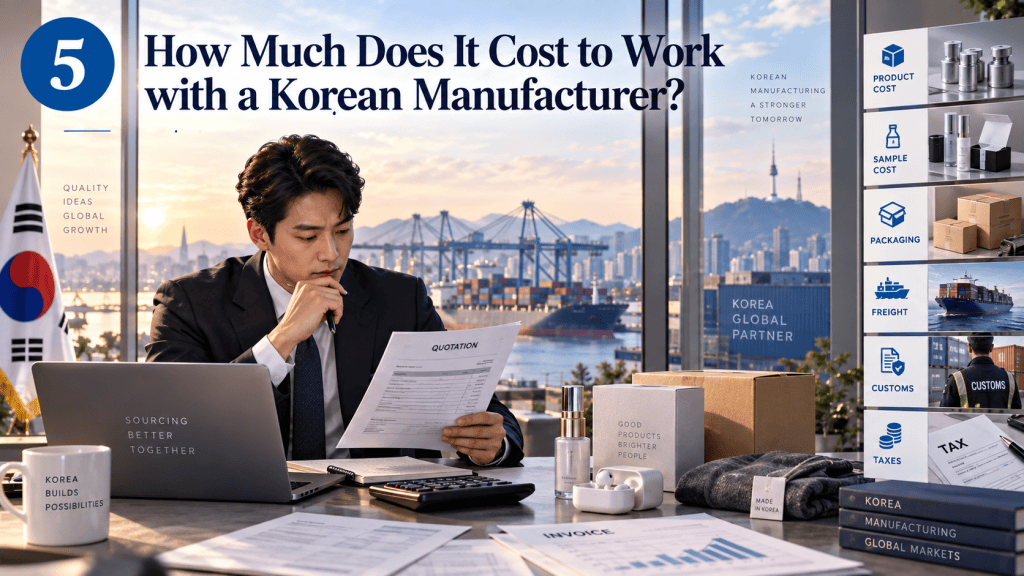
This is one of the most common questions international buyers have.
The answer depends on the type of product, order quantity, materials, manufacturing complexity, and customization requirements.
Rather than focusing only on the product’s unit price, you should understand the complete cost of importing it.
Understanding Import Costs
| Cost Category | Description |
|---|---|
| Product Cost | Price paid to the Korean supplier |
| Sample Cost | Cost of evaluating products before ordering |
| Product Development | Customized formulas, designs, or specifications |
| Packaging Cost | Boxes, labels, printing, and branding |
| Quality Inspection | Product testing and independent inspection |
| International Freight | Transportation to your destination |
| Insurance | Protection against specified transportation risks |
| Customs Duties | Applicable import duties |
| Taxes | Applicable import taxes and other charges |
| Local Compliance | Registration, testing, and documentation required in your market |
A Simple Example
Suppose you want to import Korean skincare products.
Your Korean supplier offers:
| Item | Example Amount |
|---|---|
| Product Price | US$5.00 per unit |
| Order Quantity | 2,000 units |
| Total Product Value | US$10,000 |
| Packaging and Customization | US$1,000 |
| Estimated Freight | US$800 |
| Estimated Total Before Other Import Costs | US$11,800 |
This example is illustrative, not a quotation or a typical Korean market price.
Customs duties, taxes, insurance, product testing, and other applicable expenses are not included.
Your estimated cost before those additional charges would be US$5.90 per unit.
Business Tip: Ask your supplier for a detailed written quotation specifying the applicable Incoterms® rule, named destination or delivery point, and which party is responsible for each transportation cost.
6. How to Verify a Korean Business Partner Before Signing a Contract

Finding an attractive product is only the beginning.
The next step is confirming whether the supplier can deliver what it promises.
Ten Essential Supplier Verification Questions
| No. | Verification Item | What You Should Request or Confirm |
|---|---|---|
| 1 | Legal Company Identity | Registered company name and business registration number |
| 2 | Business Location | Registered office and actual operating address |
| 3 | Manufacturing Capability | Factory information and production capacity |
| 4 | Export Experience | Previous export markets and relevant experience |
| 5 | Quality Certifications | Applicable certificates and issuing organizations |
| 6 | Product Compliance | Documents required in your destination country |
| 7 | Financial Arrangements | Official banking information and payment conditions |
| 8 | Production Schedule | Written production and delivery commitments |
| 9 | Product Quality | Approved samples and documented specifications |
| 10 | Contractual Protection | Quality obligations, dispute procedures, and remedies |
Three Important Warning Signs
1. The company refuses to provide basic business information.
A legitimate potential partner should normally be able to identify its legal entity and provide the information needed for a commercial transaction.
2. The supplier requests payment to an unrelated personal bank account.
Confirm that banking instructions match the contracted legal entity. Independently verify any changes to payment instructions through a previously established communication channel.
3. Product claims cannot be supported by documentation.
If the supplier claims that a product meets a particular certification or regulatory requirement, request the relevant documentation and verify its authenticity and applicability.
For significant transactions, consider independent inspections, appropriate payment protection, and professional legal advice.
7. Korean Business Expressions That Can Help You Build Relationships

You do not need to speak Korean fluently to do business in Korea.
However, learning a few professional Korean expressions can help create a welcoming atmosphere during your meetings.
Useful Korean Business Expressions
| English | Korean | Approximate Pronunciation |
|---|---|---|
| Hello | 안녕하세요 | An-nyeong-ha-se-yo |
| Nice to meet you | 만나서 반갑습니다 | Man-na-seo ban-gap-seum-ni-da |
| Thank you | 감사합니다 | Gam-sa-ham-ni-da |
| Please send me your company profile. | 회사소개서를 보내주시겠습니까? | Hoe-sa so-gae-seo-reul bo-nae-ju-si-get-seum-ni-kka? |
| I would like to discuss a business partnership. | 사업 협력에 대해 논의하고 싶습니다. | Sa-eop hyeom-nyeo-ge dae-hae non-ui-ha-go sip-seum-ni-da |
| I look forward to working with you. | 앞으로 잘 부탁드립니다. | A-peu-ro jal bu-tak-deu-rim-ni-da |
For technical or contractual discussions, professional interpretation can be useful when the parties are not equally comfortable communicating in the same language.
8. How to Arrange Your Korean Business Meetings Before Arrival
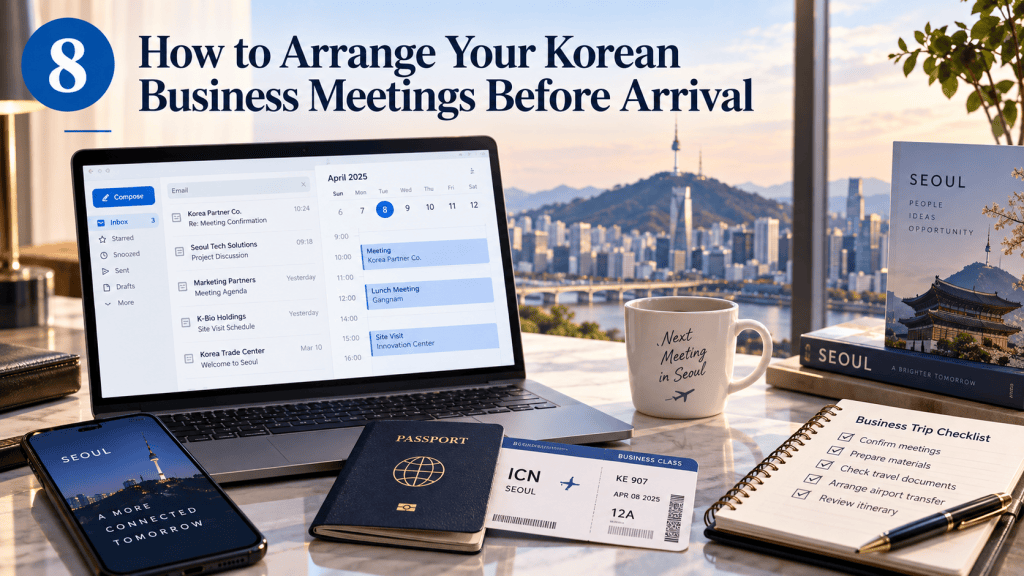
One of the most important lessons for international business visitors is simple:
Do not wait until you arrive in Korea to start looking for business partners.
Ideally, begin contacting potential suppliers two to four weeks before your planned visit, or earlier if your trip involves specialized manufacturing facilities.
Your Pre-Departure Preparation Plan
| Before Departure | Recommended Action |
|---|---|
| 4 Weeks | Identify industries and potential suppliers |
| 3 Weeks | Contact Korean companies and request meetings |
| 2 Weeks | Review company profiles and product information |
| 10 Days | Confirm meetings and possible factory visits |
| 7 Days | Finalize your business itinerary |
| 3 Days | Prepare presentations, questions, and documents |
| 1 Day | Reconfirm appointments and transportation arrangements |
Sample Email: Requesting a Business Meeting in Korea
Subject: Business Partnership Inquiry – Meeting Request During My Visit to Korea
Dear [Name],
My name is [Your Name], and I am the [Your Position] of [Company Name], based in [Country].
Our company is currently exploring opportunities to establish business partnerships with Korean manufacturers and suppliers.
We are particularly interested in your company’s products and would appreciate the opportunity to learn more about your business.
I will be visiting Korea from [Date] to [Date] and would like to arrange a meeting with your team during my stay.
If possible, I would also be interested in discussing a potential factory visit.
Please let me know your availability.
I look forward to the possibility of building a mutually beneficial business relationship.
Best regards,
[Your Name]
[Position]
[Company Name]
[Country]
[Email / WhatsApp]
9. Where to Discover Korean Trade Shows and Business Events
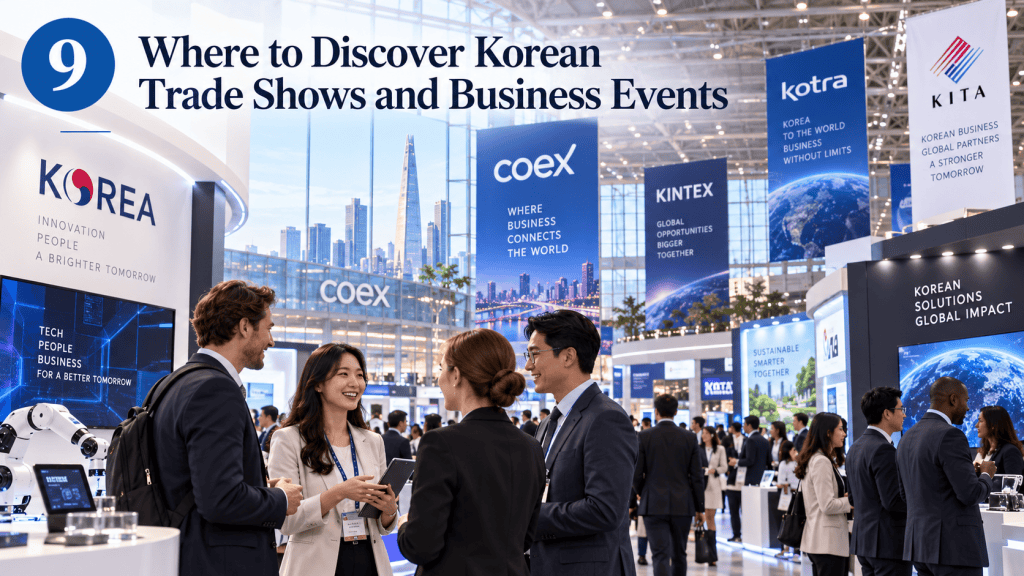
Trade shows offer another way to discover potential partners, explore products, and meet industry professionals.
Depending on your business interests, exhibitions may offer opportunities to speak with multiple companies in a single day.
Official Resources for Korean Business Events
| Organization / Platform | What You Can Find | Website |
|---|---|---|
| KOTRA | Export business meetings and international trade events | KOTRA |
| COEX | Exhibitions and conventions in Seoul | COEX |
| KINTEX | International exhibitions and business events | KINTEX |
| KITA | International trade information and business matching | KITA |
| tradeKorea | Korean supplier discovery and business matching | tradeKorea |
Check official event schedules, buyer registration requirements, and meeting availability before booking your trip.
10. Your Final Korea Business Mission Checklist

Before leaving Korea, review the following checklist.
| Business Mission Checklist | Completed? |
|---|---|
| Identified potential Korean business partners | ☐ |
| Met relevant suppliers and manufacturers | ☐ |
| Reviewed company profiles | ☐ |
| Evaluated products and samples | ☐ |
| Discussed manufacturing capabilities | ☐ |
| Requested detailed price quotations | ☐ |
| Confirmed minimum order quantities | ☐ |
| Discussed production and delivery schedules | ☐ |
| Reviewed available certifications | ☐ |
| Confirmed export and import requirements | ☐ |
| Identified preferred potential partners | ☐ |
| Agreed on follow-up meetings and responsibilities | ☐ |
You do not need to sign a contract during your three-day visit.
A successful business mission may simply mean discovering suitable partners, eliminating unsuitable suppliers, and obtaining the information necessary to make a sound business decision.
Final Thoughts: Three Days in Korea Could Be the Beginning of Your Next Global Business Opportunity
For international entrepreneurs, importers, distributors, and investors, South Korea offers much more than an opportunity to discover popular products.
It offers access to manufacturing expertise, innovative technology, specialized suppliers, and companies interested in expanding their international business relationships.
But the success of your visit depends on preparation.
Find the right companies before arriving.
Arrange meaningful meetings.
Ask detailed questions.
Understand the manufacturing process.
Verify your potential partners.
And most importantly, build relationships that can continue long after you return home.
You may spend only three days in Korea, but the business relationships you establish could create opportunities for years to come.
Welcome to Korea. Your Next Business Opportunity May Be Waiting Here.
Suggested SEO Keywords: Business in Korea, Korean Manufacturers, Korean Suppliers, Korea Business Trip, KOTRA, tradeKorea, Korean Business Partners, Import from Korea, OEM Korea, ODM Korea, Korean Export Companies, South Korea Business Guide.
Suggested Hashtags:
#BusinessInKorea #KoreanSuppliers #KoreanManufacturers #KoreaBusinessTrip #KOTRA #TradeKorea #GlobalBusiness #ImportFromKorea #BusinessPartnership #MadeInKorea


Leave a Reply