
One Day in Korea, A Healthier Future Ahead!
The Ultimate Guide to Premium Medical Checkups in South Korea
From Comprehensive Health Screening and Cancer Prevention to Women’s Health and Personalized Wellness — Discover a Different Side of Korean Medical Tourism
Your journey to South Korea could be more than a vacation. It could be an opportunity to understand your health and make informed decisions about your future.
INTRODUCTION
What If Your Next Trip to Korea Could Help You Understand Your Health?
When people think about traveling to South Korea, they often imagine exciting experiences.
Exploring the streets of Seoul.
Visiting Gyeongbokgung Palace.
Shopping for K-Beauty products in Myeongdong.
Enjoying authentic Korean food.
Discovering the world of K-POP and Korean culture.
But there is another reason international visitors may choose to travel to Korea.
A comprehensive medical checkup.
South Korea offers a variety of preventive healthcare and health-screening services through hospitals, health promotion centers, and medical institutions serving international patients.
Some medical centers provide coordinated screening programs that allow visitors to complete multiple examinations during a single appointment.
Depending on the hospital and selected program, these may include blood tests, cardiovascular assessments, gastrointestinal examinations, selected cancer screenings, and imaging tests.
International patient services may also include language assistance, appointment coordination, medical documentation, and follow-up arrangements.
Korea’s official Medical Korea platform provides information about the country’s international healthcare services and registered medical institutions serving foreign patients. (Medical Korea)
But what exactly happens during a Korean medical checkup?
How much does it cost?
Which examinations should you consider?
Can international visitors receive English-language assistance?
How long does the process take?
And how can you combine a medical appointment with an enjoyable trip to Korea?
In this K-MEDICAL SPECIAL, we explore 10 essential topics to help international visitors understand Korean health-screening services.
You will also find practical comparison tables, published hospital prices in four currencies, preparation guidelines, and useful Korean medical expressions.
One important point: A comprehensive checkup is not a guarantee of perfect health. The most valuable screening plan is one selected according to your age, medical history, symptoms, and individual risk factors.
1. Why Consider a Medical Checkup in South Korea?
Discover a Different Side of K-Medical

Korean medical tourism is not limited to plastic surgery, dermatology, or cosmetic treatments.
Preventive healthcare and medical screening are also part of the country’s international medical services.
Hospitals such as Seoul St. Mary’s Hospital offer dedicated international health-screening programs covering general health, cancer-related examinations, cardiovascular health, digestive health, and other medical concerns.
These programs organize different examinations into coordinated packages, although not every included test will necessarily be appropriate for every visitor. (CMC 서울 의료)
What Can You Explore Through Korean Health Screening?
| Area | Examples of Available Examinations | Purpose |
|---|---|---|
| General Health | Medical Consultation, Blood Pressure, Physical Measurements | Review Overall Health Status |
| Blood Tests | Blood Count, Glucose, Lipid Profile | Assess Selected Health Indicators |
| Cardiovascular Health | ECG, Selected Cardiac Examinations | Investigate Appropriate Heart-Related Concerns |
| Digestive Health | Gastroscopy, Colonoscopy | Examine the Digestive Tract When Indicated |
| Cancer Screening | Mammography, Cervical Screening, Selected Other Tests | Screen for Particular Cancers in Eligible Patients |
| Women’s Health | Gynecological Consultation, Breast and Cervical Examinations | Address Relevant Women’s Health Concerns |
| Bone Health | Bone Density Measurement | Assess Osteoporosis Risk |
| Medical Imaging | Ultrasound, CT, MRI | Investigate Specific Medical Questions |
What Makes a Coordinated Checkup Convenient?
For international visitors, the attraction often lies in the ability to organize multiple examinations through one medical institution.
Instead of separately arranging several appointments, a hospital may coordinate a personalized schedule.
Some centers also offer consultations and written results in languages other than Korean.
However, the precise services depend on the hospital.
K-MEDICAL INSIGHT
A medical checkup should not be viewed as a competition to complete the greatest number of tests.
The goal is to identify useful health information and determine whether further medical attention is needed.
2. What Happens During a Korean Comprehensive Medical Checkup?
From Registration to Medical Consultation

If you have never received a health examination in Korea, the process may seem unfamiliar.
Understanding the steps in advance can make the experience more comfortable.
A typical comprehensive checkup may involve registration, a review of medical history, physical measurements, selected laboratory tests, medical imaging, and a later consultation to discuss the results.
The Korean Health Checkup Process
| Step | Procedure | What to Expect |
|---|---|---|
| 1 | Reservation | Select a Medical Institution and Discuss Suitable Screening Options |
| 2 | Medical Questionnaire | Provide Health History, Symptoms, and Medication Information |
| 3 | Registration | Confirm Identity, Examination Schedule, and Payment |
| 4 | Physical Measurements | Height, Weight, Waist Circumference, Blood Pressure |
| 5 | Laboratory Tests | Blood and Urine Tests, If Included |
| 6 | Cardiovascular Assessment | ECG or Other Clinically Appropriate Tests |
| 7 | Medical Imaging | Ultrasound, X-Ray, CT, or MRI When Indicated |
| 8 | Gastrointestinal Examination | Gastroscopy or Colonoscopy, If Appropriate |
| 9 | Completion | Receive Initial Instructions and Recovery Guidance |
| 10 | Results Consultation | Review Findings and Any Recommended Next Steps |
Seoul St. Mary’s Hospital describes a similar sequence, including registration, examinations, completion, and a subsequent appointment for consultation about the results. (CMC 서울 의료)
Can Everything Be Completed in One Day?
Many coordinated screening packages aim to complete the scheduled examinations during one visit.
However, completing the tests in one day does not mean receiving every result on the same day.
Some laboratory results may be available relatively quickly, while specialist interpretation, biopsy results, or additional investigations may require more time.
Typical Scheduling Considerations
| Examination | What Visitors Should Know |
|---|---|
| Blood Tests | Sample collection is usually brief; results may take longer |
| Urine Tests | Often collected during the checkup |
| Ultrasound | Appointment length depends on the area examined |
| CT | The scan itself may be brief, but preparation and interpretation take additional time |
| MRI | Imaging time varies by body area and examination type |
| Gastroscopy | Preparation, examination, and recovery may be needed |
| Colonoscopy | Requires advance bowel preparation and may involve sedation |
| Biopsy | Laboratory analysis may require additional days |
Important Travel Planning Tip
Ask your hospital two separate questions:
“How long will the examinations take?”
“When will the complete medical report be available?”
These are not necessarily the same.
3. Which Health Screenings Should You Consider at Different Ages?
A Practical Guide for Your 20s, 30s, 40s, 50s, and Beyond

One of the most useful approaches to preventive healthcare is choosing examinations according to your personal risk.
A healthy person in their twenties may have very different screening needs from someone in their fifties with diabetes, high blood pressure, or a family history of cancer.
Age is important, but it should never be the only deciding factor.
Smoking history, previous illnesses, medication use, family history, and existing symptoms also matter.
Health Screening Considerations by Age
| Age Group | Main Health Priorities | Examinations to Discuss |
|---|---|---|
| 20s | Establishing a Healthy Baseline | Blood Pressure, Weight, Relevant Infection Screening, Cervical Screening When Eligible |
| 30s | Long-Term Health Risk Management | Blood Pressure, Diabetes and Cholesterol Risk Assessment, Relevant Preventive Screening |
| 40s | Cancer Prevention and Cardiovascular Risk | Age-Appropriate Cancer Screening, Blood Pressure, Metabolic Risk Assessment |
| 50s | Cardiovascular and Cancer-Related Risks | Colorectal Screening, Breast Screening When Eligible, Bone Health Assessment When Indicated |
| 60s | Chronic Disease and Functional Health | Appropriate Cancer Screening, Diabetes, Cardiovascular Risk, Bone Health |
| 70s and Beyond | Maintaining Function and Quality of Life | Individualized Screening, Medication Review, Mobility and Fall Risk |
This table provides discussion topics, not a schedule requiring every person to undergo all listed examinations.
What About Cancer Screening Ages?
Different countries use different screening guidelines.
For example, Korea’s National Cancer Screening Program includes stomach cancer screening beginning at age 40 and breast cancer screening for women beginning at age 40, while its published colorectal program uses a different starting age from some international clinical guidelines.
A 2025 revision of Korean colorectal cancer screening guidance also discusses screening beginning at age 45 for average-risk adults, illustrating why a clinician should consider current clinical guidance rather than relying only on an older program eligibility table. (국립암센터)
K-MEDICAL INSIGHT
Your ideal health checkup is not determined by age alone.
A personalized program should reflect your medical history, existing health risks, and current evidence-based screening recommendations.
4. Women’s Health Screening in Korea
A Personalized Approach to Women’s Preventive Healthcare

Women’s health screening is an important area of preventive medicine.
Depending on age, medical history, and individual risk, a clinician may discuss breast health, cervical cancer prevention, reproductive health, and bone health.
Korean medical institutions offer a range of women’s health services, including dedicated screening packages.
However, the number of examinations included in a commercial package should not be confused with the number medically recommended for an individual.
① Breast Health
Mammography is an established breast cancer screening method for women in appropriate age and risk groups.
The U.S. Preventive Services Task Force recommends mammography every two years for average-risk women aged 40–74.
Korea’s national program also includes mammography beginning at age 40, although eligibility and screening schedules may differ by healthcare system. (미국 예방 서비스 태스크 포스)
Breast Health Examinations
| Examination | Main Purpose | Important Consideration |
|---|---|---|
| Mammography | Breast Cancer Screening | Recommended According to Age and Risk |
| Breast Ultrasound | Evaluation of Selected Findings | Not Automatically a Replacement for Mammography |
| Breast MRI | Selected High-Risk Screening or Diagnostic Situations | Not Routinely Needed for Everyone |
| Clinical Consultation | Review of Symptoms and Risk Factors | Helps Determine Appropriate Testing |
② Cervical Health
Cervical cancer screening is another important component of preventive healthcare.
Available tests may include:
- Pap Smear
- HPV Testing
- Combined Screening in Appropriate Circumstances
Screening intervals and starting ages depend on the guideline and personal risk factors.
The American College of Obstetricians and Gynecologists endorsed updated U.S. cervical cancer screening guidance in July 2026, reflecting developments in HPV-based screening options. (미국산부인과학회)
③ Bone Health
Bone density testing may be appropriate for women at increased risk of osteoporosis.
Postmenopausal status, age, family history, medications, and previous fractures can influence the decision.
The American College of Obstetricians and Gynecologists recommends bone density screening for women aged 65 and older and younger postmenopausal women when fracture risk is elevated. (미국산부인과학회)
Women’s Health Screening Overview
| Health Concern | Possible Examination | Main Consideration |
|---|---|---|
| Breast Cancer | Mammography | Age and Breast Cancer Risk |
| Cervical Cancer | Pap Smear or HPV Test | Age, Screening History, and Risk |
| Osteoporosis | Bone Density Scan | Age and Fracture Risk |
| Anemia | Blood Tests | Symptoms, Menstrual History, Medical Conditions |
| Thyroid Disorders | Thyroid Function Tests | Symptoms and Individual Risk |
| Reproductive Health | Gynecological Consultation | Personal Medical Needs |
Important: More Tests Do Not Always Mean Better Screening
Some premium packages include ovarian tumor markers or pelvic ultrasound.
However, the U.S. Preventive Services Task Force recommends against routine ovarian cancer screening in asymptomatic women who are not known to have a high-risk hereditary cancer syndrome.
Women with significant family histories or inherited risk factors need individualized medical advice. (미국 예방 서비스 태스크 포스)
K-MEDICAL INSIGHT
Women’s healthcare should be personalized.
A meaningful screening plan considers your individual health needs rather than simply adding every available examination.
5. Understanding Cancer Screening in South Korea
What International Visitors Should Know
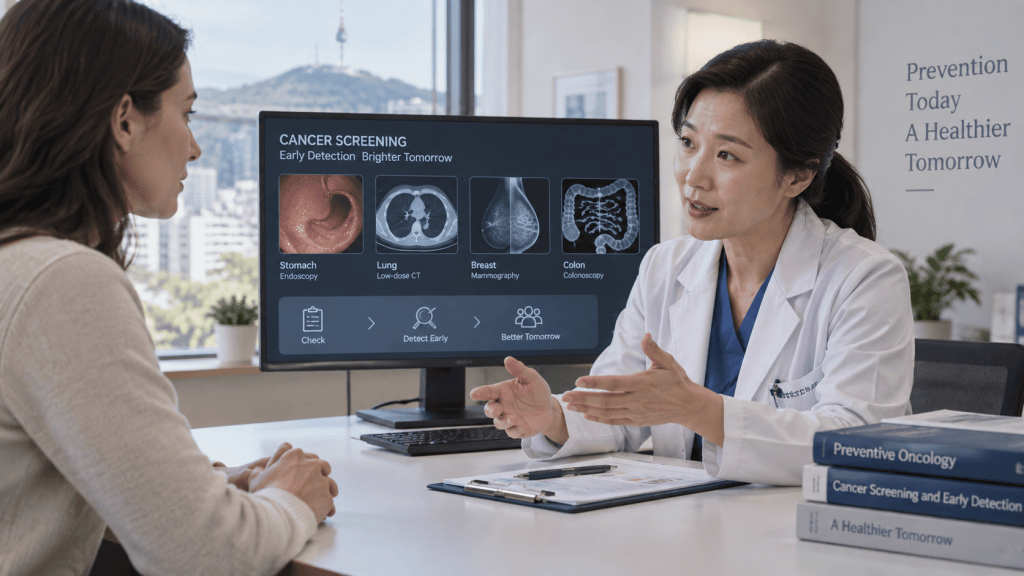
Cancer screening is often one of the main reasons people become interested in comprehensive medical examinations.
The purpose of cancer screening is to identify particular diseases before symptoms appear, when early detection may offer meaningful benefits.
However, cancer screening is not one single test.
Different cancers require different screening methods.
Some tests are supported by strong evidence for particular populations, while others may offer little benefit to people without symptoms.
Korea’s National Cancer Screening Program
Korea’s National Cancer Center describes a national program covering six cancer sites:
Stomach, liver, colorectum, breast, cervix, and lung.
The target population and test frequency vary according to cancer type and risk. (국립암센터)
Selected Korean National Cancer Screening Criteria
| Cancer Type | Population | Screening Approach |
|---|---|---|
| Stomach Cancer | Adults Aged 40+ | Screening Every 2 Years |
| Liver Cancer | Adults Aged 40+ in Defined High-Risk Groups | Ultrasound and AFP Every 6 Months |
| Colorectal Cancer | Adults Aged 50+ in the Published National Program | Annual Stool-Based Screening, Follow-Up When Indicated |
| Breast Cancer | Women Aged 40+ | Mammography Every 2 Years |
| Cervical Cancer | Women Aged 20+ | Cervical Cytology Every 2 Years |
| Lung Cancer | Adults Aged 54–74 Meeting High-Risk Smoking Criteria | Low-Dose CT Every 2 Years |
These describe the National Cancer Center’s published national program criteria, not universal recommendations for international visitors. Program eligibility, payment arrangements, and clinical screening guidance must be checked separately.
Why Lung Cancer Screening Is Different
Low-dose CT can be an important screening tool for people at high risk of lung cancer.
But it is not intended as a routine test for every healthy adult.
For example, U.S. CDC guidance updated in May 2026 recommends annual low-dose CT screening for adults aged 50–80 who have a smoking history of at least 20 pack-years and currently smoke or quit within the previous 15 years. (질병통제예방센터)
Can a Blood Test Detect Every Cancer?
No.
Some health-screening packages include several tumor marker blood tests.
However, tumor markers generally do not perform well as universal cancer screening tests for people without symptoms.
They may miss cancers or produce abnormal results in people who do not have cancer.
The U.S. National Cancer Institute explains that tumor markers often lack sufficient sensitivity or specificity for general population screening. (암 정보 포털)
Choosing Cancer Screening More Carefully
| Question | Why It Matters |
|---|---|
| Am I in the recommended age group? | Screening benefits vary with age |
| Do I have a family history of cancer? | Some people need earlier or specialized assessment |
| Have I already completed this screening? | Avoid unnecessary repetition |
| Is this test recommended for my risk group? | Not all tests provide proven benefits |
| What happens if the result is abnormal? | Follow-up may be necessary |
| Can I complete follow-up in my home country? | Particularly important for medical travelers |
K-MEDICAL INSIGHT
Cancer screening is most useful when the correct test is offered to the appropriate person at an appropriate interval.
6. MRI, CT, and Ultrasound: What’s the Difference?
Understanding Medical Imaging Before Your Checkup
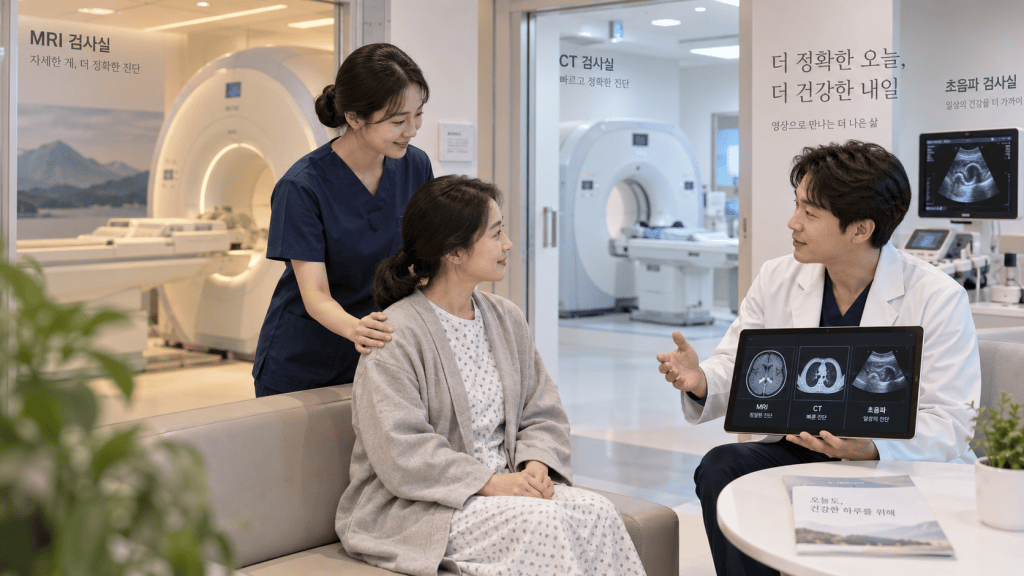
International visitors researching Korean premium health-screening packages may encounter examinations such as MRI, CT, ultrasound, and X-ray.
These technologies help medical professionals examine different parts of the body.
However, they are not interchangeable.
Each has specific applications, advantages, and limitations.
MRI — Magnetic Resonance Imaging
MRI uses strong magnetic fields and radiofrequency signals to produce detailed images of internal tissues.
It can be particularly useful for examining certain organs, joints, the brain, and soft tissues.
MRI does not use ionizing radiation.
However, examinations may take longer, and certain implants or medical devices require special safety assessment.
CT — Computed Tomography
CT uses X-rays to produce detailed cross-sectional images.
It can be valuable in diagnosing many medical conditions.
However, CT involves ionizing radiation.
For healthy people without symptoms, whole-body CT screening has not been shown to provide greater benefit than harm.
The U.S. FDA advises careful consideration of unnecessary radiation exposure and the possibility of false-positive findings. (U.S. Food and Drug Administration)
Ultrasound
Ultrasound uses sound waves to produce images of internal structures.
It does not use ionizing radiation.
It may be used to examine the abdomen, thyroid, heart, reproductive organs, and other areas when appropriate.
MRI vs. CT vs. Ultrasound
| Category | MRI | CT | Ultrasound |
|---|---|---|---|
| Technology | Magnetic Fields and Radio Waves | X-Rays | Sound Waves |
| Ionizing Radiation | No | Yes | No |
| Main Applications | Selected Soft Tissue, Brain, Spine, Joint, and Organ Examinations | Selected Chest, Abdomen, Bone, and Vascular Examinations | Selected Abdominal, Thyroid, Cardiac, and Pelvic Examinations |
| Examination Time | Often Longer | Often Relatively Short | Varies by Area |
| Contrast Agent | Sometimes Required | Sometimes Required | Usually Not Required for Routine Ultrasound |
| Main Considerations | Implant Safety, Claustrophobia, Contrast When Used | Radiation and Contrast Risks | Operator and Examination Limitations |
Is Whole-Body MRI Necessary?
Not necessarily.
The American College of Radiology states that there is insufficient evidence to recommend total-body MRI screening for people who have no symptoms, relevant risk factors, or family history suggesting underlying disease. (American College of Radiology)
Questions to Ask Before Medical Imaging
“Why is this examination recommended for me?”
“What specific condition are we investigating?”
“Are there alternatives?”
“Will contrast material be used?”
“Does my medical history affect the safety of the examination?”
K-MEDICAL INSIGHT
Advanced medical technology is valuable when it answers an important clinical question.
A more expensive scan does not automatically mean a more useful health checkup.
7. How Much Does a Premium Health Checkup Cost in Korea?
Korean Medical Screening Prices in Four Currencies

One of the most important questions international visitors ask is:
“How much should I budget for a comprehensive medical checkup in South Korea?”
Costs vary depending on the hospital, selected examinations, screening program, medical consultation, and additional services.
A basic screening package and an extensive premium package can differ considerably.
To provide a concrete example, the following prices are taken from the published international health-screening programs of Seoul St. Mary’s Hospital.
These are hospital-specific examples, not nationwide average prices or guaranteed quotations. (CMC 서울 의료)
Published Korean Health Screening Price Examples
| Program | Published Price |
|---|---|
| International Basic — Men | ₩1,300,000 |
| International Basic — Women | ₩1,450,000 |
| International Cancer Intensive — Men | ₩3,040,000 |
| International Cancer Intensive — Women | ₩3,570,000 |
| International Marian S — Men | ₩6,200,000 |
| International Marian S — Women | ₩6,760,000 |
Approximate Cost in KRW, USD, JPY, and CNY
The following conversions use XE’s September 18, 2026 reference mid-market exchange rates.
| Program | KRW | USD | JPY | CNY |
|---|---|---|---|---|
| International Basic — Men | ₩1,300,000 | $936 | ¥146,934 | ¥6,278 |
| International Basic — Women | ₩1,450,000 | $1,044 | ¥163,887 | ¥7,002 |
| International Cancer Intensive — Men | ₩3,040,000 | $2,189 | ¥343,599 | ¥14,680 |
| International Cancer Intensive — Women | ₩3,570,000 | $2,571 | ¥403,502 | ¥17,239 |
| International Marian S — Men | ₩6,200,000 | $4,465 | ¥700,760 | ¥29,940 |
| International Marian S — Women | ₩6,760,000 | $4,868 | ¥764,055 | ¥32,644 |
The table uses approximately 0.00072018 USD, 0.113026 JPY, and 0.00482898 CNY per KRW. Actual exchange rates, bank charges, hospital fees, and package availability may change. (Xe)
Understanding the Different Programs
| Program Type | General Focus | What to Consider |
|---|---|---|
| Basic | Broad Health Assessment | Suitable Starting Point for Discussing General Health Needs |
| Cancer-Focused | Additional Cancer-Related Examinations | Individual Cancer Risk and Appropriateness of Included Tests |
| Cardiovascular | Selected Heart and Vascular Examinations | Medical History and Cardiovascular Risk |
| Women’s Health | Selected Breast, Cervical, and Other Examinations | Age, Symptoms, and Personal Risk |
| Premium | Extensive Combined Examinations | Whether Every Included Test Has Clinical Value for You |
A premium package may include more examinations, but it is not necessarily the right choice for every patient.
Seven Questions to Ask About Pricing
| Question | Why It Matters |
|---|---|
| What examinations are included? | Package Contents Differ |
| Is a physician consultation included? | Consultation Arrangements Vary |
| Is medical interpretation included? | Language Assistance May Affect Cost |
| Is sedation included? | Endoscopy-Related Charges May Differ |
| Are additional tests charged separately? | Unexpected Findings May Require More Testing |
| Are translated reports included? | Important for International Visitors |
| What is the cancellation policy? | Travel Plans May Change |
K-MEDICAL INSIGHT
Choose your medical screening program based on clinical value and your personal health needs—not simply the number of tests or the package’s luxury positioning.
8. How Can International Visitors Choose a Hospital in Korea?
Finding Reliable Medical Services and Language Support

Choosing the right medical institution is an essential part of planning a health-screening trip.
For international visitors, location and price are important, but they are not the only factors.
You should also consider the medical institution’s qualifications, screening services, language support, and follow-up arrangements.
Start with Medical Korea
Medical Korea provides official information about Korean medical institutions serving international patients.
Its registered hospital database allows users to search for medical institutions in different regions, including Seoul, Busan, Incheon, Daegu, and other parts of Korea.
The foreign-patient registration system includes requirements intended to support international patient protection. (Medical Korea)
Official Website:
Medical Korea – Registered Hospitals
What Should You Look for in a Health Screening Center?
| Selection Criteria | What to Confirm |
|---|---|
| Medical Institution | Official Registration and Relevant Medical Services |
| Medical Professionals | Qualifications and Specialist Availability |
| Screening Programs | Appropriate Examinations for Your Needs |
| Language Support | English or Other Preferred Languages |
| Medical Records | Availability of Reports and Imaging Files |
| Follow-Up | Access to Additional Consultations |
| International Services | Appointment and Travel Coordination, If Available |
| Pricing | Transparent Written Quotation |
International Patient Support Services
Some Korean hospitals offer international healthcare centers or dedicated services for foreign visitors.
Depending on the hospital, these may include:
- Appointment Coordination
- Medical Interpretation
- Assistance with Hospital Procedures
- Medical Report Translation
- Follow-Up Arrangements
- Referral to Appropriate Specialists
Medical Korea also provides an accreditation-related database where users can explore institutions and available interpretation languages. (Medical Korea)
Five Important Questions Before Booking
“Do you offer comprehensive health screening for international visitors?”
“Can I receive a consultation in English?”
“Can I receive my medical report in English?”
“How long will it take to receive all results?”
“Can I arrange follow-up care after returning home?”
K-MEDICAL INSIGHT
A well-organized medical experience should provide more than a series of examinations.
Clear communication, reliable documentation, and appropriate follow-up are essential.
9. What Should You Know Before and After Your Medical Checkup?
Your Essential Preparation and Recovery Guide

Proper preparation helps medical examinations proceed safely and effectively.
However, different examinations require different preparation.
For example, an ordinary blood test, gastroscopy, colonoscopy, and contrast-enhanced CT may have different requirements.
Never assume that the same instructions apply to every screening package.
Before Your Medical Checkup
1. Confirm Fasting Instructions
Some laboratory tests and gastrointestinal examinations require fasting.
The duration and rules depend on the examination.
Seoul St. Mary’s Hospital provides detailed preparation instructions for morning and afternoon screening appointments, including fasting requirements and separate guidance for colonoscopy. (CMC 서울 의료)
2. Review Your Medication
Tell your medical provider about all medications you take.
This is particularly important for:
- Diabetes Medication
- Insulin
- Anticoagulants
- Antiplatelet Medication
- Blood Pressure Medication
- GLP-1 Medication
- Other Prescription Drugs
Do not stop prescribed medication on your own. Ask the medical team for instructions appropriate to your medication and procedure.
3. Prepare Your Medical History
Bring relevant information about previous illnesses, operations, allergies, and important medical findings.
Medical Checkup Preparation Checklist
| Item | What to Prepare |
|---|---|
| Passport | Identification |
| Appointment Confirmation | Hospital Reservation Details |
| Medical History | Previous Diagnoses and Operations |
| Medication List | Names and Dosages |
| Allergies | Medication and Contrast Allergies |
| Previous Reports | Relevant Laboratory and Imaging Results |
| Insurance Information | Coverage and Claims Requirements |
| Contact Information | Your Phone Number and Emergency Contact |
After Your Medical Checkup
Your recovery requirements depend on the tests performed.
If You Received Sedation
Sedation may temporarily affect judgment, coordination, and reaction time.
For example, Seoul St. Mary’s Hospital instructs patients not to drive on the day of an endoscopic examination performed under conscious sedation. (CMC 서울 의료)
Follow the hospital’s instructions regarding meals, activity, transportation, and medical supervision.
If You Had a Colonoscopy
Ask whether:
- A Biopsy Was Performed
- A Polyp Was Removed
- Special Dietary Instructions Apply
- You Need Follow-Up Testing
- Any Warning Symptoms Require Urgent Care
Severe or worsening abdominal pain, significant bleeding, fever, or other concerning symptoms should be assessed promptly.
If Your Results Are Abnormal
An abnormal result does not automatically mean that you have a serious disease.
Some findings require repeat testing, specialist assessment, or comparison with previous examinations.
Equally, a normal screening report does not guarantee that every disease has been excluded.
K-MEDICAL INSIGHT
A successful health checkup does not end when you leave the hospital.
Understanding your results and following an appropriate medical plan are equally important.
10. Combine K-Medical with an Unforgettable Korean Travel Experience
Health, Culture, and Discovery in One Journey

A medical checkup may be one part of a broader trip to South Korea.
International visitors can plan a journey that combines healthcare with Korean culture, shopping, food, and sightseeing.
However, medical recovery and examination requirements must take priority over tourism activities.
A simple health consultation may have little effect on travel plans, while colonoscopy, sedation, biopsy, or other procedures may require additional precautions.
Sample Five-Day K-Medical Travel Plan
The following itinerary is an illustrative example for a visitor arranging a medical checkup in Seoul.
It assumes that the hospital has confirmed the schedule and that no complications or urgent findings occur.
| Day | Main Activity | Travel Considerations |
|---|---|---|
| Day 1 | Arrive in Seoul and Check into Your Hotel | Confirm Your Appointment and Preparation Instructions |
| Day 2 | Medical Checkup | Prioritize Examinations and Recovery |
| Day 3 | Rest and Light Sightseeing, If Medically Appropriate | Follow the Hospital’s Aftercare Instructions |
| Day 4 | Explore Korean Culture and Shopping | Allow Flexibility for Follow-Up Appointments |
| Day 5 | Return Home or Continue Traveling | Confirm How Final Results Will Be Delivered |
What Can You Enjoy After Your Checkup?
Once your medical team confirms that normal activities are appropriate, you may explore Korean culture according to your interests.
Korean Experiences to Consider
| Interest | Experience |
|---|---|
| Traditional Culture | Historic Palaces and Korean Heritage |
| K-Beauty | Korean Cosmetics and Skincare Shopping |
| Korean Food | Traditional and Contemporary Korean Cuisine |
| Shopping | Fashion, Lifestyle, and Beauty Products |
| Relaxation | Parks, Cafés, and Scenic Walking Areas |
| Arts and Culture | Museums, Exhibitions, and Performances |
Avoid activities that conflict with fasting instructions, sedation precautions, or post-procedure restrictions.
Should You Choose Seoul or Busan?
Both cities offer different travel experiences.
Seoul is a major center for international visitors interested in Korean culture, shopping, and medical services.
Busan offers coastal attractions, urban sightseeing, and access to medical institutions.
Your medical needs, hospital location, available services, and travel schedule should determine where you receive care.
K-MEDICAL INSIGHT
The best K-Medical journey combines useful healthcare information with a comfortable, enjoyable travel experience.
But your medical needs should determine the travel plan—not the other way around.
BONUS 1
15 Essential Korean Expressions for Your Medical Checkup
International visitors may find these Korean expressions helpful when communicating with hospitals and health-screening centers.
| Situation | Korean Expression | English Meaning |
|---|---|---|
| Booking | 종합건강검진을 예약하고 싶습니다. | I would like to book a comprehensive health checkup. |
| Language | 영어 상담이 가능한가요? | Is consultation available in English? |
| Program | 어떤 건강검진 프로그램이 있나요? | What health-screening programs are available? |
| Price | 검진 비용은 얼마인가요? | How much does the checkup cost? |
| Duration | 검진에 얼마나 시간이 걸리나요? | How long will the examinations take? |
| Fasting | 검진 전에 금식해야 하나요? | Do I need to fast before the checkup? |
| Medication | 현재 복용 중인 약이 있습니다. | I am currently taking medication. |
| Allergy | 약물 알레르기가 있습니다. | I have a medication allergy. |
| Examination | 이 검사는 왜 필요한가요? | Why is this examination necessary? |
| Sedation | 수면내시경을 받을 수 있나요? | Can I have an endoscopy with sedation? |
| Results | 검사 결과는 언제 나오나요? | When will the results be available? |
| Report | 영문 결과지를 받을 수 있나요? | Can I receive my medical report in English? |
| Follow-Up | 추가 검사가 필요한가요? | Do I need additional examinations? |
| Departure | 언제 비행기를 타도 괜찮나요? | When can I safely fly? |
| Aftercare | 귀국 후에도 상담할 수 있나요? | Can I receive follow-up consultation after returning home? |
BONUS 2
Your Personal K-Medical Health Screening Checklist
Before booking a medical checkup, ask yourself these questions.
| Question | Your Answer |
|---|---|
| What is my main reason for requesting a health checkup? | |
| Do I have existing symptoms or medical conditions? | |
| When was my last health examination? | |
| Do I have a family history of cancer or cardiovascular disease? | |
| What medications am I currently taking? | |
| Which screening tests have I already completed? | |
| How long can I stay in Korea? | |
| What is my total medical budget? | |
| Do I need English-language medical services? | |
| How will I arrange follow-up care after returning home? |
If you currently have concerning symptoms, arrange an appropriate medical consultation rather than relying on a routine screening package.
BONUS 3
10 Questions to Ask Before Choosing a Korean Health Screening Program
| No. | Essential Question | Why It Matters |
|---|---|---|
| 1 | Is this program suitable for my age and health history? | Individualized Screening |
| 2 | Which examinations are clinically appropriate for me? | Medical Relevance |
| 3 | Are any included tests unnecessary for my circumstances? | Avoiding Unnecessary Procedures |
| 4 | What is the total price? | Financial Planning |
| 5 | Are interpretation services available? | Clear Communication |
| 6 | How long will the examinations take? | Travel Planning |
| 7 | When will I receive the complete results? | Follow-Up Arrangements |
| 8 | What happens if an abnormality is discovered? | Specialist Referral |
| 9 | Can I receive the report in English? | Medical Continuity |
| 10 | Can I obtain imaging files and contact the hospital after returning home? | Future Medical Care |
FINAL MESSAGE
Your Health Is One of Your Most Valuable Investments
Discover Korea. Understand Your Health. Plan Your Future.
Every journey to South Korea offers something new.
You might discover a beautiful historic palace.
Experience an unforgettable K-POP performance.
Explore a new Korean restaurant.
Or find a skincare product you love.
But there is another kind of discovery that may have a lasting effect on your life.
Understanding your own health.
A carefully selected medical checkup can provide useful information about certain health conditions, risk factors, and preventive care needs.
It may help you identify questions to discuss with your doctor and make more informed decisions about your health.
However, the value of preventive healthcare is not measured by the number of examinations you receive or the sophistication of the medical equipment.
It comes from receiving appropriate care, understanding your results, and following through when additional medical attention is needed.
Your health journey does not have to end when you leave Korea.
The information you gain can become part of your ongoing healthcare at home.
So, when you plan your next trip to South Korea, consider whether a medical consultation or appropriately selected health-screening program could be a meaningful part of your journey.
Explore the country.
Discover its culture.
Enjoy its food and people.
And make time to understand your health.
A healthier future begins with informed decisions today.
One Day in Korea. A Lifetime of Health Awareness.
Your Health. Your Future. Your K-Medical Journey.
K-MEDICAL | Discover Korea, Discover Your Well-Being.
Suggested Blog Tags
#KMedical #MedicalTourismKorea #HealthCheckupKorea #KoreanHealthcare #HealthScreening #PremiumHealthCheckup #MedicalTravel #PreventiveHealthcare #CancerScreening #WomensHealth #HealthyAging #HealthAndWellness #VisitKorea #MedicalKorea #SeoulMedicalTourism #BusanMedicalTourism #InternationalPatients #HealthcareInKorea #HealthyFuture #KMedicalTourism


Leave a Reply