
Beyond K-Beauty: Discover the Secrets of Korean Dermatology!
The Ultimate Korean Dermatology Guide: 10 Skin Treatments International Visitors Should Know About
From Melasma and Acne Scars to Pores, Skin Tightening, and Rejuvenation — Your Complete Guide to Korean Skin Clinics
Discover the world of K-Medical, where Korean beauty culture meets medical dermatology.
INTRODUCTION
Your Journey to Healthier Skin Begins in Korea!
For many international visitors, K-Beauty has become one of South Korea’s most exciting attractions.
Travelers explore Korean cosmetics in Myeongdong, discover new skincare products at Olive Young, experience Korean makeup styles, and wonder how Korean celebrities maintain their beautiful-looking skin.
But beyond cosmetics and everyday skincare lies another fascinating part of Korea’s beauty culture.
Welcome to the world of Korean Medical Dermatology — K-Medical!
Korean dermatology clinics and aesthetic medical practices offer a variety of treatments involving lasers, ultrasound, radiofrequency technology, and injectable products.
Some visitors are interested in improving pigmentation and dark spots. Others want to explore treatments for acne scars, uneven skin texture, enlarged-looking pores, or age-related skin changes.
However, if you have never visited a dermatology clinic in Korea, you probably have many questions.
What skin treatments are available in Korea?
What is the difference between Pico Laser and Fractional Laser?
How do Thermage, Ultherapy, and Shurink differ?
How much do Korean dermatology treatments cost?
Can I enjoy sightseeing immediately after a procedure?
How can international visitors find a suitable clinic?
In this K-MEDICAL SPECIAL, we introduce 10 essential topics to help international visitors understand Korean dermatology and make informed decisions about their skin.
You will discover treatment options, price comparisons in four currencies, recovery considerations, useful Korean expressions, and practical advice for planning your visit.
The goal is not simply to discover popular treatments. It is to understand your skin and find the care that is appropriate for you.
1. Why Is Korean Dermatology Attractive to International Visitors?
Beyond K-Beauty: Discover Korean Medical Dermatology

Korean beauty culture encompasses cosmetics, skincare routines, makeup, beauty services, and aesthetic medical procedures.
Medical dermatology offers something different from ordinary skincare.
A dermatologist can evaluate your skin medically, diagnose skin conditions, and recommend suitable treatments based on your individual needs.
For example, imagine that you notice several brown spots on your face.
At first glance, they may all look like ordinary dark spots.
However, they could be melasma, freckles, solar lentigines, or post-inflammatory hyperpigmentation.
Although these conditions may look similar, they can have different causes and respond differently to treatment.
This is why selecting a treatment based only on its popularity may not be appropriate.
The American Academy of Dermatology emphasizes that melasma treatment should be tailored to factors such as skin tone, pigmentation depth, and possible triggers. (미국 피부과학회)
K-Beauty Skincare vs. Korean Medical Dermatology
| Category | K-Beauty Skincare | Korean Medical Dermatology |
|---|---|---|
| Main Purpose | Everyday skincare and cosmetic enhancement | Medical diagnosis and treatment of skin concerns |
| Common Methods | Cleansers, Moisturizers, Serums, Masks | Prescription Medication, Lasers, Ultrasound, Radiofrequency, Injections |
| Approach | Daily skincare habits | Individual medical evaluation |
| Important Factors | Skin Type, Product Ingredients, Routine | Medical History, Skin Condition, Treatment Suitability, Risks |
| Cost | Depends on products and services | Depends on consultation and procedures |
| Treatment Period | Ongoing skincare routine | Single or multiple sessions depending on the condition |
What Can International Visitors Explore at Korean Dermatology Clinics?
| Skin Concern | Possible Dermatology Services |
|---|---|
| General Skin Assessment | Medical Consultation and Skin Evaluation |
| Pigmentation | Diagnosis, Prescription Treatments, Laser Consultation |
| Acne | Acne Treatment and Scar Management |
| Skin Firmness | Ultrasound and Radiofrequency Procedures |
| Uneven Skin Texture | Fractional Laser and Microneedling |
| Signs of Skin Aging | Consultation for Wrinkles, Firmness, and Skin Texture |
K-MEDICAL INSIGHT
The first step toward healthier-looking skin is not choosing the most famous treatment.
It is understanding what your skin actually needs.
2. Which Korean Dermatology Treatment Is Right for Your Skin?
Find the Right Treatment for Your Skin Concerns
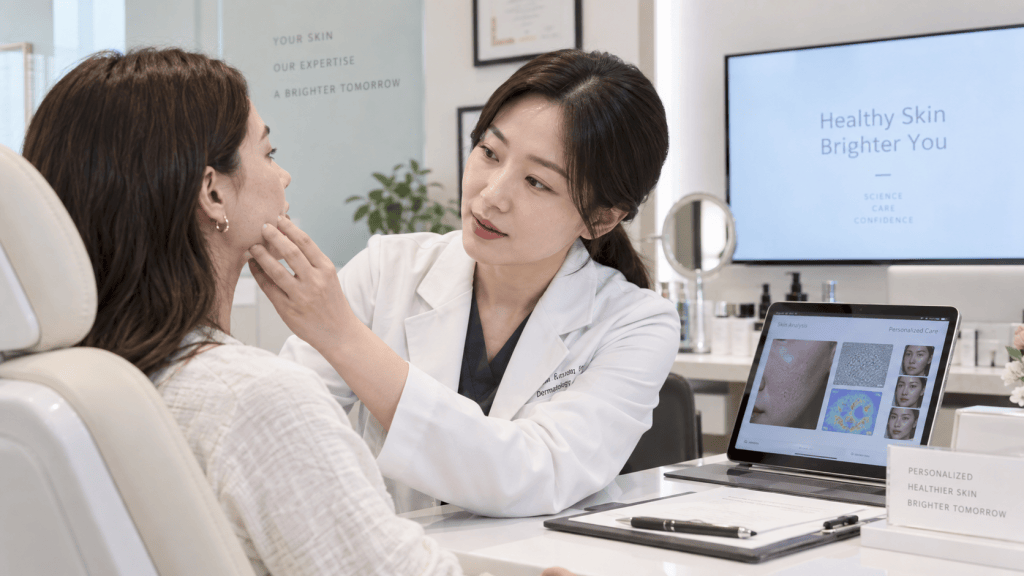
One of the most important things to do before visiting a dermatology clinic is to identify your main skin concern.
Instead of simply saying, “I want better skin,” try to explain exactly what bothers you.
For example, if your skin looks dull, the cause might involve pigmentation, dryness, inflammation, or another skin condition.
Different causes may require different approaches.
Skin Concerns and Possible Treatment Options
| Skin Concern | Common Characteristics | Possible Treatments to Discuss |
|---|---|---|
| Melasma | Irregular Brown Patches | Sun Protection, Prescription Medication, Selected Laser Treatments |
| Freckles and Dark Spots | Small Pigmented Areas | Pigment-Targeting Lasers |
| Acne | Inflammatory Lesions and Recurrent Breakouts | Topical Medication, Oral Medication, Appropriate Procedures |
| Acne Scars | Depressed or Raised Areas | Fractional Laser, Subcision, Other Scar Treatments |
| Enlarged-Looking Pores | Uneven Skin Texture | Fractional Laser, Microneedling |
| Reduced Skin Firmness | Skin Laxity and Loss of Elasticity | Radiofrequency and Ultrasound Treatments |
| Fine Lines | Small Wrinkles Around the Eyes or Mouth | Selected Lasers, Injectables, Energy-Based Treatments |
| Dry or Rough Skin | Tightness, Scaling, Irritation | Moisturization, Skin Barrier Care, Treatment of Underlying Conditions |
Why Skin Tone Matters
International visitors come from many different ethnic and cultural backgrounds, and their skin characteristics vary considerably.
The same laser treatment may produce different reactions depending on skin tone, recent sun exposure, pigmentation tendency, and medical history.
People with darker skin tones may have a greater risk of burns or dark marks after certain laser treatments.
The American Academy of Dermatology recommends working with a dermatologist experienced in treating your skin type. (미국 피부과학회)
Your Personal Skin Consultation Checklist
| Question | Your Answer |
|---|---|
| What is my main skin concern? | |
| When did the problem begin? | |
| What skincare products and medications am I currently using? | |
| Have I received laser or injectable treatments before? | |
| Does my skin develop dark marks easily? | |
| How many days can I stay in Korea after treatment? |
K-MEDICAL INSIGHT
Beautiful-looking skin begins with understanding your skin condition.
A personalized treatment plan is more meaningful than following a beauty trend.
3. Discover the World of Korean Laser Dermatology
Pico Laser, Fractional Laser, CO₂ Laser, and More
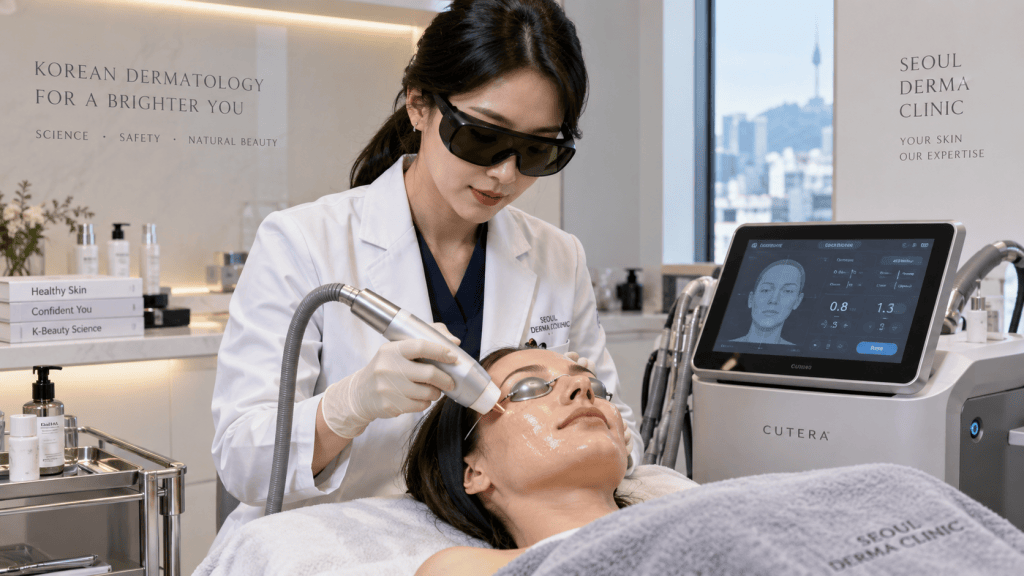
If you search for Korean dermatology treatments online, you will probably encounter many different laser names.
Pico Laser.
Laser Toning.
Fractional Laser.
CO₂ Laser.
Vascular Laser.
Understanding the basic differences can help you ask better questions during your consultation.
① Pico Laser
Pico Laser technology delivers laser energy in extremely short pulses.
Depending on the device and treatment settings, it may be used for certain pigmentation problems, tattoos, and selected skin texture or scar concerns.
Common Treatment Interests
- Freckles
- Selected Pigmented Lesions
- Uneven Skin Tone
- Some Acne Scars
- Certain Skin Texture Concerns
However, Pico Laser is not automatically suitable for every type of pigmentation.
For example, melasma can be difficult to treat, and inappropriate laser treatment may worsen pigmentation in some patients.
② Fractional Laser
Fractional lasers deliver energy to many small treatment zones rather than treating the entire skin surface uniformly.
They are commonly used in selected treatments for acne scars, uneven skin texture, and signs of skin aging.
There are different types of fractional lasers, including ablative and non-ablative devices.
Their recovery times and risks can vary considerably.
Common Treatment Interests
- Acne Scars
- Uneven Skin Texture
- Fine Lines
- Enlarged-Looking Pores
③ CO₂ Laser
CO₂ lasers deliver energy that can remove or resurface targeted skin tissue.
They may be used for selected skin lesions and resurfacing procedures.
If you want to remove a mole or another changing skin lesion, it is important to have the area medically evaluated before proceeding with cosmetic removal.
④ Vascular Laser
Vascular lasers target certain blood-vessel-related skin concerns.
Depending on the condition and device, they may be used for selected vascular lesions and facial redness.
Korean Laser Treatment Comparison
| Laser Type | Common Treatment Interests | Main Characteristics | Important Considerations |
|---|---|---|---|
| Pico Laser | Pigmentation, Selected Scars | Extremely Short Laser Pulses | Results Depend on Device and Settings |
| Laser Toning | Selected Pigmentation Problems | Often Uses Lower-Energy Repeated Treatments | Multiple Sessions May Be Needed |
| Fractional Laser | Acne Scars, Skin Texture | Treats Small Areas of Skin | Redness, Scaling, and Crusting May Occur |
| CO₂ Laser | Selected Skin Lesions, Resurfacing | Can Remove or Resurface Tissue | Healing and Scar Management Are Important |
| Vascular Laser | Selected Redness and Vascular Lesions | Targets Blood-Vessel-Related Concerns | Suitability Depends on Diagnosis |
The American Academy of Dermatology explains that laser treatments can address several skin concerns, but appropriate patient selection and the practitioner’s expertise are important. (미국 피부과학회)
K-MEDICAL INSIGHT
A famous laser name does not guarantee a better result.
The right diagnosis, appropriate technology, and experienced medical care are what matter.
4. Discover Korean Skin Tightening Treatments
Thermage vs. Ultherapy vs. Shurink
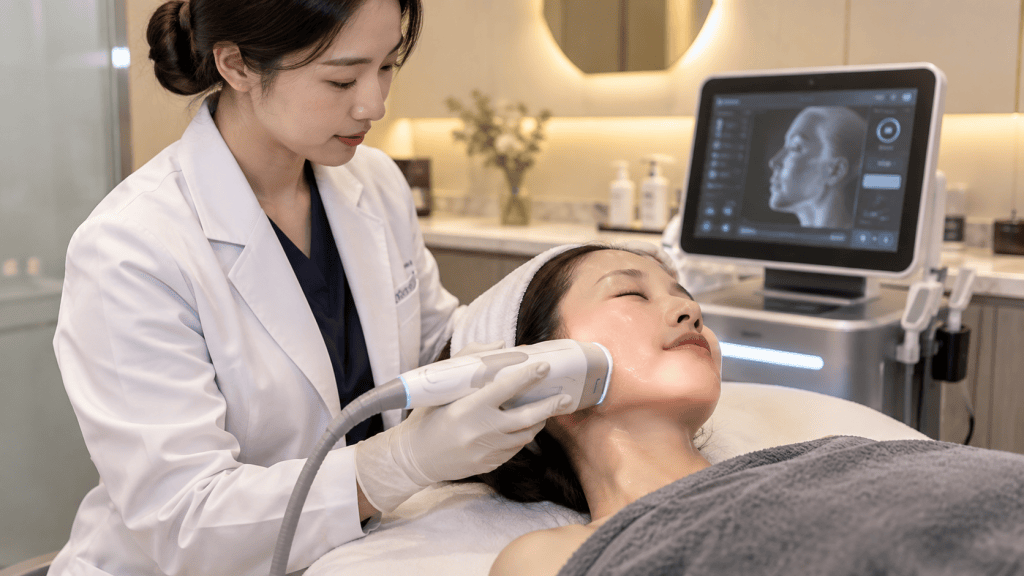
International visitors interested in Korean aesthetic medicine may have heard of three popular treatment names:
Thermage, Ultherapy, and Shurink.
All three are energy-based procedures that may be used for selected skin firmness and tightening concerns.
However, they use different technologies.
Understanding these differences can help you have a more productive consultation.
① Thermage
Thermage uses radiofrequency (RF) energy.
The treatment delivers controlled thermal energy to selected tissues and may be used to address concerns involving skin firmness, texture, and fine lines.
Common Treatment Interests
- Reduced Skin Firmness
- Fine Lines
- Selected Facial and Eye-Area Concerns
② Ultherapy
Ultherapy uses focused ultrasound energy.
The device can deliver energy to targeted tissue depths and includes ultrasound imaging technology that allows the practitioner to visualize tissue during treatment.
It may be used for selected skin laxity and lifting concerns.
However, non-invasive ultrasound treatments should not be expected to produce the same results as surgical facial lifting.
③ Shurink
Shurink is a Korean high-intensity focused ultrasound (HIFU) device family.
It is used in aesthetic medicine to deliver ultrasound energy to selected tissue depths.
Although Shurink and Ultherapy both use ultrasound technology, their device features, treatment delivery methods, and imaging capabilities differ.
Thermage, Ultherapy, and Shurink Comparison
| Category | Thermage | Ultherapy | Shurink |
|---|---|---|---|
| Energy Technology | Radiofrequency | Focused Ultrasound | Focused Ultrasound |
| Main Treatment Goal | Skin Firmness and Texture | Selected Lifting and Tightening Concerns | Selected Lifting and Tightening Concerns |
| Common Areas | Face, Eye Area, Other Suitable Areas | Face, Jawline, Neck | Face, Jawline |
| Treatment Method | RF Thermal Energy | Ultrasound Energy | Ultrasound Energy |
| Results | Develop and Vary Over Time | Develop and Vary Over Time | Develop and Vary Over Time |
| Possible Risks | Burns and Other Thermal Injuries | Pain, Swelling, Nerve-Related Injury | Pain, Swelling, Thermal Injury |
Which Treatment Should You Choose?
A medical consultation should consider:
- Skin thickness
- Degree of skin laxity
- Facial fat distribution
- Previous procedures
- Desired treatment goals
- Pain sensitivity
- Available recovery time
People with thin skin or limited facial fat should discuss the possibility of unwanted facial contour changes or fat loss when considering thermal treatments.
K-MEDICAL INSIGHT
More treatment shots or a higher price do not automatically mean better results.
The treatment plan should match your skin and facial anatomy.
5. How Can Korean Dermatology Help with Acne Scars and Enlarged-Looking Pores?
Understanding Korean Acne Scar Treatments
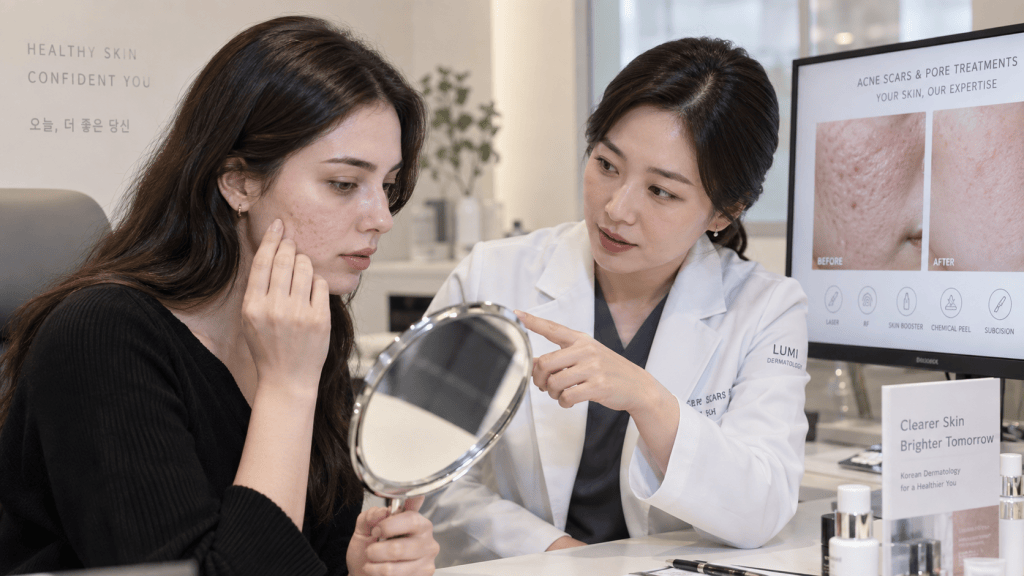
For many people, acne is frustrating even after the active breakouts disappear.
The reason?
Acne can leave scars that affect the skin’s surface and texture.
These scars vary in shape and depth, which means different scars may require different treatments.
The American Academy of Dermatology discusses treatments such as laser resurfacing, microneedling, and other procedures that may be selected according to scar type. (미국 피부과학회)
Types of Acne Scars
| Scar Type | Characteristics | Possible Treatments to Discuss |
|---|---|---|
| Ice Pick Scars | Small, Deep Depressions | Selected Focal Scar Treatments |
| Boxcar Scars | Depressed Areas with Defined Edges | Fractional Laser and Other Scar Procedures |
| Rolling Scars | Wavy or Uneven Skin Surface | Subcision and Other Treatments |
| Hypertrophic Scars | Raised Scar Tissue | Selected Scar Injections |
| Post-Acne Marks | Red or Brown Discoloration | Treatments Based on the Cause of Pigmentation |
Fractional Laser and Microneedling
Some acne scar treatments aim to stimulate skin remodeling and collagen production.
Fractional laser and microneedling are two commonly discussed approaches.
However, improvement depends on the scar’s depth, shape, location, skin response, and treatment plan.
Traditional Microneedling vs. RF Microneedling
| Category | Traditional Microneedling | RF Microneedling |
|---|---|---|
| Basic Principle | Creates Controlled Microscopic Skin Injuries | Combines Microneedles with Radiofrequency Energy |
| Main Treatment Interests | Acne Scars, Skin Texture | Selected Scars, Skin Texture, Firmness |
| Treatment Plan | May Require Repeated Sessions | Depends on Individual Goals |
| Possible Recovery Effects | Redness and Irritation | Redness, Swelling, Thermal Effects |
| Possible Risks | Infection, Scarring, Pigmentation Changes | Burns, Fat Loss, Scarring, Nerve Injury |
Important Safety Information
On October 15, 2025, the U.S. Food and Drug Administration issued a safety communication concerning certain uses of radiofrequency microneedling.
Reported serious complications included burns, scarring, fat loss, disfigurement, and nerve damage.
The FDA recommends discussing the benefits and risks with a licensed healthcare professional experienced in using the relevant device. (U.S. Food and Drug Administration)
What About Enlarged-Looking Pores?
Pores may appear more noticeable because of oil production, skin texture, previous acne, or changes in skin elasticity.
The realistic goal of treatment is generally to improve the appearance of pores and surrounding skin texture, not to eliminate pores completely.
K-MEDICAL INSIGHT
The most important step in acne scar treatment is identifying the type of scar.
A stronger treatment is not always a more appropriate treatment.
6. Discover Korean Skin Boosters
What International Visitors Should Know About Rejuran and Injectable Skin Treatments
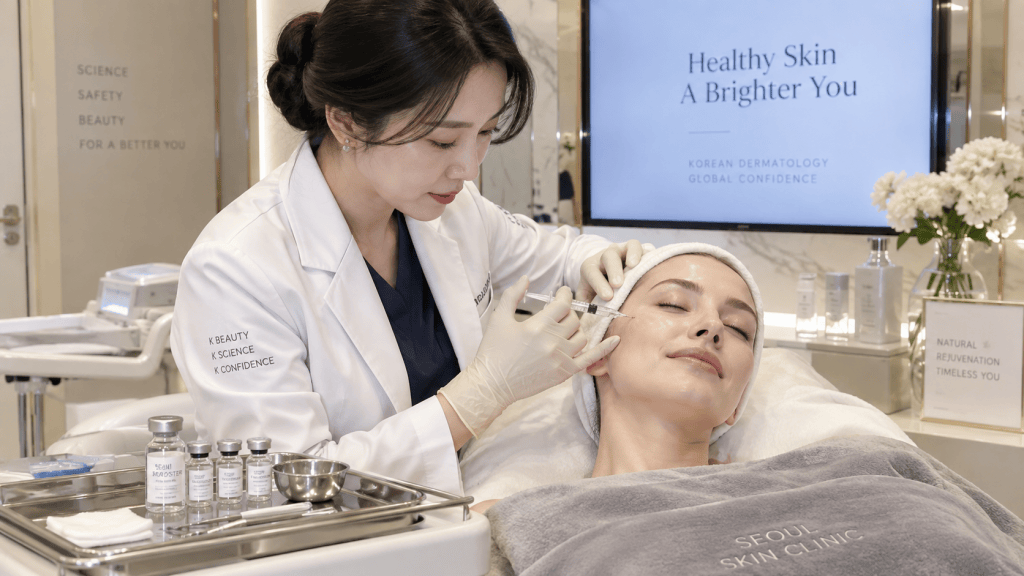
If you research Korean dermatology, you will probably encounter the term skin booster.
Skin boosters refer to a variety of injectable aesthetic treatments intended to address selected skin concerns.
Different products contain different ingredients and may have different purposes.
Therefore, skin boosters should not be treated as one single type of medical procedure.
What Is Rejuran?
Rejuran is a Korean product family associated with polynucleotide (PN)-based aesthetic treatments.
PN-based products are discussed in relation to selected concerns involving skin texture and fine lines.
However, results vary, and the evidence supporting different products and applications is still developing.
A systematic review published in July 2026 evaluated seven randomized clinical trials involving 183 participants. It reported potential benefits of PN- and PDRN-based treatments in selected dermatological applications, while emphasizing that larger studies are needed. (PubMed)
What Should You Check Before Receiving a Skin Booster?
| Item | Why It Matters |
|---|---|
| Product Name | Different Products Have Different Ingredients |
| Active Ingredients | Relevant to Allergies and Treatment Suitability |
| Treatment Volume | Confirms the Actual Amount Used |
| Injection Method | Different Delivery Methods May Have Different Risks |
| Expected Reactions | Swelling, Bruising, and Pain May Occur |
| Number of Sessions | Some Treatment Plans Involve Repeated Procedures |
| Regulatory Status | Approved Uses and Product Requirements May Differ |
What If You Do Not Want Injections?
You do not have to choose injectable treatments.
Depending on your skin condition, a dermatologist may recommend moisturization, medication, laser treatment, or another approach.
Skin boosters are not universal solutions for all skin concerns.
K-MEDICAL INSIGHT
Do not choose a skin booster simply because it is popular on social media.
Understand its ingredients, available evidence, possible benefits, and risks before making a decision.
7. How Much Do Korean Dermatology Treatments Cost?
Korean Dermatology Price Guide for International Visitors

One of the most common questions international visitors ask is:
“How much does dermatology treatment cost in Korea?”
Prices vary depending on the clinic, medical professional, equipment, treatment area, number of shots, product volume, and additional services.
There is no single nationwide price for aesthetic dermatology treatments in Korea.
Korean Dermatology Treatment Price Comparison
The following table presents selected publicly advertised clinic prices available in September 2026.
These are individual clinic price examples, not national averages or guaranteed prices.
| Treatment | Example Treatment Package | Advertised Price |
|---|---|---|
| PicoSure Toning | 1 Session | ₩89,000 |
| PicoSure Spot Treatment | Full-Face Pigmented Spot Removal, 1 Session | ₩149,000 |
| Shurink Universe Combination | 350 Shots + Duet RF 200 Shots + LDM Care | ₩269,000 |
| Ultherapy | 300 Shots + LDM Care | ₩799,000 |
| Thermage FLX | 600 Shots | ₩1,890,000 |
| Rejuran Healer | 2cc + LDM Care | ₩250,000 |
The examples above come from publicly displayed price guides and promotions at Korean medical institutions. Promotional conditions and availability may change. (유스앤영 서울뷰의원 세종)
Price Comparison in Four Currencies
To help international visitors understand Korean treatment costs, here are approximate conversions into U.S. dollars, Japanese yen, and Chinese yuan.
The conversions use reference exchange rates from September 18, 2026, rounded for readability.
| Treatment | Korean Won (KRW) | U.S. Dollar (USD) | Japanese Yen (JPY) | Chinese Yuan (CNY) |
|---|---|---|---|---|
| PicoSure Toning | ₩89,000 | Approx. $64 | Approx. ¥10,050 | Approx. CNY 430 |
| PicoSure Spot Treatment | ₩149,000 | Approx. $108 | Approx. ¥16,820 | Approx. CNY 720 |
| Shurink Combination | ₩269,000 | Approx. $194 | Approx. ¥30,370 | Approx. CNY 1,300 |
| Ultherapy | ₩799,000 | Approx. $577 | Approx. ¥90,220 | Approx. CNY 3,860 |
| Thermage FLX | ₩1,890,000 | Approx. $1,364 | Approx. ¥213,400 | Approx. CNY 9,132 |
| Rejuran Healer | ₩250,000 | Approx. $180 | Approx. ¥28,230 | Approx. CNY 1,208 |
Important: These are approximate conversions of example advertised prices, not guaranteed quotations. Some clinic advertisements exclude Korea’s 10% VAT. Actual payment amounts may differ because of taxes, consultation fees, exchange rates, card charges, promotional conditions, and treatment recommendations.
Seven Questions to Ask About Treatment Costs
| Question | Why It Matters |
|---|---|
| Is VAT included? | The final price may be higher than advertised |
| Is there a consultation fee? | Medical consultation may be charged separately |
| Is anesthesia included? | Numbing cream or other anesthesia may incur additional fees |
| How much treatment is included? | Shot Count, Product Volume, and Treatment Area Matter |
| Is recovery care included? | Additional services may be charged separately |
| What happens if I need follow-up care? | Additional medical expenses may arise |
| What is the cancellation policy? | Reservation deposits may have specific refund conditions |
How to Compare Prices Correctly
Imagine that two clinics advertise Thermage treatments at different prices.
One may offer fewer shots.
Another may include a larger treatment area or additional services.
The equipment, medical professional, and treatment plan may also differ.
You should compare the complete treatment package rather than only the advertised price.
K-MEDICAL INSIGHT
A price list is a starting point.
A treatment decision should follow an appropriate medical consultation and a clear understanding of the total cost.
8. How Much Recovery Time Do Korean Dermatology Treatments Require?
Plan Your Korean Trip Wisely

For international visitors, recovery time is one of the most important factors when planning a dermatology appointment.
If you are visiting Korea for only a few days, the procedure you choose may affect your sightseeing activities and return flight plans.
For example, after certain treatments, your dermatologist may recommend avoiding strong sunlight, swimming, saunas, intense exercise, or irritating skincare products for a period of time.
Possible Recovery Effects by Treatment Type
| Treatment Type | Possible Reactions | What International Visitors Should Consider |
|---|---|---|
| Gentle Toning | Temporary Redness, Dryness | Protect Skin from Irritation and Sun Exposure |
| Pigmented Spot Removal | Temporary Color Changes, Crusting | Follow Wound Care Instructions |
| Fractional Laser | Redness, Swelling, Scaling, Crusting | Recovery May Take Days to Weeks, Depending on Treatment |
| Ultrasound Tightening | Tenderness, Swelling, Bruising | Monitor Pain and Swelling |
| Radiofrequency Tightening | Redness, Swelling | Be Aware of Possible Thermal Injury |
| Skin Boosters | Injection Marks, Bruising, Swelling | Avoid Unnecessary Skin Irritation |
Recovery times vary considerably.
Some procedures cause little visible downtime, while stronger resurfacing treatments may require extended healing.
Planning Dermatology Around Your Korean Travel Schedule
| Length of Stay | What to Consider |
|---|---|
| 2–3 Days | Prioritize consultation; carefully assess procedures requiring recovery |
| 4–5 Days | Discuss expected reactions and your departure date |
| 6–7 Days | Allow time for follow-up care when needed |
| 8–10+ Days | May provide more flexibility for selected follow-up appointments |
| Extended Stay | May be helpful for treatments requiring multiple visits |
A longer stay does not necessarily mean that all treatments can be completed during one trip.
Skin healing and recommended treatment intervals cannot always be shortened to fit a travel schedule.
Four Important Post-Treatment Habits
1. Protect Your Skin from the Sun
Sun protection is particularly important after certain pigmentation treatments.
The American Academy of Dermatology recommends broad-spectrum, water-resistant sunscreen with SPF 30 or higher. For people with melasma, tinted sunscreen containing iron oxide may provide additional protection against visible light. (미국 피부과학회)
2. Avoid Unnecessary Irritation
Depending on your procedure, you may need to temporarily avoid:
- Harsh Facial Scrubs
- Strong Exfoliating Products
- Certain Active Skincare Ingredients
- Excessive Heat Exposure
- Activities That Irritate the Treated Area
Always follow your treating clinician’s instructions.
3. Watch for Unusual Reactions
Contact your medical provider if you experience worsening pain, blistering, severe swelling, unusual skin discoloration, numbness, or other concerning symptoms.
4. Prepare for Aftercare in Your Home Country
Some treatments require follow-up care after you return home.
Before leaving Korea, ask whether you should arrange a consultation with a dermatologist in your home country.
K-MEDICAL INSIGHT
Do not force your medical treatment to fit an unrealistic travel schedule.
Safety and adequate recovery should come first.
9. How Can International Visitors Choose a Korean Dermatology Clinic?
A Practical Guide to Choosing Medical Care in Korea

Many international visitors discover Korean dermatology clinics through social media, online reviews, promotional videos, and beauty communities.
These resources may help you begin your search.
However, choosing a medical provider requires more than comparing attractive before-and-after photographs.
① Check the Medical Professional’s Qualifications
If you need treatment for a complex skin condition, scarring, or pigmentation, ask about the treating physician’s qualifications and relevant clinical experience.
You may also wish to confirm whether the physician is a board-certified dermatologist in Korea.
② Check Registration for Treating International Patients
Medical Korea, operated by the Korea Health Industry Development Institute, provides information about medical institutions registered to serve foreign patients.
Korea’s foreign-patient registration system includes requirements intended to protect international patients, including medical malpractice liability insurance for registered institutions.
Registration is useful information, although it does not guarantee a particular treatment outcome. (Medical Korea)
Official Resource:
Medical Korea – Registered Hospitals
③ Confirm Language Support
If you are not fluent in Korean, communication is especially important.
Questions to Ask Before Booking
| Service | What to Ask |
|---|---|
| English Consultation | Can I speak directly with the physician in English? |
| Other Languages | Are Chinese or Japanese interpreters available? |
| Consent Forms | Can treatment information be explained in my preferred language? |
| Aftercare | Can I contact the clinic by email after returning home? |
| Complications | Who should I contact if I experience a problem? |
④ Verify the Products and Equipment
Before receiving a treatment, consider asking about:
- Exact Equipment Name
- Exact Product Name
- Product Authenticity
- Expiration Date
- Treatment Volume
- Number of Shots
- Medical Professional Performing the Procedure
- Possible Side Effects
⑤ Be Careful with Exaggerated Advertising
| Advertising Claim | What to Consider |
|---|---|
| “Zero Side Effects” | Medical procedures can involve risks |
| “Perfect Skin in One Session” | Results vary and may require multiple treatments |
| “Suitable for Everyone” | Skin type and medical history affect suitability |
| “Today Only: Huge Discount” | You should have enough time for medical consultation |
| “No Recovery Time” | Individual recovery and adverse reactions can vary |
Important: Not Every Skin Spot Is a Cosmetic Problem
If a mole or skin lesion changes in size, shape, or color, bleeds, or fails to heal, seek medical evaluation before cosmetic removal.
K-MEDICAL INSIGHT
Choose a clinic based on medical qualifications, clear communication, transparent pricing, and reliable aftercare—not simply the number of social media followers or reviews.
10. Your Complete Korean Dermatology Visit Guide
From Reservation to Recovery

Ready to explore Korean dermatology?
Here is a practical step-by-step guide to planning your visit.
STEP 1. Identify Your Main Skin Concern
Begin by describing what you want to discuss with a medical professional.
For example:
“I am concerned about acne scars.”
“I would like to improve dark spots and pigmentation.”
“I have noticed reduced skin firmness.”
“I would like a professional assessment of my skin.”
STEP 2. Research Medical Providers
Review official clinic websites.
Check the physician’s qualifications and relevant treatment experience.
If appropriate, confirm registration through Medical Korea.
STEP 3. Book a Consultation
Ask about available appointment dates and language services.
Whenever possible, book a consultation before committing to a particular procedure.
STEP 4. Attend Your Medical Consultation
Explain your current skin condition and medical history.
Tell the physician about relevant factors such as:
- Current Medications
- Allergies
- Previous Dermatology Procedures
- History of Scarring
- Skin Infections
- Recent Sun Exposure
- Pregnancy or Breastfeeding, When Relevant
STEP 5. Review the Proposed Treatment Plan
Before agreeing to treatment, ask about:
- Expected Benefits
- Possible Risks
- Alternative Treatments
- Recommended Number of Sessions
- Total Cost
- Recovery Requirements
STEP 6. Make an Informed Decision
Proceed only after you understand the procedure and have received clear explanations.
If something is unclear, ask additional questions.
STEP 7. Follow Recovery Instructions
Use prescribed medication and skincare products according to medical guidance.
Attend follow-up appointments when necessary.
STEP 8. Prepare for Your Return Home
Before leaving Korea, request relevant medical records, prescriptions, and aftercare instructions.
Ask how to contact the clinic if a concern develops after your departure.
International Visitor’s Dermatology Checklist
| Stage | Important Items |
|---|---|
| Before Booking | Clinic, Physician, Language Support |
| Before Departure | Appointment Confirmation, Recovery Time |
| During Consultation | Skin Concerns, Medical History, Current Medications |
| Before Treatment | Products, Equipment, Risks, Total Cost |
| After Treatment | Medication, Cleansing, Makeup, Sun Protection |
| Before Returning Home | Medical Records, Aftercare Instructions, Contact Information |
BONUS 1
15 Essential Korean Expressions for Visiting a Dermatology Clinic
Even if you do not speak Korean fluently, learning a few useful expressions can make your visit more comfortable.
Useful Korean Phrases for International Patients
| Situation | Korean Expression | English Meaning |
|---|---|---|
| Booking | 피부과 진료를 예약하고 싶습니다. | I would like to book a dermatology appointment. |
| Language Support | 영어 상담이 가능한가요? | Is consultation available in English? |
| Pigmentation | 기미가 고민입니다. | I am concerned about melasma. |
| Acne Scars | 여드름 흉터를 개선하고 싶습니다. | I would like to improve my acne scars. |
| Skin Firmness | 피부 탄력이 떨어진 것 같습니다. | I feel that my skin has lost elasticity. |
| Suitability | 제 피부에 적합한 시술인가요? | Is this treatment suitable for my skin? |
| Price | 총비용이 얼마인가요? | What is the total cost? |
| Side Effects | 어떤 부작용이 있을 수 있나요? | What side effects are possible? |
| Pain | 시술이 많이 아픈가요? | Is the procedure painful? |
| Anesthesia | 마취가 필요한가요? | Is anesthesia necessary? |
| Recovery | 회복기간은 얼마나 걸리나요? | How long is the recovery period? |
| Cleansing | 언제부터 세안할 수 있나요? | When can I wash my face? |
| Makeup | 언제부터 화장할 수 있나요? | When can I wear makeup? |
| Flying | 며칠 후 비행기를 타도 괜찮나요? | When can I safely fly after the procedure? |
| Aftercare | 귀국 후에도 상담할 수 있나요? | Can I receive follow-up consultation after returning home? |
BONUS 2
10 Questions to Ask Before Receiving Dermatology Treatment in Korea
| No. | Essential Question | What You Should Confirm |
|---|---|---|
| 1 | What is causing my skin concern? | Accurate Diagnosis |
| 2 | Is this treatment suitable for me? | Medical Suitability |
| 3 | Are there alternative treatments? | Treatment Options |
| 4 | How many sessions might I need? | Complete Treatment Plan |
| 5 | What is the total cost? | Taxes and Additional Fees |
| 6 | What side effects are possible? | Safety and Risk Information |
| 7 | How long will recovery take? | Travel and Departure Schedule |
| 8 | Who will perform the procedure? | Medical Professional’s Qualifications |
| 9 | What happens if complications occur? | Aftercare and Emergency Contact |
| 10 | Can I receive support after returning home? | Follow-Up Care |
FINAL MESSAGE
Beautiful Skin Begins with Understanding Your Skin
Discover Your Skin. Discover K-Medical.
Every traveler has a different reason for visiting South Korea.
Some come to experience the beauty of Gyeongbokgung Palace.
Others travel to Seoul to attend K-POP concerts.
Some explore Korean fashion, cosmetics, and skincare products in Myeongdong.
And others may visit Korea to learn more about their skin and explore appropriate medical care.
K-Beauty introduces the pleasure of cosmetics and everyday skincare.
K-Medical offers another opportunity: understanding skin concerns through medical evaluation and considering suitable treatment options.
But remember that beautiful-looking skin does not always require lasers or injections.
Sometimes, the right approach may involve better moisturization and sun protection.
Sometimes, prescription medication may be necessary to treat an underlying skin condition.
And in selected situations, laser treatments or other medical procedures may be appropriate.
What matters most is understanding your skin, considering your options, and making an informed decision.
Your skin is unique. Your treatment should be, too.
If you are planning a trip to South Korea, take the opportunity to discover the country’s dermatology services and learn more about your skin.
Whether your goal is to address pigmentation, understand acne scars, improve skin texture, or simply receive a professional consultation, your journey should begin with accurate information and appropriate medical guidance.
Your Skin. Your Beauty. Your K-Medical Journey.
Discover Korean Dermatology. Experience K-Medical in Korea!
K-MEDICAL | Discover Korea, Discover Your Well-Being.
Suggested Blog Tags
#KMedical #KBeauty #KoreanDermatology #SkinCareInKorea #KoreanSkinClinic #MedicalTourismKorea #KoreanBeautyTreatments #GlassSkin #KoreanLaserTreatment #Rejuran #Thermage #Ultherapy #Shurink #SkinBooster #KBeautyTravel #SeoulBeauty #VisitKorea #HealthySkin #SkinHealth #KoreanMedicalTourism


Leave a Reply