
10 Secrets to Succeeding at a Korean University

The Ultimate Academic Survival Guide for International Students
Study Smarter, Make Friends, Discover Opportunities, and Make the Most of Your University Experience in South Korea!
Studying in South Korea is more than earning a university degree. It is an exciting opportunity to discover a new culture, learn a new language, build international friendships, and develop skills that can shape your future.
However, international students often discover that university life in Korea is quite different from what they expected.
You may find yourself wondering:
- Why are attendance and assignments so important?
- How can I get better grades when my Korean is not perfect?
- How should I communicate with Korean professors?
- What if I have difficulty participating in group projects?
- How can I make Korean friends?
- Are there scholarships and university programs I might be missing?
- How can I balance studying, friendships, personal development, and daily life?
These are common questions for international students adjusting to a new academic environment.
The good news is that you do not have to figure everything out on your own.
With the right strategies, you can make your university experience in Korea more rewarding, productive, and enjoyable.
Success at a Korean university is not just about getting excellent grades. It is about learning, adapting, building relationships, discovering opportunities, and becoming a more confident version of yourself.
Here are 10 practical secrets to help international students succeed at Korean universities.
1. Understand Korean University Learning Culture
Learn How the Korean Academic System Works
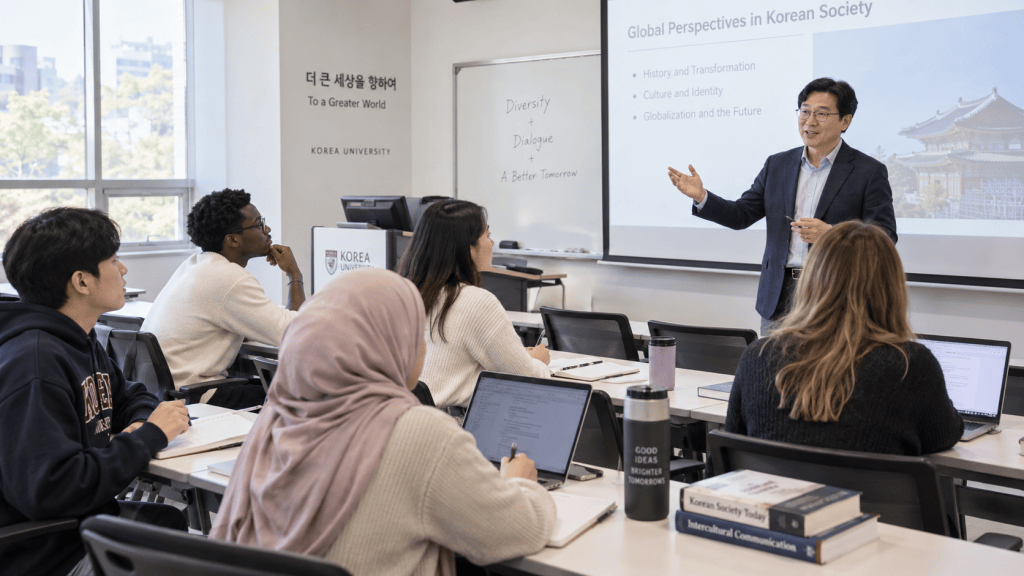
One of the first steps to succeeding at a Korean university is understanding how its academic environment works.
Even if you have attended university in another country, the learning experience in Korea may feel different.
Depending on the university, department, and professor, attendance, assignments, presentations, participation, examinations, and group projects can all contribute to your final grades.
Students are often expected to follow course instructions carefully, submit assignments on time, and take responsibility for their own academic progress.
Understanding these expectations early can help you avoid unnecessary stress.
Common Features of Korean University Classes
| Academic Area | Common Practice | What International Students Should Do |
|---|---|---|
| Attendance | Attendance may contribute to grades or course completion requirements | Attend classes regularly and avoid unnecessary absences |
| Assignments | Submission deadlines are important | Record all deadlines and prepare in advance |
| Presentations | Individual and group presentations may be required | Practice speaking and prepare presentation materials |
| Group Projects | Collaboration is common in many courses | Communicate actively with teammates |
| Examinations | Midterm and final exams are frequently used | Review course materials throughout the semester |
| Class Participation | Questions, discussions, and participation may be evaluated | Take notes and contribute when appropriate |
Three Habits That Can Make a Difference
1. Prepare before attending class.
Read assigned materials and familiarize yourself with the topic.
2. Review what you learned immediately afterward.
Even a short review can help you understand unfamiliar terminology and remember important concepts.
3. Ask questions when you need help.
You do not need to understand everything immediately. Asking for clarification is an important part of learning.
K-Study Success Tip
Don’t just attend your classes.
Participate in them.
The more actively you engage in your education, the more opportunities you have to learn and grow.
2. Master Korean University Course Registration
Build a Timetable That Works for You
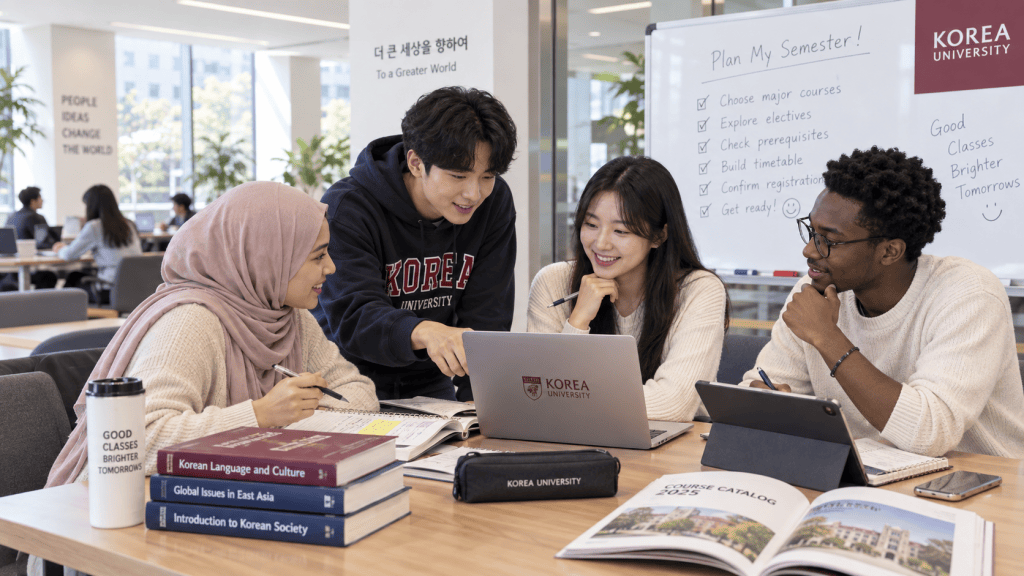
Course registration is an important part of university life in Korea.
Popular courses may fill quickly, and students sometimes find that their preferred timetable is unavailable.
For international students, course selection is particularly important because language ability, academic difficulty, and workload can affect the overall learning experience.
A carefully planned timetable can help you manage your studies more effectively.
Course Registration Checklist
| What to Check | Why It Matters |
|---|---|
| Required Courses | Some subjects are necessary for graduation |
| Language of Instruction | Classes may be taught in Korean, English, or another language |
| Assessment Methods | Exams, reports, presentations, and group projects may have different weightings |
| Class Schedule | Consider travel time and your daily routine |
| Academic Difficulty | Some courses may require prior knowledge |
| Course Syllabus | Understand expectations before registering |
| Prerequisites | Certain courses require completion of earlier subjects |
Recommended Course Selection Strategies
| Your Situation | Recommended Strategy |
|---|---|
| First Semester in Korea | Choose a manageable workload while adapting to university life |
| Still Developing Korean Skills | Consider an appropriate balance of Korean- and English-taught courses |
| Nervous About Presentations | Avoid scheduling too many presentation-intensive classes together |
| Worried About Group Projects | Balance collaborative courses with individual-assignment courses |
| Planning for Graduation | Prioritize required courses and check graduation requirements |
What Should You Do Before Registration Day?
Check the university’s registration schedule and procedures.
Prepare a list of preferred courses and alternatives.
Read course descriptions carefully.
Ask senior students about courses when possible.
Check whether registration operates on a first-come, first-served basis or through another system.
K-Study Success Tip
The best timetable is not necessarily the one with the fewest classes or the longest weekends.
It is the timetable that allows you to learn effectively, manage your responsibilities, and complete the semester successfully.
3. Understand How Korean University Grades Work
Study Strategically, Not Just Harder
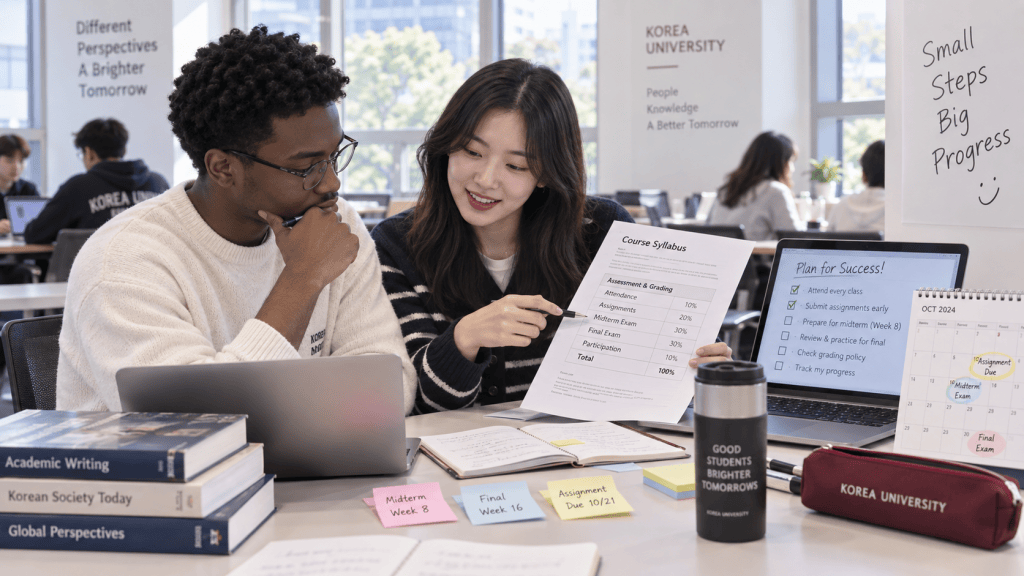
Many international students assume that their final examination will determine most of their course grade.
However, Korean university courses may evaluate students through several different components.
Attendance, assignments, participation, presentations, midterm examinations, and final examinations may all contribute to the final result.
Universities may also use different grading systems, including relative grading and absolute grading.
Understanding your professor’s evaluation criteria can help you plan your studies more effectively.
Common University Assessment Components
| Assessment Component | What It Measures | Recommended Preparation |
|---|---|---|
| Attendance | Participation in scheduled classes | Attend regularly and understand attendance policies |
| Assignments | Understanding and application of course material | Begin early and follow instructions carefully |
| Presentations | Communication and subject knowledge | Prepare and rehearse |
| Participation | Engagement in class activities | Ask questions and contribute to discussions |
| Midterm Examination | Understanding of material covered during the first part of the semester | Review regularly |
| Final Examination | Understanding of material covered during the course | Organize notes and prepare in advance |
Relative Grading vs. Absolute Grading
| Grading System | General Explanation |
|---|---|
| Relative Grading | Grades may depend partly on students’ performance compared with others in the class |
| Absolute Grading | Grades are assigned according to established performance standards |
| Pass/Fail | Students receive a pass or fail based on course requirements |
Grading policies vary by university, department, and course. Always check your university’s official academic regulations and the course syllabus.
Four Habits That Can Improve Academic Performance
| Habit | Potential Benefit |
|---|---|
| Review class notes every week | Reduces pressure before examinations |
| Start assignments early | Allows time for research and revisions |
| Record professor feedback | Helps improve future assignments |
| Study with classmates | Provides opportunities to clarify difficult concepts |
K-Study Success Tip
Do not ignore small assignments or attendance requirements simply because they contribute fewer points.
Consistent effort throughout the semester can be just as important as examination preparation.
4. Turn Group Projects into Opportunities
How to Succeed in Korean University Team Projects

Group projects can be one of the most challenging parts of university life for international students.
You may find it difficult to follow rapid Korean conversations, understand cultural communication styles, or express your opinions confidently.
Sometimes, students feel excluded from discussions because they are less comfortable speaking Korean.
However, group projects can also become opportunities to develop friendships, strengthen communication skills, and gain practical collaboration experience.
The key is to participate actively and identify how you can contribute.
Common Group Project Challenges and Solutions
| Challenge | Possible Situation | Recommended Solution |
|---|---|---|
| Language Barrier | Difficulty understanding fast conversations | Ask teammates to summarize important decisions |
| Limited Participation | Not receiving a clear role | Volunteer for a task you can complete confidently |
| Scheduling Problems | Team members have different schedules | Agree on deadlines and meeting times early |
| Presentation Anxiety | Nervous about presenting in Korean | Practice and divide presentation responsibilities |
| Miscommunication | Different interpretations of instructions | Confirm responsibilities in writing |
Valuable Roles International Students Can Take
| Project Role | How You Can Contribute |
|---|---|
| Research | Find international references and case studies |
| Presentation Design | Create slides and visual materials |
| Translation | Assist with Korean-English communication when appropriate |
| International Market Analysis | Share knowledge of your home country’s market |
| Data Analysis | Organize and interpret research findings |
| Presentation | Explain selected topics and participate in Q&A |
Useful Korean Expressions for Group Projects
| Korean Expression | English Meaning |
|---|---|
| 제가 이 부분을 맡겠습니다. | I will take responsibility for this part. |
| 다시 한번 설명해 주실 수 있을까요? | Could you explain that one more time? |
| 제 의견을 말씀드려도 될까요? | May I share my opinion? |
| 언제까지 완료하면 될까요? | When should I complete this? |
| 함께 검토하면 좋겠습니다. | It would be helpful to review this together. |
K-Study Success Tip
You do not have to be the best Korean speaker in your group.
You can become a valuable team member through reliability, preparation, initiative, and your own unique strengths.
Group projects are not just academic assignments. They are opportunities to develop skills that will also be useful in your future career.
5. Build Positive Relationships with Your Professors
Learn How to Communicate with Korean Professors
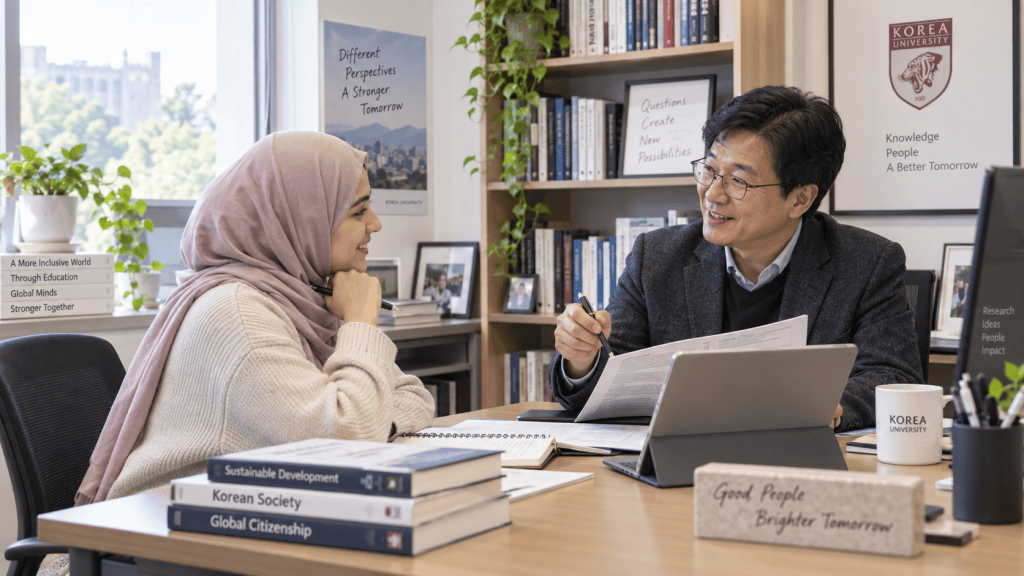
For some international students, approaching a professor can feel intimidating.
You may worry about using the wrong Korean expression or asking an inappropriate question.
However, communicating with professors can be an important part of academic success.
Professors can provide guidance on coursework, research interests, academic development, and potential career paths.
Building professional academic relationships may also be helpful if you plan to pursue graduate studies.
Ways to Communicate with Your Professors
| Communication Method | Appropriate Situations |
|---|---|
| Questions about assignments, appointments, or academic matters | |
| Before or After Class | Short questions or clarification |
| Office Hours | Detailed academic discussions |
| Department Events | Academic networking and informal conversations |
| Academic Advising | Course selection and research planning |
| Recommendation Requests | Graduate school or scholarship applications |
How to Write a Polite Email to a Korean Professor
A professional email should be clear, respectful, and concise.
| Step | What to Include |
|---|---|
| 1 | Greeting |
| 2 | Your name, department, and course |
| 3 | The reason for your email |
| 4 | Your specific question or request |
| 5 | Thank-you message |
| 6 | Your name and student ID, if appropriate |
Example: Email to Request an Appointment
Subject: Request for Academic Consultation
Dear Professor Kim,
My name is [Your Name], and I am an international student in your [Course Name] class.
I would like to ask a few questions about the course material and my academic progress.
If possible, I would appreciate the opportunity to meet with you during your office hours.
Thank you very much for your time and consideration.
Best regards,
[Your Name]
[Department / Student ID]
Good Communication Habits
| Recommended | Avoid |
|---|---|
| Use respectful expressions | Overly casual or demanding language |
| Explain your question clearly | Long messages without a clear purpose |
| Prepare before meetings | Attending without knowing what to ask |
| Follow up appropriately | Repeatedly sending the same request |
| Apply feedback | Ignoring previously provided guidance |
K-Study Success Tip
Your professors are not only people who evaluate your academic performance.
They can also become valuable academic mentors.
A simple question after class may be the beginning of a meaningful professional relationship.
6. Take Advantage of Korean University Learning Resources
Your University May Offer More Support Than You Realize

Korean universities may provide a wide range of academic facilities and student-support services.
However, international students sometimes miss these opportunities because they are unfamiliar with university systems or do not know where to find information.
Libraries, study rooms, writing centers, tutoring programs, international offices, and digital learning platforms can all help improve your university experience.
University Resources Worth Exploring
| University Resource | What It May Offer | How to Use It |
|---|---|---|
| University Library | Academic Books, Journals, Study Areas | Research and Examination Preparation |
| Study Rooms | Spaces for Group Work and Presentations | Reserve Rooms for Team Projects |
| Academic Support Center | Tutoring and Learning Programs | Improve Difficult Subjects |
| Writing Center | Academic Writing Support | Develop Reports and Essays |
| International Office | International Student Information and Administrative Support | Seek Guidance on University Procedures |
| Online Learning System | Lecture Materials, Assignment Submission, Announcements | Check Regularly |
| Career Center | Career Counseling and Employment Preparation | Explore Future Opportunities |
Find the Right Study Space
| Study Space | Best Used For |
|---|---|
| University Library | Focused Reading and Examination Preparation |
| Group Study Room | Collaborative Projects |
| Campus Learning Lounge | Independent Study and Light Assignments |
| Available Presentation Room | Presentation Rehearsal |
| International Student Lounge | Information Sharing and Networking |
A Smart First-Month Strategy
During your first month at university, try to identify the following locations:
Your department office.
The international student office.
The main university library.
The academic support center.
The career development center.
The student counseling center.
The location where you can access information about scholarships and student programs.
Learning where these resources are located can save time and help you become more independent.
K-Study Success Tip
Successful students do not necessarily do everything alone.
They know when and where to seek useful information and support.
7. Develop Academic Korean, Not Just Everyday Korean
Go Beyond Daily Conversation
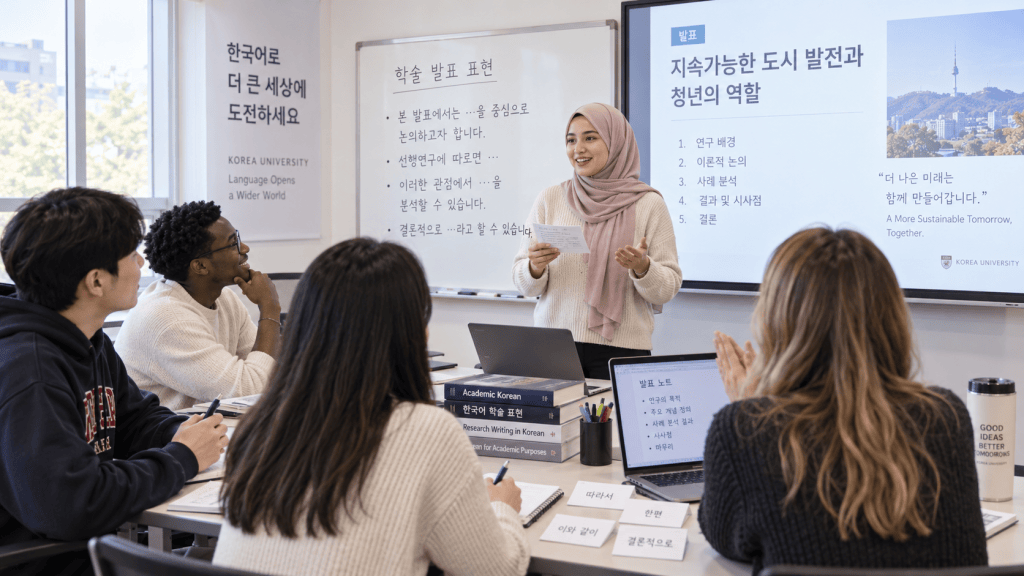
One of the biggest challenges for international students is the difference between conversational Korean and academic Korean.
You may be comfortable ordering food, shopping, traveling, and speaking with friends in Korean.
However, understanding lectures, reading academic papers, participating in discussions, and writing university reports require additional language skills.
Developing academic Korean can help you participate more confidently in your courses.
Six Essential Academic Korean Skills
| Academic Area | Important Skill |
|---|---|
| Listening | Understanding lectures and taking notes |
| Presentations | Explaining ideas logically |
| Discussions | Expressing agreement, disagreement, and opinions |
| Academic Writing | Creating structured reports and essays |
| Reading | Understanding textbooks and academic materials |
| Asking Questions | Requesting clarification politely |
Useful Korean Expressions for University Classes
| Situation | Korean Expression | English Meaning |
|---|---|---|
| Asking a Question | 이 부분을 다시 설명해 주실 수 있을까요? | Could you explain this part again? |
| Sharing an Opinion | 제 생각에는 …라고 볼 수 있습니다. | In my opinion, it can be viewed as… |
| Starting a Presentation | 지금부터 발표를 시작하겠습니다. | I will begin my presentation now. |
| Ending a Presentation | 이상으로 발표를 마치겠습니다. | This concludes my presentation. |
| Disagreeing Politely | 저는 조금 다른 의견을 가지고 있습니다. | I have a slightly different opinion. |
| Asking About an Assignment | 과제의 범위를 확인하고 싶습니다. | I would like to confirm the scope of the assignment. |
Practical Ways to Improve Academic Korean
| Learning Method | Potential Benefit |
|---|---|
| Review lecture recordings when permitted | Improve listening comprehension |
| Create a major-specific vocabulary notebook | Learn academic terminology |
| Write presentation scripts | Develop confidence when speaking |
| Study with Korean classmates | Learn natural academic expressions |
| Request writing feedback | Improve report quality |
| Read academic articles regularly | Become familiar with formal Korean |
Always obtain permission before recording lectures and follow your university’s policies regarding recording and academic materials.
Create Your Own Academic Korean Dictionary
For example, if you study business administration, organize important vocabulary by topic.
| Korean Term | English Meaning |
|---|---|
| 경영전략 | Business Strategy |
| 시장조사 | Market Research |
| 소비자 행동 | Consumer Behavior |
| 경쟁우위 | Competitive Advantage |
| 조직문화 | Organizational Culture |
| 성과평가 | Performance Evaluation |
| 의사결정 | Decision-Making |
Students in engineering, computer science, medicine, design, and other disciplines can create similar vocabulary lists.
K-Study Success Tip
You do not need perfect Korean to begin participating.
Start by learning how to express your academic ideas clearly.
Over time, your confidence and communication skills can improve together.
8. Make Korean Friends and Build Your University Network
University Life Is About People, Too

Academic performance is important, but your university experience is also shaped by the people you meet.
Having friends and supportive classmates can make everyday life more enjoyable and help you feel connected to your new environment.
For international students, friendships may also provide opportunities to practice Korean, understand local culture, and exchange academic information.
However, building friendships in a new country may take time.
The most important step is often the simplest one: start a conversation.
Where Can International Students Make Friends?
| Opportunity | Why It Can Help |
|---|---|
| Group Projects | Work together toward a shared goal |
| University Clubs | Meet students with similar interests |
| Mentoring Programs | Connect with Korean or senior students |
| Language Exchange | Learn languages and cultures together |
| Department Events | Meet classmates outside the classroom |
| Study Groups | Combine academic support and friendship |
| University Festivals | Experience campus culture and social activities |
Conversation Starters You Can Use
| Topic | Korean Expression | English Meaning |
|---|---|---|
| Classes | 이 수업 어려웠어요? | Was this class difficult? |
| Food | 학교 근처 맛집 추천해 주세요. | Could you recommend a good restaurant near campus? |
| Culture | 한국에서는 이런 행사 자주 하나요? | Are events like this common in Korea? |
| Hobbies | 주말에 보통 뭐 하세요? | What do you usually do on weekends? |
| Travel | 한국에서 꼭 가봐야 할 곳이 있나요? | Is there somewhere in Korea I should definitely visit? |
Five Small Habits That Help Build Friendships
| Habit | Why It Helps |
|---|---|
| Say Hello First | Creates opportunities for conversation |
| Ask Simple Questions | Makes starting conversations easier |
| Respect Appointments | Builds trust |
| Express Appreciation | Strengthens relationships |
| Participate in Activities | Increases opportunities to meet people |
Don’t Limit Yourself to One Group
Spending time with students from your home country can provide comfort and support.
At the same time, building friendships with Korean students and international students from other countries can broaden your experience.
You can maintain familiar relationships while also developing new ones.
K-Study Success Tip
You do not need hundreds of friends to enjoy university life.
A few meaningful friendships can make a significant difference.
Sometimes, your most valuable university memories come from the people you meet along the way.
9. Discover Scholarships and University Support Programs
Don’t Miss Opportunities That Could Make Your Student Life Easier

Many Korean universities offer scholarships and student-support programs.
However, international students sometimes miss application deadlines or overlook programs that could be useful to them.
Depending on your university and eligibility, you may be able to explore academic scholarships, mentoring programs, tutoring, counseling services, career support, and international exchange opportunities.
These resources can help you make the most of your university experience.
Programs Worth Exploring
| Program | Possible Benefits | How It May Help |
|---|---|---|
| Scholarships | Academic or Financial Support | Reduce Education-Related Expenses |
| Mentoring | Guidance from Senior or Korean Students | Improve University Adjustment |
| Tutoring | Academic Support in Specific Subjects | Strengthen Academic Understanding |
| Student Counseling | Personal and Adjustment Support | Help Manage University Life |
| Career Development Programs | Resume Reviews, Interview Preparation, Career Information | Prepare for Future Opportunities |
| International Exchange | International Academic and Cultural Programs | Expand Global Experience |
| Academic Workshops | Study Skills, Writing, Presentations | Develop Academic Competencies |
Important Scholarship Information to Check
| Item | Why It Matters |
|---|---|
| Application Period | Missing deadlines may mean losing an opportunity |
| Eligibility | Some scholarships have specific nationality, degree, or academic requirements |
| Required Documents | Incomplete applications may not be accepted |
| Academic Performance Requirements | Some scholarships require a minimum GPA |
| Responsible Office | Programs may be managed by different university departments |
| Official Announcements | Conditions may change from semester to semester |
Where Should You Look?
Start with your university’s official website.
Check your international office’s announcements.
Review department notices.
Read your university email regularly.
Visit your career development center.
Ask whether your university operates a student mentoring or academic support program.
K-Study Success Tip
One of the simplest ways to discover opportunities is to develop a habit of checking official university announcements.
A scholarship or valuable program may be available, but you need to know about it before you can apply.
10. Design a Successful International Student Routine
Balance Academic Success, Friendships, and Personal Well-Being

Success at university is not simply about spending more hours studying.
It also involves managing your time, energy, responsibilities, and personal well-being.
International students often balance academic work with language learning, friendships, household responsibilities, and sometimes authorized part-time employment.
Without a sustainable routine, it can become difficult to maintain motivation throughout the semester.
A realistic daily schedule can help you stay organized while leaving room for enjoyment and personal development.
Example: A Balanced Day at a Korean University
| Time | Suggested Activity |
|---|---|
| 7:30 AM | Wake Up and Prepare for the Day |
| 8:00 AM | Breakfast and Review of Daily Schedule |
| 9:00 AM | Attend University Classes |
| 12:00 PM | Lunch with Friends or Classmates |
| 1:00 PM | Afternoon Classes or Group Projects |
| 3:00 PM | Library Study and Assignment Preparation |
| 5:00 PM | Korean Language Practice or University Activities |
| 6:30 PM | Dinner and Personal Time |
| 7:30 PM | Review Lectures and Prepare for Upcoming Classes |
| 9:00 PM | Exercise, Relaxation, or Social Activities |
| 10:30 PM | Prepare for the Next Day |
| 11:00 PM | Sleep |
This is an illustrative schedule. Your routine should reflect your actual classes, responsibilities, preferences, and health needs.
Five Time-Management Habits Worth Developing
| Habit | Benefit |
|---|---|
| Create a Daily To-Do List | Organize Responsibilities |
| Record Assignment Deadlines | Reduce the Risk of Missing Submissions |
| Plan Weekly | Prepare for Upcoming Exams and Projects |
| Schedule Breaks | Help Maintain Focus |
| Maintain Regular Sleep | Support Learning and Daily Functioning |
Don’t Forget Your Personal Well-Being
| Healthy Habit | Why It Matters |
|---|---|
| Regular Sleep | Supports Concentration and Learning |
| Balanced Meals | Helps Maintain Energy |
| Physical Activity | Supports Physical and Mental Well-Being |
| Social Connection | Helps Reduce Isolation |
| Personal Reflection | Helps You Understand Your Progress |
| Time for Enjoyment | Makes University Life More Sustainable |
A Weekly Self-Reflection Exercise
At the end of each week, ask yourself:
What did I learn this week?
What was difficult?
What did I do well?
Did I make progress in my Korean language skills?
Did I spend meaningful time with other people?
What would I like to improve next week?
A few minutes of reflection can help you recognize your progress and make practical adjustments.
K-Study Success Tip
The goal is not to create a perfect schedule.
The goal is to create a routine you can maintain.
Consistency, balance, and self-awareness can help you enjoy a more fulfilling university experience.
At a Glance: 10 Secrets to Succeeding at a Korean University
| No. | Success Strategy | Key Takeaway |
|---|---|---|
| 1 | Understand Korean Learning Culture | Learn How Your University’s Academic System Works |
| 2 | Master Course Registration | Build a Realistic and Effective Timetable |
| 3 | Understand Grading Systems | Manage Attendance, Assignments, and Examinations |
| 4 | Succeed in Group Projects | Turn Collaboration into a Learning Opportunity |
| 5 | Communicate with Professors | Build Positive Academic Relationships |
| 6 | Use University Resources | Take Advantage of Available Academic Support |
| 7 | Develop Academic Korean | Improve Language Skills for University Learning |
| 8 | Build Friendships and Networks | Connect with Korean and International Students |
| 9 | Explore Scholarships and Programs | Discover Opportunities That Support Your Education |
| 10 | Design a Balanced Routine | Build Sustainable Academic and Personal Habits |
BONUS: International Student Success Checklist
How Well Are You Adjusting to University Life in Korea?
Use this simple checklist to reflect on your current habits.
| Question | Yes | Not Yet |
|---|---|---|
| Do I review my course syllabuses? | ☐ | ☐ |
| Do I keep track of assignment deadlines? | ☐ | ☐ |
| Have I asked a professor a question or requested academic advice? | ☐ | ☐ |
| Do I have Korean friends or study partners? | ☐ | ☐ |
| Do I use university libraries and learning resources? | ☐ | ☐ |
| Do I prepare for presentations and group projects in advance? | ☐ | ☐ |
| Do I maintain a balanced daily routine? | ☐ | ☐ |
| Am I improving my academic Korean? | ☐ | ☐ |
| Do I check scholarship and university program announcements? | ☐ | ☐ |
| Do I have personal goals for my university experience in Korea? | ☐ | ☐ |
If you answered “Yes” to most questions, you have already developed several habits that can support your university experience.
If you answered “Not Yet” to some questions, use them to identify practical changes you can make.
You do not have to improve everything at once.
Start with one habit and build from there.
Final Thoughts: Your Korean University Journey Is What You Make It
Studying in Korea can be exciting, challenging, rewarding, and sometimes overwhelming.
You are learning in a new academic environment while adapting to a different language, culture, and way of life.
There may be moments when you feel uncertain.
There may be classes you find difficult, conversations you cannot fully understand, and situations that require you to move beyond your comfort zone.
But every new experience offers an opportunity to learn.
The knowledge you gain in your classes, the friendships you develop, the challenges you overcome, and the confidence you build can become valuable parts of your personal and professional growth.
You do not need to be perfect.
You do not need to speak flawless Korean.
And you do not need to figure everything out immediately.
What matters is your willingness to learn, participate, ask questions, connect with people, and continue developing your abilities.
Your success at a Korean university is not defined by one examination, one semester, or one academic result.
It is shaped by the experiences you create and the person you become throughout your journey.
So explore your campus.
Ask questions.
Join a student club.
Meet new people.
Challenge yourself academically.
Discover your strengths.
And enjoy the unique experience of being an international student in South Korea.
Study in Korea. Learn More. Grow Further.
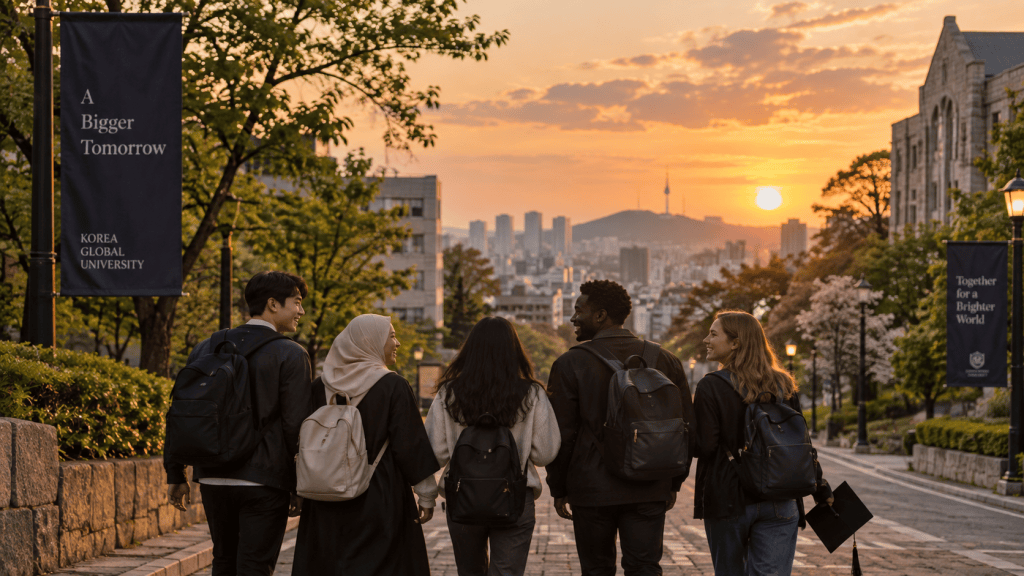
Make Your Korean University Experience the Beginning of Something Extraordinary!
K-STUDY | Study in Korea, Build Your Future.
Suggested Blog Tags
#KStudy #StudyInKorea #KoreanUniversity #KoreanUniversities #InternationalStudents #StudyAbroad #UniversityLifeInKorea #KoreanCampusLife #StudentSuccess #AcademicSuccess #KoreanLanguage #TOPIK #KoreanEducation #LifeInKorea #StudyTips #GlobalEducation #ScholarshipsInKorea #StudentLife #StudySmart #EducationInKorea


Leave a Reply