
Why International Patients Are Choosing Korea for Medical Care
For international visitors, Korea is no longer simply the home of K-Pop, K-Drama, and K-Beauty.
Another powerful “K” is rapidly gaining global attention:
K-MEDICAL
From comprehensive health screenings and eye surgery to dentistry, dermatology, plastic surgery, and hair transplantation, Korea has developed a strong international reputation for combining:
**Advanced medical technology
- Highly specialized doctors
- Efficient medical services
- Sophisticated patient care
- Competitive pricing**
The real strength of K-Medical is not simply that medical treatment can be affordable.
It is the combination of quality, technology, speed, service, and value.
Why Is Korean Healthcare Considered High Quality?
Korea operates a registration system for medical institutions that treat international patients.
Hospitals and clinics serving foreign patients are expected to meet requirements related to medical professionals, patient protection, and medical liability.
Korea also operates the KAHF — Korean Accreditation Program for Hospitals Serving Foreign Patients, which evaluates areas such as:
- Patient safety
- Medical treatment
- Medication management
- Infection control
- Facilities and environment
- Services designed for international patients
For international visitors, this provides another useful reference point when selecting a medical institution.
Key Strengths of K-Medical
| K-Medical Strength | What It Means for Patients |
|---|---|
| Specialized doctors | Highly specialized medical departments and treatment centers |
| Patient safety | Structured safety and quality-management systems |
| Advanced technology | MRI, CT, robotic systems, lasers, and advanced diagnostic devices |
| Efficient service | Consultation, diagnosis, and treatment can often be coordinated within a short period |
| International patient support | English, Chinese, Japanese, and other language assistance may be available |
| Price transparency | Many hospitals disclose non-covered medical fees |
| Follow-up care | Post-treatment consultation and follow-up may be available |
So how much does medical care in Korea actually cost?
The following prices are approximate reference ranges.
For convenient comparison, currency conversions are based on an approximate September 21, 2026 exchange rate:
KRW 1,000,000 ≈ USD 728 ≈ CNY 4,873 ≈ JPY 114,361
Actual exchange rates constantly fluctuate.
1. Comprehensive Health Screening
One Day That Could Change the Future of Your Health
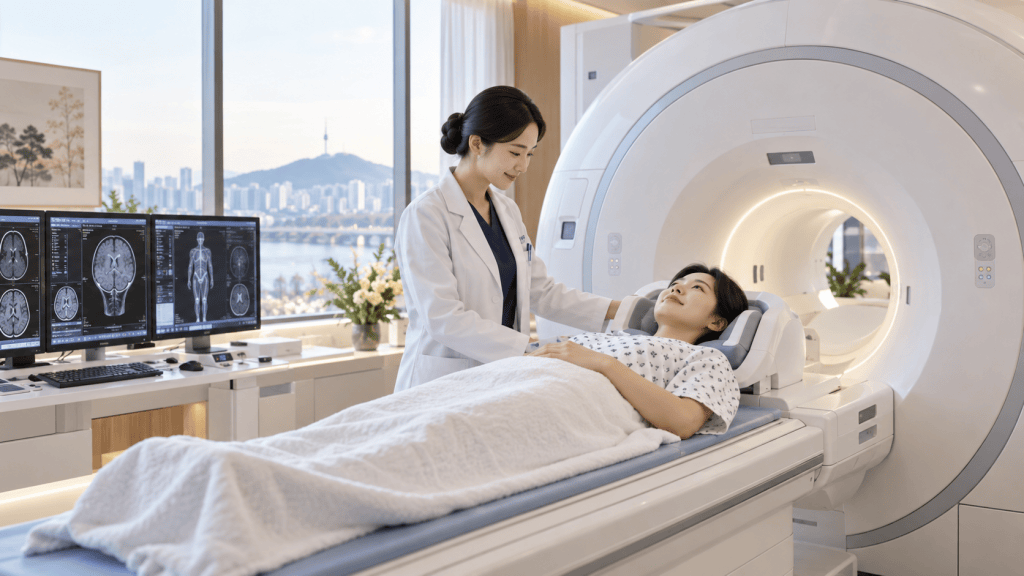
One of the most attractive areas of K-Medical for international visitors is Korea’s comprehensive health-screening system.
A premium Korean health examination can go far beyond a basic blood test.
Depending on the program, it may include:
- Blood and urine tests
- Gastroscopy
- Colonoscopy
- Ultrasound
- CT scans
- MRI
- Cardiovascular testing
- Cancer screening
- Brain examinations
- Women’s or men’s health screening
Some major Korean hospitals offer programs ranging from basic screenings to highly sophisticated premium checkups.
Approximate Health Screening Costs
| Program | KRW | USD | CNY | JPY |
|---|---|---|---|---|
| Basic Screening | ₩740,000–₩900,000 | $538–$655 | CNY 3,606–4,385 | ¥84,627–¥102,925 |
| Advanced Screening | ₩2,090,000–₩3,000,000 | $1,521–$2,183 | CNY 10,184–14,618 | ¥239,014–¥343,083 |
| Premium Screening | ₩5,100,000–₩6,350,000 | $3,710–$4,620 | CNY 24,850–30,941 | ¥583,241–¥726,192 |
Some programs published online may be intended primarily for Korean residents, so international patients should confirm the exact program and price directly with the hospital’s international healthcare center.
The K-Medical Advantage
The philosophy is increasingly shifting from:
“Treat disease after it appears”
to:
“Detect risk before disease becomes serious.”
For first-time medical visitors to Korea, a comprehensive health screening can be one of the easiest ways to experience Korean healthcare.
2. LASIK, LASEK & SMILE
Advanced Vision Correction in Korea
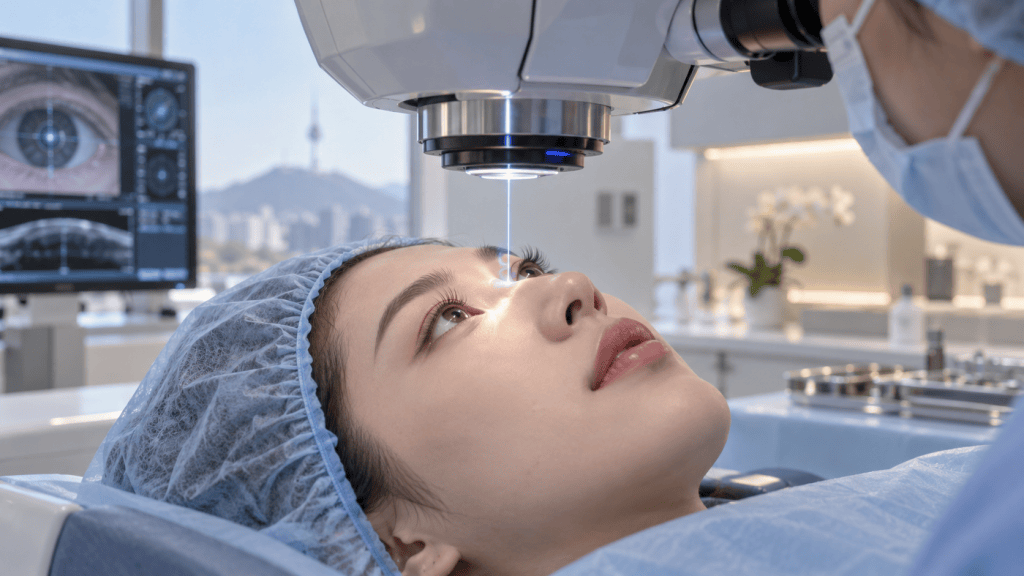
Korea has a highly developed ophthalmology market, particularly in laser vision correction.
Patients can often compare several procedures after detailed eye examinations.
Options may include:
- LASIK
- LASEK
- SMILE
- Other customized vision-correction procedures
Approximate Vision Correction Costs
| Procedure | KRW | USD | CNY | JPY |
|---|---|---|---|---|
| LASIK | ₩1,800,000–₩2,800,000 | $1,310–$2,037 | CNY 8,771–13,643 | ¥205,850–¥320,211 |
| SMILE | ₩2,700,000–₩3,000,000 | $1,964–$2,183 | CNY 13,156–14,618 | ¥308,775–¥343,083 |
Prices can differ depending on the technology used, the surgeon, diagnostic testing, and whether follow-up examinations are included.
The most important consideration is not price alone.
Corneal thickness, dry-eye condition, refractive error, and overall eye health must be evaluated before deciding which procedure is appropriate.
3. Dental Implants
Precision Dentistry Meets Korean Medical Technology
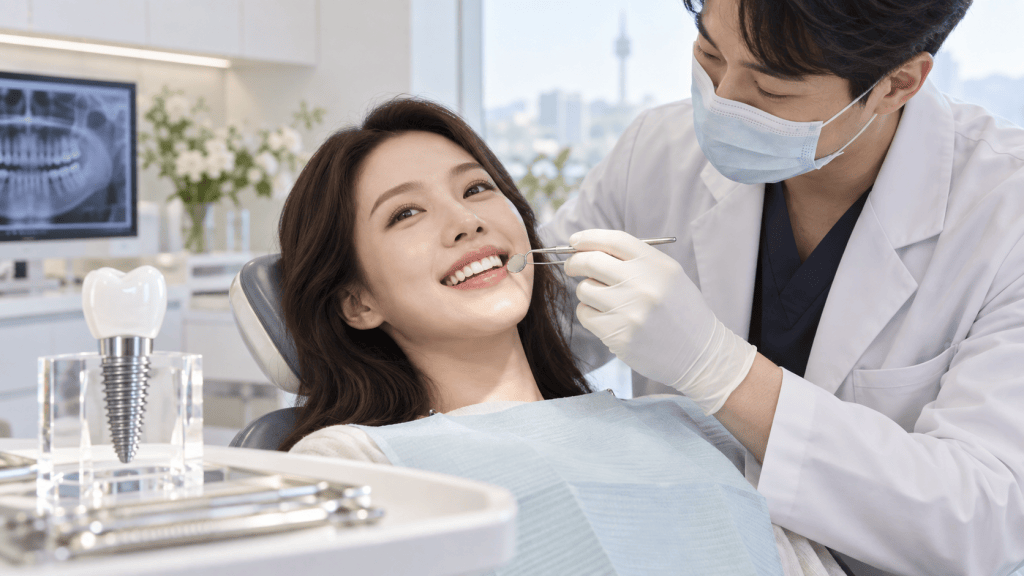
Dentistry is another important part of Korea’s medical-tourism industry.
Korea is home to major dental implant manufacturers and a highly developed dental healthcare market.
Many clinics serving international patients offer implant packages that may include:
- Implant fixture
- Abutment
- Crown
- X-rays or CT imaging
- Follow-up treatment
Approximate Cost Per Dental Implant
| Treatment | KRW | USD | CNY | JPY |
|---|---|---|---|---|
| Dental Implant | ₩900,000–₩1,500,000 | $655–$1,091 | CNY 4,385–7,309 | ¥102,925–¥171,542 |
Premium imported implant systems may cost more.
Additional treatment may also be required for patients who need:
- Bone grafting
- Sinus lifting
- Gum treatment
- Complex reconstruction
Therefore, international patients should request a complete quotation rather than comparing only the advertised implant price.
4. Double-Eyelid & Eye Surgery
Where K-Beauty Meets K-Medical
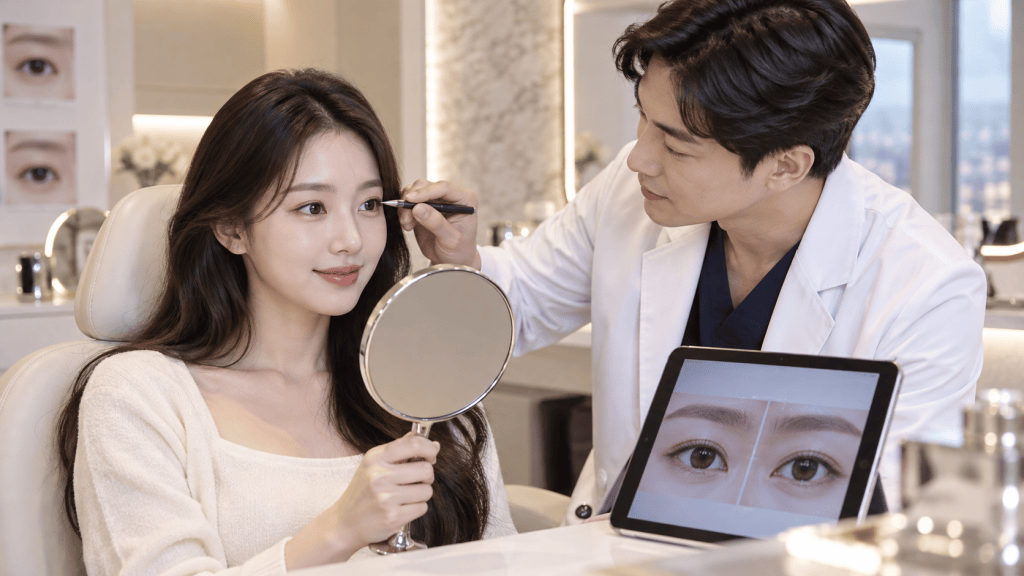
Eye surgery is one of Korea’s most internationally recognized cosmetic medical fields.
However, modern Korean eye surgery is not simply about making the eyes appear larger.
Many surgeons focus on achieving balance between the eyes and the patient’s:
- Face shape
- Eyebrows
- Nose
- Facial proportions
- Individual ethnicity and appearance
Common procedures include:
- Non-incisional double-eyelid surgery
- Incisional double-eyelid surgery
- Ptosis correction
- Epicanthoplasty
- Lateral canthoplasty
- Revision surgery
Approximate Eye Surgery Costs
| Procedure | KRW | USD | CNY | JPY |
|---|---|---|---|---|
| Double-Eyelid Surgery | ₩1,000,000–₩3,000,000 | $728–$2,183 | CNY 4,873–14,618 | ¥114,361–¥343,083 |
Combined procedures or revision surgery can significantly increase the total price.
The most important question should not be:
“Which clinic is the cheapest?”
It should be:
“Which surgeon can recommend the safest and most appropriate procedure for my face?”
5. Rhinoplasty
Precision at the Center of the Face

Rhinoplasty is another major field of Korean cosmetic medicine.
Because the nose sits at the center of the face, even relatively small changes can significantly influence overall facial appearance.
Korean rhinoplasty may involve:
- Bridge augmentation
- Tip refinement
- Nasal reduction
- Alar reduction
- Functional correction
- Cartilage grafting
- Revision rhinoplasty
Approximate Primary Rhinoplasty Costs
| Procedure | KRW | USD | CNY | JPY |
|---|---|---|---|---|
| Primary Rhinoplasty | ₩4,000,000–₩7,500,000 | $2,910–$5,457 | CNY 19,490–36,545 | ¥457,444–¥857,708 |
Revision surgery, rib cartilage, complex tip reconstruction, or functional nasal surgery can cost considerably more.
One important characteristic of Korean rhinoplasty is the emphasis on:
Facial Harmony
The goal is increasingly not simply to create a higher nose, but to create a nose that complements the eyes, lips, jawline, and overall face.
6. Ultherapy & Non-Surgical Lifting
K-Dermatology Without Major Surgery
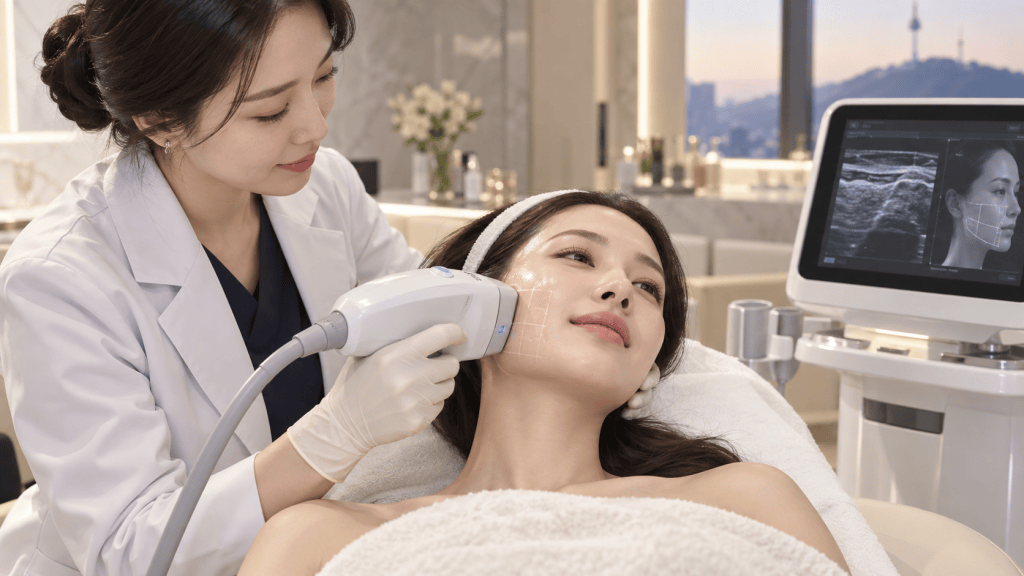
Dermatology is particularly attractive for medical tourists because many treatments can be completed during relatively short visits.
One of the best-known procedures is Ultherapy, which uses focused ultrasound energy for skin lifting and tightening.
Other Korean lifting treatments may use:
- HIFU
- Radiofrequency
- Laser technology
- Combination therapies
Approximate Ultherapy Price
| Treatment | KRW | USD | CNY | JPY |
|---|---|---|---|---|
| Ultherapy — 300 Shots | ₩1,300,000–₩1,650,000 | $946–$1,200 | CNY 6,334–8,040 | ¥148,669–¥188,696 |
Prices differ substantially according to:
- Number of shots
- Treatment area
- Device
- Physician
- Combination treatments
One of the strengths of Korean dermatology is the large number of treatment options that can be customized according to an individual’s skin condition.
7. Rejuran & Skin Boosters
From Changing the Face to Improving the Skin Itself
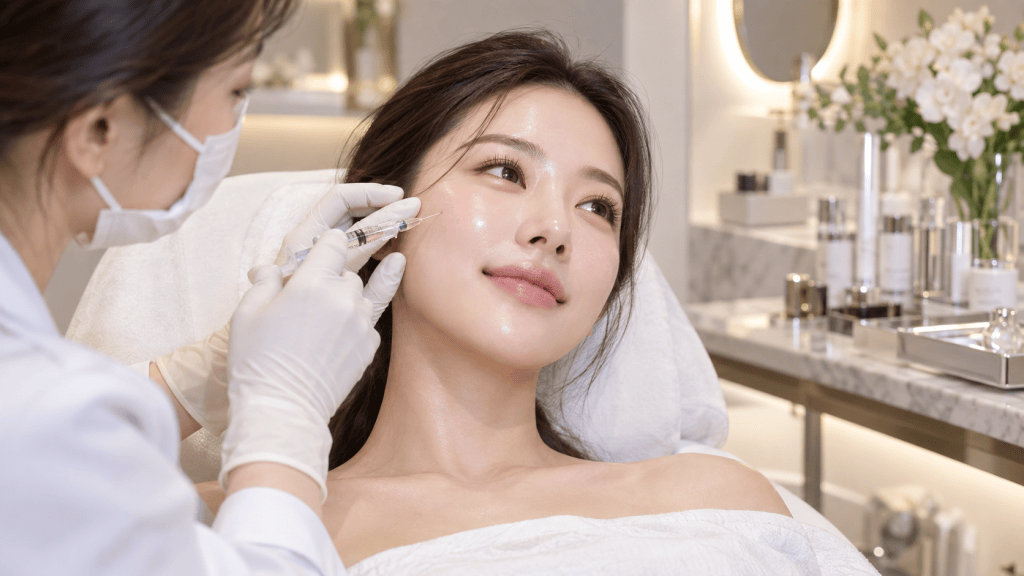
One major K-Beauty Medical trend is moving away from dramatic transformation and toward improving skin quality itself.
Treatments such as Rejuran and other skin boosters are popular among patients who want improvements in:
- Skin texture
- Elasticity
- Hydration
- Fine lines
- Overall skin condition
Approximate Rejuran Costs
| Treatment | KRW | USD | CNY | JPY |
|---|---|---|---|---|
| Rejuran Session | ₩300,000–₩650,000 | $218–$473 | CNY 1,462–3,167 | ¥34,308–¥74,335 |
Prices depend on the product, dosage, injection technique, and combination with other treatments.
International patients should always confirm:
What product is being used?
How much is being injected?
Who is performing the procedure?
These details are often more important than the advertised price.
8. Hair Transplantation
Precision Down to Every Hair
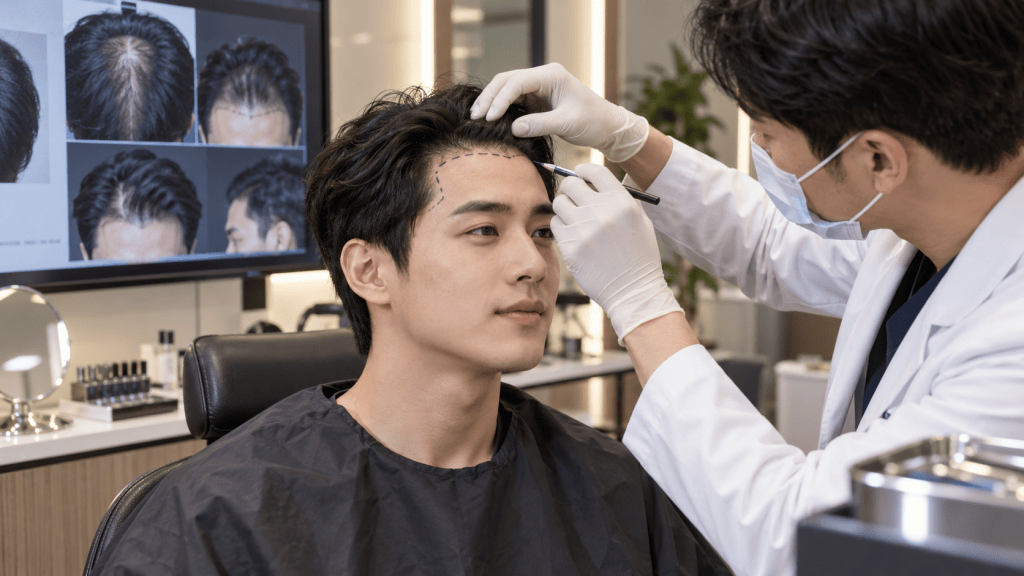
Hair transplantation has also become a highly specialized medical field in Korea.
Prices can vary widely depending on:
- FUE or other surgical techniques
- Number of grafts
- Hair density
- Donor-area condition
- Hairline design
- Surgeon experience
Approximate Hair Transplant Costs
| Treatment | KRW | USD | CNY | JPY |
|---|---|---|---|---|
| Approx. 2,000–3,000 Grafts | ₩4,000,000–₩12,000,000 | $2,910–$8,731 | CNY 19,490–58,471 | ¥457,444–¥1,372,332 |
A successful hair transplant is not simply about implanting the largest possible number of hairs.
The final appearance is influenced by:
Hairline Design + Graft Survival + Hair Direction + Natural Density
This makes surgeon experience and aesthetic judgment especially important.
9. Facial Contouring Surgery
One of the Most Advanced Areas of Korean Cosmetic Surgery

Facial contouring surgery can involve modification of the facial bones, including the:
- Jaw
- Chin
- Cheekbones
- V-line
This is considerably more invasive than many eye or nose procedures.
Approximate Facial Contouring Costs
| Procedure | KRW | USD | CNY | JPY |
|---|---|---|---|---|
| Facial Contouring | ₩9,000,000–₩15,000,000 | $6,548–$10,913 | CNY 43,853–73,089 | ¥1,029,249–¥1,715,415 |
For major surgery of this type, patients should evaluate much more than price.
Important considerations include:
- Surgeon credentials
- Anesthesia system
- Imaging and surgical planning
- Emergency-response capability
- Hospitalization
- Postoperative monitoring
- Follow-up care
For high-risk or invasive procedures, patient safety should always come before price.
10. Liposuction & Body Contouring
K-Beauty Medical Beyond the Face

Korean aesthetic medicine is expanding beyond facial treatments into full-body contouring.
Liposuction may be performed on areas such as the:
- Abdomen
- Thighs
- Arms
- Waist
- Back
- Hips
Approximate Liposuction Costs
| Treatment | KRW | USD | CNY | JPY |
|---|---|---|---|---|
| One Treatment Area | ₩3,000,000–₩6,000,000 | $2,183–$4,365 | CNY 14,618–29,236 | ¥343,083–¥686,166 |
The total cost can increase depending on:
- Number of areas
- Amount of fat removed
- Anesthesia
- Compression garments
- Hospital stay
- Postoperative care
That is why international patients should compare the Total Medical Cost, not just the advertised procedure fee.
K-Medical Prices at a Glance
| Medical Field | Approximate Price in Korea |
|---|---|
| Comprehensive Health Screening | ₩740,000–₩6,350,000+ |
| LASIK | ₩1,800,000–₩2,800,000 |
| SMILE | ₩2,700,000–₩3,000,000 |
| Dental Implant | ₩900,000–₩1,500,000 per tooth |
| Double-Eyelid Surgery | ₩1,000,000–₩3,000,000 |
| Rhinoplasty | ₩4,000,000–₩7,500,000 |
| Ultherapy | ₩1,300,000–₩1,650,000 / 300 shots |
| Rejuran | ₩300,000–₩650,000 |
| Hair Transplant | ₩4,000,000–₩12,000,000 |
| Facial Contouring | ₩9,000,000–₩15,000,000 |
| Liposuction | ₩3,000,000–₩6,000,000 per area |
What Is the Real Competitive Advantage of K-Medical?
There are countries where certain medical procedures may be cheaper than in Korea.
So why do patients continue to consider Korea?
Because Korea’s competitive advantage is not simply low price.
It is the balance between:
Advanced Technology × Skilled Doctors × Efficient Service × Competitive Cost
In other words:
K-Medical is not about “Cheap Medical Care.”
It is about “High-Value Medical Care.”
International patients increasingly want more than inexpensive treatment.
They want:
- Reliable doctors
- Modern medical technology
- Efficient service
- Clear communication
- Clean facilities
- Good follow-up care
- Predictable costs
- Patient safety
Korea has built a medical ecosystem that attempts to combine all of these elements.
10 Things International Patients Should Check Before Choosing a Korean Hospital
| Checkpoint | What to Confirm |
|---|---|
| 1. Registered medical institution | Is it registered to treat international patients? |
| 2. Doctor’s qualifications | Is the physician a specialist in the relevant field? |
| 3. Total price | Are examinations, anesthesia, medicine, materials, and follow-up included? |
| 4. Medical equipment | Which device, implant, or product will actually be used? |
| 5. Language assistance | Is professional interpretation available? |
| 6. Follow-up system | Can the hospital assist after you return home? |
| 7. Risk explanation | Have possible complications and alternatives been clearly explained? |
| 8. Written quotation | Have you received the final price in writing? |
| 9. Surgical safety | What anesthesia, emergency, and inpatient systems are available? |
| 10. Medical records | Can you receive records and test results in English? |
International patients should never make a major medical decision based solely on social-media advertisements or unusually low promotional prices.
The safest choice is an informed choice.
K-MEDICAL — Beauty Is Only the Beginning
Many international visitors may first discover K-Medical through dermatology or plastic surgery.
But Korean medicine extends far beyond beauty.
It includes:
Comprehensive health screening.
Cancer detection.
Dentistry.
Ophthalmology.
Dermatology.
Plastic surgery.
Hair restoration.
Advanced hospital treatment.
K-Pop introduced Korean music to the world.
K-Drama introduced Korean storytelling.
K-Beauty introduced Korean beauty and skincare.
And now,
K-Medical is introducing Korea’s medical technology and healthcare services to the world.
The real value of Korean healthcare is not simply that treatment may cost less.
It is the ability to provide:
**More precise diagnosis,
more specialized treatment,
more sophisticated technology,
stronger patient service,
and competitive value.**
That is why the world is paying increasing attention to K-Medical.
K-MEDICAL
Where Technology, Quality, Care, and Value Meet.
Price Disclaimer
All prices shown above are approximate reference ranges based on publicly available medical prices and market information. They are not guaranteed nationwide averages or final quotations.
Actual costs vary depending on the hospital or clinic, physician, patient’s condition, treatment complexity, anesthesia, medical materials, medication, additional procedures, and follow-up care.
Foreign-currency amounts are approximate conversions and will change with exchange rates.
Patients should always obtain a written final quotation directly from the medical institution before treatment.


Leave a Reply