
10 Practical Strategies for Doing Business Successfully with Korean Companies
A Practical Guide to Korean Corporate Culture & Business Negotiation for International Professionals
Doing business successfully with Korean companies requires more than simply understanding Korean etiquette.
Making a good impression is important, but closing a deal is a completely different challenge.
To negotiate effectively with Korean companies, international business professionals need to understand:
- How decisions are actually made
- How internal approval processes work
- What Korean managers need to report internally
- What can be negotiated besides price
- How to reduce the buyer’s perceived risk
- How to turn a successful meeting into an actual contract
Of course, not every Korean company operates in the same way.
Decision-making can vary significantly among large corporations, mid-sized companies, startups, and public institutions.
However, the following 10 strategies can help international businesspeople navigate Korean corporate negotiations more effectively.
At a Glance: 10 Strategies for Successful Negotiation in Korea
| No. | Key Strategy | What International Companies Should Remember |
|---|---|---|
| 1 | Understand internal approval, not just meetings | Who actually approves the deal? |
| 2 | Make your proposal easy to sell internally | Help your contact persuade management |
| 3 | Reduce the risk of the first deal | Pilot before full-scale commitment |
| 4 | Negotiate the whole package, not just price | Think total value |
| 5 | Attach conditions to every concession | Give & Get |
| 6 | Separate fast communication from final approval | Speed ≠ Decision |
| 7 | Make it easy to choose | Offer clear A/B/C options |
| 8 | Reduce risk before asking for commitment | Make it safe to say yes |
| 9 | Treat payment terms as part of the negotiation | Revenue is not cash until paid |
| 10 | Finish negotiations with an execution document | Agreement → Action |
1. Do Not Assume the Person in the Meeting Is the Final Decision-Maker

One of the most common mistakes international companies make in Korea is assuming that a positive meeting means the deal is almost complete.
A meeting may go extremely well.
The Korean partner may show strong interest.
They may even say:
“This looks very good.”
But the project may still require several layers of internal review.
Depending on the company and the size of the contract, the process could look like this:
Working-Level Manager → Team Leader → Department Head → Procurement → Finance → Legal → Information Security → Executive Approval
The exact structure varies considerably by company.
Therefore, instead of simply asking:
“Do you like our proposal?”
ask:
“What is the internal decision-making process after this meeting?”
or:
“Who else needs to review or approve this project?”
Questions You Should Ask
| Question | Why It Matters |
|---|---|
| Who will be involved in the final decision? | Identifies key decision-makers |
| What is your internal approval process? | Reveals the approval structure |
| Which departments need to review this proposal? | Identifies stakeholders |
| What information will management need? | Helps prepare internal-selling materials |
| What would be the ideal decision timeline? | Clarifies the expected schedule |
Key Insight
In Korean business,
understanding the Decision Map can be more important than understanding the Meeting Map.
2. Turn Your Proposal into an Internal Approval Document

Many international companies design proposals mainly to explain their own products, technology, or services.
But the Korean manager sitting across from you often has another challenge.
After the meeting, that person may need to explain your proposal to senior management.
Their real question may therefore be:
“How can I convince my management that we should choose this company?”
A strong proposal should not only persuade your immediate contact.
It should also help your contact sell your proposal internally.
What an Internal-Friendly Proposal Should Include
| Section | Question It Should Answer |
|---|---|
| Problem | What problem are we solving? |
| Solution | How will this solution solve it? |
| Cost | How much will it cost? |
| Benefit | What measurable improvement can we expect? |
| Comparison | Why is this better than the current approach? |
| Risk | What risks exist, and how will they be controlled? |
| Timeline | When can implementation begin and results appear? |
| References | Who is already using this solution successfully? |
A concise one-page Executive Summary can be especially powerful.
Make it easy for your Korean counterpart to explain:
- Why the project matters
- Why your company was selected
- What it will cost
- What the expected return will be
- Why the risk is manageable
Remember:
Make your Korean partner your internal salesperson.
If your contact can explain your proposal clearly and confidently to management, your chances of moving forward can increase significantly.
3. Do Not Start with the Biggest Deal — Start with a Small Success

International companies entering the Korean market sometimes make a common mistake:
They immediately propose a nationwide rollout, an exclusive agreement, or a large multi-year contract.
From the Korean buyer’s perspective, however, working with an unfamiliar overseas company may represent additional risk.
A better approach can be:
Pilot → Proof → Expansion
Instead of asking the company to make a large commitment immediately, help it prove the value first.
Examples
Company-wide rollout → One department pilot
Three-year contract → Three-month Proof of Concept
Nationwide distribution → Test market in one region
Entire factory → One production line
Ten products → One or two core products
A smaller first step can reduce the psychological and organizational burden of saying yes.
A Smart Expansion Model
| Stage | Goal |
|---|---|
| STEP 1 | Small Pilot |
| STEP 2 | Measure Results |
| STEP 3 | Verify ROI |
| STEP 4 | Expand |
| STEP 5 | Build a Long-Term Partnership |
Your first goal does not always need to be:
“How do we win the biggest contract?”
A better question may be:
“What is the smallest meaningful next step that is easy for the customer to approve?”
4. Negotiate the Total Package, Not Just the Price

When doing business in Korea, you may receive requests for price reductions.
If every request immediately leads to a discount, however, you quickly lose negotiating flexibility.
Instead, treat the transaction as a complete package of commercial terms.
Elements That Can Be Negotiated
| Negotiation Item | Example |
|---|---|
| Price | Unit price |
| Volume | Purchase quantity |
| Contract Period | Length of contract |
| Payment | Payment schedule |
| Delivery | Delivery schedule |
| Training | Training support |
| Technical Support | Service level |
| Warranty | Warranty period |
| Marketing Support | Joint promotion |
| Territory | Geographic rights |
| Exclusivity | Exclusive distribution |
| Renewal | Renewal conditions |
Suppose your customer requests a 10% price reduction.
Instead of simply saying:
“Okay, we can give you a 10% discount.”
you might say:
“A 10% discount would be possible if we agree on a three-year contract and a minimum annual purchase volume.”
The important idea is simple:
Price should be one part of the negotiation—not the entire negotiation.
5. Every Concession Should Have a Condition

One of the most useful principles in negotiation is:
IF → THEN
If your counterpart asks you to give something, ask for something meaningful in return.
Weak Negotiation
Buyer:
“Can you reduce the price by 8%?”
Seller:
“Okay.”
The problem is that the buyer may now ask for another concession.
Stronger Negotiation
“If we reduce the price by 8%, could you increase the order volume to 20,000 units?”
Or:
“If we extend the warranty period, could we agree on a two-year contract?”
Give & Get
| Customer Requests | What You Might Request in Return |
|---|---|
| Lower price | Higher purchase volume |
| Faster delivery | Earlier purchase confirmation |
| Exclusivity | Minimum sales commitment |
| Additional services | Longer contract term |
| Free training | Minimum number of participants or contract value |
| Longer payment period | Adjustment to pricing |
The principle is simple:
Never Just Give. Trade.
A concession should not automatically become a gift.
Use it to create a mutually beneficial exchange.
6. Separate Korea’s Fast Business Pace from Final Decision Speed
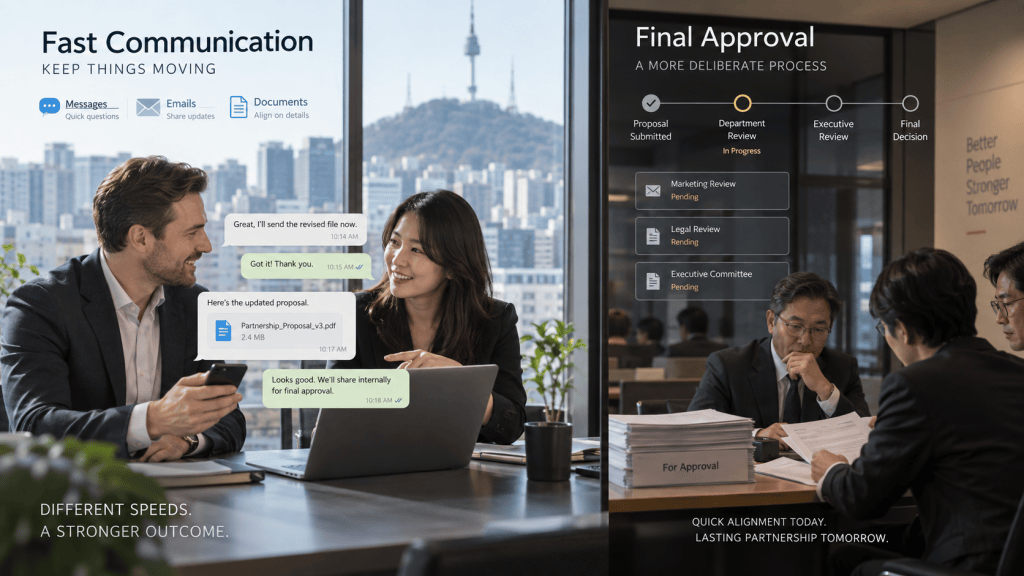
International businesspeople often notice that Korean companies can move very quickly.
Meetings may be scheduled suddenly.
Requests may arrive with short deadlines.
You may hear:
“Can you send this today?”
or:
“Can we receive the revised proposal by tomorrow?”
However, there is an important distinction:
Fast communication does not always mean fast final approval.
Operational speed and decision-making speed are not necessarily the same.
Think in Terms of Two Clocks
| Clock 1 | Clock 2 |
|---|---|
| Operational Speed | Decision Speed |
| Document submission | Internal approval |
| Quotation response | Budget approval |
| Technical questions | Contract approval |
| Sample delivery | Purchasing decision |
Therefore, do not assume that a fast response means the deal is almost complete.
Instead, regularly ask:
“What is the next internal milestone?”
This helps you understand where the deal actually stands.
7. Make the Decision Easy with Clear Options

Too many choices can make decision-making difficult.
Instead of presenting one complicated package, offer two or three clearly differentiated alternatives.
For example:
| OPTION A | OPTION B | OPTION C | |
|---|---|---|---|
| Position | Starter | Recommended | Strategic |
| Contract | 1 Year | 2 Years | 3 Years |
| Support | Basic | Advanced | Premium |
| Training | Online | Online + On-site | Full Program |
| Price Level | Standard | Better | Best |
| Best For | Trial | Growth | Long-Term Partnership |
This changes the conversation from:
“Should we do this or not?”
to:
“Which option is best for us?”
You may also identify one option as:
RECOMMENDED
when there is a genuine reason it best matches the client’s stated requirements.
The easier you make the decision process, the easier it becomes for your Korean counterpart to discuss the proposal internally.
8. Reduce Risk Before Asking for Commitment

Corporate buyers do not evaluate only how attractive a product is.
They also consider:
“What happens if this goes wrong?”
This means that reducing uncertainty can be just as important as demonstrating benefits.
Important Issues to Clarify Before Contracting
| Area | Questions to Clarify |
|---|---|
| Scope | What exactly will be provided? |
| Deliverables | What will the final outputs be? |
| Schedule | When will each stage be completed? |
| SLA | What level of service is guaranteed? |
| IP | Who owns the intellectual property? |
| Confidentiality | How will confidential information be protected? |
| Data | Where and how will data be managed? |
| Warranty | What is covered? |
| Liability | Who is responsible if problems occur? |
| Termination | How can the agreement be terminated? |
For international transactions, applicable Korean laws and regulations should also be reviewed carefully where relevant.
A strong seller does not merely say:
“Our product is excellent.”
A stronger message is:
“Choosing us is a manageable and well-controlled business decision.”
Great negotiation is often about making the buyer feel safe enough to move forward.
9. Payment Terms Matter as Much as the Contract Value

Winning a US$1 million contract sounds impressive.
But there is something even more important:
Actually receiving the US$1 million.
In international transactions, payment conditions should be clearly defined before signing.
Payment Checklist
| Item | What to Confirm |
|---|---|
| Currency | KRW / USD / EUR, etc. |
| Payment Method | T/T, L/C, etc. |
| Deposit | Is an advance payment required? |
| Milestone Payment | Are payments linked to project stages? |
| Final Payment | When is the balance paid? |
| Invoice | How and when will invoices be issued? |
| Tax | Are taxes included or excluded? |
| Bank Fees | Who pays transfer fees? |
| Delay | What happens if payment is late? |
For project-based contracts, a structure such as the following may be considered:
30% — Contract Signing
40% — Milestone Completion
30% — Final Acceptance
The appropriate structure depends on the transaction, industry, risk allocation, and negotiating position of the parties.
Remember:
A good sales contract should also function as a:
Cash Collection Plan.
Revenue written in a contract is not the same as cash received.
10. End the Negotiation with an Action Document — Not Just a Handshake

A friendly meeting is not the same as a completed negotiation.
At the end of every important discussion, make sure everyone clearly understands:
- What has been agreed
- What remains unresolved
- Who needs to do what
- When each action must be completed
- When the next decision will occur
Instead of sending only a polite thank-you email, consider sending a short:
Decision & Action Summary
| Item | Description |
|---|---|
| Agreed | Items already confirmed |
| Open Issues | Matters still under discussion |
| Buyer Action | What the Korean company needs to do |
| Seller Action | What your company needs to do |
| Owner | Person responsible |
| Deadline | Completion date |
| Next Meeting | Next decision point |
Example
AGREED
Pilot scope confirmed.
OPEN ISSUE
Final pricing.
KOREAN PARTNER
Confirm internal budget.
INTERNATIONAL PARTNER
Submit revised proposal.
DEADLINE
Friday.
NEXT DECISION
Executive approval.
This simple document can greatly reduce misunderstandings and prevent different parties from remembering the meeting differently.
🇰🇷 K-BUSINESS GOLDEN RULES
| Avoid This | Do This Instead |
|---|---|
| Successful meeting = successful deal | Understand the internal approval process |
| Explain only your product | Provide internal-selling materials |
| Push immediately for a large contract | Pilot → Proof → Expansion |
| Negotiate only price | Negotiate the entire package |
| Give unconditional discounts | Use IF → THEN |
| Fast response = final approval | Separate operational speed from decision speed |
| Present one complicated proposal | Provide clear A/B/C options |
| Talk only about benefits | Reduce perceived risk |
| Focus only on contract value | Negotiate payment terms |
| End with a positive atmosphere | Document decisions and actions |
The Most Important Lesson When Negotiating with Korean Companies
Doing business successfully in Korea does not mean trying to imitate Korean culture.
It means understanding:
How the company makes decisions,
what the people inside the company are worried about,
and what they need in order to confidently say “Yes.”
The strongest international business partner is not necessarily the person who talks the most.
It is the partner who makes the Korean client think:
“This partner understands how our business works.”
Ultimately, the purpose of negotiation is not simply to lower a price or obtain a signature.
It is to create a deal that both sides can approve, implement, and sustain.
Make It Easy to Decide.
Make It Safe to Say Yes.
Make It Valuable for Both Sides.
K-BUSINESS — Understand Korea. Negotiate Smarter. Build Better Business.


Leave a Reply