
How Much Does It Cost to Study at a Korean University?
A Complete Guide to Tuition, Living Expenses, Scholarships, and Selection Criteria for International Students
If you are considering studying in Korea, you probably have a few important questions:
“How much does university cost in Korea?”
“Can international students receive scholarships?”
“What grades or qualifications do I need to win a scholarship?”
Korea offers a wide range of universities, from national and public institutions to private universities, along with numerous scholarship opportunities for international students.
Many Korean universities offer international students scholarships covering approximately 30% to 100% of tuition, depending on academic performance, language proficiency, and other qualifications.
Currency Note
For easy comparison, the figures below use approximate exchange rates as of September 22, 2026:
KRW 1,000,000 ≈ US$737 / CN¥4,944 / JP¥115,856
Actual exchange rates may vary.
1. How Much Is Tuition at a Four-Year University in Korea?

According to official Study in Korea data, the average annual tuition at a four-year Korean university is approximately KRW 6.82 million.
| University Type | Annual Tuition | US Dollar | Chinese Yuan | Japanese Yen |
|---|---|---|---|---|
| Average for Korean Universities | ₩6,820,244 | Approx. US$5,029 | Approx. CN¥33,722 | Approx. JP¥790,166 |
| National & Public Universities | ₩4,265,842 | Approx. US$3,145 | Approx. CN¥21,092 | Approx. JP¥494,223 |
| Private Universities | ₩7,625,336 | Approx. US$5,622 | Approx. CN¥37,703 | Approx. JP¥883,441 |
| Universities in the Seoul Metropolitan Area | ₩7,654,030 | Approx. US$5,644 | Approx. CN¥37,845 | Approx. JP¥886,765 |
| Universities Outside the Metropolitan Area | ₩6,316,885 | Approx. US$4,658 | Approx. CN¥31,233 | Approx. JP¥731,849 |
National and public universities are generally more affordable because they receive government funding, while private universities tend to have higher tuition.
For students who want to reduce the overall cost of studying in Korea, choosing a national or public university can be an excellent option.
2. Tuition Costs by Major
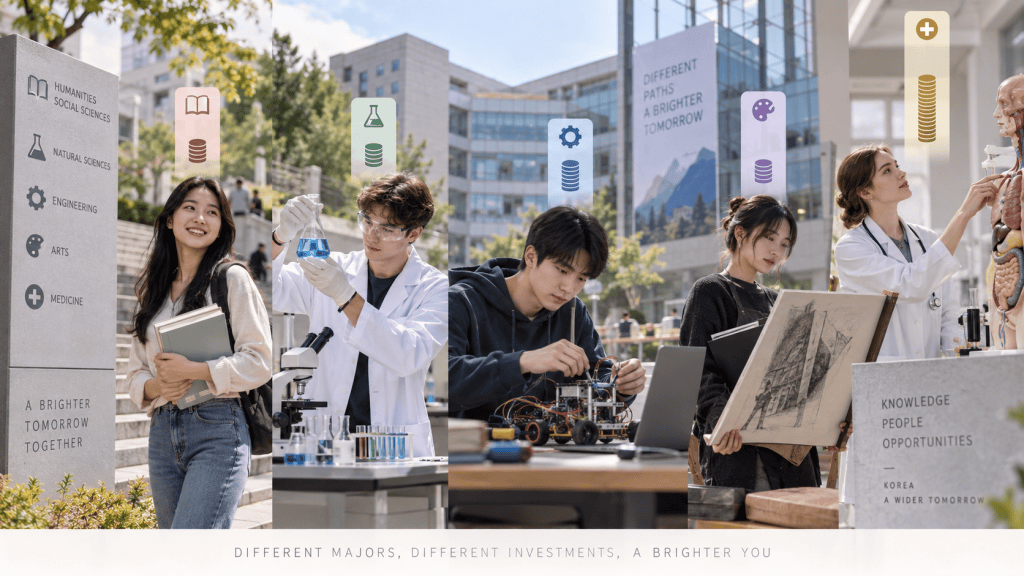
Tuition in Korea varies significantly depending on the field of study.
Humanities and social sciences tend to have lower tuition, while engineering, arts, and medicine usually cost more.
| Field of Study | Average Annual Tuition | US Dollar | Chinese Yuan | Japanese Yen |
|---|---|---|---|---|
| Humanities & Social Sciences | ₩6,003,000 | Approx. US$4,426 | Approx. CN¥29,681 | Approx. JP¥695,484 |
| Natural Sciences | ₩6,875,000 | Approx. US$5,069 | Approx. CN¥33,993 | Approx. JP¥796,510 |
| Engineering | ₩7,277,200 | Approx. US$5,366 | Approx. CN¥35,981 | Approx. JP¥843,107 |
| Arts & Physical Education | ₩7,828,200 | Approx. US$5,772 | Approx. CN¥38,706 | Approx. JP¥906,944 |
| Medicine | ₩9,843,400 | Approx. US$7,258 | Approx. CN¥48,670 | Approx. JP¥1,140,417 |
This means that your total study budget will depend not only on the university you choose but also on your major.
3. How Much Does It Cost to Live in Korea?

Tuition is only part of the cost of studying abroad.
International students also need to budget for accommodation, meals, transportation, mobile services, health insurance, books, and personal expenses.
Study in Korea estimates that international students generally need around KRW 750,000 to KRW 1,000,000 per month for living expenses.
| Living Expenses | Korean Won | US Dollar | Chinese Yuan | Japanese Yen |
|---|---|---|---|---|
| Estimated Monthly Cost | ₩750,000–₩1,000,000 | US$553–737 | CN¥3,708–4,944 | JP¥86,892–115,856 |
| Estimated Annual Cost | ₩9,000,000–₩12,000,000 | US$6,636–8,848 | CN¥44,500–59,333 | JP¥1,042,704–1,390,272 |
Actual expenses vary depending on the city, accommodation type, lifestyle, and whether the student lives in a university dormitory.
A typical monthly budget may include:
| Expense | Approximate Monthly Cost |
|---|---|
| Housing | ₩500,000–₩700,000 |
| Food | ₩200,000–₩300,000 |
| Transportation | ₩50,000–₩100,000 |
| Mobile, Insurance & Other Expenses | ₩100,000–₩200,000 |
Living in a university dormitory or outside Seoul can often reduce overall costs.
4. How Much Does One Year of Study in Korea Cost?

If we combine average tuition with estimated living expenses, a typical international student may need the following annual budget.
| Category | Estimated Annual Cost |
|---|---|
| Average University Tuition | Approx. ₩6,820,000 |
| Living Expenses | Approx. ₩9,000,000–₩12,000,000 |
| Estimated Total | Approx. ₩15,820,000–₩18,820,000 |
| In US Dollars | Approx. US$11,665–13,877 |
| In Chinese Yuan | Approx. CN¥78,222–93,055 |
| In Japanese Yen | Approx. JP¥1,832,870–2,180,438 |
These figures are estimates.
Students who attend national or public universities, live in dormitories, or receive scholarships may be able to reduce their actual expenses significantly.
5. Can International Students Receive Scholarships in Korea?
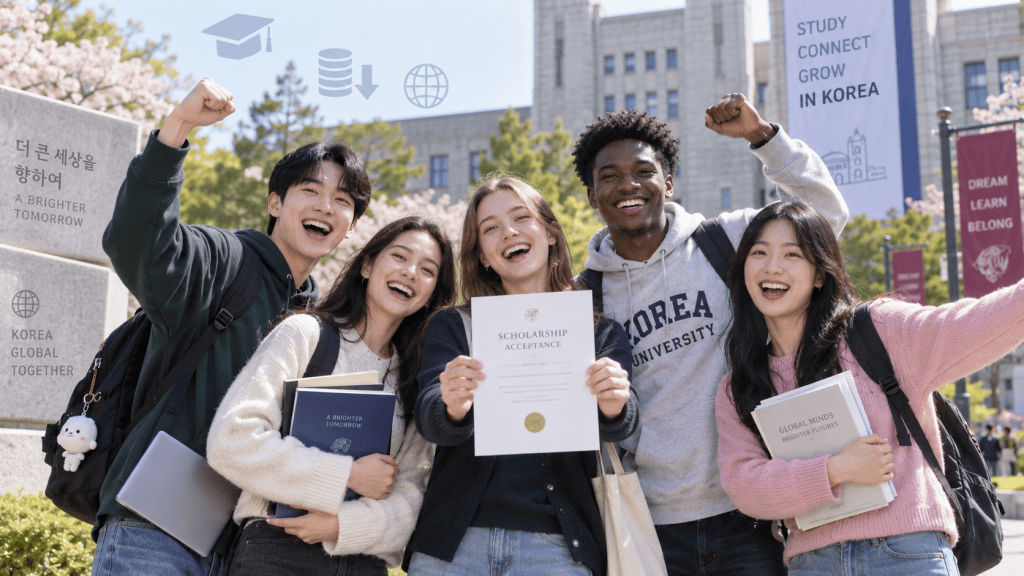
Yes. Absolutely.
Korean universities, the Korean government, foundations, and other organizations offer a wide variety of scholarships for international students.
Many universities provide scholarships covering approximately 30% to 100% of tuition, depending on the student’s academic record, Korean or English proficiency, and university-specific requirements.
| Scholarship Type | Main Selection Criteria | Typical Support |
|---|---|---|
| Admission Scholarship | High school grades, admission evaluation | Partial to full tuition |
| TOPIK Scholarship | Korean language proficiency | Approx. 20%–100% |
| English Proficiency Scholarship | IELTS, TOEFL, etc. | Varies by university |
| Academic Excellence Scholarship | University GPA | Approx. 20%–100% |
| Department Recommendation | Academic performance, research potential, recommendation | Partial to full tuition |
| GKS | Nationality, academic record, qualifications and overall evaluation | Comprehensive financial support |
6. What Is the Global Korea Scholarship, or GKS?

The Global Korea Scholarship (GKS) is one of the most prestigious scholarship programs for international students wishing to study in Korea.
It is supported by the Korean government and is designed to attract talented students from around the world.
Depending on the program, GKS may provide support such as:
- Airfare
- Tuition
- Korean language training fees
- Monthly living allowance
- Settlement allowance
- Medical insurance
- Degree program support
For undergraduate students, the scholarship usually includes Korean language training followed by a degree program.
For students planning to begin university in 2027, the 2027 GKS Undergraduate Scholarship Guidelines were officially announced in September 2026.
7. What Are the Basic Eligibility Requirements for GKS?

Detailed requirements may change each year, but the major criteria generally include nationality, age, education, and academic performance.
| Category | General Requirement |
|---|---|
| Nationality | Applicant and parents must generally be non-Korean citizens |
| Age | Undergraduate applicants are generally required to be under 25 for the applicable selection year |
| Education | High school graduation or expected graduation for undergraduate applicants |
| Academic Record | Generally 80% or higher, top 20% of class, or an accepted equivalent GPA |
| Documents | Personal statement, study plan, academic records and other required documents |
| Application Route | Embassy Track or University Track |
| Final Selection | Multi-stage document and qualification review |
One of the most important academic standards is usually an overall academic score of at least 80%, a ranking within the top 20% of the class, or an equivalent accepted GPA standard.
However, country quotas, participating universities, departments, application procedures, and detailed requirements can change from year to year.
Students should always check the official GKS guidelines for the year in which they apply.
8. What Do Korean Universities Look for When Awarding Scholarships?

Scholarship rules vary from university to university, but several factors are commonly considered.
These include:
① Previous academic performance
② TOPIK score
③ IELTS or TOEFL score
④ Admission evaluation or interview
⑤ GPA after enrollment
⑥ Academic goals and suitability for the chosen major
In some Korean universities, international students may receive different levels of tuition reduction depending on their TOPIK score.
For example:
| Korean Proficiency | Possible Scholarship Example |
|---|---|
| TOPIK Level 3 | 30% Tuition Reduction |
| TOPIK Level 4 | 40% Tuition Reduction |
| TOPIK Level 5 | 50% Tuition Reduction |
| TOPIK Level 6 | Up to 100% Tuition Reduction |
This is only an example. Scholarship percentages and requirements vary by university.
Still, it shows why Korean language ability can have a direct impact on the cost of studying in Korea.
9. What TOPIK Level Should International Students Aim For?

For Korean-taught degree programs, TOPIK Level 3 is often considered an important starting point, although requirements vary by university and department.
Students who want to compete for better scholarships should consider aiming higher.
| TOPIK Level | What It Can Mean for International Students |
|---|---|
| TOPIK 3 | A basic starting level for admission at some universities |
| TOPIK 4 | Better ability to follow academic classes and stronger scholarship potential |
| TOPIK 5 | Advanced Korean proficiency and potential access to higher scholarship benefits |
| TOPIK 6 | Highest proficiency level and eligibility for some of the strongest language-based scholarships |
A very important point is that TOPIK 3 may help you enter a university, but TOPIK 4, 5, or 6 can significantly improve your scholarship competitiveness.
International students should therefore view Korean language study not only as an admission requirement but also as a potential way to reduce tuition costs.
10. How Can You Improve Your Chances of Winning a Scholarship?

Winning a scholarship in Korea is not simply about having high grades.
Universities and scholarship organizations often want to understand:
Why do you want to study in Korea?
Why did you choose this university and this major?
What do you plan to achieve during your studies?
How will you use your education after graduation?
A strong scholarship candidate usually has a combination of:
Strong Academic Record + High TOPIK or English Score + Clear Academic Goals + Strong Study Plan + Relevant Activities + Clear Future Vision
Preparing early can make a major difference.
K-STUDY Quick Guide
| Question | Key Answer |
|---|---|
| Average annual tuition in Korea? | Approx. ₩6.82 million |
| National & public university average? | Approx. ₩4.27 million |
| Private university average? | Approx. ₩7.63 million |
| Monthly living expenses? | Approx. ₩750,000–₩1,000,000 |
| Scholarships for international students? | Often 30%–100% of tuition, depending on the university |
| Korea’s major government scholarship? | GKS – Global Korea Scholarship |
| Basic GKS academic requirement? | Generally 80% or above, top 20%, or equivalent GPA |
| Korean language requirement? | Often TOPIK 3 or above for Korean-taught programs, depending on the university |
| Recommended level for stronger scholarship opportunities? | TOPIK 4–6 |
| Is a full scholarship possible? | Yes. GKS and some university scholarships may cover full tuition or more |
🌏 Study in Korea, Build Your Future
One of the greatest advantages of studying in Korea is that international students do not always have to pay the full cost of their education.
With strong academic performance, language proficiency, and a well-prepared study plan, students may qualify for partial or even full scholarships.
So when considering studying in Korea, do not ask only:
“How much will it cost?”
Also ask:
“What scholarship opportunities can I qualify for?”
Your academic ability, language skills, and preparation can make studying in Korea far more affordable than you may expect.
K-STUDY — Study in Korea, Discover Your Future.


Leave a Reply