
Your Cultural Survival Guide to Studying in Korea
Studying in Korea is not only about attending lectures, earning credits, and passing exams.
For international students, some of the biggest challenges come from things that are never written in the university handbook.
How should you email a professor?
Is it okay to disagree during a group project?
Should you join department dinners?
Why does everyone communicate through KakaoTalk?
And what does it mean when a Korean classmate says, “Let’s eat together sometime”?
Understanding these small cultural signals can make a huge difference in your university experience.
Here are 10 unwritten rules of Korean university life that every international student should know.
1. Respectful Communication with Professors Matters

Korean universities generally maintain a relatively formal relationship between professors and students.
Calling a professor by their first name may feel natural in some countries, but in Korea it can sound overly casual unless the professor specifically asks you to do so.
A safe approach is:
Professor + Family Name
For example:
Professor Kim
Professor Lee
When speaking Korean, students commonly use:
교수님 (gyosu-nim)
The ending “-nim” adds respect.
When Emailing a Professor
A professional email should include:
| Part | Recommended Approach |
|---|---|
| Subject | Clearly state your course and purpose |
| Greeting | Dear Professor Kim |
| Introduction | Name, student ID, course |
| Request | Keep it short and specific |
| Closing | Thank the professor for their time |
| Signature | Full name and student number |
Example
Dear Professor Kim,
My name is Alex Brown, and I am a student in your International Business class.
I would like to ask a question regarding next week’s assignment.
Could you please confirm whether international market data may be included in the final report?
Thank you very much for your time.
Best regards,
Alex Brown
K-STUDY Tip
Avoid sending messages such as:
“Hi, I don’t understand the assignment.”
Instead, explain exactly what you need.
Clear and respectful communication usually produces a much better response.
2. Group Projects Are a Big Part of Korean University Life

If you study in Korea, there is a good chance you will eventually hear the word:
조별과제 (jobyeol gwaje)
It means group assignment or team project.
Group projects are extremely common in Korean universities.
They may involve:
- Research
- Presentation preparation
- PowerPoint design
- Data collection
- Video production
- Team meetings
- Final presentations
The challenge for international students is often not the academic work itself.
It is the communication style.
Typical Team Roles
| Role | Common Responsibility |
|---|---|
| Team Leader | Coordinates meetings and deadlines |
| Researcher | Collects information and data |
| Writer | Organizes the report |
| Designer | Creates PowerPoint slides |
| Presenter | Gives the final presentation |
| Editor | Checks the final submission |
Korean students may initially hesitate to openly criticize another person’s idea.
Instead of saying:
“That’s a bad idea.”
You may hear:
“Maybe we could consider another approach.”
Understanding this indirect communication style can prevent misunderstandings.
K-STUDY Tip
Volunteer for a specific responsibility early.
For example:
“I can prepare the English-language research sources.”
This immediately shows your value to the team.
3. KakaoTalk Is Almost Essential

In many Korean universities, KakaoTalk is more than a social messaging app.
It functions almost like part of the university infrastructure.
Students use KakaoTalk for:
- Group projects
- Student clubs
- Department announcements
- Study groups
- Class discussions
- Event invitations
- Social gatherings
You may be invited to a group chat room, often called a:
단톡방 (dantokbang)
This means a group chat.
Common KakaoTalk Situations
| Situation | What Usually Happens |
|---|---|
| Group project | A team chat is created immediately |
| Student club | Announcements are posted in the group |
| Department event | Participation information is shared |
| Study group | Meeting times and materials are posted |
| Social dinner | Location and time are coordinated |
Important
Do not assume that all important information will arrive by university email.
Some informal but important communication may happen through KakaoTalk.
Check your university’s official channels first, but staying active in relevant student group chats can help you avoid missing useful information.
4. Being On Time Is Very Important

Punctuality is taken seriously in many Korean academic and professional environments.
If a class begins at 10:00 a.m., arriving at exactly 10:00 may already feel late.
For presentations, interviews, meetings, or official university events, arriving about 10–15 minutes early is usually safer.
Recommended Arrival Times
| Situation | Recommended Arrival |
|---|---|
| Regular class | 5–10 minutes early |
| Presentation | 10–15 minutes early |
| Professor meeting | 5–10 minutes early |
| Job interview | 15–20 minutes early |
| University ceremony | 20–30 minutes early |
Repeated lateness may affect how classmates or professors perceive your reliability.
K-STUDY Tip
When you are using public transportation in a large city such as Seoul, allow extra time for transfers, long station exits, and crowded commuting hours.
5. Senior–Junior Relationships Still Exist

Korean university culture has traditionally placed importance on the relationship between:
선배 (seonbae) — senior student
후배 (hubae) — junior student
The culture is becoming more relaxed, but the concept still exists in many departments and student clubs.
A senior student may help you with:
- Choosing classes
- Understanding professors
- Finding internships
- Joining clubs
- Preparing for exams
- Finding housing
- Understanding campus life
This relationship can be especially helpful for international students.
But Remember
Respect does not mean you must accept inappropriate behavior.
Modern Korean universities increasingly emphasize equality, inclusion, and respectful relationships.
Healthy senior-junior relationships should be based on guidance and mutual respect.
6. Department Dinners Can Be Important Social Events
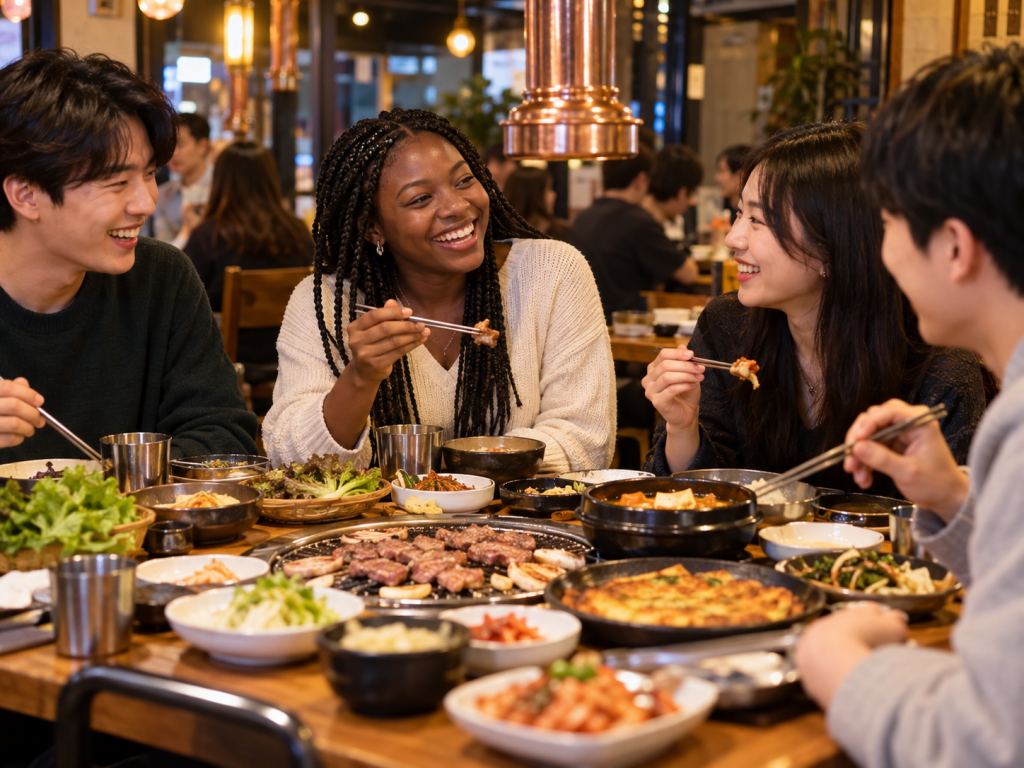
You may be invited to a:
회식 (hoesik)
or a student department dinner.
These gatherings are often used to help students become closer outside the classroom.
Participation may not always be mandatory, but attending occasionally can help you build relationships.
Typical Dinner Costs
Depending on the restaurant and location, a casual student dinner might cost approximately:
| Type | Approximate Cost |
|---|---|
| Simple Korean meal | ₩8,000–₩15,000 (about US$6–11) |
| Student group dinner | ₩15,000–₩30,000 (about US$11–22) |
| Korean BBQ meal | ₩20,000–₩40,000+ (about US$15–29+) |
| Café after dinner | ₩4,000–₩8,000 (about US$3–6) |
USD figures are approximate and exchange rates vary.
Do You Have to Drink Alcohol?
No.
You can simply say:
“I don’t drink alcohol.”
or
“I prefer a soft drink.”
You do not need to drink to participate socially.
7. Korean Students May Be Shy About Speaking English

Many international students are surprised by this.
A Korean student may understand English quite well but still hesitate to speak because they are afraid of making mistakes.
This does not necessarily mean they do not want to communicate with you.
Try initiating conversation with simple questions such as:
- What is your major?
- Which classes are you taking?
- Do you know a good restaurant near campus?
- Have you studied abroad?
- Which club would you recommend?
A Powerful Strategy
If you are learning Korean, try speaking a little Korean first.
Even simple phrases such as:
안녕하세요 — Annyeonghaseyo — Hello
or
같이 밥 먹어요 — Gachi bap meogeoyo — Let’s eat together
can immediately reduce social distance.
8. “Let’s Eat Together Sometime” May Be a Social Invitation
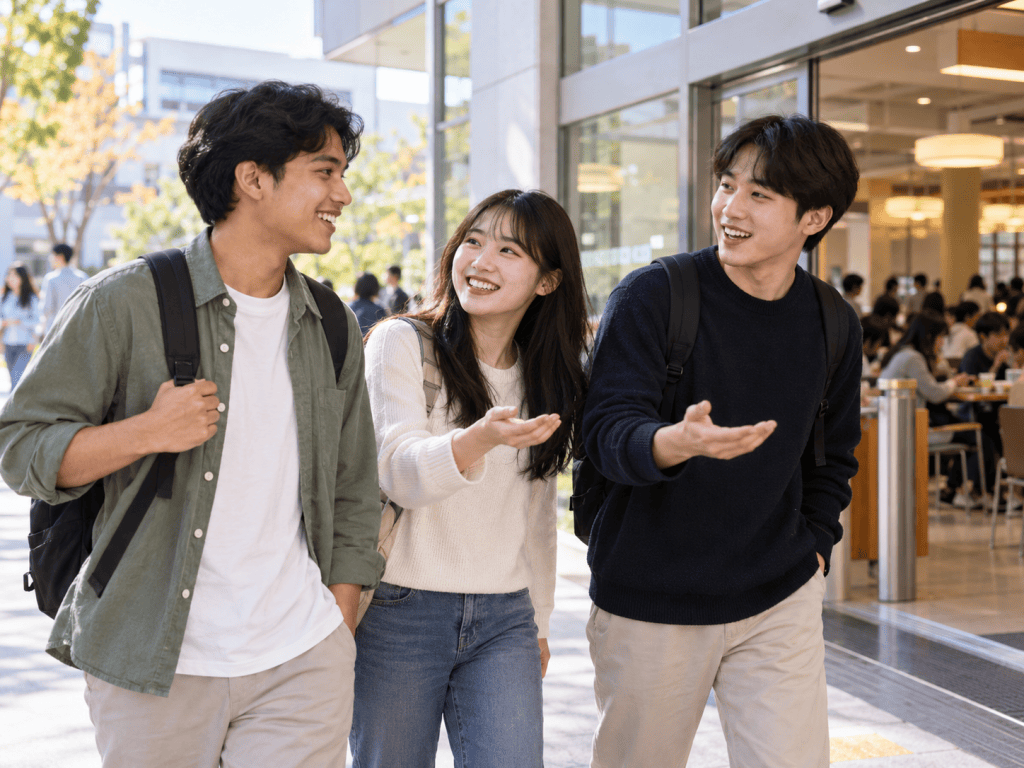
Food is extremely important in Korean social culture.
One phrase you may hear often is:
밥 한번 먹어요.
Literally:
“Let’s have a meal sometime.”
Sometimes it is a genuine invitation.
Sometimes it is simply a friendly way of saying:
“Let’s stay in touch.”
If you want to turn it into a real meeting, suggest a specific time.
For example:
“Are you free for lunch next Thursday?”
This makes it much easier to know whether the invitation was serious.
Why Meals Matter
In Korea, relationships often become closer through shared meals rather than formal conversations.
A 60-minute lunch may sometimes create more friendship than weeks of classroom interaction.
9. Presentation Style Can Be Different from What You Expect

Presentations are common in Korean university courses.
Students often put significant effort into:
- PowerPoint design
- Visual organization
- Data
- Charts
- Team coordination
- Timing
International students sometimes focus primarily on spoken content.
In Korea, however, the visual quality of the presentation may also receive significant attention.
Strong Presentation Checklist
| Element | Recommendation |
|---|---|
| Slides | Clean and visually organized |
| Text | Avoid overcrowding |
| Data | Use charts when possible |
| Team roles | Decide responsibilities early |
| Timing | Rehearse before presentation |
| Sources | Cite reliable information |
| Conclusion | Finish with a clear message |
K-STUDY Tip
If you are confident speaking English, offering to present part of a team project can become a major strength.
10. Building Relationships Can Be Just as Important as Getting Good Grades
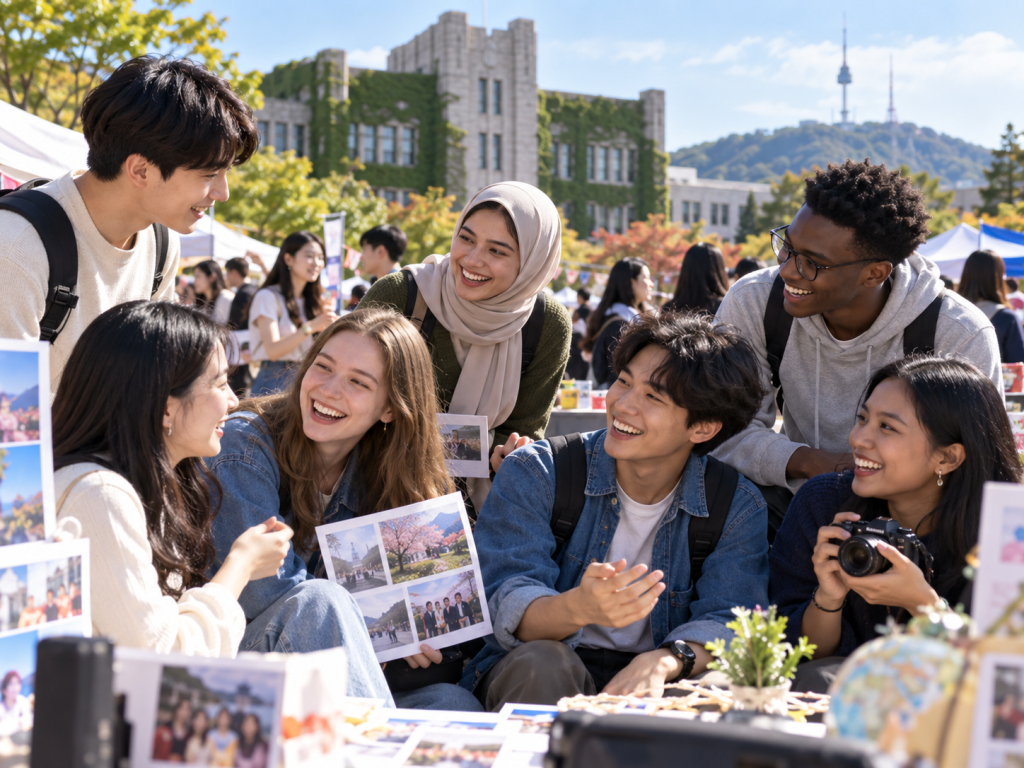
University life in Korea is not only about GPA.
The people you meet may become:
- Friends
- Internship connections
- Research partners
- Future colleagues
- Business contacts
- Mentors
Participating in university life can therefore be extremely valuable.
Consider joining:
- Student clubs
- International student organizations
- Language exchange groups
- Academic societies
- Volunteer programs
- Sports clubs
- Startup clubs
- Career programs
Typical Student Activities and Costs
| Activity | Typical Cost |
|---|---|
| Language exchange | Often free |
| University club | Free–₩50,000 per semester (US$0–36) |
| Student society | About ₩10,000–₩50,000 (US$7–36) |
| Campus event | Often free |
| Cultural activity | ₩10,000–₩50,000+ (US$7–36+) |
| Café meetup | ₩4,000–₩8,000 (US$3–6) |
Costs vary significantly by university and activity.
At a Glance: 10 Unwritten Rules
| No. | Unwritten Rule | Why It Matters |
|---|---|---|
| 1 | Communicate respectfully with professors | Academic relationships |
| 2 | Learn how Korean group projects work | Team performance |
| 3 | Use KakaoTalk actively | Daily communication |
| 4 | Be punctual | Reliability and respect |
| 5 | Understand senior-junior culture | Campus relationships |
| 6 | Join social meals when possible | Networking and friendship |
| 7 | Help overcome language barriers | Making Korean friends |
| 8 | Understand meal invitations | Social communication |
| 9 | Prepare polished presentations | Academic success |
| 10 | Build relationships beyond class | Career and personal growth |
5 Things International Students Should Avoid
Understanding what not to do can be equally important.
1. Do Not Ignore Group Messages
If your project team asks a question, respond—even if your answer is simply:
“I’ll check and reply tonight.”
Silence can sometimes be interpreted as lack of participation.
2. Do Not Wait Until the Last Minute to Contact Professors
Give professors enough time to respond.
3. Do Not Assume Everyone Speaks English Fluently
Speak clearly and patiently.
4. Do Not Compare Everything to Your Home Country
Instead of saying:
“In my country, we do it better.”
Try:
“This is different from what I’m used to.”
5. Do Not Spend Your Entire University Life Only with Other International Students
International friendships are valuable, but building relationships with Korean students will dramatically deepen your experience of studying in Korea.
Your First 30 Days in Korea: K-STUDY Checklist
During your first month at a Korean university, try to complete these 10 actions.
☐ Install and set up KakaoTalk
☐ Join your department’s student communication channels
☐ Introduce yourself to at least three Korean classmates
☐ Learn how to contact your professors professionally
☐ Join at least one student club or activity
☐ Attend one campus social event
☐ Learn basic Korean university vocabulary
☐ Find your university’s international student office
☐ Learn how your university’s LMS works
☐ Have a meal with Korean students
Complete these steps early, and university life can become much easier.
Essential Korean University Vocabulary
| Korean | Romanization | Meaning |
|---|---|---|
| 교수님 | Gyosu-nim | Professor |
| 선배 | Seonbae | Senior student |
| 후배 | Hubae | Junior student |
| 동기 | Donggi | Student in the same year |
| 조별과제 | Jobyeol gwaje | Group project |
| 단톡방 | Dantokbang | Group chat |
| 과제 | Gwaje | Assignment |
| 발표 | Balpyo | Presentation |
| 수강신청 | Sugangsinhaeong | Course registration |
| 학점 | Hakjeom | Academic credit / GPA |
| 동아리 | Dongari | Student club |
| 학생회 | Haksaenghoe | Student council |
Learning even these basic words can make your first semester much easier.
Final Message
Don’t Just Study in Korea. Become Part of Korea.
Your experience in Korea will be shaped not only by the university you attend, but also by the people you meet and the relationships you build.
You do not need to understand every Korean cultural rule from your first day.
Be curious.
Ask questions.
Respect differences.
Try speaking Korean.
Join activities.
Eat together.
Make mistakes.
And keep connecting with people.
One day, you may realize that Korea is no longer simply the country where you came to study.
It has become part of your story.
K-STUDY
Study in Korea.
Connect in Korea.
Grow with Korea.


Leave a Reply