
10 Things International Students Should Prepare Before Graduation
Your 4-Year Roadmap from International Student to Global Professional in Korea
Getting accepted to a Korean university is only the beginning.
For many international students, the bigger dream is not simply:
“I want to study in Korea.”
It is:
“I want to study in Korea, graduate successfully, and build my career here.”
That requires much more than good grades.
Employers may look at your Korean-language ability, professional skills, internship experience, communication skills, understanding of Korean workplace culture, portfolio, network, and whether your qualifications fit an appropriate work-visa route.
The good news is that you do not have to prepare everything during your final semester.
The smartest strategy is to begin early.
Here are 10 things every international student who wants to work in Korea should prepare before graduation.
1. Start Your Career Plan in Your First Year — Not Your Final Year

One of the biggest mistakes international students make is waiting until their final year to start thinking about employment.
Your first year should be a period of exploration.
Ask yourself:
- What industry interests me?
- What type of company do I want to work for?
- Do I want to work for a Korean company or a multinational company?
- Which skills are employers looking for?
- Does my major connect naturally to the job I want?
- What level of Korean will I realistically need?
You do not need to have your entire future decided.
But you should begin building a direction.
A Simple 4-Year Career Roadmap
| University Year | Primary Goal | Recommended Actions |
|---|---|---|
| Year 1 | Explore | Learn Korean, join clubs, explore industries |
| Year 2 | Build Skills | Certificates, projects, networking |
| Year 3 | Gain Experience | Internships, portfolio, career fairs |
| Year 4 | Get Job-Ready | Applications, interviews, visa planning |
| After Graduation | Transition | Job search, employment, appropriate visa status |
K-STUDY Tip
Create a document called:
“My Korea Career Plan.”
Update it every six months.
Write down:
Target industries → Target companies → Required skills → Korean ability → Experiences → Missing qualifications
Your career becomes much easier to manage when you can actually see the gap between where you are and where you want to go.
2. Build Korean Language Ability That Works in the Workplace

You do not necessarily need perfect Korean to work in Korea.
But in many workplaces, being able to communicate in Korean can dramatically increase the number of positions available to you.
Academic Korean and workplace Korean are also different.
You may need to understand:
- Emails
- Meetings
- Phone calls
- Team discussions
- Business vocabulary
- Reporting
- Instructions from managers
- Workplace etiquette
TOPIK can help demonstrate your Korean proficiency, but employers may also evaluate whether you can actually communicate.
A Practical Korean-Language Target
| Level | Career Use |
|---|---|
| Beginner | Daily survival communication |
| Intermediate | Basic university and workplace conversation |
| TOPIK 3–4 range | Useful for many academic and professional environments |
| TOPIK 5–6 range | Strong advantage for Korean-intensive professional roles |
| Business Korean | Meetings, email, presentations and professional communication |
Do not focus only on grammar.
Practice phrases you could actually use at work.
For example:
“I will send the report by 3 p.m.”
“Could you please clarify this part?”
“May I share another suggestion?”
“I have updated the document.”
These sentences may be more valuable in the workplace than memorizing hundreds of rare vocabulary words.
Possible Korean-Learning Budget
| Item | Approx. KRW | Approx. USD |
|---|---|---|
| Online Korean course | ₩50,000–₩300,000 | US$37–221 |
| Private tutoring per session | ₩20,000–₩60,000 | US$15–44 |
| Study materials | ₩20,000–₩100,000 | US$15–74 |
| Semester language program | ₩1,200,000–₩1,800,000+ | US$884–1,326+ |
Costs vary significantly by institution and program.
3. Turn Your Major into Employable Skills

Your degree tells employers what you studied.
Your skills tell them what you can actually do.
That distinction is extremely important.
For example:
Business Major
Do not stop at:
“I majored in Business Administration.”
Develop practical skills such as:
- Excel
- PowerPoint
- Data analysis
- Market research
- Digital marketing
- Financial analysis
- Presentation
- AI productivity tools
Computer Science Major
Build:
- Coding projects
- GitHub portfolio
- App development
- AI projects
- Data analysis
- Cloud skills
- Cybersecurity knowledge
Design Major
Build:
- Portfolio
- Branding projects
- UX/UI
- Visual communication
- Adobe tools
- Figma
- AI-assisted creative tools
Humanities / Language Major
Develop:
- Translation
- Localization
- Global communication
- Research
- Content creation
- International marketing
- Cross-cultural business skills
The Key Question
Ask yourself:
“What can I show an employer that proves I can do the job?”
That is the beginning of employability.
4. Get Internship Experience Before Graduation

An internship can be one of the most valuable bridges between university and employment.
It helps you understand:
- Korean workplace culture
- Team communication
- Business etiquette
- Deadlines
- Reporting structures
- Professional expectations
More importantly, it gives future employers evidence that you can operate in a real organization.
Where to Look
Consider:
- Korean corporations
- Startups
- Multinational companies
- University research centers
- International organizations
- Export companies
- Global marketing firms
- Technology companies
- Tourism companies
- Foreign chambers of commerce
Korean companies doing business in your home country may be especially interested in your language and cultural knowledge.
Internship Value
| Experience | Career Value |
|---|---|
| Classroom assignment | Demonstrates academic knowledge |
| Club activity | Shows collaboration |
| Personal project | Shows initiative |
| Internship | Shows professional experience |
| Internship + measurable results | Strong career evidence |
Instead of writing:
“Worked as a marketing intern.”
Try:
“Researched consumer trends in Southeast Asia and helped create English-language marketing content for overseas customers.”
Specific experience is more memorable.
5. Build a Portfolio — Even If You Are Not a Designer

Many students think portfolios are only for designers.
They are not.
A portfolio is simply evidence of what you can do.
Your portfolio could contain:
- University projects
- Research reports
- Marketing campaigns
- Coding projects
- Business presentations
- Data dashboards
- Videos
- Articles
- Translation projects
- Volunteer projects
- Internship results
- Competition entries
Portfolio Structure
| Section | What to Include |
|---|---|
| Profile | Who you are |
| Skills | Your strongest capabilities |
| Projects | 3–6 high-quality examples |
| Role | What you personally contributed |
| Results | What changed because of your work |
| Tools | Software or technology used |
| Contact | Professional contact information |
K-STUDY Tip
Do not upload 30 mediocre projects.
Show 5 excellent projects.
Quality is usually more persuasive than quantity.
6. Build Your Professional Network Before You Need a Job
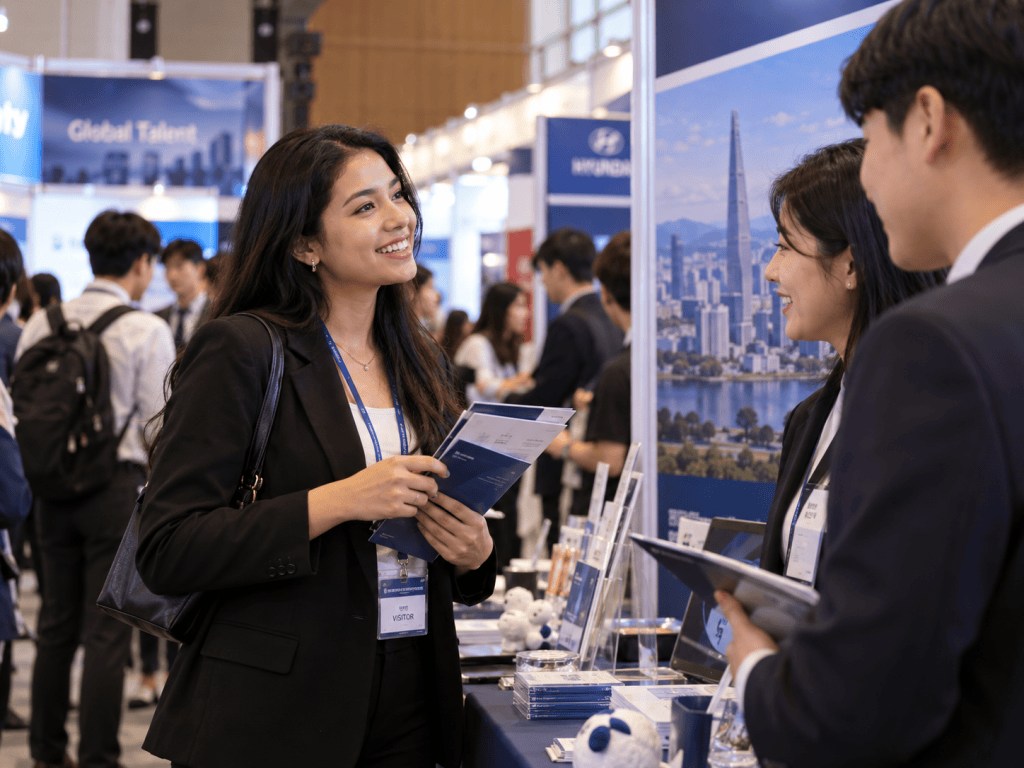
Many jobs are discovered through people, not only job advertisements.
Start building relationships while you are still a student.
Useful connections may include:
- Professors
- Alumni
- Senior students
- Internship supervisors
- Korean classmates
- International classmates
- Career center staff
- Recruiters
- Professionals in your target industry
Networking does not mean asking:
“Can you give me a job?”
A better question is:
“I am interested in working in Korea’s semiconductor industry. What skills would you recommend I develop before graduation?”
That conversation can become the beginning of a professional relationship.
Good Places to Network
- University career events
- Job fairs
- Alumni meetings
- Industry conferences
- Student clubs
- Startup events
- Professional seminars
- Internship programs
The Korean government’s Study in Korea service also provides employment-related notices, integrated job listings and support resources for international students, and in 2026 it has promoted foreign-student employment and recruitment fairs.
7. Use Your International Background as a Career Advantage

Do not think:
“I am a foreigner competing against Korean students.”
Think:
“What can I offer because I understand both Korea and another market?”
International students may bring valuable advantages such as:
- Native or fluent foreign-language ability
- Understanding overseas consumers
- Cultural knowledge
- International networks
- Global communication
- Localization capability
- Overseas market research
- Export support
Imagine a Korean company planning to enter:
Indonesia.
Vietnam.
India.
Saudi Arabia.
France.
Germany.
Mexico.
Brazil.
Your knowledge of that market may become highly valuable.
Transform Your Background into Business Value
Instead of:
“I am from Vietnam.”
Say:
“I understand Vietnamese consumer behavior, language and cultural expectations, and I can help Korean companies communicate more effectively with Vietnamese customers.”
That is a completely different professional message.
8. Prepare for Korean-Style Recruitment Before Your Final Semester

Korean recruitment processes may include several steps.
Depending on the company, these can include:
Application → Resume → Self-Introduction → Aptitude Test → Interview → Final Interview → Offer
Not every company follows the same process.
Start preparing early.
Your Job-Search Toolkit
You should ideally have:
- Korean résumé
- English résumé
- Korean self-introduction
- English cover letter
- Portfolio
- Professional profile photo if appropriate
- LinkedIn profile
- Project examples
- Reference list
- Interview stories
Useful Interview Preparation Framework
Prepare examples covering:
Leadership
Teamwork
Conflict
Failure
Problem solving
Achievement
Cross-cultural communication
Adaptability
Do not only tell employers what you believe.
Show what you have actually done.
9. Understand the Visa Transition Before Graduation

This is one of the most important areas international students should not leave until the last minute.
Your ability to remain in Korea and work legally depends on your immigration status and circumstances.
International graduates may need to consider a transition from student status to an appropriate job-seeking or employment status depending on their situation.
A commonly discussed pathway for graduates is:
Student status → Job-seeking status such as D-10, where eligible → Employment status appropriate to the job, such as an E-series status where applicable
However, immigration eligibility can vary depending on factors such as:
- Degree
- Major
- Job
- Employer
- Salary
- Qualifications
- Work experience
- Nationality
- Immigration regulations in effect at the time
Very Important
Do not accept employment first and investigate immigration later.
Instead:
Job target → Visa eligibility → Employer eligibility → Employment contract → Status change
These issues should be checked through official Korean immigration channels and your university’s international office because requirements can change.
10. Treat Your Final Year Like the First Year of Your Career

During your final year, your weekly schedule should include career preparation.
Do not wait until graduation day.
A useful weekly routine could look like this:
| Activity | Weekly Target |
|---|---|
| Job research | 2–3 hours |
| Korean study | 5+ hours |
| Applications | 3–5 targeted positions |
| Networking | 1 new professional contact |
| Portfolio improvement | 2 hours |
| Interview preparation | 1–2 hours |
| Industry news | 30 minutes × 3 |
Consistency matters more than one frantic month of job searching.
How Much Money Should You Prepare for Your Job Search?
Job hunting itself does not have to be expensive, but graduating students should have a financial buffer.
Here is a practical planning example.
| Expense | Approx. KRW | Approx. USD |
|---|---|---|
| Professional clothing | ₩150,000–₩500,000 | US$110–368 |
| Resume / portfolio printing | ₩20,000–₩100,000 | US$15–74 |
| Professional photo | ₩30,000–₩100,000 | US$22–74 |
| Certificate preparation | ₩50,000–₩500,000+ | US$37–368+ |
| Korean-language study | ₩100,000–₩1,500,000+ | US$74–1,105+ |
| Interview transportation | ₩50,000–₩200,000 | US$37–147 |
| Career events / seminars | Free–₩200,000 | US$0–147 |
| Emergency living reserve | ₩3,000,000–₩6,000,000 | US$2,210–4,420 |
Suggested Job-Search Reserve
A reasonable planning target for some graduates may be approximately:
₩3,500,000–₩7,000,000
≈ US$2,578–5,157
This is not an official requirement.
It is simply a planning buffer that may help cover living and job-search expenses while transitioning from university to employment.
Actual needs vary greatly depending on housing, location and lifestyle.
Know the Salary Baseline
As of 2026, Korea’s statutory minimum wage is:
₩10,320 per hour
≈ US$7.60 per hour
For a standard calculation of 209 monthly hours:
₩2,156,880 per month
≈ US$1,589 per month
This is the statutory minimum-wage benchmark, not a recommended salary for university graduates. Actual graduate salaries vary substantially by industry, occupation, qualifications and employer.
For 2027, Korea has already announced a minimum wage of ₩10,700 per hour, with a standard monthly equivalent of ₩2,236,300 based on 209 hours.
Your 4-Year K-STUDY Career Blueprint
Year 1 — EXPLORE
Your mission:
Understand Korea and discover your career direction.
Focus on:
- Korean language
- Campus relationships
- Clubs
- Understanding industries
- Career exploration
- Basic digital skills
Target by the End of Year 1
Know the answer to:
“What are the three industries I am most interested in?”
Year 2 — BUILD
Your mission:
Build employable skills.
Focus on:
- Practical certifications
- Korean communication
- Projects
- Competitions
- Volunteering
- Professional networking
- Career center programs
Target by the End of Year 2
Have:
At least 2–3 projects worth showing an employer.
Year 3 — EXPERIENCE
Your mission:
Turn skills into experience.
Focus on:
- Internships
- Industry projects
- Career fairs
- LinkedIn networking
- Alumni connections
- Portfolio development
Target by the End of Year 3
Have:
At least one meaningful professional experience.
Year 4 — LAUNCH
Your mission:
Turn your university experience into employment.
Focus on:
- Applications
- Interviews
- Company research
- Portfolio
- Korean résumé
- English résumé
- Visa preparation
- Financial reserve
Target Before Graduation
Be able to explain in 60 seconds:
Who you are.
What you can do.
Why a Korean company should hire you.
The International Student Career Scorecard
Give yourself one point for each item you can confidently answer “YES” to.
| Question | YES / NOT YET |
|---|---|
| Can I explain my career goal in one sentence? | □ |
| Can I communicate professionally in Korean? | □ |
| Do I have practical skills related to my major? | □ |
| Do I have internship or project experience? | □ |
| Do I have a professional portfolio? | □ |
| Do I know people in my target industry? | □ |
| Can I explain my international advantage? | □ |
| Is my résumé ready in Korean and/or English? | □ |
| Do I understand my possible immigration pathway? | □ |
| Have I started applying before graduation? | □ |
Your Score
8–10: You are building a strong transition toward employment.
5–7: You have a good foundation, but several areas need attention.
0–4: Start now. You still have time to build your career profile.
10 Skills That Can Make International Students More Competitive
| Skill | Why It Matters |
|---|---|
| Korean communication | Expands workplace opportunities |
| English / native language | Supports global business |
| AI literacy | Increasingly relevant across industries |
| Data analysis | Helps turn information into decisions |
| Presentation | Important in Korean workplaces |
| Excel / spreadsheets | Common business requirement |
| Cross-cultural communication | Valuable for global teams |
| Digital marketing | Useful for international expansion |
| Project management | Demonstrates execution ability |
| Industry expertise | Separates you from general applicants |
Before Graduation: Final 90-Day Checklist
☐ Update Korean résumé
☐ Update English résumé
☐ Complete portfolio
☐ Prepare 10 interview stories
☐ Research 30 target companies
☐ Identify appropriate immigration options
☐ Meet university career counselor
☐ Attend at least one recruitment event
☐ Contact alumni working in your target industry
☐ Apply consistently every week
☐ Prepare professional interview clothing
☐ Build an emergency financial reserve
☐ Practice a 60-second self-introduction in Korean
☐ Practice the same introduction in English
Your 60-Second Career Introduction
A strong introduction should answer four questions:
1. Who are you?
“I am an international student majoring in International Business in Korea.”
2. What is your strength?
“I specialize in digital marketing and Southeast Asian market research.”
3. What have you done?
“During my internship, I supported social-media research and analyzed consumer trends for an overseas market.”
4. What can you contribute?
“I hope to help Korean companies communicate more effectively with customers in Southeast Asia.”
That is much stronger than simply saying:
“I want to work in Korea because I like Korea.”
Employers need to understand your value.
From “Foreign Student” to “Global Talent”
The most important mindset change may be this:
Do not define yourself only as an international student.
You are developing into someone who understands:
your home country + Korea + your professional field.
That combination can become a competitive advantage.
Your language matters.
Your culture matters.
Your international experience matters.
Your Korean university experience matters.
But those advantages become powerful only when you connect them to a company’s business needs.
Final Message
Don’t Wait Until Graduation to Build Your Career.
A diploma may open the door.
But your skills, relationships, experience and preparation determine how confidently you can walk through it.
Start learning Korean today.
Build one project.
Meet one professional.
Apply for one internship.
Improve one skill.
Take one step every week.
Four years later, those small steps can become something much bigger than a university degree.
They can become your career.
K-STUDY
Study in Korea.
Build Your Skills.
Launch Your Career.
Go Global.


Leave a Reply