
10 BUSINESS MISTAKES FOREIGNERS SHOULD AVOID IN SOUTH KOREA
From First Impressions to Successful Partnerships: Your Essential Guide to Korean Business Culture
RESPECT THE CULTURE. UNDERSTAND THE PEOPLE. BUILD LASTING PARTNERSHIPS.
INTRODUCTION: SUCCESS IN KOREA STARTS WITH CULTURAL UNDERSTANDING
South Korea is one of Asia’s major business and innovation centers.
Home to globally recognized companies such as Samsung, Hyundai Motor, LG, and SK, the country offers international business opportunities across industries including semiconductors, automobiles, technology, batteries, beauty, healthcare, and entertainment.
For international executives, entrepreneurs, investors, and business professionals, understanding Korean business culture can be an important part of building successful partnerships.
However, entering the Korean market involves more than offering competitive products, innovative technology, or attractive commercial terms.
Business etiquette, communication styles, organizational structures, relationship management, and expectations regarding professional conduct can all influence business interactions.
A behavior that seems perfectly natural in one country may be interpreted differently in another.
Understanding these differences can help international professionals avoid unnecessary misunderstandings and develop stronger business relationships.
IMPORTANT: Korean business culture is not uniform. Practices vary significantly depending on the industry, company size, generation, leadership style, and international business experience.
The following recommendations are practical guidelines rather than universal rules that apply to every Korean company or individual.
Here are 10 common business mistakes foreigners should avoid when doing business in South Korea.
01. DON’T ADDRESS BUSINESS PARTNERS TOO CASUALLY
Understand the Importance of Names, Titles, and Professional Respect

In many American and European workplaces, addressing colleagues and even senior executives by their first names is common.
However, in some Korean business environments, particularly during formal meetings or interactions with senior executives, professional titles and appropriate forms of address remain important.
Calling a senior executive by their first name immediately after meeting them may feel overly familiar in certain situations.
When meeting Korean business partners for the first time, it is generally advisable to use their family name with an appropriate professional title or courtesy title.
If your business partner invites you to use their first name, you can adjust accordingly.
Common Korean Business Titles
| Korean Title | Common English Equivalent | Example of Address |
|---|---|---|
| 회장 | Chairman | Chairman Kim |
| 대표이사 | Chief Executive Officer | CEO Lee |
| 사장 | President | President Park |
| 부사장 | Executive Vice President | Executive Vice President Choi |
| 전무 | Executive Director / Managing Director | Use the title shown on the business card |
| 상무 | Managing Director / Executive Director | Use the official company title |
| 부장 | General Manager / Department Manager | Use the official company title |
| 팀장 | Team Leader | Team Leader Kim |
| 과장 | Manager | Use the official company title |
Important: English titles differ considerably between Korean organizations. Always refer to the title displayed on your business partner’s official business card or email signature.
Common Mistakes and Better Alternatives
| Situation | Potentially Inappropriate Approach | Recommended Approach |
|---|---|---|
| Meeting a CEO for the first time | “Hi, Minsoo!” | “Good morning, Mr. Kim.” |
| Addressing a senior executive | Using their first name without invitation | Using their official title |
| Writing a formal email | Using an excessively casual greeting | Using an appropriate professional greeting |
| Uncertain about someone’s title | Guessing their position | Politely asking for their preferred title |
Real-Life Business Scenario
Imagine an international entrepreneur meeting the CEO of a Korean company.
The entrepreneur immediately says:
“Hi, Minsoo! Great to finally meet you!”
A globally experienced Korean executive may welcome this approach.
However, during a formal first meeting, a more professional introduction may be appropriate.
Recommended Expression:
“Good morning, Mr. Kim. It’s a pleasure to meet you.”
SUCCESS TIP
Start with a professional form of address.
As the relationship develops, follow your business partner’s preferred communication style.
Professional respect creates a positive first impression.
02. DON’T TREAT BUSINESS CARDS AS JUST PIECES OF PAPER
Your Business Card Is an Important Professional Introduction

Business card exchanges can be an important part of initial business meetings in South Korea.
A business card provides more than contact information.
It identifies your business partner’s name, organization, department, and professional position.
These details can help you understand whom you are meeting and how to communicate appropriately.
Receiving a business card without looking at it or immediately putting it away may appear inattentive in some formal business settings.
Five Steps for Exchanging Business Cards
STEP 1: Stand Up
When appropriate, stand while exchanging business cards.
STEP 2: Present Your Card Respectfully
Offer your business card with both hands, positioning it so the recipient can easily read your information.
STEP 3: Receive the Other Person’s Card Carefully
Accept the card respectfully, using both hands or supporting your receiving hand with the other.
STEP 4: Read the Card
Take a moment to review your business partner’s name, title, and organization.
STEP 5: Store the Card Appropriately
During a formal meeting, you may place the cards neatly on the table to help remember participants’ names and positions.
Afterward, store them in a business card holder.
Business Card Etiquette
| Avoid | Recommended Practice |
|---|---|
| Handing over a card carelessly | Presenting it respectfully |
| Immediately putting away a received card | Taking time to read it |
| Writing directly on someone’s card without permission | Taking notes separately |
| Folding or damaging business cards | Keeping them in a card holder |
| Guessing someone’s position | Checking their official title |
Prepare for International Business
Consider preparing bilingual business cards that include both English and Korean.
Make sure your name, position, company, email address, and telephone number are accurate.
When arranging meetings with large Korean organizations, checking the official titles of participants can also help you prepare for the discussion.
SUCCESS TIP
A thoughtful business card exchange demonstrates attention to detail and helps establish professional communication from the beginning.
Small gestures can support meaningful business relationships.
03. DON’T ARRIVE LATE FOR BUSINESS MEETINGS
Punctuality Is an Essential Part of Professional Reliability

Arriving on time is important in international business, and South Korea is no exception.
Business professionals should recognize that arriving late can disrupt their partners’ schedules and create an unfavorable impression.
Seoul’s traffic congestion, unfamiliar transportation routes, building security procedures, and visitor registration requirements can sometimes cause unexpected delays.
Planning ahead is especially important when visiting an office for the first time.
Business Meeting Preparation Guide
| Situation | Recommended Action |
|---|---|
| First visit to an office | Check the address and building entrance |
| In-person meeting | Allow extra time for transportation |
| Unexpected traffic | Notify participants as soon as possible |
| Online meeting | Test your connection and equipment beforehand |
| Schedule changes | Request changes as early as possible |
| Meeting cancellation | Explain the situation professionally and promptly |
What Should You Do If You Are Running Late?
Contact your business partner immediately.
Explain the situation briefly and provide a realistic estimated arrival time.
Recommended Expression:
“I sincerely apologize. Due to unexpected traffic, I may arrive approximately 10 minutes late. Thank you for your understanding.”
Avoid waiting until after the scheduled meeting time to inform your business partner.
Essential Meeting Preparation Checklist
Before leaving for an important business meeting, confirm:
- The meeting time and location.
- Participants’ names and positions.
- The meeting’s purpose and expected duration.
- Presentation materials and required documents.
- Whether interpretation services are needed.
For international online meetings, clearly specify the time zone when confirming the schedule.
SUCCESS TIP
Reconfirm important meetings the day before, particularly when participants are traveling internationally.
Reliability begins before the meeting starts.
04. DON’T IGNORE ORGANIZATIONAL ROLES AND DECISION-MAKING PROCEDURES
Understand Who Is Responsible for Each Stage of the Business Process

Korean companies have different organizational structures and decision-making procedures.
Depending on the company and the nature of the transaction, a proposal may require review by operational staff, department managers, senior executives, or other authorized decision-makers.
A positive response from an employee does not necessarily mean that the entire organization has formally approved your proposal.
At the same time, assuming that operational staff are unimportant simply because they do not have final approval authority would be a serious mistake.
Employees responsible for technical reviews, procurement, operations, or project management may play essential roles throughout the decision-making process.
Understanding Organizational Responsibilities
| Organizational Role | Typical Responsibilities | Recommended Approach |
|---|---|---|
| Operational staff | Technical reviews and practical coordination | Provide accurate and detailed information |
| Team leaders | Team-level evaluation and coordination | Explain implementation requirements |
| Department heads | Departmental decisions and management reporting | Present business value, feasibility, and risks |
| Senior executives | Strategic decisions within their responsibilities | Explain strategic relevance and long-term benefits |
| Executive leadership | Major corporate decisions | Present the overall business case |
Actual decision-making authority varies between organizations and transactions.
Common Business Mistake
Imagine an international sales executive presenting a new technology solution to a Korean company’s operational team.
The team expresses enthusiasm about the product.
The international executive responds:
“Excellent! Then we can sign the contract tomorrow.”
However, the team may still need to complete technical evaluations, procurement reviews, budget approvals, or executive reporting.
A More Effective Approach
Politely ask about the internal approval process.
Recommended Expression:
“Could you kindly explain the next steps in your internal review and approval process?”
You might also ask:
“Are there any additional materials we should prepare to support your internal discussions?”
SUCCESS TIP
Respect every participant’s contribution and clarify the decision-making process early.
Successful partnerships depend on understanding both people and procedures.
05. DON’T MISINTERPRET INDIRECT COMMUNICATION
A Positive Response Is Not Always a Final Commitment
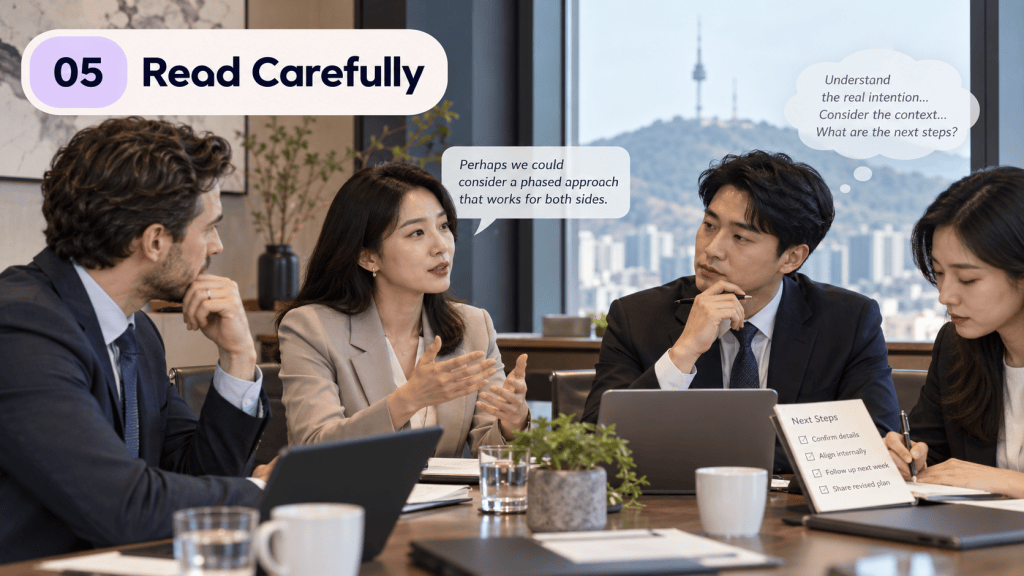
Communication styles vary across countries, cultures, organizations, and individuals.
In some Korean business environments, people may prefer diplomatic expressions when communicating disagreement, uncertainty, or reservations.
However, it is important not to assume that every indirect statement carries a hidden meaning.
Sometimes, a request for additional review genuinely means that further analysis is necessary.
The most effective approach is to clarify expectations rather than speculate about intentions.
Understanding Common Business Expressions
| Expression | Possible Meaning | Recommended Response |
|---|---|---|
| “We will review your proposal.” | Additional evaluation is required | Ask about the review timeline |
| “We need to discuss this internally.” | Internal consultation is necessary | Ask whether additional information is needed |
| “This may be difficult.” | There may be obstacles or reservations | Ask about specific concerns |
| “We are considering this positively.” | There may be interest, but approval is not necessarily final | Clarify the next steps |
| “We will contact you later.” | Further communication is expected | Agree on an appropriate follow-up schedule |
Real-Life Business Scenario
After presenting your proposal, a Korean business partner says:
“We will review your proposal internally.”
Avoid interpreting this as confirmation that your proposal has been accepted.
Instead, ask what happens next.
Recommended Expression:
“Thank you. Would it be appropriate for me to follow up with you next week?”
Another useful question is:
“Are there any additional documents or information that would help your review?”
Three Practical Communication Strategies
1. Confirm the Next Step
Ask what additional actions are necessary before a decision can be made.
2. Agree on a Timeline
When appropriate, establish a reasonable schedule for the next discussion.
3. Summarize Important Points
After the meeting, send a concise written summary of the discussion and agreed action items.
SUCCESS TIP
Do not rely on assumptions about another person’s intentions.
Clear follow-up questions help prevent misunderstandings.
06. DON’T EMBARRASS BUSINESS PARTNERS DURING PUBLIC MEETINGS
Express Disagreement Professionally and Constructively

Disagreements are a normal part of international business.
Different perspectives can improve negotiations, identify risks, and create better solutions.
However, the way disagreements are communicated can affect professional relationships.
Interrupting someone repeatedly, criticizing a proposal aggressively, or publicly blaming a business partner may create unnecessary tension.
In meetings where participants have different organizational responsibilities, carefully structured communication is particularly valuable.
You do not need to avoid disagreement.
Instead, express your position clearly while maintaining professional respect.
Better Ways to Communicate Disagreement
| Avoid | Recommended Expression |
|---|---|
| “Your idea is wrong.” | “May I suggest an alternative approach?” |
| “That doesn’t make sense.” | “Could you explain your reasoning in more detail?” |
| “We will never accept this.” | “We may need to explore other options.” |
| “Your team made a mistake.” | “Let’s review the process and identify what happened.” |
| “This is your responsibility.” | “How can we work together to resolve this?” |
Real-Life Negotiation Scenario
Imagine negotiating the price of an important product or service.
Your Korean business partner proposes a price significantly higher than your budget.
Instead of saying:
“Your price is completely unreasonable.”
Try:
“We appreciate your proposal. However, the current price is above our budget. Would it be possible to explore alternative pricing options?”
This response communicates your financial requirements without making unnecessary personal judgments.
What If You Strongly Disagree?
Consider the following approach:
- Acknowledge the other party’s position.
- Explain your concerns using relevant facts.
- Identify the specific issue that requires resolution.
- Propose an alternative or request additional information.
- Agree on the next step.
If the disagreement is complex, a separate technical meeting or written exchange may help clarify the issue.
SUCCESS TIP
You can maintain a firm negotiating position while communicating respectfully.
Professional disagreement can strengthen cooperation when handled constructively.
07. DON’T ASSUME THAT BUSINESS DINNERS REQUIRE ALCOHOL
Understand Social Hospitality While Respecting Personal Boundaries

Business lunches and dinners can provide opportunities for Korean and international professionals to become better acquainted.
These gatherings may allow participants to communicate in a less formal setting and learn more about each other’s professional interests.
However, business dining practices differ significantly between Korean organizations.
Not every Korean company considers after-work gatherings essential, and alcohol consumption is not a requirement for successful business relationships.
International visitors may choose not to drink for personal, medical, religious, or other reasons.
Those choices should be respected.
Business Dining Guidelines
| Situation | Recommended Practice |
|---|---|
| Receiving an invitation | Confirm your availability |
| Choosing food | Communicate allergies or dietary requirements |
| Being offered alcohol | Accept or politely decline according to your preference |
| Informal conversation | Respect personal and cultural boundaries |
| Paying for the meal | Follow relevant company and hospitality policies |
| After the meal | Thank your hosts for their hospitality |
How to Politely Decline Alcohol
Recommended Expression:
“Thank you very much for offering. I don’t drink alcohol, but I’d be happy to join you with a non-alcoholic beverage.”
There is generally no need to provide a lengthy explanation.
Business Dining Etiquette
If your hosts have arranged seating, follow their guidance.
Use the meal as an opportunity to learn about your business partners while remaining attentive to personal boundaries.
Avoid assuming that every informal conversation is an appropriate opportunity to raise sensitive commercial issues.
For example, a business dinner may not be the best setting to discuss confidential contract terms unless everyone involved has agreed to do so.
Who Should Pay?
Payment arrangements depend on the occasion, organization, and applicable company policies.
When dealing with public officials or organizations subject to hospitality restrictions, additional legal requirements may apply.
Never assume that paying for an expensive dinner will strengthen a business relationship.
SUCCESS TIP
Appreciate your hosts’ hospitality while maintaining your personal preferences and professional standards.
Genuine relationships are built through mutual respect, not obligatory drinking.
08. DON’T ASSUME EXPENSIVE GIFTS WILL IMPROVE BUSINESS RELATIONSHIPS
Understand Compliance, Ethics, and Anti-Bribery Requirements

Gift-giving and corporate hospitality practices vary internationally.
However, offering expensive gifts or entertainment without understanding local laws and organizational policies can create significant risks.
South Korea has legal restrictions that may apply to gifts and hospitality involving certain public officials and other individuals covered by its anti-graft legislation.
Private companies may also maintain their own strict policies regarding gifts, entertainment, and conflicts of interest.
International business professionals should review applicable requirements before offering gifts or hospitality.
Business Gifts and Hospitality: Important Considerations
| Situation | Potential Concern | Recommended Action |
|---|---|---|
| Visiting a private company | Internal gift acceptance policies | Check the recipient’s company policy |
| Meeting public-sector representatives | Applicable anti-graft regulations | Review legal requirements in advance |
| Participating in a procurement process | Fair competition and conflicts of interest | Avoid gifts and seek appropriate compliance advice |
| Negotiating commercial terms | Possible perception of improper influence | Maintain transparent negotiations |
| Inviting partners to international events | Restrictions on travel, accommodation, and hospitality | Verify eligibility and applicable rules |
Real-Life Business Scenario
An international supplier is negotiating a potential contract with a Korean public institution.
To demonstrate appreciation, the supplier considers offering the purchasing manager an expensive gift or an overseas vacation.
Such an offer could create serious legal and ethical concerns.
The appropriate approach is to review the applicable laws and organizational policies before providing anything of value.
Three Essential Compliance Principles
1. Transparency
Keep business discussions and commercial decisions transparent.
2. Compliance
Understand the relevant legal requirements and corporate policies.
3. Professional Independence
Avoid arrangements that could improperly influence procurement or contracting decisions.
SUCCESS TIP
Do not rely on expensive gifts or entertainment to establish business relationships.
Build trust through professional conduct, transparent transactions, and consistent performance.
09. DON’T CONFUSE VERBAL AGREEMENTS WITH FINALIZED CONTRACTS
Put Important Commercial Terms in Writing

Positive discussions and verbal expressions of interest are encouraging.
However, they do not necessarily mean that a formal contract has been approved or finalized.
Depending on the transaction, Korean companies may require technical reviews, financial approval, procurement procedures, legal reviews, or executive authorization.
International transactions can also involve complex questions regarding payment, delivery, taxation, intellectual property, and applicable law.
Clearly documenting agreed terms can reduce misunderstandings and support effective cooperation.
Ten Contract Terms to Clarify
| No. | Contract Element | Questions to Address |
|---|---|---|
| 1 | Contracting parties | Are the legal entities and authorized representatives correctly identified? |
| 2 | Scope of work | Are the products, services, and deliverables clearly defined? |
| 3 | Contract value | Are the currency, taxes, and applicable expenses specified? |
| 4 | Payment terms | Are payment schedules and methods clearly established? |
| 5 | Delivery schedule | Are delivery dates and project milestones agreed upon? |
| 6 | Quality standards | Are acceptance criteria and performance requirements documented? |
| 7 | Confidentiality | Are sensitive business information and trade secrets protected? |
| 8 | Intellectual property | Are ownership and licensing rights clearly addressed? |
| 9 | Termination | Are termination conditions and procedures specified? |
| 10 | Dispute resolution | Are governing law and dispute resolution procedures established? |
A Common International Business Misunderstanding
During a meeting, a Korean company representative says:
“We agree with your proposal in principle.”
This may indicate agreement with the proposal’s general direction.
However, it does not necessarily mean that every contractual term has been approved.
Recommended Follow-Up Question
“Could we summarize the agreed terms and identify any outstanding issues before moving forward?”
This question helps clarify the current status of the negotiations.
Essential Post-Meeting Documentation
| Item | Information to Record |
|---|---|
| Meeting date | Date and time of the discussion |
| Participants | Names, organizations, and roles |
| Agreed items | Specific points confirmed during the meeting |
| Outstanding matters | Issues requiring additional review |
| Responsibilities | Person or team responsible for each action |
| Deadlines | Expected completion dates |
| Next meeting | Proposed follow-up arrangements |
Important Legal Consideration
Whether a particular agreement is legally binding depends on its actual terms, the parties’ intentions, and the applicable law.
Some agreements may have legal consequences even before a final formal contract is signed.
For important international transactions, obtain qualified legal advice rather than assuming that all verbal discussions are non-binding.
SUCCESS TIP
Clarify commercial commitments and document important agreements.
Successful international partnerships require transparency and clearly defined responsibilities.
10. DON’T NEGLECT FOLLOW-UP COMMUNICATION AFTER YOUR FIRST MEETING
Long-Term Business Relationships Require Consistency

An excellent first meeting can create an opportunity for cooperation.
However, successful business relationships develop through consistent communication, reliable performance, and professional follow-up.
Failing to provide promised documents, missing agreed deadlines, or neglecting important communications can undermine confidence.
International professionals should develop a structured follow-up process after important meetings.
Recommended Post-Meeting Follow-Up Schedule
| Timing | Recommended Action | Objective |
|---|---|---|
| Meeting day or next business day | Send a thank-you email | Express appreciation |
| Within one or two business days | Provide requested documents when feasible | Demonstrate responsiveness |
| Agreed deadline | Share updates or additional information | Maintain progress |
| Before the next meeting | Review outstanding issues | Prepare productive discussions |
| After signing a contract | Provide regular progress updates | Support long-term cooperation |
These are suggested practices rather than mandatory timelines.
Actual follow-up arrangements should reflect the circumstances and agreements between the parties.
Example: Professional Thank-You Email
Subject: Thank You for Today’s Meeting
Dear Mr. Kim,
Thank you very much for taking the time to meet with us today.
We sincerely appreciate the opportunity to learn more about your business and discuss potential areas of cooperation.
As discussed, we will send you the additional information by Friday.
We look forward to continuing our discussions and exploring opportunities to work together.
Best regards,
[Your Name]
What Makes an Effective Follow-Up Email?
An effective message should include:
- Appreciation for the meeting.
- A brief reference to the discussion.
- Confirmation of any agreed responsibilities.
- The expected timeline for the next action.
- A professional closing statement.
Avoid sending repeated messages that unnecessarily pressure the other party to make a decision.
If the company requires additional time to complete its internal review, respect the agreed schedule.
SUCCESS TIP
An impressive presentation can open the door to a business opportunity.
Consistent follow-through helps sustain the relationship.
Trust develops through communication, reliability, and keeping commitments.
BONUS GUIDE
YOUR 10-POINT CHECKLIST BEFORE MEETING KOREAN BUSINESS PARTNERS
Preparing for an important business meeting in Korea?
Use the following checklist to make sure you have covered the essentials.
| No. | Preparation Checklist | Completed |
|---|---|---|
| 1 | Confirm participants’ names and official titles | ☐ |
| 2 | Prepare business cards and relevant presentation materials | ☐ |
| 3 | Double-check the meeting location and schedule | ☐ |
| 4 | Understand participants’ organizational responsibilities | ☐ |
| 5 | Define the meeting’s objectives and expected outcomes | ☐ |
| 6 | Prepare important questions and alternative proposals | ☐ |
| 7 | Review applicable hospitality and compliance requirements | ☐ |
| 8 | Identify important contractual and commercial issues | ☐ |
| 9 | Prepare any documents that may be needed after the meeting | ☐ |
| 10 | Establish an appropriate follow-up communication plan | ☐ |
Completing these preparations can help international professionals approach business meetings with greater confidence.
QUICK REFERENCE
10 COMMON BUSINESS MISTAKES AND HOW TO AVOID THEM
| No. | Mistake | Better Business Practice |
|---|---|---|
| 1 | Using overly casual forms of address | Start with appropriate professional titles |
| 2 | Treating business cards carelessly | Exchange and receive cards respectfully |
| 3 | Arriving late for meetings | Plan ahead and communicate delays promptly |
| 4 | Ignoring organizational responsibilities | Understand the relevant decision-making process |
| 5 | Misinterpreting indirect communication | Clarify expectations and confirm next steps |
| 6 | Embarrassing partners during meetings | Express disagreement professionally |
| 7 | Assuming alcohol is essential to business relationships | Respect individual preferences and professional boundaries |
| 8 | Offering expensive gifts without checking the rules | Follow applicable laws and organizational policies |
| 9 | Treating verbal discussions as finalized contracts | Clarify commitments and document important terms |
| 10 | Failing to follow up after meetings | Communicate consistently and fulfill commitments |
FINAL MESSAGE
SUCCESSFUL BUSINESS IN KOREA BEGINS WITH UNDERSTANDING, RESPECT, AND TRUST
Understanding Korean business culture does not mean abandoning your own professional standards or automatically following every traditional practice.
Instead, it involves recognizing cultural differences and adapting your approach to communicate more effectively.
Respect your business partners’ professional roles.
Understand organizational responsibilities.
Communicate clearly.
Confirm important agreements.
Follow relevant legal and ethical requirements.
And most importantly, fulfill your commitments.
Korean companies operate across a wide range of industries, organizational structures, and international business environments.
There is no single formula for building successful partnerships.
However, cultural awareness, professional integrity, and consistent communication can help you navigate unfamiliar situations and establish stronger business relationships.
RESPECT THE CULTURE.
UNDERSTAND THE PEOPLE.
COMMUNICATE WITH CLARITY.
BUILD TRUST.
CREATE LASTING PARTNERSHIPS.
Your next successful international partnership could begin with a better understanding of your business partners.
K-BUSINESS GUIDE
Your Essential Guide to Doing Business Successfully in South Korea.
Disclaimer: This article provides general cultural and professional guidance. Business practices vary between organizations and individuals. References to legal compliance, contracting, gifts, hospitality, and other regulated matters are general information and should not be considered legal advice. Consult qualified professionals and relevant authorities when necessary.


Leave a Reply