
STUDY SMART, LIVE BETTER!
10 Ways International Students Can Save Money and Work Legally in Korea
The Ultimate Guide to Affordable Student Living in South Korea
Study in Korea. Save More Money. Work Legally. Enjoy a Better Student Life!
Studying in South Korea can be an exciting opportunity to experience an excellent education system, discover a fascinating culture, make international friends, and prepare for a successful future.
However, international students often face an important challenge: managing their finances while pursuing their education.
How much money do you need to live in Seoul?
Can international students work part-time in South Korea?
How much can you earn while studying?
Is it possible to live comfortably on a limited budget?
And most importantly, how can you save money without sacrificing your university experience?
According to Study in Korea, a monthly living budget of approximately KRW 750,000–1,000,000 is a general reference for international students. However, actual expenses in Seoul may be higher depending on accommodation, personal spending, and lifestyle.
The good news is that careful financial planning, legal part-time employment, student benefits, and practical money-saving strategies can help you manage your expenses.
This guide introduces 10 essential strategies for international students who want to study smarter, spend wisely, and enjoy life in Korea.
Currency Reference
All currency comparisons in this article use an illustrative exchange rate of:
USD 1 ≈ KRW 1,354
The exchange rate is based on September 30, 2026. All US dollar amounts are approximate and may change depending on market conditions.
01. GET PERMISSION BEFORE STARTING A PART-TIME JOB
Understanding the Legal Requirements for International Students

Can every international student work freely in South Korea?
The answer is no.
International students holding D-2 student visas or eligible D-4 language-training visas are generally required to obtain permission before engaging in part-time employment.
Finding an employer or signing an employment contract does not automatically give you permission to work.
Your eligibility depends on your visa category, academic status, language proficiency, and other immigration requirements.
Working without the necessary authorization may result in serious immigration consequences.
Six Essential Requirements to Check
| Requirement | What You Need to Know |
|---|---|
| Visa status | You must hold an eligible visa, such as D-2 or an applicable D-4 category |
| Academic status | You must satisfy the relevant academic and enrollment requirements |
| Korean proficiency | Language requirements may apply depending on your academic program |
| University confirmation | Your university may need to verify your eligibility |
| Employment permission | You generally need authorization from immigration authorities |
| Working conditions | Your job, workplace, and working hours must comply with the authorization |
How to Apply for Part-Time Work Permission
STEP 1: Find an Eligible Part-Time Job
Identify a job that is compatible with your visa and permitted employment activities.
STEP 2: Confirm Your Working Conditions
Discuss your hourly wage, working hours, workplace, and responsibilities with your prospective employer.
STEP 3: Prepare an Employment Contract
Your contract should clearly specify your salary, working hours, and other employment conditions.
STEP 4: Obtain University Confirmation
Contact your university’s international student office and complete the required confirmation procedures.
STEP 5: Apply for Employment Permission
Submit the required documents through Hi Korea or the relevant immigration office.
STEP 6: Start Working After Approval
Begin working only after receiving the necessary authorization.
Documents You May Need
| Category | Typical Documents |
|---|---|
| Identification | Passport and Residence Card |
| Application | Relevant immigration application form |
| University approval | International Student Part-Time Employment Confirmation Form |
| Academic status | Certificate of Enrollment |
| Language proficiency | TOPIK or other applicable evidence |
| Employment | Employment contract and employer’s business registration certificate |
Additional documents may be required depending on your individual circumstances.
IMPORTANT!
Never assume that permission is unnecessary simply because an employer offers you a job.
Unauthorized employment or violations of approved working conditions can result in fines and immigration penalties.
Before accepting a position, consult your university’s international office or contact the Immigration Contact Center at 1345.
SMART STUDENT TIP: Always confirm your legal employment eligibility before starting work.
02. UNDERSTAND YOUR WORKING-HOUR LIMITS
Your Visa, Academic Program, and Korean Language Skills Matter

International students in South Korea do not all have the same working-hour allowance.
The permitted number of hours depends on several factors, including your visa category, academic program, year of study, Korean language proficiency, and your university’s applicable status.
Understanding these requirements is essential when creating a realistic financial plan.
D-2 vs. D-4 Visas
| Category | D-2 Student Visa | D-4 Language-Training Visa |
|---|---|---|
| Primary purpose | University and graduate studies | Language training and other designated training activities |
| Employment eligibility | Subject to applicable requirements and authorization | Subject to applicable requirements and authorization |
| Typical eligibility timing | Depends on relevant student requirements | Eligible language trainees generally become eligible after six months |
| Language requirements | Vary by academic program and year | Depend on applicable training requirements |
| Prior authorization | Generally required | Generally required |
| Working hours | Depend on individual eligibility | Depend on individual eligibility |
General Working-Hour Reference
The following figures provide a general reference for eligible international students.
Actual authorization may vary.
| Academic Program | Without Required Korean Proficiency | With Required Korean Proficiency |
|---|---|---|
| Language training | 10 weekday hours | 20 weekday hours |
| Associate degree | 10 weekday hours | 25 weekday hours |
| Undergraduate years 1–2 | 10 weekday hours | 25 weekday hours |
| Undergraduate years 3–4 | 10 weekday hours | 25 weekday hours |
| Master’s and doctoral programs | 15 weekday hours | 30 weekday hours |
Additional conditions may affect your eligibility.
Different rules may also apply to weekends and academic vacations.
Always verify your individual authorization rather than assuming that these general figures automatically apply to you.
The Financial Value of Korean Language Skills
Improving your Korean proficiency can create academic and professional advantages.
For eligible students, satisfying the relevant Korean language requirements may also affect permitted working hours.
Consider the following hypothetical example using South Korea’s 2026 minimum wage.
| Category | Student A | Student B |
|---|---|---|
| Weekly working hours | 10 hours | 20 hours |
| Hourly wage | KRW 10,320 | KRW 10,320 |
| Four-week basic income | KRW 412,800 | KRW 825,600 |
| Approximate USD | $305 | $610 |
Student B earns approximately KRW 412,800 ($305) more over four weeks.
This is a simplified illustration. It excludes paid weekly holiday allowances, taxes, and other deductions.
Students must receive authorization for their actual working hours.
SMART STUDENT TIP: Improving your Korean language skills may expand your academic, professional, and permitted employment opportunities.
03. EXPLORE 10 PART-TIME JOB OPPORTUNITIES
Find Employment That Matches Your Skills and Academic Schedule

The best part-time job is not necessarily the one offering the highest hourly wage.
International students should consider legal eligibility, working hours, transportation costs, safety, academic responsibilities, and opportunities to develop useful skills.
Various types of work may be available, but you must verify that your intended position is permitted under your visa and individual employment authorization.
10 Part-Time Job Categories to Explore
| No. | Job Category | Typical Responsibilities | Important Considerations |
|---|---|---|---|
| 1 | Café assistant | Preparing drinks and serving customers | Confirm workplace and employment eligibility |
| 2 | Restaurant assistant | Customer service and restaurant operations | Check permitted duties and working hours |
| 3 | University administrative assistant | Document organization and administrative support | Verify university recruitment requirements |
| 4 | University library assistant | Organizing materials and assisting library operations | Confirm the type of campus employment |
| 5 | Office assistant | Data entry and general office support | Verify permitted responsibilities |
| 6 | Tourism assistant | Supporting visitor information services | Check the scope of permitted activities |
| 7 | Duty-free shop assistant | Assisting international customers | Confirm employment eligibility and authorization |
| 8 | Hotel service assistant | General customer service and operational support | Verify workplace and specific job duties |
| 9 | Event assistant | Event registration and operational support | Check authorization for temporary employment |
| 10 | Translation support assistant | Assisting with documents and communication | Confirm whether the specific activity is permitted |
These categories are examples of opportunities to investigate, not a guarantee that every position is legally available to every student.
Translation assignments, short-term event work, and online employment may require particular attention to immigration requirements.
How to Choose the Right Part-Time Job
| Factor | Questions to Ask |
|---|---|
| Legal eligibility | Is this job permitted under my visa and authorization? |
| Academic compatibility | Will the schedule interfere with classes or examinations? |
| Employment conditions | Are wages and responsibilities clearly stated? |
| Transportation | How much will commuting cost? |
| Safety | Is the workplace safe and professionally managed? |
| Career development | Will the experience improve my language or professional skills? |
Jobs That Require Particular Caution
Some occupations or employment arrangements may be restricted or prohibited.
Delivery work, certain construction activities, unauthorized private tutoring, and other restricted occupations require particular attention.
Always check the applicable rules before accepting an offer.
SMART STUDENT TIP: Consider jobs near your university. Saving commuting time and transportation costs may be almost as valuable as earning a slightly higher hourly wage.
04. CALCULATE YOUR POTENTIAL PART-TIME INCOME
How Much Can International Students Earn in Korea?

South Korea’s minimum wage for 2026 is:
KRW 10,320 PER HOUR
Approximately USD 7.62
The minimum wage generally applies to covered employees regardless of nationality.
Understanding your expected earnings can help you develop a realistic student budget.
Basic Earnings at the 2026 Minimum Wage
| Working Time | Korean Won | US Dollars |
|---|---|---|
| 1 hour | KRW 10,320 | $7.62 |
| 4 hours | KRW 41,280 | $30.49 |
| 6 hours | KRW 61,920 | $45.73 |
| 8 hours | KRW 82,560 | $60.97 |
Potential Earnings by Weekly Working Hours
The following calculations assume four weeks of employment at the statutory minimum wage.
| Weekly Hours | Weekly Basic Earnings | Four-Week Basic Earnings | Approximate USD |
|---|---|---|---|
| 10 hours | KRW 103,200 | KRW 412,800 | $305 |
| 15 hours | KRW 154,800 | KRW 619,200 | $457 |
| 20 hours | KRW 206,400 | KRW 825,600 | $610 |
| 25 hours | KRW 258,000 | KRW 1,032,000 | $762 |
| 30 hours | KRW 309,600 | KRW 1,238,400 | $915 |
These calculations exclude taxes, deductions, and any additional allowances.
They illustrate potential income only. Your actual permitted working hours must be confirmed individually.
What Is the Weekly Holiday Allowance?
Under Korean labor law, employees who meet the applicable conditions may qualify for paid weekly rest days.
Eligibility generally depends on factors including scheduled weekly working hours and attendance.
For example, an employee who works 20 scheduled hours across five working days may qualify if all legal conditions are satisfied.
The actual amount depends on the employment arrangement.
Before Signing an Employment Contract
| Item | What to Check |
|---|---|
| Hourly wage | Meets or exceeds the applicable minimum wage |
| Working hours | Comply with your authorized working hours |
| Payment date | Clearly specified |
| Weekly holiday allowance | Applicable eligibility and payment conditions |
| Break time | Complies with labor regulations |
| Workplace | Matches your employment authorization |
| Deductions | Relevant taxes and other applicable deductions |
SMART STUDENT TIP: Build your budget using guaranteed basic earnings rather than assuming you will always receive overtime pay or additional allowances.
05. SAVE MONEY ON HOUSING IN SEOUL
Seven Practical Ways to Reduce Your Accommodation Expenses

Housing is often one of the largest expenses for international students living in Seoul.
Two students attending the same university can have significantly different living costs depending on where and how they live.
A student staying in a shared dormitory may spend considerably less than someone renting a private apartment.
However, monthly rent is only part of the total housing cost.
Security deposits, maintenance fees, utilities, internet access, and transportation should also be considered.
Estimated Monthly Housing Budgets in Seoul
These figures are illustrative planning ranges, not verified market averages or current rental quotations.
| Accommodation | Estimated Monthly Budget | Approximate USD |
|---|---|---|
| Shared university dormitory | KRW 300,000–500,000 | $222–369 |
| Shared housing | KRW 400,000–700,000 | $295–517 |
| Goshiwon | KRW 350,000–650,000 | $258–480 |
| Private studio | KRW 600,000–1,000,000 | $443–738 |
| Shared rental apartment | KRW 450,000–700,000 per person | $332–517 |
Actual prices vary considerably.
Security deposits are excluded, and maintenance fees and utilities may be charged separately.
STRATEGY 1: CHECK UNIVERSITY DORMITORIES FIRST
University accommodation may help you reduce transportation costs and commuting time.
Check application deadlines, room availability, and eligibility requirements as early as possible.
STRATEGY 2: COMPARE TOTAL HOUSING COSTS
Never compare accommodation based solely on advertised rent.
Consider maintenance fees, electricity, gas, heating, and internet charges.
STRATEGY 3: EXPLORE NEIGHBORHOODS OUTSIDE THE UNIVERSITY AREA
Apartments immediately next to university campuses are not always the most economical choice.
Explore nearby neighborhoods with convenient public transportation.
However, consider whether transportation expenses and commuting time outweigh potential rent savings.
STRATEGY 4: INSPECT THE PROPERTY BEFORE SIGNING
Whenever possible, visit the accommodation in person.
Check heating, ventilation, noise, security, cleanliness, and building conditions.
STRATEGY 5: UNDERSTAND THE SECURITY DEPOSIT
Many Korean rental agreements require a security deposit.
Carefully review the deposit amount, refund conditions, contract duration, and early termination provisions.
STRATEGY 6: CONTROL UTILITY EXPENSES
Electricity, heating, and gas bills can increase your monthly expenses.
Monitor consumption, particularly during extremely hot or cold weather.
STRATEGY 7: USE INTERNATIONAL STUDENT SUPPORT SERVICES
If you do not fully understand a rental agreement, ask your university’s international office or an appropriate foreign-resident support service for assistance.
SMART STUDENT TIP: The cheapest apartment is not always the most economical option. Calculate rent, maintenance fees, transportation costs, and commuting time together.
06. UNIVERSITY DORMITORY VS. SHARED HOUSING
Which Accommodation Option Better Fits Your Budget?

University dormitories and shared housing can both offer practical accommodation options for international students.
However, they differ in privacy, facilities, location, costs, and contract conditions.
The right option depends on your circumstances.
Accommodation Comparison
| Category | University Dormitory | Shared Housing |
|---|---|---|
| Typical location | On campus or nearby | Various neighborhoods |
| Privacy | Depends on room type | Private rooms may be available |
| Kitchen access | Depends on university facilities | Shared kitchen often available |
| House rules | May be relatively strict | Depends on the property |
| Commuting | Often convenient | Depends on location |
| Application | University application process | Rental agreement |
| Deposit | Depends on university | Depends on contract |
Monthly Living Cost Comparison
Consider two hypothetical international students with different accommodation arrangements.
| Expense | Dormitory Student | Shared Housing Student |
|---|---|---|
| Accommodation | KRW 400,000 | KRW 550,000 |
| Food | KRW 250,000 | KRW 250,000 |
| Transportation | KRW 30,000 | KRW 60,000 |
| Other expenses | KRW 100,000 | KRW 100,000 |
| Monthly Total | KRW 780,000 | KRW 960,000 |
| Approximate USD | $576 | $709 |
In this hypothetical example, the student living in a dormitory spends approximately KRW 180,000 less each month.
Potential Annual Difference
| Period | Korean Won | US Dollars |
|---|---|---|
| Monthly difference | KRW 180,000 | $133 |
| Six-month difference | KRW 1,080,000 | $798 |
| Annual difference | KRW 2,160,000 | $1,595 |
Actual savings will depend on your university, accommodation contract, commuting costs, and personal lifestyle.
Before choosing a dormitory, check whether accommodation is available during university vacations.
Before choosing shared housing, review maintenance fees, deposit requirements, shared facilities, and household rules.
SMART STUDENT TIP: University dormitories can be particularly convenient for students arriving in Korea for the first time. However, always compare the actual costs and conditions.
07. TAKE ADVANTAGE OF STUDENT DISCOUNTS AND TRANSPORTATION BENEFITS
Enjoy Korea Without Overspending

Living on a student budget does not mean giving up entertainment, travel, or cultural experiences.
Small savings on transportation, communication services, entertainment, and everyday purchases can make a significant difference over time.
International students should explore discounts offered by universities, public institutions, and participating businesses.
Seven Ways to Reduce Everyday Expenses
| Category | Money-Saving Opportunity | What to Check |
|---|---|---|
| Public transportation | Transportation passes and eligible refund programs | Residency and program eligibility |
| Movie theaters | Student and youth discounts | Accepted identification |
| Museums | Student discounts and free admission days | Exhibition-specific conditions |
| Performances | Student offers and special events | Age and student verification |
| Software | Educational software licenses | University agreements |
| Fitness | University sports facilities | Membership fees |
| Mobile services | Suitable mobile plans | Contracts and additional charges |
Discounts are not automatically available to every international student.
Check whether your Korean university student ID or International Student Identity Card is accepted.
Transportation Budget Examples
The following figures are illustrative monthly transportation budgets.
| Transportation Pattern | Monthly Budget | Approximate USD |
|---|---|---|
| Mainly walking | KRW 20,000 | $15 |
| Limited public transportation | KRW 40,000 | $30 |
| Regular commuting | KRW 60,000 | $44 |
| Frequent public transportation | KRW 100,000 | $74 |
Actual expenses depend on commuting distance, transportation frequency, fares, and eligibility for applicable benefits.
Explore Transportation Savings
Seoul offers transportation programs that may benefit eligible residents and frequent public transportation users.
Before purchasing a transportation pass, compare your actual monthly transportation expenses with the cost and eligibility conditions of available programs.
Foreign residents may need to complete additional identification or registration procedures for certain benefits.
Enjoy Affordable Cultural Experiences
Explore university cultural programs, public libraries, government-operated museums, free exhibitions, and local community events.
Many universities also organize activities that allow international students to experience Korean culture at reduced costs.
SMART STUDENT TIP: Check student discounts before paying the regular price, but do not assume that every discount applies to international students.
08. EXPLORE ON-CAMPUS JOBS AND INTERNATIONAL STUDENT SUPPORT
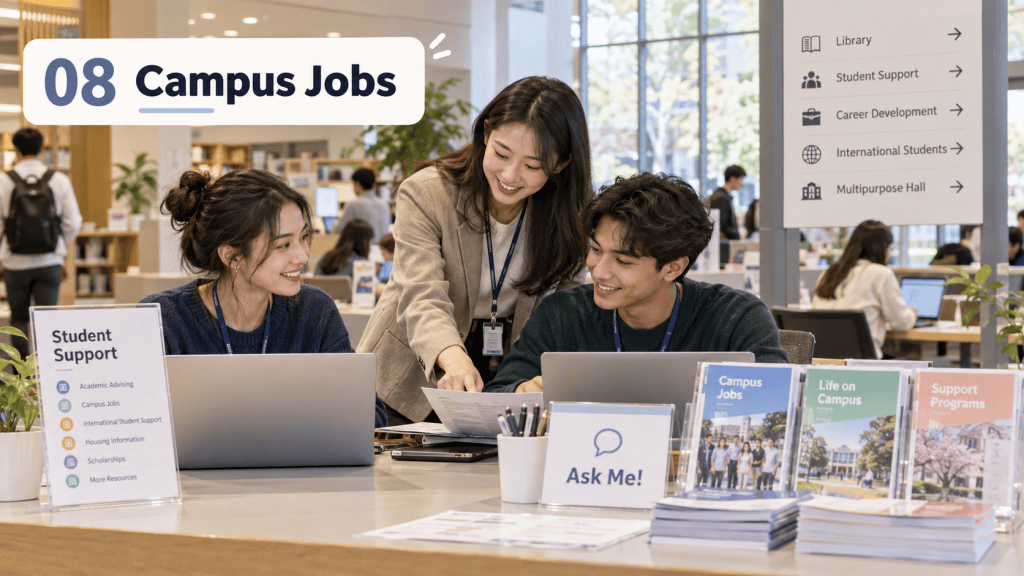
Your University May Offer More Than Academic Education
Many students concentrate on finding employment outside their universities.
However, universities may also provide employment-related opportunities, practical training, student support programs, and career development activities.
Depending on the institution, opportunities may exist in administrative offices, libraries, international student services, and other university departments.
However, working on campus does not automatically exempt international students from immigration requirements.
Confirm the legal status of each activity before participating.
On-Campus Opportunities to Explore
| Department | Possible Activities | What to Verify |
|---|---|---|
| International Student Office | Assisting international students | Recruitment conditions |
| University Library | Organizing materials and administrative support | Employment authorization |
| Administrative Office | General administrative assistance | University eligibility requirements |
| Student Support Center | Supporting student programs | Eligibility for international students |
| Academic Research Laboratory | Research-related assistance | Legal classification of the activity |
| University Events | Registration and event assistance | Authorization for short-term activities |
Potential Advantages of Campus Employment
Convenient location
Campus employment may reduce commuting time and transportation expenses.
Academic compatibility
Some university positions may offer schedules that accommodate academic responsibilities.
Professional experience
Administrative and research-related activities may provide valuable experience.
Communication skills
Working in a university environment may help students practice professional communication.
However, not all university programs offer paid employment, and eligibility varies.
Campus Jobs vs. Off-Campus Employment
| Category | Campus Employment | Off-Campus Employment |
|---|---|---|
| Commuting | May require less travel | Depends on workplace |
| Job opportunities | Limited by university vacancies | Opportunities across various industries |
| Scheduling | May accommodate university schedules | Depends on employer |
| Work authorization | Must be checked for the activity | Generally requires prior authorization |
| Professional development | University administration and research experience | Industry-specific work experience |
Where to Find Opportunities
Regularly check announcements from your university’s international student office, student affairs department, and career center.
Ask specifically about paid opportunities available to international students and the immigration procedures required.
SMART STUDENT TIP: Look for opportunities that reduce commuting costs while developing skills relevant to your long-term career.
09. REDUCE HEALTHCARE COSTS AND UNDERSTAND HEALTH INSURANCE
Protect Your Health and Your Financial Security

Unexpected medical expenses can create significant financial pressure for international students.
Even if you maintain a healthy lifestyle, accidents and unexpected illnesses can occur.
Understanding your health insurance coverage and preparing a medical emergency budget can help you manage these risks.
Health Insurance for International Students
International students who meet the applicable requirements may qualify for reduced National Health Insurance contributions.
For 2026, the monthly premium for an eligible international student receiving the applicable 50% reduction is approximately:
KRW 79,320
Approximately USD 59 per month
The actual amount depends on individual eligibility and insurance conditions.
Not every international student automatically qualifies for the same premium.
Health Insurance Premium Comparison
| Category | Korean Won | Approximate USD |
|---|---|---|
| Premium before the applicable reduction | KRW 158,630 | $117 |
| Premium after the applicable reduction | KRW 79,320 | $59 |
| Approximate monthly difference | KRW 79,310 | $59 |
These figures are reference amounts. Confirm your actual premium and reduction eligibility with the National Health Insurance Service.
Five Ways to Manage Healthcare Expenses
1. Verify Your Insurance Status
Confirm whether you are enrolled in the National Health Insurance system.
2. Check Your Eligibility for Reduced Premiums
Ask whether the relevant international student reduction applies to your situation.
3. Understand Medical Coverage
Before receiving non-emergency treatment, check whether the service is covered and what out-of-pocket expenses may apply.
4. Explore University Health Services
Some universities operate student health centers or provide health-related support services.
5. Maintain a Medical Emergency Budget
Health insurance does not necessarily cover every medical expense.
Prepare additional savings for unexpected healthcare needs.
Example Monthly Healthcare Budget
| Expense | Korean Won | Approximate USD |
|---|---|---|
| Health insurance | KRW 79,320 | $59 |
| Medical emergency savings | KRW 20,000 | $15 |
| Total | KRW 99,320 | $73 |
This example assumes eligibility for the reduced student premium.
Actual insurance and medical expenses may vary.
SMART STUDENT TIP: Saving money should never mean postponing necessary medical care. Understand your insurance benefits and seek appropriate treatment when needed.
10. BUILD A REALISTIC KRW 1 MILLION MONTHLY BUDGET
Can You Live in Seoul on Approximately USD 738 a Month?

Living in Seoul on KRW 1 million per month may be possible under certain conditions.
However, it requires careful budgeting, affordable accommodation, and controlled daily spending.
Students who secure reasonably priced dormitory accommodation may find it easier to maintain a limited budget.
Nevertheless, individual circumstances vary considerably.
University tuition, housing deposits, flights, and initial relocation expenses must be planned separately.
Example: A KRW 1 Million Monthly Student Budget
The following hypothetical budget assumes that an international student lives in a university dormitory.
| Expense | Monthly Budget (KRW) | Approximate USD |
|---|---|---|
| University dormitory | 420,000 | $310 |
| Food | 250,000 | $185 |
| Transportation | 50,000 | $37 |
| Health insurance | 79,320 | $59 |
| Mobile phone | 45,000 | $33 |
| Personal items and entertainment | 55,000 | $41 |
| Emergency savings | 80,000 | $59 |
| TOTAL | 979,320 | $723 |
Your Monthly Budget at a Glance
Monthly spending limit: KRW 1,000,000 (approximately $738)
Planned monthly expenses: KRW 979,320 (approximately $723)
Remaining amount: KRW 20,680 (approximately $15)
This budget requires careful spending and assumes relatively affordable accommodation.
Unexpected housing costs, higher food prices, or additional transportation expenses could push actual spending above KRW 1 million.
Can Part-Time Work Cover Your Living Expenses?
Consider the following income scenarios.
These calculations use the 2026 minimum wage and assume four weeks of employment.
They exclude weekly holiday allowances, taxes, and other deductions.
| Weekly Working Hours | Four-Week Basic Earnings | Approximate USD | Percentage of KRW 1 Million |
|---|---|---|---|
| 10 hours | KRW 412,800 | $305 | 41% |
| 15 hours | KRW 619,200 | $457 | 62% |
| 20 hours | KRW 825,600 | $610 | 83% |
| 25 hours | KRW 1,032,000 | $762 | 103% |
Under this hypothetical scenario, 25 hours of weekly employment would generate basic earnings slightly above KRW 1 million over four weeks.
However, not every international student is authorized to work 25 hours per week.
Actual take-home pay may also be lower after applicable deductions.
Never build your financial plan around working hours that have not been authorized.
Four Categories Worth Managing Carefully
| Expense | Higher-Budget Example | Reduced-Budget Example | Potential Monthly Savings |
|---|---|---|---|
| Accommodation | KRW 550,000 | KRW 420,000 | KRW 130,000 |
| Food | KRW 350,000 | KRW 250,000 | KRW 100,000 |
| Transportation | KRW 80,000 | KRW 50,000 | KRW 30,000 |
| Mobile phone | KRW 60,000 | KRW 45,000 | KRW 15,000 |
| TOTAL | KRW 1,040,000 | KRW 765,000 | KRW 275,000 |
What Could These Savings Mean?
If a student achieves these hypothetical monthly savings consistently:
| Period | Korean Won | Approximate USD |
|---|---|---|
| One month | KRW 275,000 | $203 |
| Six months | KRW 1,650,000 | $1,219 |
| One year | KRW 3,300,000 | $2,437 |
Actual savings depend on individual spending patterns and living conditions.
Five Essential Budgeting Habits
1. Control Your Biggest Expense First
Housing costs often have the greatest influence on your monthly budget.
Compare accommodation options carefully before signing a contract.
2. Use University Dining Facilities
University cafeterias may provide convenient and affordable meals.
Compare available meal options and plan your weekly food spending.
3. Track Small Daily Purchases
Coffee, snacks, delivery meals, and unnecessary subscriptions can gradually increase monthly spending.
Monitor recurring expenses.
4. Avoid Overestimating Your Earnings
Actual working hours may change during examinations, university vacations, or unexpected circumstances.
Create a conservative income estimate.
5. Maintain Emergency Savings
Set aside money for unexpected healthcare, transportation, or accommodation-related expenses.
SMART STUDENT TIP: The objective is not simply to spend less. It is to make your money support a safe, enjoyable, and sustainable student experience.
BONUS: YOUR ANNUAL STUDENT BUDGET IN KOREA
Think Beyond Monthly Expenses
One common financial planning mistake is calculating monthly living expenses without considering annual costs and unexpected financial commitments.
International students should prepare a financial plan covering at least one academic year whenever possible.
Annual Living Budget Comparison
| Monthly Living Budget | Approximate USD | Annual Budget (KRW) | Annual Budget (USD) |
|---|---|---|---|
| KRW 800,000 | $591 | KRW 9,600,000 | $7,090 |
| KRW 1,000,000 | $738 | KRW 12,000,000 | $8,860 |
| KRW 1,200,000 | $886 | KRW 14,400,000 | $10,635 |
| KRW 1,500,000 | $1,108 | KRW 18,000,000 | $13,294 |
These figures exclude tuition fees, housing deposits, flights, and initial relocation expenses.
Additional Expenses to Plan For
| Expense | Financial Planning Considerations |
|---|---|
| University tuition | Verify tuition costs and payment deadlines |
| Housing deposit | Prepare according to actual rental conditions |
| International flights | Include arrival, departure, and potential vacation travel |
| Initial relocation | Budget for bedding, household items, and essential purchases |
| Emergency expenses | Prepare for unexpected medical and living expenses |
| Exchange-rate changes | Consider potential fluctuations in currency exchange rates |
Students receiving financial support from abroad should pay particular attention to exchange-rate fluctuations.
Changes in currency exchange rates may affect the amount of money available for living expenses.
Your International Student Financial Checklist
Before beginning your studies in South Korea, review the following questions.
| Financial Planning Question | Completed |
|---|---|
| Have I calculated my estimated monthly living expenses? | ☐ |
| Have I compared available accommodation options? | ☐ |
| Have I included health insurance in my budget? | ☐ |
| Have I checked my eligibility for legal part-time employment? | ☐ |
| Have I researched relevant transportation benefits? | ☐ |
| Have I investigated university student support programs? | ☐ |
| Have I prepared an emergency savings fund? | ☐ |
| Have I considered exchange-rate fluctuations? | ☐ |
| Have I calculated my estimated annual living expenses? | ☐ |
| Have I reviewed my university tuition and payment schedule? | ☐ |
CONCLUSION
IT’S NOT ABOUT SPENDING LESS. IT’S ABOUT LIVING SMARTER!
Your experience as an international student in South Korea should be about more than attending classes and earning a degree.
It is also an opportunity to become more independent, develop important life skills, experience a new culture, and prepare for your future.
Learning how to manage money is an essential part of that journey.
Part-time employment may help reduce financial pressure, but your education, health, personal safety, and legal immigration status must remain priorities.
Choose accommodation carefully.
Understand your employment eligibility.
Take advantage of student benefits.
Monitor your spending.
And develop a financial plan that supports both your present needs and future ambitions.
Remember that a successful study-abroad experience is not determined by how much money you earn or spend.
It is about making thoughtful decisions that allow you to study, grow, and enjoy your time in Korea.
STUDY SMART.
SPEND WISELY.
WORK LEGALLY.
LIVE BETTER!
Make the most of your Korean university experience while building a stronger financial foundation for your future.
K-STUDY
Your Practical Guide to Studying, Living, and Building Your Future in South Korea.
Disclaimer: Living expenses and income scenarios in this article are illustrative estimates. Actual costs, employment eligibility, permitted working hours, insurance contributions, and take-home earnings depend on individual circumstances and applicable regulations. Students should verify current requirements with their universities, relevant government agencies, and prospective employers.


Leave a Reply