
Korea’s Companies Do Not Grow Alone — 10 Reasons Why Korea’s “Business Ecosystem Model” Is So Powerful
When people outside Korea think about Korean business, they often think first of global names such as Samsung, Hyundai, Naver, Kakao, CJ, LG, or SK.
But this misses one of the most important reasons Korean companies can move so quickly.
The real strength of Korean business is often found around the company, not only inside it.
A major Korean company may sit at the center of a dense network of suppliers, logistics providers, universities, research institutes, startups, digital platforms, distributors, government programs, investors, and specialized service companies.
In other words:
Korea competes not only company against company, but ecosystem against ecosystem.
This interconnected structure helps explain why Korea has been able to scale industries such as semiconductors, automobiles, batteries, electronics, digital platforms, entertainment, beauty, food, and biotechnology at remarkable speed.
Here are 10 powerful characteristics of the Korean business ecosystem that foreign entrepreneurs and companies should understand.
Korea’s Business Ecosystem at a Glance
| # | Ecosystem Advantage | How It Works | Why It Matters to Foreign Companies |
|---|---|---|---|
| 1 | Large Company–Supplier Networks | Major corporations work with layers of specialized suppliers | One partnership can open access to a much larger network |
| 2 | Dense Supply Chains | Manufacturing, components, logistics and engineering are closely connected | Faster sourcing, prototyping and commercialization |
| 3 | Industrial Clusters | Companies, talent and infrastructure concentrate geographically | Easier access to partners, workers and technology |
| 4 | University–Industry Cooperation | Universities and companies collaborate on R&D and talent | Strong pathway from research to commercialization |
| 5 | Government Support | Grants, R&D programs, incubation and commercialization support | Foreign firms may find partners with public support |
| 6 | Open Innovation | Corporations increasingly collaborate outside their own organizations | Startups can become technology partners or suppliers |
| 7 | Startup–Corporate Collaboration | Startups provide technology, speed and experimentation | A practical route into large Korean corporations |
| 8 | Platforms & Franchise Networks | Platforms connect consumers, merchants, creators and logistics | Rapid national expansion becomes possible |
| 9 | Cross-Industry K-Ecosystems | Beauty, entertainment, food, tourism and commerce reinforce each other | One Korean trend can create demand across several industries |
| 10 | Multiple Entry Routes for Foreign Firms | Partnerships, JV, distributors, R&D, startup programs and clusters | Korea can be entered through an ecosystem, not only by establishing a subsidiary |
1. Large Companies Are Often the Center of an Entire Network

One of the biggest misunderstandings about Korean business is that a large corporation operates mainly by itself.
In reality, major companies often work with extensive networks of:
- component manufacturers,
- software companies,
- logistics providers,
- equipment makers,
- engineering firms,
- professional-service companies,
- distributors,
- research organizations,
- and specialized SMEs.
A global manufacturer may design and sell the final product, but hundreds or even thousands of companies can contribute technology, parts, logistics, testing, packaging, software and services behind the scenes.
This creates an important phenomenon:
Winning one Korean corporate customer can sometimes mean entering an entire value chain.
For a foreign company, the opportunity may therefore be much larger than one contract.
A successful relationship with one anchor company can potentially create introductions to suppliers, affiliates, distributors and technology partners.
Foreign Business Insight
Do not ask only:
“How can we sell to Samsung, Hyundai or LG?”
Also ask:
“Who supplies them, develops technology with them, distributes their products and solves their operational problems?”
That second question may reveal far more opportunities.
2. Korea’s Dense Supply Chains Create Speed
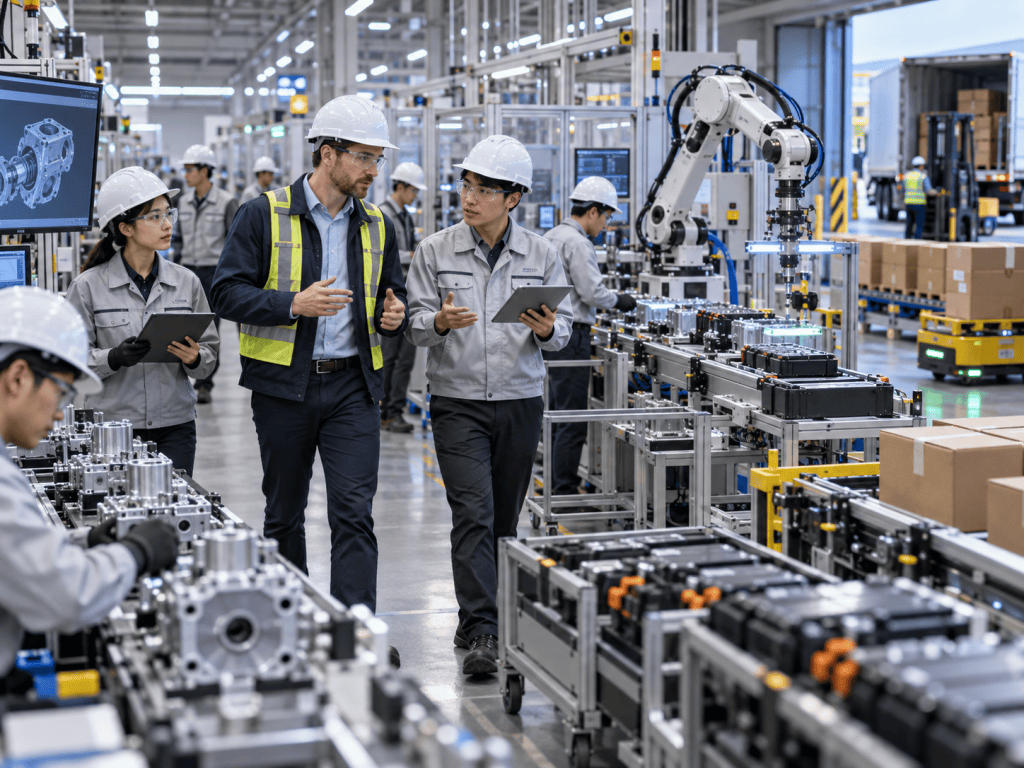
Korea has developed highly connected industrial supply chains, particularly in areas such as:
- semiconductors,
- displays,
- automobiles,
- batteries,
- electronics,
- machinery,
- chemicals,
- shipbuilding,
- biotechnology,
- and ICT.
What makes these ecosystems valuable is not simply the existence of manufacturers.
It is their density and connectivity.
A company may be able to find component suppliers, engineering companies, testing facilities, packaging companies, logistics operators and R&D partners within the same industrial region.
The result can be dramatically shorter development cycles.
Typical Ecosystem Flow
Idea → Prototype → Component → Testing → Manufacturing → Packaging → Distribution
In highly developed Korean industrial ecosystems, these steps can often take place within interconnected domestic networks.
Why This Matters
For foreign companies, Korea can function not only as a consumer market, but also as:
- a sourcing base,
- technology-development base,
- prototype-development location,
- manufacturing partner,
- and Asian supply-chain hub.
3. Industrial Clusters Put Companies, Technology and Talent Together

Korea has deliberately developed specialized geographic business clusters.
Examples include ecosystems built around:
- semiconductors,
- biotechnology,
- automotive manufacturing,
- batteries,
- digital media,
- artificial intelligence,
- shipbuilding,
- research and development.
Seoul itself illustrates this model. Its specialized innovation districts include areas focused on digital media, biotechnology, AI and R&D, while other Korean regions have strong manufacturing and technology specializations. 과학기술정보통신부
The logic is simple:
Innovation accelerates when companies, researchers, suppliers, investors and skilled workers are physically and institutionally connected.
A cluster can provide far more than office space.
It may include:
- research laboratories,
- startup incubators,
- corporate R&D centers,
- universities,
- government agencies,
- demonstration facilities,
- investors,
- and specialized suppliers.
Foreign Business Insight
When entering Korea, choosing the right ecosystem location can sometimes be as important as choosing the right customer.
A biotechnology company, AI company and automotive supplier should not necessarily enter Korea through the same network or city.
4. Universities Are Part of the Business Infrastructure
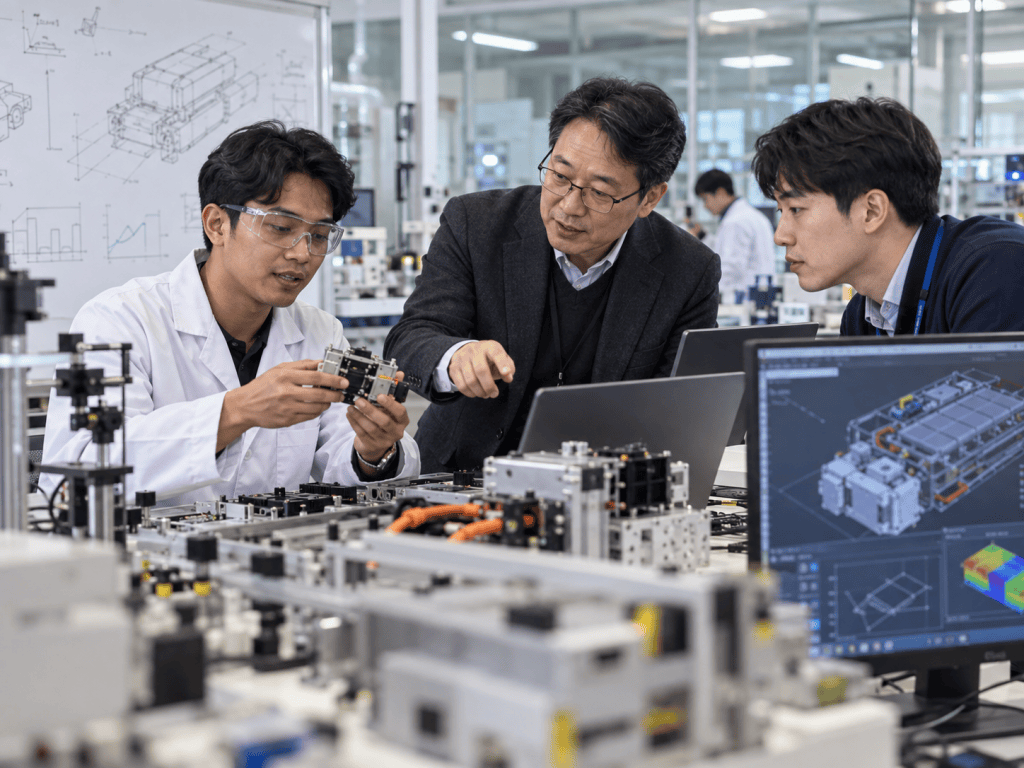
Korean universities are not only educational institutions.
Many also participate directly in:
- technology transfer,
- startup incubation,
- corporate R&D,
- joint laboratories,
- industry-sponsored research,
- patent commercialization,
- entrepreneurship programs,
- and talent development.
Government-supported programs continue to strengthen commercialization of university and public research technologies. For example, Korea has programs supporting laboratory-based entrepreneurship and university science and technology innovation. 과학기술정보통신부
This means a company searching for technology in Korea should not look only at established corporations.
Some valuable technologies may still be inside:
- university laboratories,
- public research institutes,
- professors’ research groups,
- or university spin-offs.
A Common Korean Commercialization Path
University Research
↓
Patent / Technology
↓
Startup or Technology Transfer
↓
Corporate Partnership
↓
Commercial Product
For foreign technology companies, universities can therefore become powerful entry partners.
5. Government Is Often an Ecosystem Builder

Another distinctive feature of Korea is the active role of public policy in technology and industrial development.
Government programs can support areas including:
- R&D,
- startup incubation,
- commercialization,
- global expansion,
- technology transfer,
- AI adoption,
- industry-academia cooperation,
- regional innovation,
- and corporate-startup collaboration.
For example, Korea’s 2026 policies include programs that connect traditional companies with AI startups and encourage companies to adopt startup-developed AI solutions. 과학기술정보통신부
The government has also increased support for SMEs and startups and for translating university and public-research technologies into commercial applications. 과학기술정보통신부
This creates an unusual opportunity.
A partnership between two companies may sometimes become:
Company + Startup + Research Institute + Government Program
rather than simply:
Company + Vendor
That ecosystem approach can reduce innovation risk and accelerate experimentation.
6. Open Innovation Is Changing How Korean Corporations Innovate

Historically, large Korean corporations were known for strong internal capabilities.
That is changing.
Increasingly, corporations are searching outside their own organizations for:
- AI technologies,
- robotics,
- climate technology,
- healthcare solutions,
- digital transformation tools,
- advanced materials,
- mobility technologies,
- fintech,
- and new consumer services.
This is the logic of open innovation.
Instead of developing everything internally, companies can collaborate with startups, universities and research institutes.
Korean public programs now explicitly encourage these kinds of partnerships, including open-innovation cooperation between mid-sized companies and public research organizations. 한국산업기술진흥원
The New Model
Old model:
Corporate R&D → Develop internally → Commercialize
Open-innovation model:
Corporate Challenge → Startup / Research Partner → Pilot → Validation → Scale
This creates one of the best opportunities for foreign technology companies.
You do not necessarily need to replace an existing supplier.
You may instead enter Korea as an innovation partner.
7. Startups Can Become the Gateway to Large Corporations
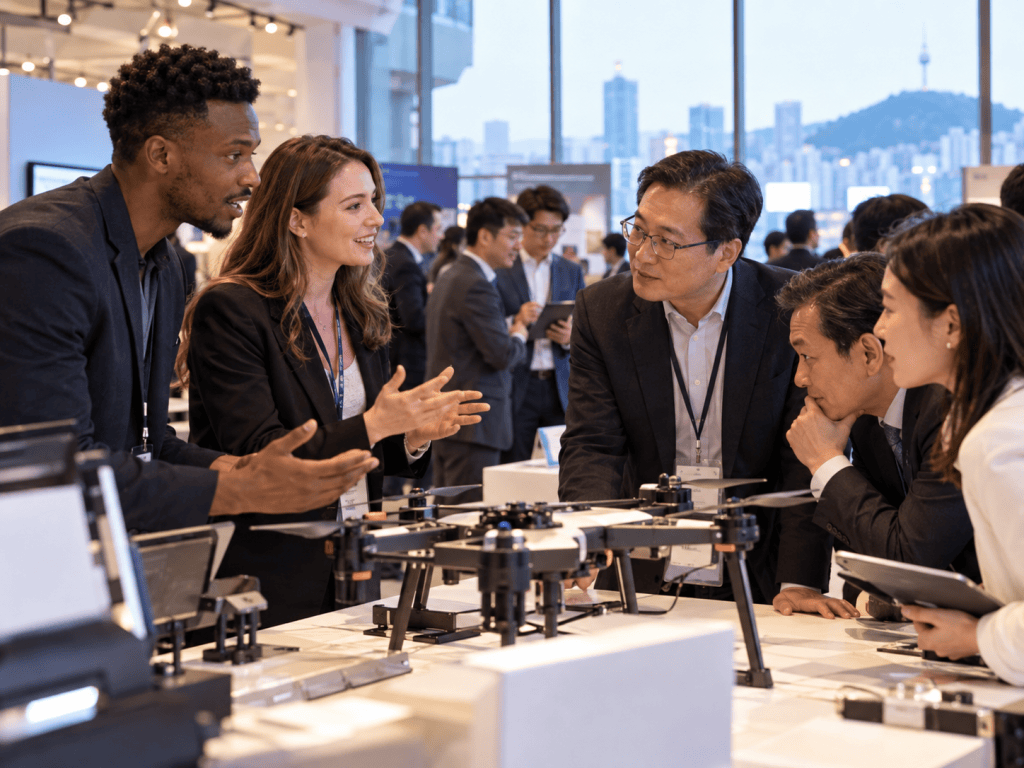
Korea’s startup ecosystem is increasingly connected with established companies.
Large corporations need startups because startups can provide:
- speed,
- niche technologies,
- new business models,
- experimentation,
- software,
- AI capabilities,
- and access to emerging consumer trends.
Startups, meanwhile, benefit from corporations through:
- investment,
- distribution,
- manufacturing,
- market credibility,
- customer access,
- and international expansion.
Korea’s K-Startup ecosystem currently includes public-private open-innovation programs and programs involving global companies. 창업진흥원
This creates a powerful two-way relationship.
Startup Advantage
Innovation + Speed
Corporate Advantage
Scale + Capital + Market Access
Combined
Faster Commercialization
For a foreign startup, Korea’s open-innovation programs can therefore become an alternative route into major corporate networks.
8. Platforms Can Turn Small Businesses into National Businesses

Korea’s digital economy demonstrates another form of ecosystem power.
Companies such as Naver, Kakao and other major commerce, delivery, mobility and content platforms do not simply sell one product.
They connect multiple groups:
Consumers ↔ Merchants ↔ Advertisers ↔ Creators ↔ Logistics ↔ Payment Providers
This is fundamentally different from a traditional linear business model.
A successful platform becomes more valuable as more participants join it.
The same principle applies to Korean franchise systems.
A successful brand may rapidly expand through:
- standardized operations,
- centralized procurement,
- national marketing,
- delivery platforms,
- digital payments,
- and franchise partners.
Foreign Business Lesson
In Korea, market entry does not always require building distribution from zero.
Sometimes the faster strategy is to connect with an existing platform or network that already aggregates customers.
9. K-Beauty, K-Content, K-Food and Tourism Reinforce Each Other

Perhaps one of Korea’s most distinctive ecosystem advantages is the interaction between industries.
Consider the following chain:
K-Drama
↓
K-Pop
↓
K-Beauty
↓
K-Fashion
↓
K-Food
↓
K-Tourism
↓
E-Commerce
A viewer may discover Korea through entertainment.
That interest can lead to Korean cosmetics.
Then fashion.
Then Korean food.
Then travel.
Then language study.
Then Korean products purchased online.
This means Korean industries often create demand for one another.
Example
A Korean celebrity appears in a drama.
The hairstyle becomes popular.
A beauty product used by the celebrity gains attention.
Influencers reproduce the look.
Foreign distributors begin importing the product.
Tourists visit Korean beauty stores.
E-commerce demand rises internationally.
The original entertainment content has therefore generated commercial activity across several industries.
This is ecosystem economics in action.
10. Foreign Companies Can Enter Korea Through the Ecosystem

Perhaps the most important lesson is this:
You do not need to conquer the Korean market alone.
Foreign companies can enter through multiple ecosystem routes.
| Entry Route | Best For | Possible Korean Partner |
|---|---|---|
| Distributor | Consumer products | Importer / retail network |
| Supplier Partnership | Manufacturing technology | Major company or Tier-1 supplier |
| Joint Venture | Long-term market expansion | Korean strategic partner |
| Startup Program | New technology | Accelerator / corporation |
| Open Innovation | B2B solutions | Large enterprise |
| University Collaboration | Advanced technology | University laboratory |
| Research Partnership | Deep-tech / R&D | Public research institute |
| Platform Entry | Digital or consumer services | Korean platform |
| Government Program | Technology commercialization | Korean company + public agency |
| Local Cluster Entry | Manufacturing / R&D | Regional innovation ecosystem |
The key is to stop thinking about Korea as a single market.
Think of it instead as a collection of interconnected ecosystems.
The Korean Business Ecosystem Formula
A simplified way to understand Korean business strength is:
Large Companies
+
SMEs & Suppliers
+
Startups
+
Universities
+
Research Institutes
+
Government Programs
+
Digital Platforms
+
Logistics & Distribution
=
A High-Speed Business Ecosystem
And when these elements work together effectively:
Innovation becomes faster.
Commercialization becomes easier.
Scale becomes larger.
And global expansion becomes more achievable.
What Foreign Companies Should Do Before Entering Korea
Instead of beginning with the question:
“Who can buy our product?”
Ask five better questions:
1. Which Korean ecosystem does our company belong to?
2. Who is the anchor company in that ecosystem?
3. Which suppliers, startups, universities and research institutes surround it?
4. Which government or open-innovation programs support that industry?
5. Which Korean partner could introduce us to the entire network?
The company that answers these five questions well may enter Korea much faster than a company relying only on traditional sales.
Final Takeaway
Korea’s competitive strength is often misunderstood.
It is not simply the strength of Samsung.
Or Hyundai.
Or Naver.
Or Kakao.
Or CJ.
The deeper advantage is the network surrounding them.
Suppliers provide specialization.
Startups provide speed.
Universities provide knowledge.
Research institutes provide technology.
Government provides infrastructure and support.
Platforms provide scale.
And global Korean brands connect everything to the market.
That is why one of the most powerful lessons from Korean business is:
**In Korea, companies rarely grow alone.
They grow as part of an ecosystem.**
And for foreign companies, understanding that ecosystem may be the difference between merely selling in Korea and actually becoming part of Korea’s next growth story.


Leave a Reply