
Eating in Korea is much more than simply choosing a dish from a menu. Korean restaurants have their own unique dining culture—from complimentary side dishes and tabletop grilling to call buttons, spice levels, and paying at the front counter.
For first-time visitors, these small customs can sometimes be confusing. But once you understand them, eating in Korea becomes easier, more enjoyable, and much more authentic.
Here are 10 essential tips for ordering and enjoying Korean food like a local.
Quick Guide: Korean Restaurant Costs & Customs
| No. | Essential Tip | Typical Cost in Korea | Approx. USD | What You Should Know |
|---|---|---|---|---|
| 1 | Understand Banchan Culture | Usually free with main meal | Usually free | Side dishes normally come automatically |
| 2 | Check the “1 Serving” Rule | ₩9,000–₩18,000 per person | $6.70–$13.40 | Some dishes require 2 servings minimum |
| 3 | Learn Korean BBQ Ordering | ₩15,000–₩30,000 per serving | $11–$22 | Meat is usually priced per person/portion |
| 4 | Make a Proper Ssam | Included with BBQ | Included | Wrap meat in lettuce with sauces and vegetables |
| 5 | Choose Your Spice Level | ₩5,000–₩15,000 | $3.70–$11 | Ask for “less spicy” if necessary |
| 6 | Ask for Water & Banchan Refills | Usually free | Usually free | Some restaurants use self-service stations |
| 7 | Use the Staff Call Button | Free | Free | Press the button instead of calling loudly |
| 8 | Pay at the Front Counter | Meal cost only | Meal cost only | Tipping is generally not expected |
| 9 | Ask for Takeout | ₩0–₩1,000 packaging fee | $0–$0.75 | “Pojang” means takeout |
| 10 | Use Korean Delivery Apps | ₩15,000–₩35,000+ | $11–$26+ | Delivery fees may be added |
Prices are approximate and vary according to restaurant, neighborhood, menu, and portion size.
1. Understand Banchan Culture — Side Dishes Come Automatically
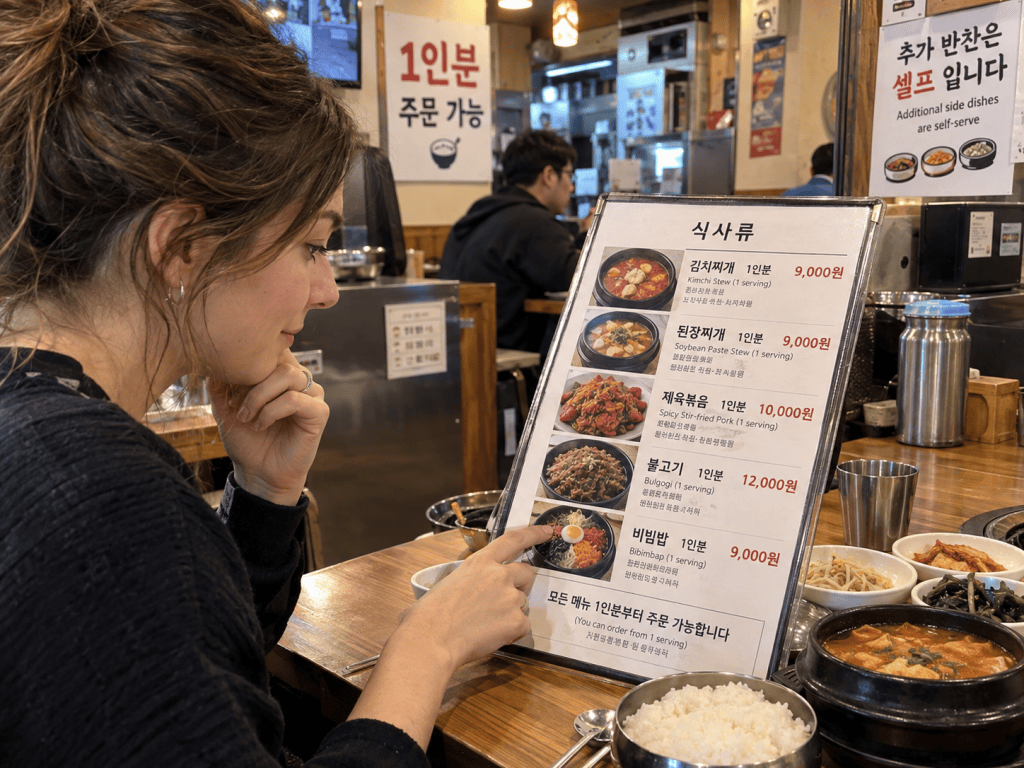
One of the first things visitors notice in a Korean restaurant is the number of small dishes that suddenly appear on the table.
These are called banchan (반찬).
Common banchan include kimchi, seasoned bean sprouts, spinach, pickled radish, seaweed, stir-fried anchovies, cucumber salad, and other seasonal vegetables.
In most traditional Korean restaurants, banchan are included in the price of your main meal. You normally do not need to order each side dish separately.
For example, if you order kimchi jjigae for around ₩9,000–₩12,000 ($6.70–$8.90), you may receive rice plus three to eight small side dishes.
Many foreign visitors are surprised by the amount of food on the table because the side dishes may appear before the main course.
A useful phrase is:
“Igeo geunyang juseyo?” — 이거 그냥 주세요?
However, in most cases you do not need to ask. Banchan simply arrives automatically.
Another helpful phrase is:
“Banchan deo juseyo.” — 반찬 더 주세요.
“Please give me some more side dishes.”
Many restaurants will refill basic banchan free of charge, although premium side dishes may not be refillable.
Local Tip
Do not assume every dish on the table has been separately charged. In traditional Korean restaurants, several side dishes are often included as part of the meal.
2. Understand “1 Serving” and Minimum Order Rules
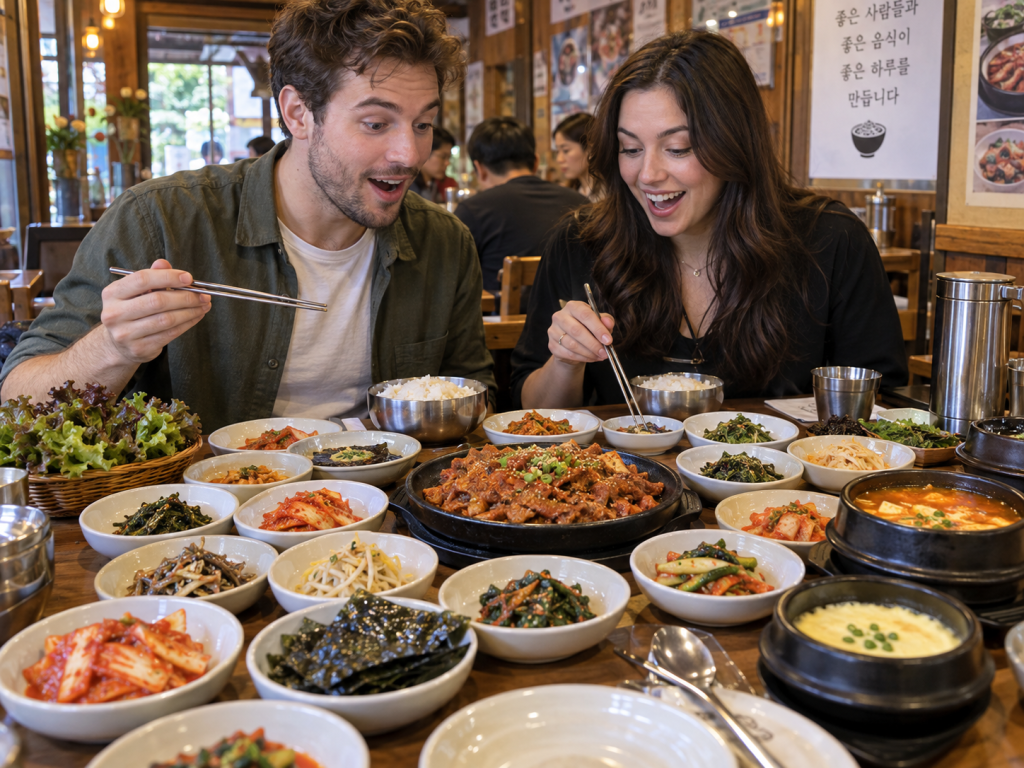
Menus in Korea frequently use the term:
1인분 — il-in-bun — one serving
For individual meals such as bibimbap, kimchi jjigae, doenjang jjigae, or naengmyeon, ordering one serving is usually easy.
Typical prices are:
Bibimbap: ₩9,000–₩15,000 / approximately $6.70–$11
Kimchi jjigae: ₩9,000–₩13,000 / approximately $6.70–$9.70
Naengmyeon: ₩10,000–₩16,000 / approximately $7.40–$11.90
However, Korean BBQ restaurants are different.
A menu may say:
Samgyeopsal — ₩17,000 per serving
but the restaurant may require:
Minimum order: 2 servings
That means one diner might need to order:
₩17,000 × 2 = ₩34,000, or approximately $25
This is especially common at BBQ restaurants, dakgalbi restaurants, and restaurants serving large shared dishes.
Look for Korean expressions such as:
2인분 이상 주문 가능
“Minimum order of two servings.”
or
2인분부터 주문 가능합니다
“Orders start from two servings.”
Local Tip
Solo travelers should look for restaurants displaying:
1인분 주문 가능
“One-person orders available.”
3. Learn How Korean BBQ Works
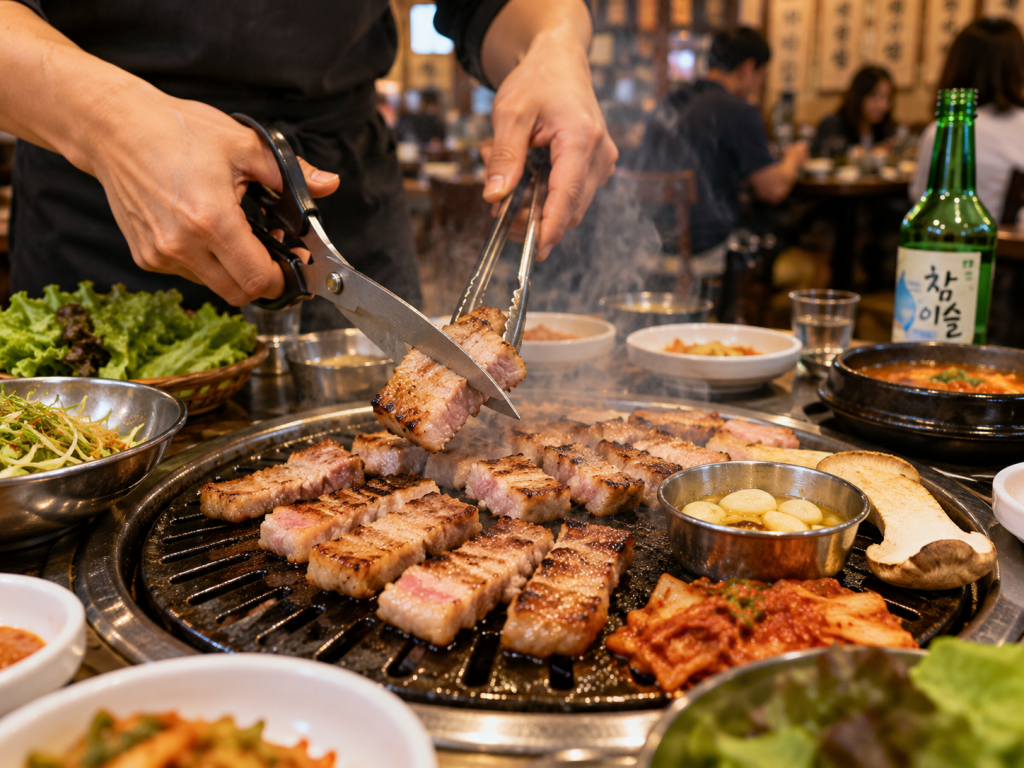
Korean BBQ is one of the country’s most popular dining experiences.
Typical choices include:
Samgyeopsal (삼겹살) — pork belly
Moksal (목살) — pork shoulder
Galbi (갈비) — marinated ribs
Bulgogi (불고기) — marinated beef
Hanwoo (한우) — premium Korean beef
Ordinary pork BBQ generally costs around ₩15,000–₩22,000 ($11–$16) per serving.
Beef may cost ₩20,000–₩40,000 ($15–$30) per serving, while premium Hanwoo can cost considerably more.
The meat is usually grilled directly at your table.
Depending on the restaurant, either the staff will cook the meat for you or you will cook it yourself.
If staff members begin grilling the meat, it is usually best to let them handle it. Many restaurants have their own recommended cooking method.
When cooking yourself, use the metal tongs to handle raw meat and scissors to cut larger pieces.
Avoid using your personal chopsticks to handle raw meat.
Once the meat is cooked, move it away from the hottest part of the grill so it does not burn.
Local Tip
Garlic, kimchi, mushrooms, or onions are often grilled alongside the meat.
That combination is a major part of the Korean BBQ experience.
4. Make and Eat Ssam Like a Korean
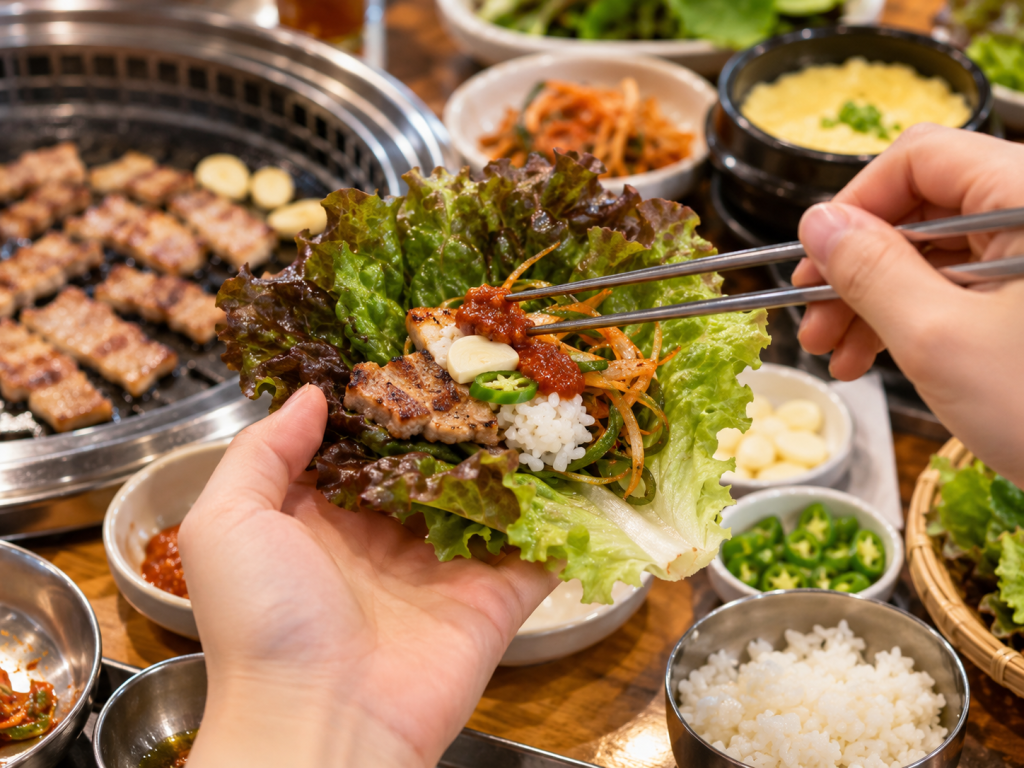
One of the most enjoyable parts of Korean BBQ is making ssam (쌈).
Ssam means wrapping meat and other ingredients inside a lettuce leaf or perilla leaf.
A classic combination is:
lettuce + grilled meat + garlic + green chili + ssamjang + a little rice.
Ssamjang (쌈장) is the thick reddish-brown dipping paste served with Korean BBQ.
To eat it, place the ingredients on a lettuce leaf, fold the leaf around them, and eat the entire wrap in one bite if possible.
Koreans usually make each wrap individually rather than preparing several in advance.
There is no strict recipe. You can customize it with kimchi, scallion salad, pickled radish, or grilled garlic.
The vegetables and sauces usually come with the BBQ meal and normally do not cost extra.
Local Tip
Do not overload the lettuce leaf.
A smaller wrap is much easier—and much more elegant—to eat.
5. Tell the Restaurant How Spicy You Want Your Food
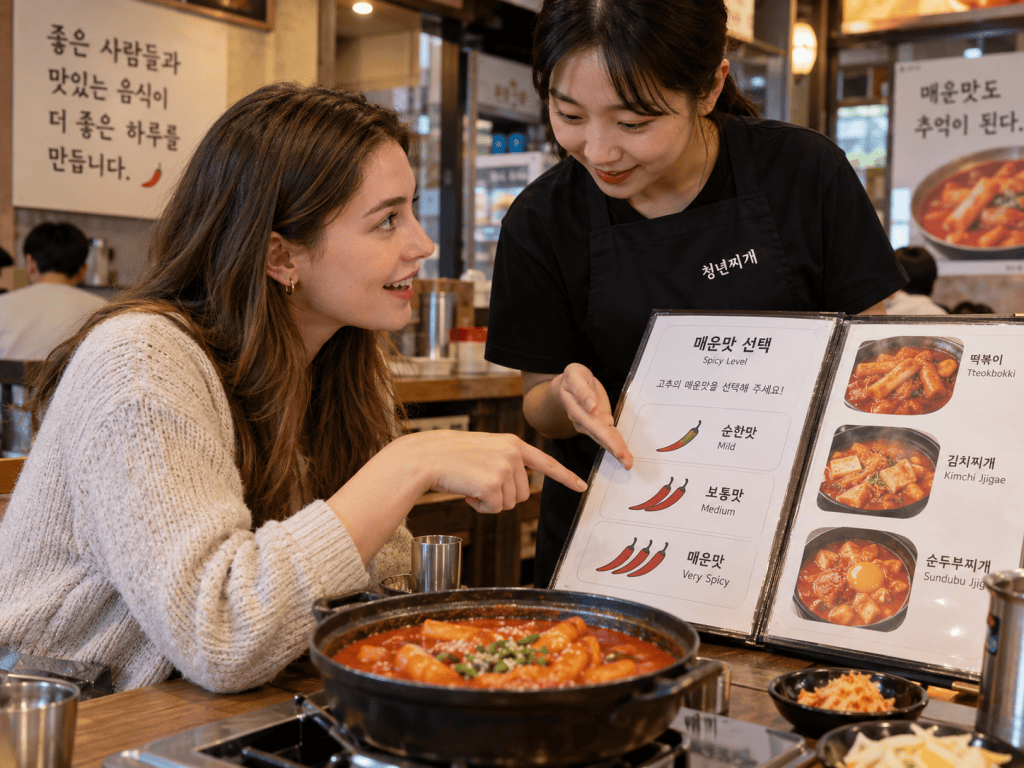
Korean cuisine contains many spicy dishes, but not everything is spicy.
Popular spicy foods include:
tteokbokki, kimchi jjigae, dakgalbi, spicy noodles, jjamppong, and spicy chicken dishes.
A bowl or serving typically costs around ₩5,000–₩15,000 ($3.70–$11) depending on the restaurant.
Some restaurants allow customers to select a spice level.
You may see:
순한맛 — Mild
보통맛 — Medium
매운맛 — Spicy
아주 매운맛 — Very Spicy
If you are sensitive to spicy food, say:
“An maepge haejuseyo.” — 안 맵게 해주세요.
“Please make it not spicy.”
Or:
“Deol maepge haejuseyo.” — 덜 맵게 해주세요.
“Please make it less spicy.”
Keep in mind that “mild” in Korea can still feel quite spicy to visitors who are not accustomed to chili.
Local Tip
When uncertain, start one level lower than you normally would.
You can always add chili sauce later.
6. Water and Many Side-Dish Refills Are Usually Free
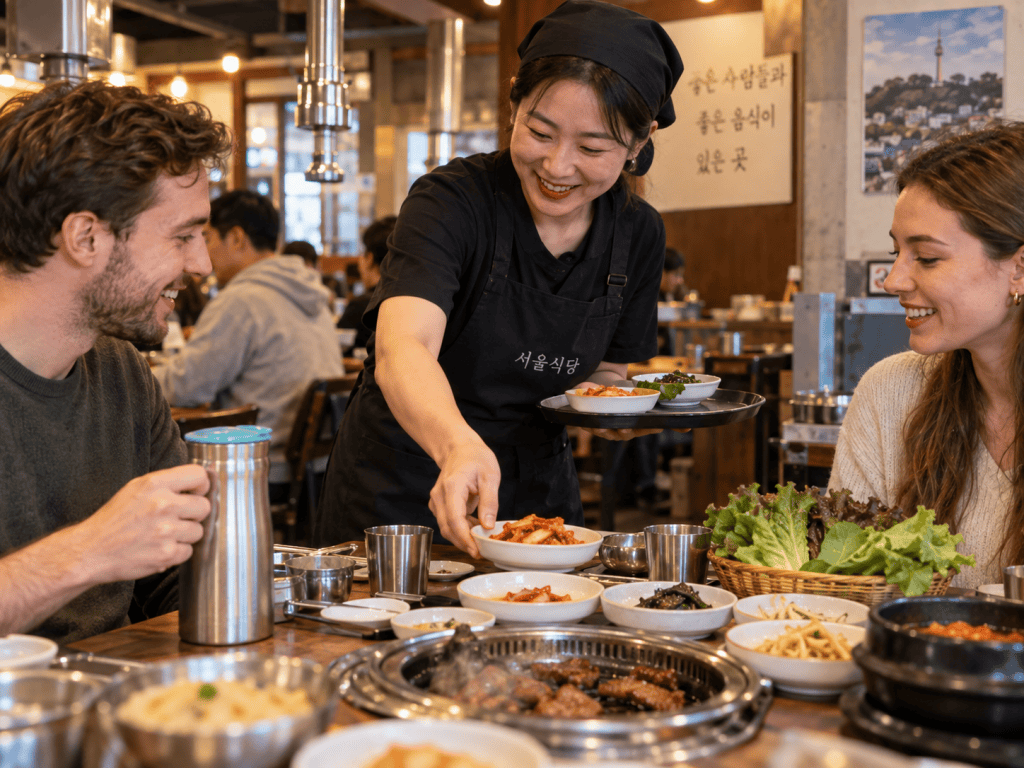
In many Korean restaurants, drinking water is provided free of charge.
You may receive a bottle or pitcher of water automatically.
Other restaurants have a self-service water station.
Basic banchan, such as kimchi, pickled radish, or bean sprouts, may also be refillable without additional charge.
You can say:
“Mul juseyo.” — 물 주세요.
“Water, please.”
For more kimchi:
“Kimchi deo juseyo.” — 김치 더 주세요.
However, modern restaurants increasingly use self-service stations.
Look for signs reading:
셀프 — Self-service
or:
추가 반찬은 셀프입니다
“Additional side dishes are self-service.”
Local Tip
Take only as much as you plan to eat.
Free refills do not mean diners should take excessive amounts of food and leave it unfinished.
7. Use the Call Button Instead of Shouting for Staff
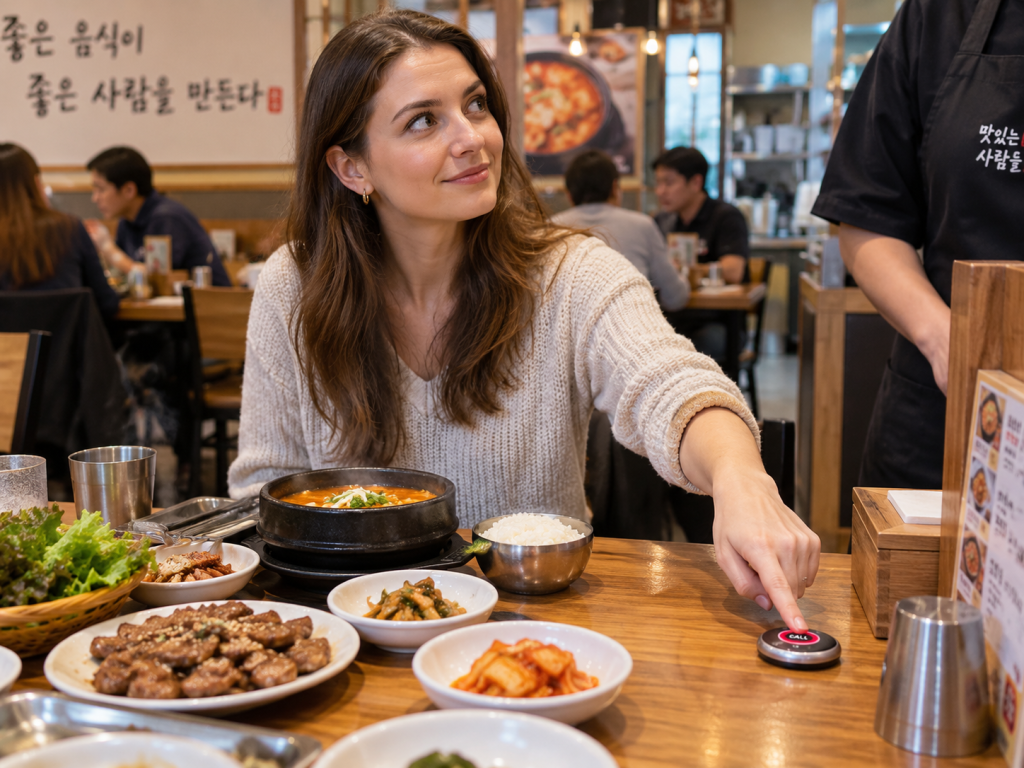
Many Korean restaurants have a small button on the table.
It may say:
호출 — Call
or simply have a bell symbol.
Pressing the button alerts the staff electronically.
This is completely normal in Korea.
Foreign visitors sometimes wait for a waiter to regularly check the table, as happens in some Western countries.
Korean restaurants often work differently.
Staff generally give customers more privacy, so you may need to call them when you want to order more food, request water, ask for side dishes, or get assistance.
If there is no button, say politely:
“Jeogiyo!” — 저기요!
This roughly means:
“Excuse me!”
It is one of the most useful Korean restaurant expressions for travelers.
Local Tip
Press the button once.
Repeatedly pressing it is unnecessary because the staff system has already received your request.
8. Pay at the Front Counter
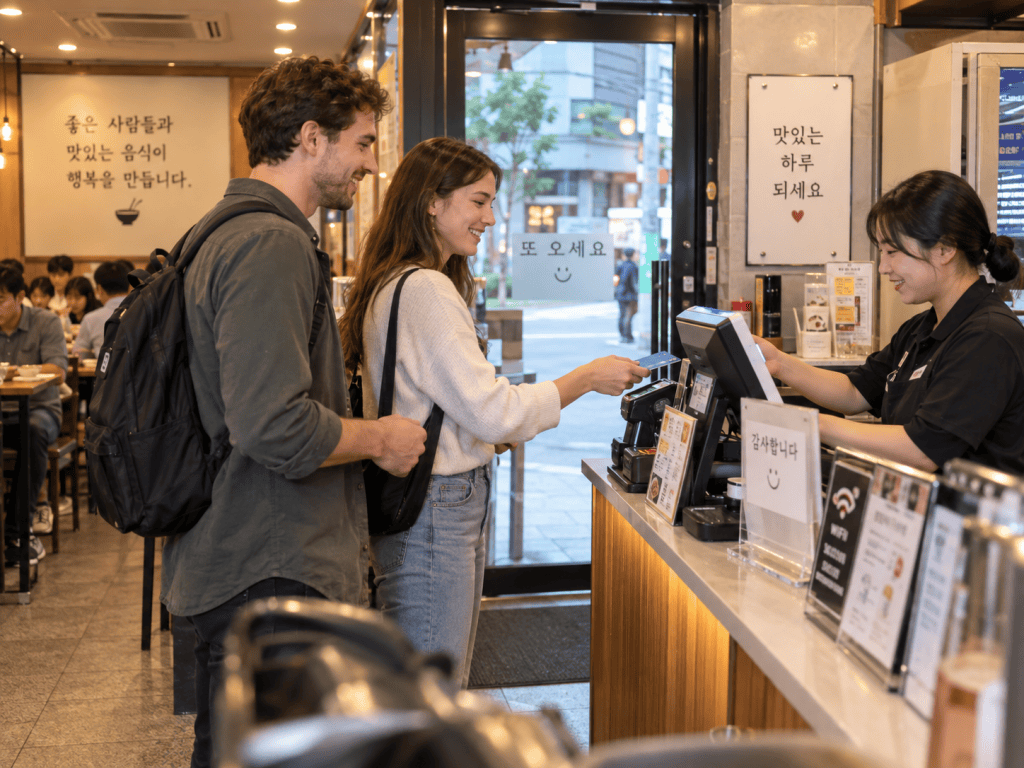
One of the biggest differences between Korean restaurants and restaurants in many Western countries is the payment system.
In many Korean restaurants, you do not wait for the server to bring the bill to your table.
Instead, when your meal is finished, simply walk to the cashier near the entrance or exit.
Say:
“Gyesan halgeyo.” — 계산할게요.
“I’d like to pay.”
Most restaurants accept Korean credit cards, and many accept major international cards.
However, travelers should keep some cash available because certain small restaurants, traditional markets, or food stalls may be more convenient with cash.
For a typical casual restaurant meal, expect around ₩10,000–₩20,000 ($7.40–$14.90) per person.
A Korean BBQ dinner often runs around ₩25,000–₩50,000 ($18.60–$37) per person depending on meat and drinks.
Another important difference:
Tipping is generally not expected in Korea.
The amount on your bill is normally the amount you pay.
Local Tip
If you are eating with friends, one person often pays the entire restaurant bill and the group settles the cost afterward using a bank transfer or mobile payment.
9. Ask for Takeout Using the Word “Pojang”
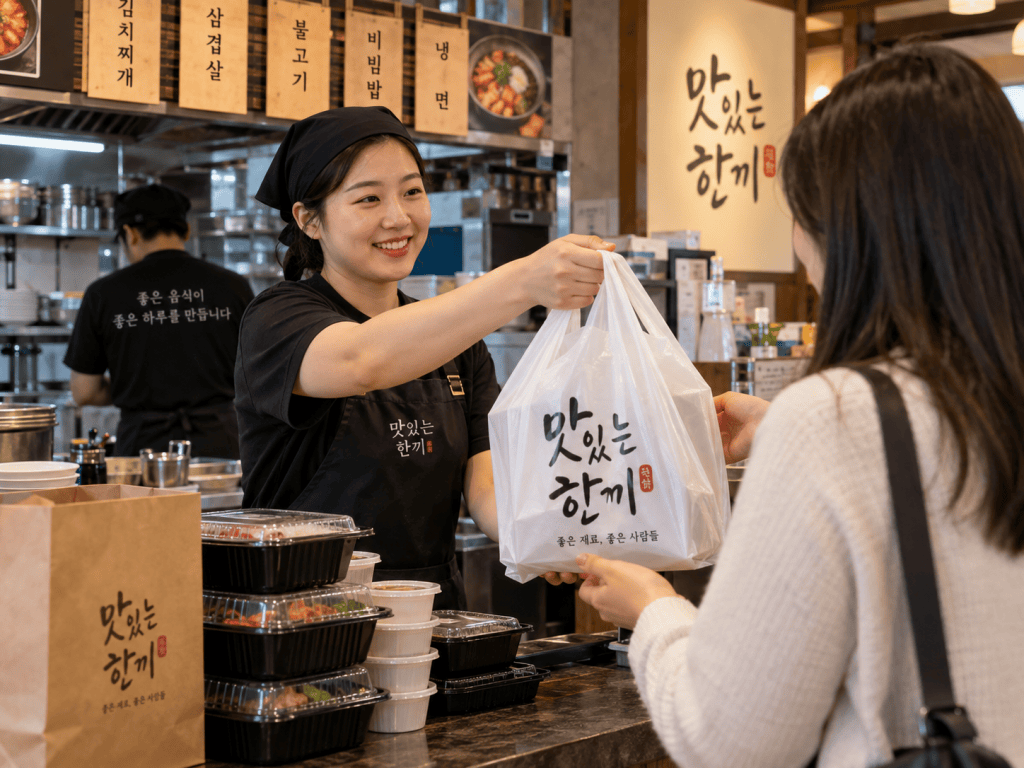
Takeout is very common in Korea.
The Korean word you need is:
포장 — pojang — takeout / packing
When ordering, say:
“Pojang haejuseyo.” — 포장해 주세요.
“Please make it to go.”
Or:
“Pojang dwaeyo?” — 포장 돼요?
“Can I get this to go?”
Restaurants commonly offer takeout for fried chicken, gimbap, tteokbokki, noodles, rice dishes, soups, and many other foods.
Some restaurants may provide packaging free, while others may charge around ₩500–₩1,000 ($0.40–$0.75) for containers or bags.
Not every restaurant will pack partially eaten leftovers, particularly dishes that are difficult to transport safely.
Local Tip
If you already know you want takeout, tell the restaurant when ordering rather than after the food has been served.
10. Try Korean Food Delivery Apps
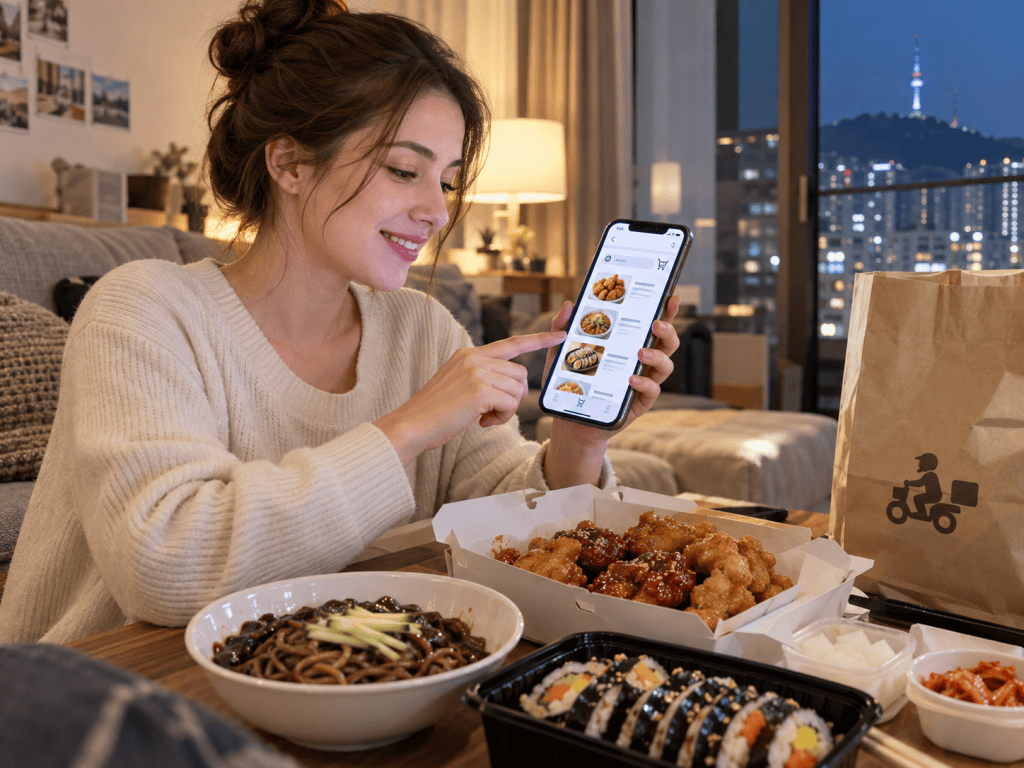
Food delivery is a major part of daily life in Korea.
In Seoul and other major cities, almost every type of Korean food can be delivered directly to apartments, hotels, offices, or guesthouses.
Popular delivery categories include fried chicken, pizza, jokbal, bossam, tteokbokki, gimbap, Chinese-Korean dishes, burgers, coffee, desserts, and even convenience-store products.
A typical delivery order may cost:
Food: ₩15,000–₩30,000 ($11–$22)
Delivery fee: ₩1,000–₩5,000 ($0.75–$3.70)
A meal for two may therefore cost approximately:
₩25,000–₩40,000 ($18.60–$29.70)
Korean delivery platforms can sometimes require a Korean mobile number, Korean payment method, or address entered in Korean.
Foreign visitors staying at hotels may find it easier to ask the hotel reception desk for assistance if the app presents difficulties.
When entering your location, make sure you provide the correct building name and room or unit information.
Local Tip
Delivery drivers in Korea are extremely fast, but complicated building access can cause delays.
Include clear entrance instructions whenever possible.
10 Korean Restaurant Expressions Worth Remembering
저기요! — Jeogiyo!
Excuse me!
이거 주세요. — Igeo juseyo.
I’ll have this, please.
안 맵게 해주세요. — An maepge haejuseyo.
Please make it not spicy.
물 주세요. — Mul juseyo.
Water, please.
반찬 더 주세요. — Banchan deo juseyo.
More side dishes, please.
이거 뭐예요? — Igeo mwoyeyo?
What is this?
추천해 주세요. — Chucheonhae juseyo.
Please recommend something.
포장해 주세요. — Pojang haejuseyo.
Please make it to go.
계산할게요. — Gyesan halgeyo.
I’d like to pay.
감사합니다. — Gamsahamnida.
Thank you.
Final Advice
Ordering Korean food may feel unfamiliar during your first few meals, but the system becomes surprisingly easy once you understand a few basic customs.
Remember the essentials: banchan is often included, some dishes have minimum serving requirements, Korean BBQ is meant to be shared, the call button is your friend, payment usually happens at the front counter, and tipping is generally unnecessary.
Most importantly, do not be afraid to point at the menu, ask questions, or say “Chucheonhae juseyo” — “Please recommend something.”
Korean dining culture is built around sharing, variety, and enjoying food together.
Once you learn these simple habits, you will not just be ordering Korean food—you will be eating like a local.


Leave a Reply