
Renting in Korea Without Getting Scammed: The Ultimate Housing Guide for International Students
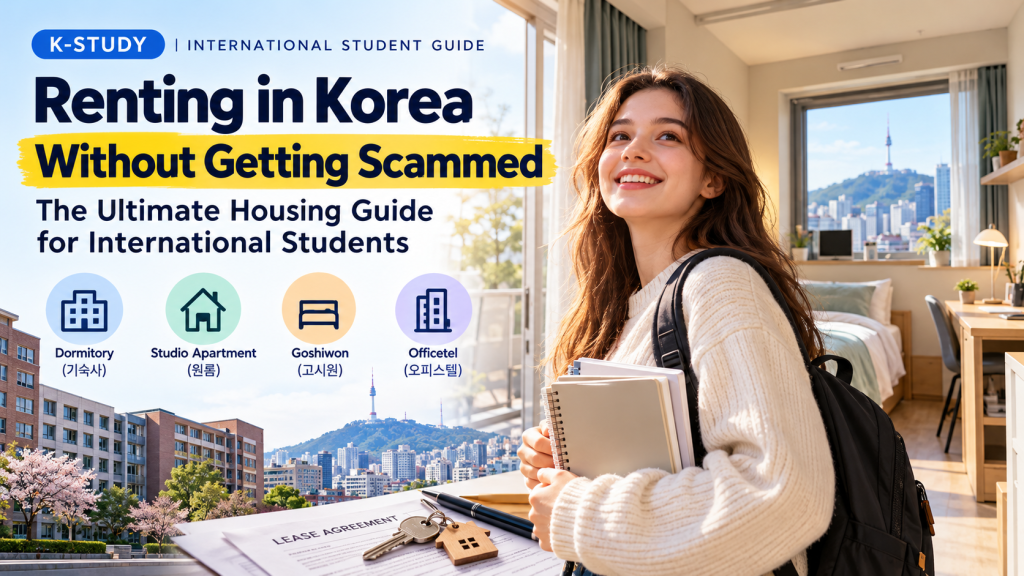
Everything you need to know about dormitories, studio apartments, rental deposits, monthly rent, hidden costs, contracts, and protecting your money in South Korea.


11
Moving to South Korea to study is exciting. You are about to experience a new culture, meet new friends, explore fascinating cities, and build your future.
But before enjoying university life, you need to answer one very important question:
Where will you live, and how can you rent a place safely without losing your money?
Housing in Korea can be quite different from what international students are accustomed to in their home countries.
You may encounter unfamiliar words such as jeonse, wolse, bojeunggeum, and gwanlibi. You might also be asked to pay several thousand dollars as a security deposit before moving into a small studio apartment.
Don’t worry!
This K-Study guide explains how Korea’s rental system works, how much accommodation may cost, where to look for housing, and how to protect yourself from rental scams.
1. Understanding Your Housing Options in Korea
International students generally have several accommodation choices. Each has different costs, advantages, and disadvantages.

University Dormitory (기숙사)
Convenient, campus-based housing

Studio Apartment (원룸)
Private living space with greater independence

Goshiwon (고시원)
Budget-friendly small private room

Officetel (오피스텔)
Self-contained accommodation with amenities
Estimated accommodation costs
The following figures are illustrative student-budget ranges, not guaranteed market quotes. Actual costs depend heavily on the city, neighborhood, building, season, and amenities.
| Housing type | Monthly cost (KRW) | Approx. USD |
|---|---|---|
| University dormitory | ₩250,000–₩600,000 | $189–$453 |
| Goshiwon | ₩300,000–₩550,000 | $226–$415 |
| Shared housing (per person) | ₩350,000–₩700,000 | $264–$528 |
| Studio apartment | ₩400,000–₩900,000 | $302–$679 |
| Officetel | ₩600,000–₩1,200,000 | $453–$905 |
USD figures are rounded using an illustrative exchange rate of USD 1 ≈ KRW 1,326. Dormitory fees may be charged by semester rather than month. Deposits and utilities are not included unless otherwise specified.
K-Study Tip: For your first semester, a university dormitory may be the easiest option. It gives you time to understand local rental practices before signing a private housing contract.
2. The Three Korean Rental Terms Every Student Must Know

Korea has a distinctive rental system. Understanding these three words can help you avoid expensive mistakes.
① Bojeunggeum (보증금) — Security Deposit
A bojeunggeum is money you pay the landlord before moving into a property.
Unlike monthly rent, the deposit is generally returned when the lease ends, subject to lawful deductions such as unpaid rent or damage beyond normal wear and tear.
Example:
- Security deposit: ₩5,000,000 (approximately $3,771)
- Monthly rent: ₩500,000 (approximately $377)
- Lease period: 12 months
At the end of the lease, the landlord should return the refundable balance of your deposit in accordance with the contract and applicable law.
However, a deposit is not automatically safe merely because the contract promises repayment. The landlord’s debts, property rights, and financial position matter.
② Wolse (월세) — Monthly Rent
Wolse refers to a rental arrangement in which you pay a security deposit and monthly rent.
For example:
ILLUSTRATIVE STUDIO APARTMENT
Security deposit
₩5,000,000
Approximately $3,771
Monthly rent
₩500,000
Approximately $377
Additional monthly costs: building maintenance, electricity, gas, water, and internet, depending on the lease.
A higher deposit may sometimes allow you to negotiate lower monthly rent, but this creates greater financial exposure if the deposit is not returned.
③ Jeonse (전세) — Large-Deposit Rental
Jeonse is a Korean rental arrangement in which tenants pay a large lump-sum deposit instead of ordinary monthly rent.
For example, a property might require a deposit of ₩100,000,000 (approximately $75,415).
The deposit is generally intended to be repaid at the end of the lease.
However, jeonse can carry substantial deposit-return risks, including cases where a financially troubled landlord cannot repay the tenant.
For international students without experience evaluating Korean property records, a conventional monthly-rent arrangement with a manageable deposit is often easier to understand.
For more background, consult the Korean government’s Study in Korea housing guide.
Run by Korean Government
+1
3. How Much Money Do You Really Need Each Month?

Rent is only one part of your housing budget.
Many international students underestimate their expenses because they focus only on the advertised monthly rental price.
Here is an illustrative budget for one student renting a modest studio apartment.
| Expense | Monthly KRW | Approx. USD |
|---|---|---|
| Rent | ₩500,000 | $377 |
| Building maintenance | ₩70,000 | $53 |
| Electricity | ₩30,000 | $23 |
| Gas/heating allowance | ₩50,000 | $38 |
| Water | ₩15,000 | $11 |
| Internet | ₩25,000 | $19 |
| Total housing expenses | ₩690,000 | $520 |
These are planning assumptions, not standardized charges. Some buildings include water, internet, or other utilities in maintenance fees; winter heating bills can be significantly higher.
Your housing budget calculator
Use this calculator to estimate your own monthly costs in Korean won and US dollars.Deposit (KRW)Monthly rent (KRW)Maintenance fee (KRW)Utilities / internet (KRW)Exchange rate: KRW per USD
Monthly housing total
₩690,000
$520
Deposit + first month
₩5,690,000
$4,291
Initial estimate excludes brokerage fees, moving expenses, and other possible charges. Exchange rate is editable and not live.
Important: The money you need before moving in can be much higher than one month’s rent. Always calculate your upfront costs and keep a separate emergency fund.
4. Where Can International Students Find Accommodation?


6
Searching for an apartment in Korea is easier when you know where to look.
Here are several popular starting points.
| Platform | Best for | Website |
|---|---|---|
| Dabang (다방) | Studio apartments and rentals | dabangapp.com |
| Zigbang (직방) | Studios and officetels | zigbang.com |
| Naver Real Estate (네이버 부동산) | Comparing listings and neighborhoods | land.naver.com |
| University Housing Office | Dormitories and student guidance | Your university’s official website |
These real estate platforms are also introduced in the government’s Study in Korea housing guide.
Run by Korean Government
+1
Five smart apartment-hunting strategies
- Start with your university. Ask the international student office about dormitories, trusted housing resources, and common rental problems in the area.
- Compare multiple listings. Check the deposit, rent, maintenance fees, location, and contract period rather than focusing on the lowest advertised rent.
- Visit before paying. A property may look attractive online but have mold, poor insulation, noise, or other problems.
- Check the commute. Living farther from campus may save rent but increase transportation costs and travel time.
- Work with a licensed real estate agent. Verify the agency’s registration and request a clear explanation of all brokerage fees.
Important warning: A listing on a popular app is not proof that the landlord, property, or deposit arrangement is safe.
5. Ten Things You Must Check Before Signing a Contract

A rental agreement is a legal contract, not just paperwork.
Before transferring any money, use this checklist.
Student Rental Safety Checklist
0 of 10 completedI visited and inspected the actual property.I checked the property address and unit number.I reviewed a recent official real estate register.I verified the legal property owner and the landlord’s identity.I checked mortgages, seizures, and other registered claims.I verified the receiving bank account and payment instructions.I understand the deposit, rent, utilities, and maintenance fees.I checked the lease dates, termination terms, and deposit refund conditions.I confirmed whether residence registration at this address is possible.I received an understandable contract and kept copies of every document.
Reset Copy checklist
What is a real estate register?
In Korea, the official real estate register, commonly called deunggi-bu-deungbon (등기부등본), contains important information about the property.
It can help you identify the registered owner, mortgages, and other recorded legal rights.
You can access South Korea’s official registry system through the Supreme Court Internet Registry Office.
However, registry records do not necessarily reveal every risk. For buildings with multiple tenants, additional checks of existing deposits, tax liabilities, and building classification may be needed. Ask a qualified professional to review the documents before paying a substantial deposit.
찾기쉬운 생활법령정보
+1
6. Protecting Your Security Deposit: Essential Legal Steps

This may be the most important section of the entire guide.
South Korea has legal protections for residential tenants, and foreign residents may qualify when the applicable requirements are fulfilled.
Step 1. Complete your foreign resident registration
If you are staying in Korea long-term, make sure you complete the required foreign resident registration and keep your residence details accurate.
Foreign students who have completed their registration and appropriate residence reporting may qualify for protection under the Housing Lease Protection Act.
Easy to Find, Practical Law
Step 2. Report your new residential address
Registered foreign residents generally must report a change of residential address within 15 days after moving.
You can usually report it through the appropriate immigration office or local government office, with online options available for eligible applicants.
You may need:
- Passport
- Residence card
- Lease agreement or proof of residence
- Required application form
Failure to report the change on time may result in a financial penalty.
Run by Korean Government
+1
Step 3. Obtain a fixed date (확정일자)
A hwakjeong-ilja, or fixed date, is an officially recognized date associated with your rental agreement.
Together with other legal requirements, it can help establish a tenant’s priority for repayment of the rental deposit.
Ask your local community service center how to obtain it. Bring the necessary identification and original lease agreement. Simply obtaining a fixed date does not guarantee that your entire deposit will be recovered.
조문정보
+1
Step 4. Keep records of everything
Save your signed contract, bank transfer confirmations, payment receipts, deposit records, landlord messages, and photographs of the property’s condition.
Never rely entirely on verbal promises.
7. What If Your Landlord Refuses to Return Your Deposit?
Imagine that your rental agreement has ended, but your landlord says:
“I cannot return your deposit until another tenant moves in.”
What should you do?
First, do not assume that you must move out immediately and hope to receive your money later.
Under Korean law, leaving and giving up possession before securing repayment can affect important tenant protections. A legal procedure known as a leasehold registration order may help preserve those rights, but it must be properly completed before you rely on it.
A practical response is to request repayment in writing, preserve your evidence, seek qualified housing-law assistance, and confirm the legal implications before moving.
Depending on the circumstances, formal demands, court payment procedures, or leasehold registration may be available.
Easy to Find, Practical Law
+1
8. Useful Korean Phrases When Renting an Apartment

You do not need to speak perfect Korean to rent accommodation. However, knowing a few key phrases makes it easier to ask the right questions.
| Korean | English |
|---|---|
| 월세가 얼마예요? | How much is the monthly rent? |
| 보증금은 얼마예요? | How much is the security deposit? |
| 관리비가 포함되어 있나요? | Is the maintenance fee included? |
| 전기세는 별도인가요? | Is electricity charged separately? |
| 인터넷이 포함되어 있나요? | Is internet included? |
| 방을 직접 볼 수 있을까요? | May I see the room in person? |
| 계약 기간은 얼마나 되나요? | How long is the lease? |
| 외국인도 계약할 수 있나요? | Can a foreigner sign the lease? |
| 등기부등본을 확인하고 싶어요. | I’d like to check the property register. |
| 전입 신고가 가능한가요? | Is address registration possible here? |
| 확정일자를 받을 수 있나요? | Can I obtain a fixed date? |
| 보증금은 언제 돌려받나요? | When will my deposit be returned? |
K-Study Tip: Save this table on your phone before visiting a real estate office. Asking clear questions can prevent misunderstandings.
9. Hidden Costs Students Often Forget
The advertised rent is rarely your complete housing cost.
| Additional expense | What to know |
|---|---|
| Maintenance fee (관리비) | May cover cleaning, building services, or selected utilities |
| Electricity (전기세) | Depends on consumption and building arrangements |
| Gas/heating (가스비) | Winter heating can substantially increase bills |
| Water (수도세) | May be included or separately charged |
| Internet (인터넷) | Check whether service is already provided |
| Brokerage fee (중개보수) | Ask for the legally applicable fee calculation |
| Moving expenses (이사비) | Depend on distance and the amount of belongings |
| Cleaning costs (청소비) | Check the contract for applicable obligations |
Never assume that all these services are included in your monthly rent.
A supposedly inexpensive apartment can end up costing much more than expected.
10. Red Flags: How to Recognize Possible Rental Scams

Rental fraud can happen anywhere, and international students may be especially vulnerable when dealing with unfamiliar laws and language barriers.
Watch for the following warning signs:
- Someone demands an immediate deposit before showing you the property.
- The person receiving the money cannot satisfactorily establish their authority to rent the property.
- The landlord refuses reasonable ownership or registration checks.
- The advertised price is suspiciously lower than comparable properties.
- You are pressured to sign a Korean-language agreement without understanding it.
- The bank account information changes unexpectedly.
- The agent refuses to explain additional charges or refund conditions.
- The landlord asks you to accept an incorrect address or an arrangement that prevents required residence reporting.
A warning sign does not automatically prove fraud, but it is a reason to stop and verify.
Golden rule: Never transfer a large housing deposit until the property, contract, ownership, and payment recipient have been properly checked.
11. Where to Get Help in Korea
International students do not have to solve housing problems alone.
| Organization | What it can help with |
|---|---|
| University International Office | Student housing, dormitory guidance, referrals |
| Immigration Contact Center — 1345 | Immigration and residence-reporting questions |
| Korea Legal Aid Corporation — 132 | Legal assistance and eligibility information |
| Local community service center (주민센터) | Address procedures and fixed-date applications |
| Seoul Foreign Portal | Housing and administrative information for foreign residents |
For official information, visit:
- Study in Korea — Government guidance for international students
- Hi Korea — Immigration and residence services
- Easy-to-Find Practical Law — Korean legal guidance
- Seoul Foreign Portal — Foreign-resident support
- Korea Legal Aid Corporation — Legal assistance
12. Your First Apartment: A Practical Move-In Plan
- Before arriving in KoreaResearch your university’s dormitories, neighborhood rental prices, and transportation routes.
- Two to four weeks before movingCompare accommodation options, arrange viewings, and investigate the property and landlord.
- Before signing or payingVerify the official register, read the contract, calculate the full cost, and confirm the payment details.
- On move-in dayPhotograph the room, check appliances and utilities, document existing damage, and keep proof of payment.
- After movingComplete required residence reporting, obtain a fixed date when applicable, and save all records.
Final Advice: Your Home Should Be a Safe Beginning, Not a Financial Risk

Studying abroad is a major investment in your future.
Finding a safe and comfortable place to live is an important part of making that investment successful.
Remember these five principles:
Choose carefully. Understand the costs. Verify ownership. Protect your deposit. Keep written records.
The cheapest room is not always the best choice. A slightly more expensive apartment with clear contractual terms, reasonable costs, and a manageable commute may offer much greater peace of mind.
Whether you choose a dormitory, a studio apartment, or shared housing, understanding the Korean rental system will help you make informed decisions and concentrate on your studies.
Your journey in Korea deserves a safe and confident beginning.
Welcome to Korea, and welcome to your new home!
— K-Study | Your Guide to Studying and Living in Korea
Editor’s note: All housing budgets are illustrative. USD conversions use an approximate rate of ₩1,326 per US dollar; exchange rates and housing costs change. Rental rights and administrative procedures depend on the specific contract, property, and resident’s status. For major deposits or disputes, seek current professional advice.


Leave a Reply