

Suggested WordPress title: A Student’s Guide to Visiting a Doctor in Korea: Insurance, Costs, and Useful Phrases
Suggested slug: student-guide-doctor-korea
Exchange-rate note: Dollar amounts below are approximate, using US$1 ≈ ₩1,325.
Image note: The photos are placed between sections below. Upload each image to your WordPress Media Library before publishing so it displays on your live site.
Studying in Korea is exciting, but getting sick in a new country can feel confusing. Which clinic should you visit? What should you bring? How much might you pay?
This guide explains the basics of Korea’s National Health Insurance, how to find care, what happens at a clinic or pharmacy, and what to do in an emergency.
exec-9eb7f338-7368-4d84-8403-5f45abb78d65.png
1. Check Your Health Insurance First

Many international students are automatically enrolled in Korea’s National Health Insurance (NHIS), but the start date depends on your visa and situation.
| Student status | General enrollment timing |
|---|---|
| Degree student (D-2) | Generally from the date of foreign resident registration |
| General training student (D-4) | Generally after six months in Korea |
| Other visa or special situation | Check directly with NHIS or your university |
Students who qualify for the student reduction may receive a 50% premium reduction. The commonly reported 2026 monthly premium for eligible students is about ₩79,320 (approximately US$60). Your actual premium can differ based on eligibility and your circumstances, so check your NHIS bill or ask NHIS directly.
NHIS coverage does not mean every service is free. You usually pay part of the cost, and some services may not be covered.
2. How Much Might You Pay?
The amount you pay depends on the type of facility and whether the service is covered by NHIS. The percentages below apply to covered care costs; non-covered services may be charged separately.
| Type of care | Typical patient share for covered costs |
|---|---|
| Clinic outpatient visit | About 30% |
| Hospital outpatient visit | About 40% |
| General hospital outpatient visit | About 45–50% |
| Tertiary hospital outpatient visit | About 60% |
| Inpatient care | About 20% |
| Prescription medicine at a pharmacy | About 30% |
These are general reference rates, not a price quote. Your final bill may include additional charges, and the exact amount varies by treatment and facility.
exec-9d665d99-743c-4915-963e-f2a13f5b6ebe.png
3. Where Should You Go?
For a common illness—such as a cold, mild fever, stomach discomfort, or a minor skin problem—a nearby clinic is often a practical first stop.
A hospital may be a better option for more complex care or when a clinic recommends further evaluation. Large university hospitals and tertiary hospitals often have more departments, but they may require an appointment or referral and can involve longer waits.
Before you go, check:
- Whether the clinic accepts NHIS
- Its opening hours and appointment requirements
- Whether English-language support is available
- Whether you need a referral for the hospital you want to visit
You can search for nearby medical facilities through Korea’s official health information services or ask your university’s international student office for recommendations.
4. What to Bring to a Clinic
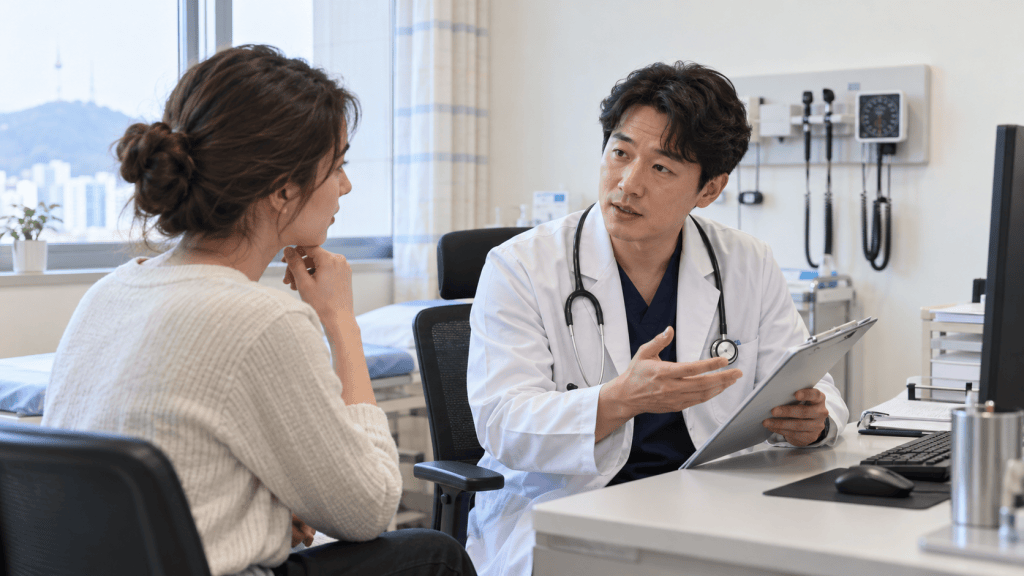
Bring these items if you have them:
- Your Alien Registration Card (ARC) or other identification
- Your NHIS information or insurance card
- A list of medicines you take
- Any relevant medical records or allergy information
- A payment card or another way to pay
Tell the clinic about allergies, existing conditions, and medicines you are currently taking. If you need help explaining something in Korean, write it down or use a translation app.
5. What Happens at a Clinic?
A typical visit follows these steps:
- Register at the reception desk. Tell them whether you have NHIS and show your identification.
- Wait to be called. The clinic may ask you to complete a short form.
- Describe your symptoms. Explain when they started and what makes them better or worse.
- See the doctor. Ask questions if you do not understand the diagnosis or instructions.
- Pay at the desk. The clinic will tell you whether you need to visit a pharmacy.
- Take your prescription to a pharmacy. Prescription medicines are usually collected separately.
exec-80447abc-6a03-4860-ac11-5b2a4fd76c99.png
6. Getting Medicine at a Pharmacy

If the doctor gives you a prescription, take it to a pharmacy. The pharmacist will prepare your medicine and explain how to take it. Ask about the dose, timing, and possible side effects if anything is unclear.
You can also buy some non-prescription products directly at a pharmacy. Tell the pharmacist about any allergies or other medicines you use.
7. Useful Korean Phrases
| Korean | Pronunciation | English |
|---|---|---|
| 영어 가능한 직원이 있나요? | Yeongeo ganeunghan jigwoni innayo? | Is there a staff member who speaks English? |
| 건강보험이 있어요. | Geongang boheomi isseoyo. | I have health insurance. |
| 여기 아파요. | Yeogi apayo. | It hurts here. |
| 언제부터 아팠어요? | Eonje-buteo apasseoyo? | When did it start hurting? |
| 이 약은 언제 먹어요? | I yageun eonje meogeoyo? | When should I take this medicine? |
| 알레르기가 있어요. | Allereugiga isseoyo. | I have an allergy. |
8. In an Emergency
For an urgent medical emergency, call 119. If you can, give your location clearly and describe what happened.
For non-emergency questions about health and welfare services, call 129. For questions about NHIS eligibility, premiums, or benefits, contact the National Health Insurance Service. Ask whether interpretation is available when you call.
Quick Checklist
Before your visit, check your insurance status and clinic hours. Bring your identification, note your symptoms and medicines, and keep your prescription instructions. If your symptoms are severe or urgent, call 119.
Official information
- Study in Korea: Health Insurance for International Students
- National Health Insurance Service: Guidance for Foreigners
- National Health Insurance Service: Insurance Benefits and Co-payments
- National Health Insurance Service: Contribution Rates
- Health and Welfare Call Center 129
Information checked on October 24, 2026. Insurance eligibility, premiums, and medical costs can change; confirm your individual details with NHIS or your university.


Leave a Reply