
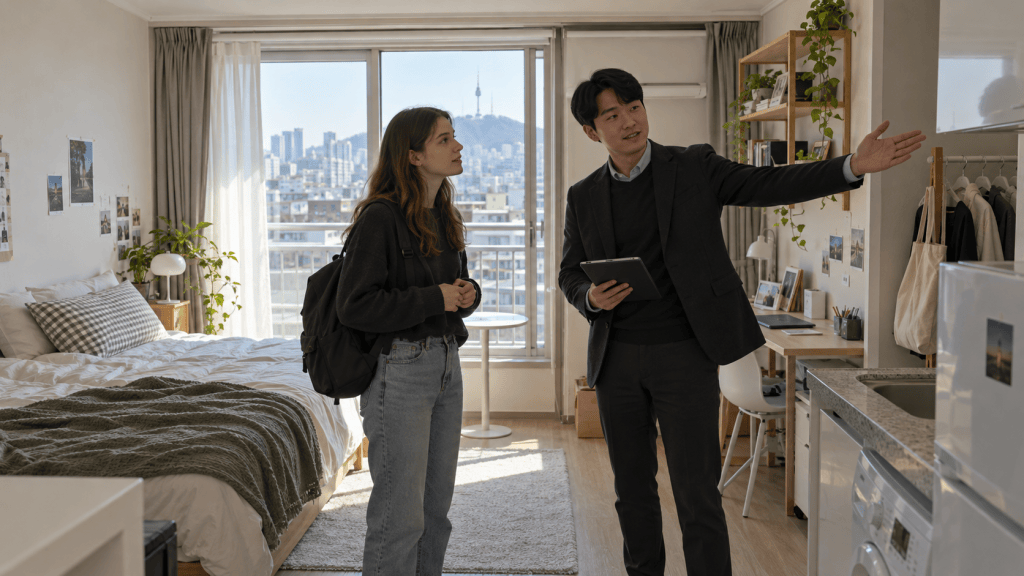
Moving out of a university dormitory can be an exciting step toward independence. Renting a private room in Korea may also involve unfamiliar housing terms, upfront costs, Korean-language paperwork, and address-reporting procedures.
This guide takes you through the process step by step: choosing a neighborhood, comparing housing options, planning your budget, checking a property, reviewing a lease, and preparing for move-in day.
1. Start with Your Daily Routine
Before browsing listings, think about how you will use the neighborhood every day. A room with lower rent may not be a good deal if it adds a long commute or makes daily errands difficult.
Check these points before arranging a viewing:
- Commute: How long does it take to reach campus by bus or subway?
- Transit access: How far is the nearest station or bus stop? When is the last train or bus?
- Daily essentials: Are supermarkets, pharmacies, convenience stores, and laundromats nearby?
- Study environment: Is the neighborhood quiet enough at night?
- Safety and access: Is the building entrance secure? Is the route from transit well lit?
- Connectivity: Is your mobile signal strong inside the room? Is internet service available?
- Room conditions: Does the room receive daylight? Can you open the windows for ventilation?
If possible, check the route at the time you expect to commute. You can also visit the neighborhood in the evening to get a better sense of noise and lighting.
2. Compare Housing Options
International students may choose a university dormitory, a private studio, a shared home, or a room with shared facilities. The right option depends on your budget, privacy needs, and length of stay.
| Housing option | General arrangement | Questions to ask |
|---|---|---|
| University dormitory | Student housing managed by your university | What is included in the fee? Are there curfews, guest rules, or vacation closures? |
| Wolse (월세) | Monthly rent, usually with a deposit | How much are the deposit, rent, maintenance fee, and utility bills? |
| Jeonse (전세) | A large lump-sum deposit is paid instead of monthly rent | How is the deposit protected, and when will it be returned? |
| Short-term rental | A furnished room rented for a limited period | What are the minimum stay, cleaning charges, and refund conditions? |
| Goshiwon (고시원) | A small private room, often with shared facilities | Is the bathroom private? Are utilities, internet, or meals included? |
| Share house | A private bedroom with shared spaces such as a kitchen | Who are the housemates? How are bills and cleaning responsibilities divided? |
A listing described as a one-room usually refers to a small studio where the sleeping area, kitchenette, and living space are combined. The layout and facilities can vary, so confirm what is included during the viewing.
Viewing a property in person helps you check the room, the building, and the surrounding neighborhood.
3. Build a Realistic Move-In Budget
Monthly rent is only one part of the cost. Your budget may also need to cover the deposit, maintenance fee, utilities, agent’s fee, moving expenses, and basic household items.
The figures below are examples, not market averages or price quotes. Dollar conversions use an approximate rate of US$1 = ₩1,325, based on the latest available reference rate on October 26, 2026. Exchange rates and payment fees may change. narabaro.fingr.io
| Example cost | Korean won (KRW) | Approx. US dollars (USD) |
|---|---|---|
| Deposit | ₩3,000,000 | US$2,264 |
| Deposit | ₩5,000,000 | US$3,774 |
| Deposit | ₩10,000,000 | US$7,549 |
| Monthly rent | ₩300,000 | US$226 |
| Monthly rent | ₩500,000 | US$377 |
| Monthly maintenance fee | ₩100,000 | US$75 |
For example, if a room requires a ₩5,000,000 deposit, ₩500,000 monthly rent, and a ₩100,000 maintenance fee, the deposit plus the first month’s rent and maintenance fee would total about ₩5,600,000 (approximately US$4,228). This estimate does not include utilities, moving costs, or an agent’s fee.
Ask exactly what the maintenance fee covers. Internet, water, building cleaning, and shared facilities may be included or billed separately. Electricity, gas, and heating may also be separate expenses. Ask how those bills are measured and when they are due.
Before you commit, make a monthly budget that includes housing, food, transportation, phone service, and study materials. Leave room for unexpected expenses, such as a replacement key or basic household items.
4. Inspect the Room During Your Viewing
Online photos can help you shortlist properties, but they cannot show every problem. Visit the actual room and take your time. If the landlord or agent agrees, test the basic facilities while you are there.
Inside the room
- Look for mold, water stains, peeling wallpaper, or musty smells.
- Turn on the taps and check water pressure and drainage.
- Test the heating, air-conditioning, lights, refrigerator, and washing machine.
- Open and close the windows; check the locks and outside noise.
- Check for enough storage, electrical outlets, and space for a desk.
- Make sure the bathroom has ventilation and hot water.
In the building and neighborhood
- Look at the entrance, hallways, elevators, and shared spaces.
- Ask how parcels are delivered and where trash and recycling go.
- Check the walking route to the nearest bus stop or subway station.
- Ask about noise, construction, and building rules.
- Find out who to contact if heating, hot water, or an appliance stops working.
Write down your observations after each visit. If you see several rooms in one day, notes can help you remember which property had which costs or issues.
5. Review Every Lease Term Before Signing
A lease should state the conditions you agreed to in writing. Do not rely only on a verbal promise or a listing description.
Before signing, confirm that the contract identifies:
- The full address and exact room or unit
- The landlord and tenant
- The deposit amount and payment schedule
- The monthly rent and the date it is due
- The lease start and end dates
- The maintenance fee and what it includes
- Responsibility for repairs and utility bills
- Conditions for ending the lease early
- How and when the deposit will be returned
Confirm that the person signing as landlord has authority to rent out the property. Ask the agent to explain any document you do not understand. Before transferring a deposit, check that the payment recipient matches the landlord or authorized representative shown in the transaction documents. Keep proof of every payment.
The Seoul Foreign Portal provides translated versions of the standard residential lease form. A translation can help you understand the contract, but check that the signed version records the exact terms you agreed to. global.seoul.go.kr
Review the written terms together. Ask for an explanation before signing if a fee, date, or responsibility is unclear.
6. Document the Room on Move-In Day
Before unpacking, take dated photos or a short video of the walls, floors, windows, bathroom, appliances, and any existing damage. Save the files somewhere you can find them later, such as a dated folder in cloud storage.
Keep these records together:
- A copy of the signed lease
- Receipts or bank-transfer records for the deposit and rent
- Messages about repairs, fees, or move-in conditions
- Photos of existing damage and meter readings, if relevant
- Contact details for the landlord, agent, and building manager
If you find damage after moving in, report it promptly in writing and keep the reply. Clear records can help avoid misunderstandings when you move out.
Photograph existing marks or damage before moving your belongings into the room.
7. Complete Address-Reporting Steps
Foreign residents registered in Korea generally need to report a change of residence within 15 days. The Ministry of Justice says the report can be made at the relevant community service center or immigration office. Check the current instructions for your visa status and location. www.moj.go.kr
A separate housing lease report may also apply to some contracts. If your contract is covered by the reporting system, the contract details must be reported within 30 days of signing. Confirm whether the system applies to your rental and how to file with the local community service center or the official real-estate transaction system. global.seoul.go.kr
Keep a copy or confirmation number for any report you submit. If you are unsure which requirement applies, ask your university’s international student office, the local community service center, or an immigration office.
8. Useful Korean Words and Phrases
| Korean | Meaning |
|---|---|
| 보증금 (bojeunggeum) | Deposit |
| 월세 (wolse) | Monthly rent |
| 전세 (jeonse) | Lump-sum deposit lease |
| 관리비 (gwanlibi) | Maintenance fee |
| 공과금 (gonggwageum) | Utility bills |
| 계약기간 (gyeyak-gigan) | Lease term |
| 집주인 (jipjuin) | Landlord |
| 부동산 (budongsan) | Real-estate agency |
| 수리 (suri) | Repair |
| 영수증 (yeongsujeung) | Receipt |
Useful questions to ask:
- 관리비에 무엇이 포함되어 있나요? — What is included in the maintenance fee?
- 전기와 가스 요금은 별도인가요? — Are electricity and gas billed separately?
- 계약서를 영어로 설명해 주실 수 있나요? — Could you explain the contract in English?
- 수리가 필요하면 누구에게 연락해야 하나요? — Who should I contact if something needs repair?
- 입주 전에 사진을 찍어도 될까요? — May I take photos before moving in?
Final Checklist
Before signing or paying, confirm that you have:
- Viewed the actual room and checked its condition
- Compared the full monthly cost, including fees and utilities
- Read the lease and understood the deposit-return terms
- Confirmed who is authorized to rent out the property
- Received a signed copy of the lease and proof of payment
- Taken dated photos before unpacking
- Saved the landlord’s and building manager’s contact details
- Checked the address-reporting requirements that apply to you
Renting in a new country takes preparation, but the process becomes easier when you compare total costs, ask questions before signing, and keep clear records. A careful viewing and a lease you understand can help you settle into student life in Korea with greater confidence.


Leave a Reply